

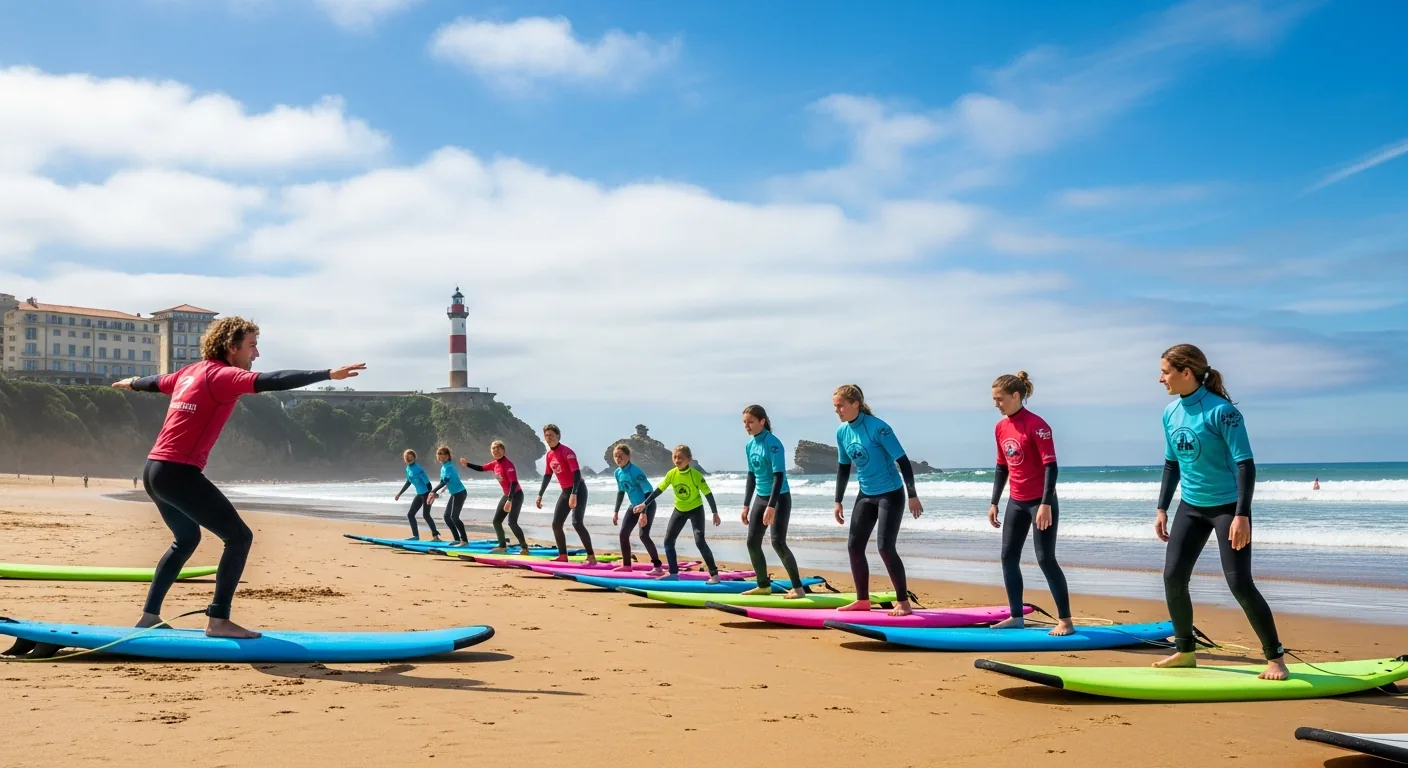
Someone else handles the logistics, so a week's holiday turns into real, lasting progress.

An organised watersports holiday bundles coaching from qualified instructors, gear matched to your weight and level, accommodation close to the spot and transfers to the beach. The aim is to cut out the guesswork on the day and maximise your time on the water.
Surf holidays in Newquay arrow_forward
Instructors pick the best spot for the day based on your level and the sea conditions. Professional coaching helps you break through sticking points, corrects your technique and gives you a real read on your progress – something a solo trip can't match.
Surf holidays in Croyde arrow_forward
Immersive surf camps, structured school courses, footloose road trips, family breaks – the watersports holiday market has diversified enormously. Each format suits a different appetite for intensity, duration and setting.
Surf holidays on the Gower arrow_forward
Thurso and the north coast offer consistent, year-round waves and a wild, authentic atmosphere far from the summer crowds. Ideal for an out-of-season trip if you're properly kitted out for the cold.
See Thurso East arrow_forward
The South West's surf corridor, from Newquay to Croyde and Woolacombe, packs in the best concentration of schools and surf camps in the UK, for every level from complete beginner to advanced.
See the destination arrow_forward
Heading off on your first surf holiday? Here's everything you need to get started: stance, the pop-up, safety and early progression tips.
Read the guide arrow_forward
Set on a surf trip specifically? Our dedicated guide breaks down surf schools, coached courses, camps and family trips, UK and abroad.
See surf holidays arrow_forward
Head off on a kitesurfing course with a British Kitesports-accredited school: a structured programme, professional coaching and great destinations to progress quickly.
See the courses arrow_forwardEach format – surf camp, coached course, road trip, family break – has its own strengths and its own ideal rider.
Surf camps are intensive trips lasting a week or more, built around progress. Most run daily coaching in a level-matched group, with talks on reading the ocean, post-session recovery and nutrition advice alongside, then evenings spent with the rest of the guests. Living among like-minded people for a week encourages plenty of shared learning and new friendships in a relaxed but committed atmosphere. It's the ideal format for beginners looking to progress fast.
A surf school course asks far less of your diary than a full trip. Programmes are structured by level – beginner, intermediate, advanced – so you get a level check when you arrive, a progress plan built around you and coaching tools such as video and drills, then a review at the end. Perfect for an intensive week of training or for closing gaps in your technique in a safe setting.
A road trip lets you rack up experience across different wave types. The itinerary follows the conditions rather than a schedule, a local guide opens up the lesser-known spots, boards travel in convoy and you sleep wherever the trip lands you. Ideal for groups of experienced friends, or anyone chasing discovery without being tied to a fixed schedule.
A family watersports holiday lets everyone share the experience of the ocean together. Schools run dedicated children's lessons from around 6–8 years old and build their timetables around the school holidays. There are usually activities for the non-surfers too, and accommodation with room for a family. For kitesurfing lessons as a family, see how to get started with kitesurfing.
The UK, Portugal, the Canaries and Morocco each suit a different type of rider and a different set of conditions.
Newquay is the benchmark for UK surfing. It suits intermediate and advanced surfers who like their waves fast and hollow, and anyone drawn to the competitive scene – Fistral Beach has hosted major events. Backed by numerous schools and surf camps, it's also a genuine gathering point for enthusiasts. Nearby beaches like Watergate Bay are great for beginners.
Croyde combines surfing with a genuine surf-town feel. The waves at Croyde Bay are technical, the village is an easy place to base yourself, the food is good and the evenings are lively. Intermediate surfers will find plenty of opportunity here, especially on a rising tide, while gentler nearby Woolacombe suits those still learning.
Llangennith on the Gower Peninsula is a more family-friendly, forgiving destination. There's enough choice of spots to suit whatever the day throws up, coaching at every level and well-established schools behind it all. The vibe is relaxed, and the wide beach means groups can spread out without crowding each other in the water.
Waves land all year round, costs sit well below much of Western Europe, the watersports infrastructure is well developed, and Nazaré is one of the great big-wave arenas. From Peniche to Sagres, the country offers a spread of spots suited to every style. Students and younger travellers find excellent value here.
The Canary Islands benefit from strong, reliable wind. Fuerteventura is often cited as the ideal island for kitesurfing, with shallow lagoons that are perfect for learning, a steady thermal wind, warm water and strong sunshine even in winter. Lanzarote isn't far behind, with dedicated set-ups for wind sports: wing foil and windfoil are both growing fast there.
Morocco blends Mediterranean influences with real African character. The draw for watersports is a lower cost of living, conditions that hold up for much of the year (September to April), striking Berber architecture and waves that vary from town to town. Taghazout has built its reputation on fast, punchy surf, while Essaouira is a magnet for kitesurfers thanks to its constant trade winds.
Your level shapes the format and the destination, whether you've never stood up or you're entirely self-sufficient.
Beginners should always pick a surf camp or organised course with structured level-1 lessons, personalised coaching, a suitable board fleet (longboards, soft tops) and a safety-first teaching approach. The habits you pick up in your first few hours will have a lasting impact on your progress – a poor start can bake in bad habits that are hard to correct later.
Intermediate surfers are looking to refine their technique, tackle more demanding waves and develop real ocean feel. The right course gets them onto more technical or more powerful waves, on gear closer to what they'll ride long-term, with a coach watching their rides and video to pick over afterwards. Newquay, Croyde and Portugal all suit this profile well.
What experienced riders want most is to be near the best waves the moment conditions turn on. That means a bed close to the spots, expert-level gear hire, detailed marine forecasting and the freedom to move as the forecast dictates. A camper van road trip, chasing the swell with no fixed schedule, remains the ultimate way to do it.
The ideal calendar varies considerably by destination and by discipline.
The shoulder seasons give you the best of the UK. Fewer tourists outside the school holidays, off-peak prices, water that's still manageable and settled seas. Along the Atlantic-facing South West coast in September and October, the autumn swells often bring the best waves of the year, once the summer crowds have thinned out.
For kitesurfing in the Canaries, November to March are the standout months, with steadier thermal wind, fewer tourists and mild temperatures. These months line up with the high season for wind sports, but sit at the quieter end of the general tourist season, so accommodation prices are attractive.
From September to April Morocco delivers on every front – kitesurfing winds, consistent waves, comfortable water and crowds you can live with. Avoid July and August, when land temperatures push past 40°C and the spots fill up with tourists.
Accreditation, coach-to-pupil ratio and the state of the gear are what make the real difference.
Make sure the school holds the right national accreditation for the discipline (Surfing England, the Welsh Surfing Federation or Scottish Surfing Federation, the RYA or British Kitesports, depending on the sport and nation), carries public liability insurance and employs instructors with a recognised coaching qualification. Without these safeguards, you're not properly covered if something goes wrong.
Favour courses that guarantee a maximum of around eight pupils per coach, with level-matched groups and age-grouped options for children. A ratio that's too high (15+ pupils per coach) makes proper coaching impossible and slows your progress.
Always check the range of boards on offer (beginner through to expert), the age of the fleet (newer gear is a good sign) and whether kit is available for every build. A fleet of worn, damaged boards is a red flag about the quality of the school.
Everything you're wondering before booking your next watersports holiday.
Pricing varies widely by destination and package. Budget options generally cover daily lessons, gear hire and dorm-style accommodation. Premium packages, with a private room and video coaching, cost considerably more. Ask each school for a current quote before booking.
Many schools welcome children from around 6–8 years old, with lessons adapted to their size and attention span. Some centres even run sessions from age 5 on giant foam boards in the shallows.
For the summer holidays, booking several months ahead secures the best availability and often the best rates. Outside July and August, last-minute offers can include worthwhile discounts – particularly for trips to Portugal or Morocco in the autumn.
A comprehensive travel insurance policy should cover emergency repatriation, watersports accidents (often excluded from standard policies), public liability and technical assistance. Some operators include minimum cover in their packages: check the exact terms before you go.