

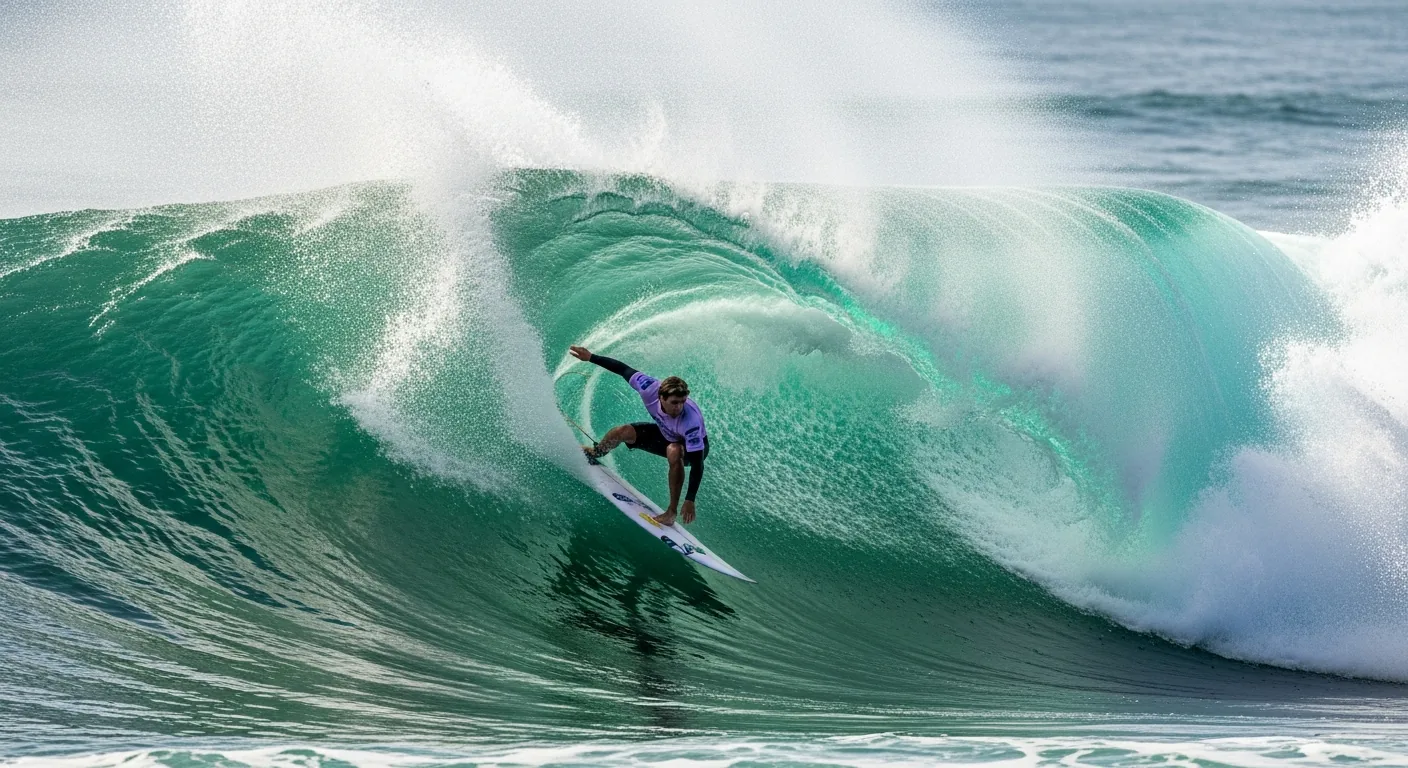
Getting better at surfing comes down to mastering a handful of precise techniques. From the pop-up to the cutback, every manoeuvre builds on fundamentals that every surfer needs to ingrain. What follows breaks down the essential moves, with practical drills for dry land and for the water.
1. The pop-up: getting up in one motion
The pop-up is the most fundamental technique in surfing. It's the move that takes you from lying on the board to standing on it. A clean pop-up is the non-negotiable base for every manoeuvre that follows.
🔹 The starting position
Lie on your front, chest centred on the board, feet just above the tail. Hands flat either side, level with your chest, fingers pointing forward. The nose of the board should sit an inch or two clear of the water.
🔹 The explosive sequence
In one continuous move: push up on your arms like a press-up, draw your front foot in between your hands, then plant the back foot immediately. No stopping at the knees – that's the most common mistake. The move should be smooth and quick, almost instinctive.
🔹 The standing stance
Knees bent, feet shoulder-width apart and angled 45° towards the rails (the edges of the board). Arms slightly out from your body for balance. Your gaze reaches out towards the shoulder of the wave – never down at your feet or the nose of the board.
Dry-land drill: the pop-up on the sand
Before you get in the water, practise 20 to 30 pop-ups on the sand or on a yoga mat. Time yourself: a good pop-up takes less than half a second. Get a mate to film you – it's the best self-analysis tool there is. If your feet don't land in the right spot first time, go again until the move feels natural.
The secret to a good pop-up is explosiveness. It isn't a slow, controlled movement – it's quick and decisive. One sharp move, exactly as the name suggests. The more you hesitate, the more of the wave's momentum you lose.
2. The take-off: catching the wave at the right moment
The take-off is the moment you commit to the wave and start your descent. It's the transition between the paddling zone and the face of the wave. A good take-off decides 80% of how the ride goes.
Positioning at the peak
The peak is where the wave breaks first. For a clean take-off, sit slightly to the side of the peak (towards the shoulder), not directly on it. That way you avoid taking the lip on the head and give yourself time to get up before the wave catches you.
The committing strokes
When you feel the wave lift you, take three or four deep, powerful strokes. Don't look back: trust the feeling. When the wave carries you and the nose tips downward, that's the moment to pop up.
The drop down the face
Once you're up, your weight should be slightly on the front foot to drive the board down the face. Too much weight back and the board stalls and you go over the nose. Too much forward and you bury the nose (a pearl). The balance is subtle – it comes with repetition.
3. Trim: finding speed and the right line
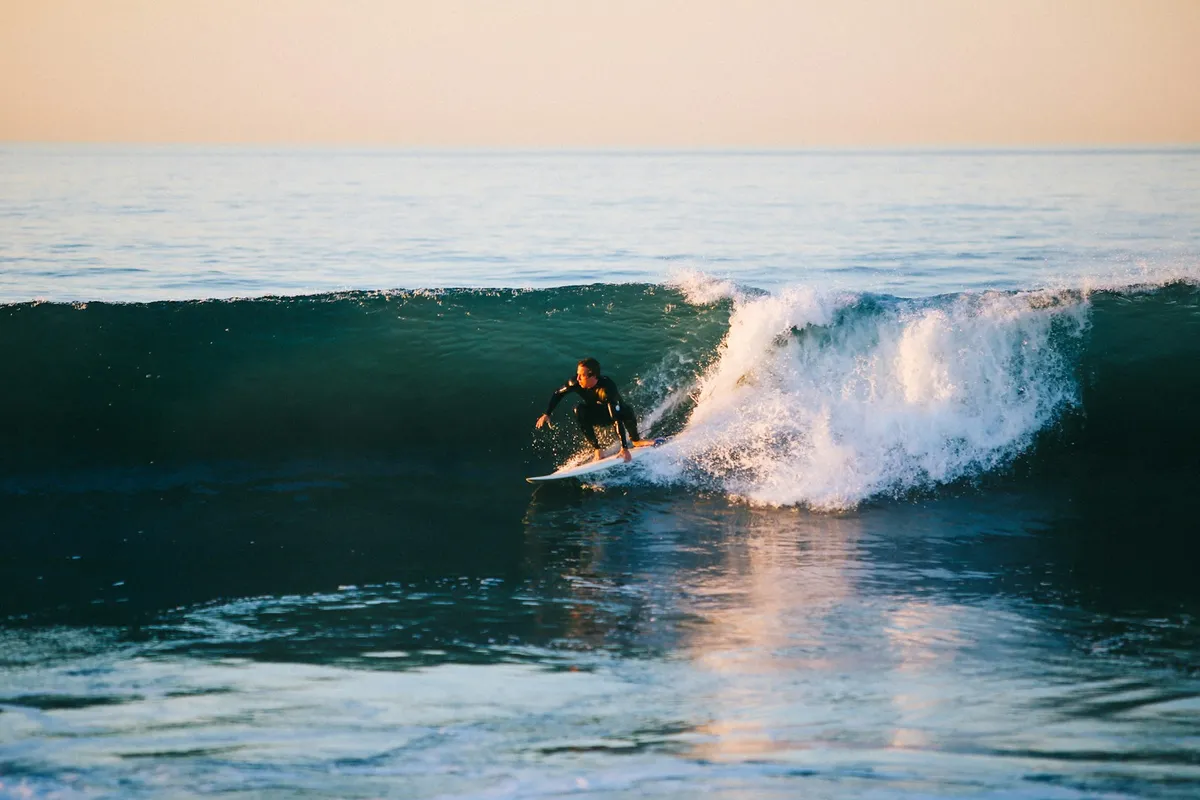
Trim is the art of holding your speed as you surf along the face of the wave, without any pronounced turn. It's the foundation of every advanced manoeuvre: no trim, no bottom turn, no cutback.
The trim position
Standing, adjust your weight: front foot to speed up (dropping down the wave), back foot to slow down (climbing back towards the lip). Trim is about finding the sweet spot on the face where the board holds its speed effortlessly.
Reading the wave
While trimming, your eyes are constantly scanning the wave: where is the steepest section? Where does the wave open up a shoulder to work with? Trim isn't passive – it's an active exercise in reading and anticipating.
Drill: in your sessions, dedicate half of your waves to trim alone. No manoeuvres, just holding speed and finding the best line. You'll be surprised how much your wave-reading improves.
4. The bottom turn: the key manoeuvre
The bottom turn is the first real manoeuvre every surfer needs to master. It's the turn you make at the bottom of the wave to climb back towards the lip and generate speed for the moves that follow. No bottom turn, no modern surfing.
🔹 Step 1: The compression
At the bottom of the face, bend deeply at the knees. Your body compresses like a spring, and that's the energy stored for the turn. Your gaze is already turned up the wave, to where you want to go.
🔹 Step 2: Engaging the rail
Spread your weight between both feet while engaging the inside rail of the board (the rail on the wave side): it's the pressure on that rail that initiates the turn, not simply shifting onto the back foot. The arms follow the movement, the eyes lead.
🔹 Step 3: The exit
Climb the face of the wave while holding the pressure on the rail. As you reach the shoulder, release the pressure and settle back into trim. You've generated speed for the next manoeuvre.
Common bottom-turn mistakes
- Too early: setting the bottom turn while there is still face to drop down loses speed. Wait for the bottom of the wave.
- Looking at the nose: your gaze should be up the wave, not down at the board.
- Not enough bend: without deep compression the turn is soft and ineffective. Bend your knees more than you think you need to.
- Over-turning: a bottom turn isn't a 180°. Aim for 90 to 120° of rotation at most when starting out.
5. The cutback: coming back to the power
The cutback is the manoeuvre that lets you come back to the powerful part of the wave after you have surfed too far out onto the shoulder. It's a tight turn, and often the first 'real' turn that improving surfers learn.
When to cut back?
When you feel the wave losing power behind you (the shoulder flattening off), it's time to cut back. The timing is crucial: too early and you miss the power section; too late and the wave has already closed out.
The mechanics of the cutback
- Initiation: shift your weight onto the back foot, engaging the back rail.
- Rotation: shoulders and gaze turn first, the board follows. The movement is circular and smooth.
- Re-entry: the board comes back towards the powerful part of the wave (the pocket). That's where the energy is greatest.
- Exit: once back in the pocket, release the pressure and pick up your trim again.
Work on the cutback first on soft, slow waves (mellow beach breaks). Don't attempt one in steep or fast waves before the move is in your muscle memory. Repetition on gentle waves builds the confidence.
6. The top turn: turning at the top of the wave
The top turn is the turn you make high on the wave, near the lip. It's a more advanced manoeuvre that needs a solid bottom turn and good trim as prerequisites.
The mechanics
After a bottom turn has driven you up the wave, the top turn involves:
- Reaching the lip (or just below it) with enough speed
- Shifting your weight onto the back foot to pivot
- Using the tail kick (the lifted rear of the board) as a pivot point
- Dropping back down while controlling your line
The snap: the aggressive top turn
The snap is a sharper top turn, where the board pivots almost 180° at the top of the wave and drops back down with power. It's the signature move of modern surfing. It calls for a short board (a shortboard or fish) and steep waves.
Recommended progression by level
🟢 Beginner (sessions 1–20)
Aim: a reliable pop-up in the whitewater, angling across the foam, first sideways
movements.
Focus: dry-land pop-ups, reading the waves, a stable standing
stance.
🟡 Intermediate (sessions 20–80)
Aim: take-offs on green waves, a controlled bottom turn, trim held the whole
length of the wave.
Focus: positioning at the peak, compression in the bottom
turn, reading sections.
🔴 Advanced (sessions 80+)
Aim: cutback, top turn, linking manoeuvres, advanced set-reading.
Focus:
timing, flow, adapting to varied conditions.
Dry-land drills to progress faster
Surfing isn't something you only work on in the water. These are the dry-land drills that speed up your progress:
- Pop-ups on a mat: three sets of 10 reps, three times a week. Time each pop-up.
- Dynamic core work: plank (3 × 45 sec), Russian twists (3 × 20), mountain climbers (3 × 30). Core strength is crucial for stability on the board.
- Surfskate or skateboard: work on turns, transitions and balance. A surfskate (Carver, YOW, Smoothstar) recreates the feel of surfing on tarmac.
- Squats and lunges: 3 × 15 squats, 3 × 10 lunges per leg. Leg power is the engine of your turns.
- Video analysis: film yourself in the water and compare your moves with the tutorials. Self-analysis is the most underrated progression tool there is.
Looking to structure your progression? Read our complete guide to learning to surf, or sort out the right kit with our surf gear guide. And whatever the conditions, brush up on the essentials in our surf safety guide.
❓ Frequently asked questions about surf technique
What is the fundamental technique in surfing?
The pop-up is the fundamental technique – getting from lying down to standing in one smooth move. It's the base for every other manoeuvre. Without a reliable pop-up, the other techniques are impossible to pull off properly.
How do I improve my pop-up?
Practise 20 to 30 reps on dry land before you get in the water. Work on explosiveness, foot placement and keeping your eyes looking ahead. Filming yourself on your phone is a great self-analysis tool.
When should I learn the bottom turn?
Once you're catching green waves regularly and your pop-up is stable (usually after 20 to 40 sessions). The bottom turn is the first turning manoeuvre to master.
How long does it take to master the cutback?
Reckon on 6 to 12 months of regular practice once the bottom turn is solid. It's an intermediate manoeuvre that demands timing and wave-reading.