

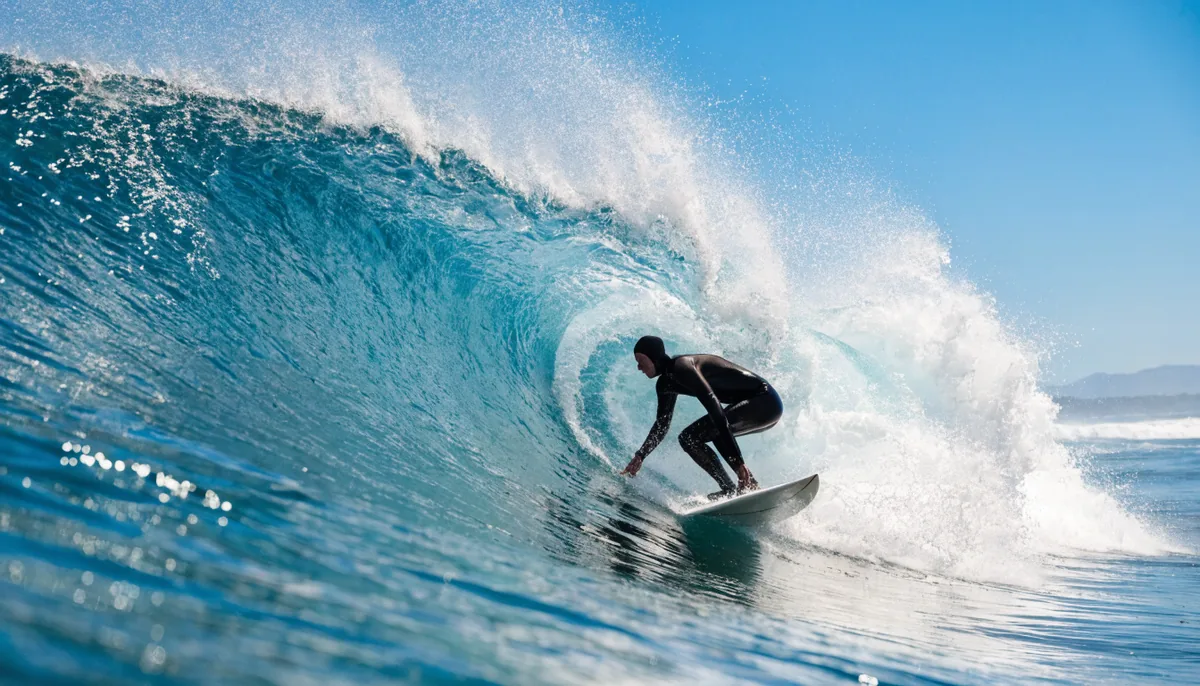
Learning to surf is one of the most rewarding things you can do. That moment when you finally get to your feet, carried by the energy of a wave, stays with you for good. But between those frustrating first sessions and riding with real control, there are a few key stages to work through. We take them one at a time, from choosing your kit through to your first turns on unbroken waves.
.jpg)
Step 1: Choosing your first surfboard
Your choice of board is the single biggest factor in how quickly you progress. Too small and it will be unstable and disheartening. Too big and it will be heavy and awkward. This is the sweet spot for a beginner.
The funboard or mini-mal (7'6" to 8'6")
The funboard (also called a mini-mal or mini-Malibu) is the ideal board to start on. At 7'6" to 8'6" long, it gives you a volume of 55 to 70 litres, which is plenty of float to get up easily while staying manageable. For an average-sized adult (65–80kg), an 8'0" board with around 60 litres is an excellent starting point. Look for one second-hand and you can pick up a solid first board without spending a fortune.
The longboard (9' and up)
The longboard (9' to 10'6") is the benchmark for stability. With 75 to 100-plus litres, it lets you get to your feet from your very first session. The trade-off is that it's bulky to carry, hard to turn in steeper waves, and you'll eventually need to size down to progress towards performance surfing. It's the ideal choice for heavier riders over 85kg, or anyone who just wants a smooth, easy glide.
Boards to avoid as a beginner
The shortboard (6' to 7') isn't for beginners, and its low volume (25–35L) makes the pop-up hard and catching waves hit-and-miss. Likewise, fish and gun shapes are specialist boards that are no use for learning. Resist the urge to rush: a good beginner board will get you progressing faster than a shortboard that only frustrates you.
Volume rule of thumb: to learn, budget roughly your body weight in litres. A 70kg surfer starts well on a board in the 60 to 80 litre range — see our surfboard guide for the factors by ability. Don't be shy about sizing up – it's the secret to progressing fast.
Step 2: Getting the right kit
Beyond the board, a few bits of kit are essential for learning to surf in decent comfort.
The wetsuit
In the UK, the sea sits somewhere between roughly 7–9°C in winter and 17–18°C at the height of summer. Dress for the season:
- Summer (July–September): a 3/2mm steamer covers most of it. On a warm, calm day some surfers drop to a shorty, but the water rarely gets truly warm.
- Spring and autumn (April–June, October): a 4/3mm wetsuit is the sensible standard, often with boots on the colder days.
- Winter (November–March): a 5/4mm (or 5/4/3mm) wetsuit with a hood, plus 5mm boots and gloves for water down around 6–8°C.
A good wetsuit is the single best investment for surfing UK waves through the seasons. Brands like O'Neill, Rip Curl and Xcel offer excellent value.
The leash and the wax
The leash (the cord linking the board to your ankle) is not optional – a loose board in the water is a hazard to everyone. Choose a length to match your board: for an 8'0" funboard, a 7' or 8' leash does the job.
The wax (grippy surf wax) goes on the deck of the board to keep your feet planted. In our cold water, use a cold-water (below 14°C) or cool-water (14–20°C) formula. Rub on a base coat, then work up little bumps on top for grip.
Boots and cold-water extras
In winter, neoprene boots are essential on UK beaches – 3mm for the shoulder seasons, stepping up to 5mm from December through March. Don't forget earplugs (such as SurfEars) to guard against surfer's ear (exostosis), a common complaint among regular cold-water surfers.
Step 3: Reading the waves
Before you even get in the water, spending five minutes watching the waves from the beach will transform your session. The sea is predictable – learn to read it.
The anatomy of a wave
A wave is made up of the peak (the highest point, where it breaks first), the lip (the part that pitches over), the face (the smooth wall you surf) and the whitewater (the broken, foamy part). As a beginner you will start in the whitewater, where the push is most powerful and most consistent, and perfect for learning the pop-up.
Sets and lulls
Waves arrive in sets of three to six, separated by calmer lulls of two to five minutes. Learn to read these cycles from the shore. Use the lull to paddle out to the peak. It's also the moment to spot rip currents – channels where water rushes back out to sea, recognisable by darker, choppier, wave-free water. If one carries you out, don't fight it: paddle across it, parallel to the beach, until you're clear, then head back in.
Rights, lefts and closeouts
A right peels to the surfer's right as they look at the beach; a left peels to their left. A closeout is a wave that breaks along its whole length at once, which makes it impossible to ride cleanly. Look for waves that peel gradually along a shoulder to make the most of your ride.
Use a forecast app (Surfline, Windy) to check swell size, period and wind. A period of 10 to 14 seconds with a light offshore wind is ideal for beginners.
Step 4: Nailing the pop-up
The pop-up is the movement that takes you from lying down to standing on the board. It's the fundamental move in surfing, and it's best drilled on dry land first.
The starting position
Lie on your board, chest centred, feet just above the tail. Your hands are flat either side, level with your chest. The nose of the board should sit just clear of the water (an inch or two): if your board is the right volume, that happens naturally.
The pop-up in five steps
- Paddle hard: as soon as you feel the wave lift you, three or four deep, powerful strokes.
- Push up on your hands: place your hands flat and push, drawing your feet in underneath you, like an explosive press-up.
- Front foot first: your front foot (left for a natural-footer, right for a goofy-footer) lands between your hands, with the back foot following instantly.
- Stand in one motion: no stopping at the knees. The pop-up should be one smooth, quick move.
- Standing stance: knees bent, feet angled 45° towards the rail, arms slightly out for balance, and eyes looking ahead – not at the board or your feet. Where you look is where the board goes.
Practising on dry land
Before your first session, practise the pop-up on the sand or a yoga mat. 20 to 30 reps is enough to build the muscle memory. Get a mate to watch: the move should be smooth, with no fumbling, and your feet should land in the right spot first time. Filming yourself on your phone is a great way to self-check.
Step 5: Your first sessions in the water
Sessions 1–3: the whitewater
Your first sessions happen in the broken waves (white foam). The aim is to get into position, feel the board accelerate, pop up and stay on your feet for three to five seconds. Don't try to turn – just learn to stay on the board and absorb the bumps of the foam with your knees.
Sessions 4–10: angling across the foam
Once you're up on your feet regularly, start to angle your board left or right. Shift your weight onto your back foot to speed up, onto your front foot to slow down. Those first little sideways movements are the beginnings of the bottom turn.
Sessions 11–20: green waves
This is the biggest step: moving from the whitewater to unbroken waves (green waves). Positioning at the peak, timing your take-off and catching the wave are the new skills to master. Be patient: this stage takes time, but every session brings the breakthrough closer.
Step 6: Progressing and avoiding the traps
Classic beginner mistakes
- Looking at your feet: your gaze steers your body. Look where you want to go, not down at your feet.
- Stopping at your knees: it slows the pop-up and kills the wave's momentum. Go straight from lying to standing.
- Sitting too far from the peak: the foam has run out of energy there. Move closer to where the wave breaks first.
- Rushing onto a shortboard: the number-one trap. Stay on your beginner board until you're catching green waves regularly.
- Ignoring right of way: the surfer closest to the peak has priority. Don't drop in on someone already up and riding.
Consistency beats duration
Two one-hour sessions a week will progress you far faster than a single four-hour one. Repetition builds muscle memory. If you can only surf once a week, top it up with dry-land training (press-ups, squats, core work) and some skating or surfskate to work on balance and turning.
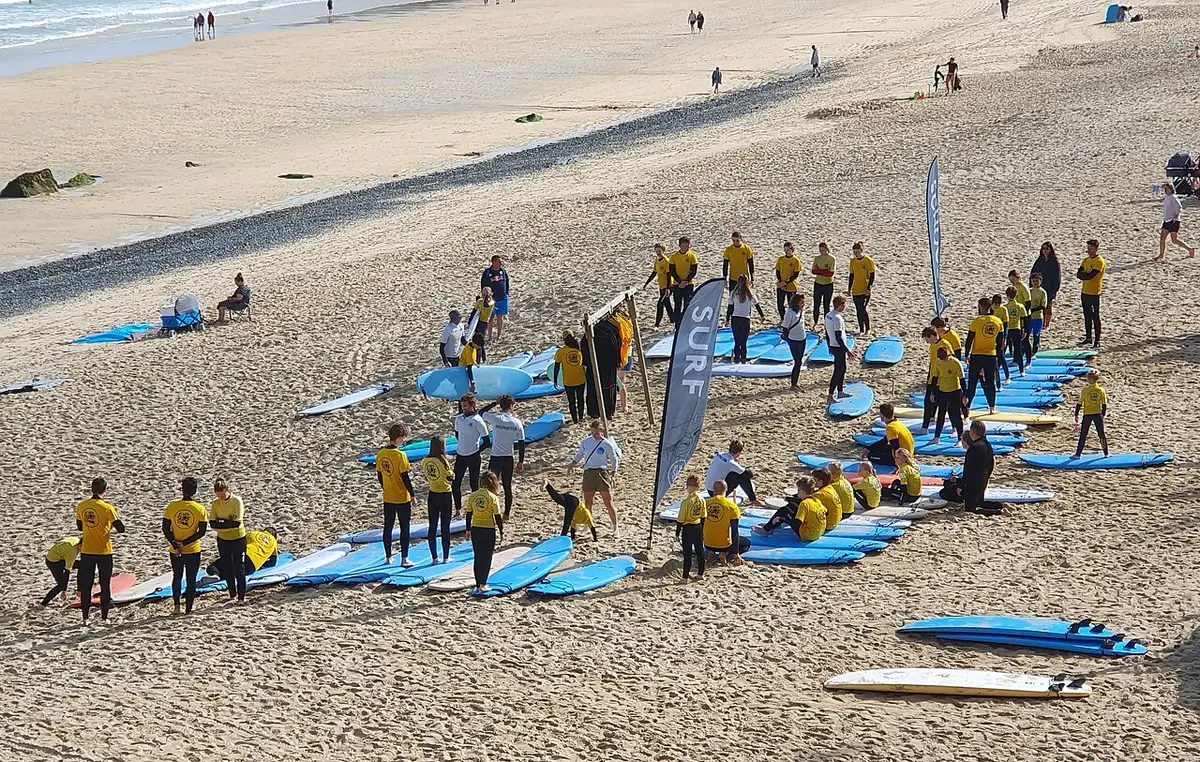
Book two or three lessons with a good surf school. A qualified instructor corrects your mistakes from the off and saves you years of bad habits. Most UK schools offer half-day and multi-day courses that are ideal for getting started.
The best beginner spots in the UK
The UK coast is packed with beaches that work for beginners. These are the safe bets:
- Fistral, Newquay (Cornwall): the home of UK surfing, with surf schools on the sand and waves for every level.
- Woolacombe (North Devon): a long, mellow beach break that is forgiving and ideal for learning.
- Llangennith, Gower (Wales): a long, exposed beach with plenty of room to spread out and schools on hand.
- Saunton Sands (North Devon): gentle, rolling waves that are a longboarder's and learner's dream.
- Tynemouth (North East): a friendly, sheltered beach break with a strong surf-school scene.
- Croyde Bay (North Devon): a classic, forgiving beach break with plenty of whitewater to practise on, backed by a village full of surf schools and board hire.
For a full run-down of UK surf spots, see our surf destinations page, or read up on the fundamentals in our surf techniques guide.
Frequently asked questions about learning to surf
How many sessions does it take to learn to surf?
Reckon on 10 to 20 sessions to feel comfortable in moderate-sized surf and start catching unbroken waves. Consistency (two sessions a week) beats spread-out sessions. Your first pop-ups usually come somewhere between session two and five.
Which surfboard suits a beginner adult?
A funboard or mini-mal of 7'6" to 8'6" with 55 to 70 litres of volume is ideal. These boards strike a good balance between stability and manoeuvrability. If you're over 85kg, look at a 9'0"-plus longboard.
Do I need surf lessons to learn to surf?
Not compulsory, but strongly recommended. Two or three lessons with a qualified instructor speed up your progress enormously and build a solid foundation. UK surf schools run half-day and multi-day courses covering all the fundamentals.
What age can you start surfing?
Children can start from five or six with specialist schools, and there is no upper limit: plenty of surfers take it up after 40 and progress happily. Fitness and motivation matter more than age.
What kit do you need to start surfing?
A complete beginner set-up is a funboard, a wetsuit to suit the season, a leash, a bar of wax and, for winter, boots and gloves. Buying second-hand roughly halves the outlay.