
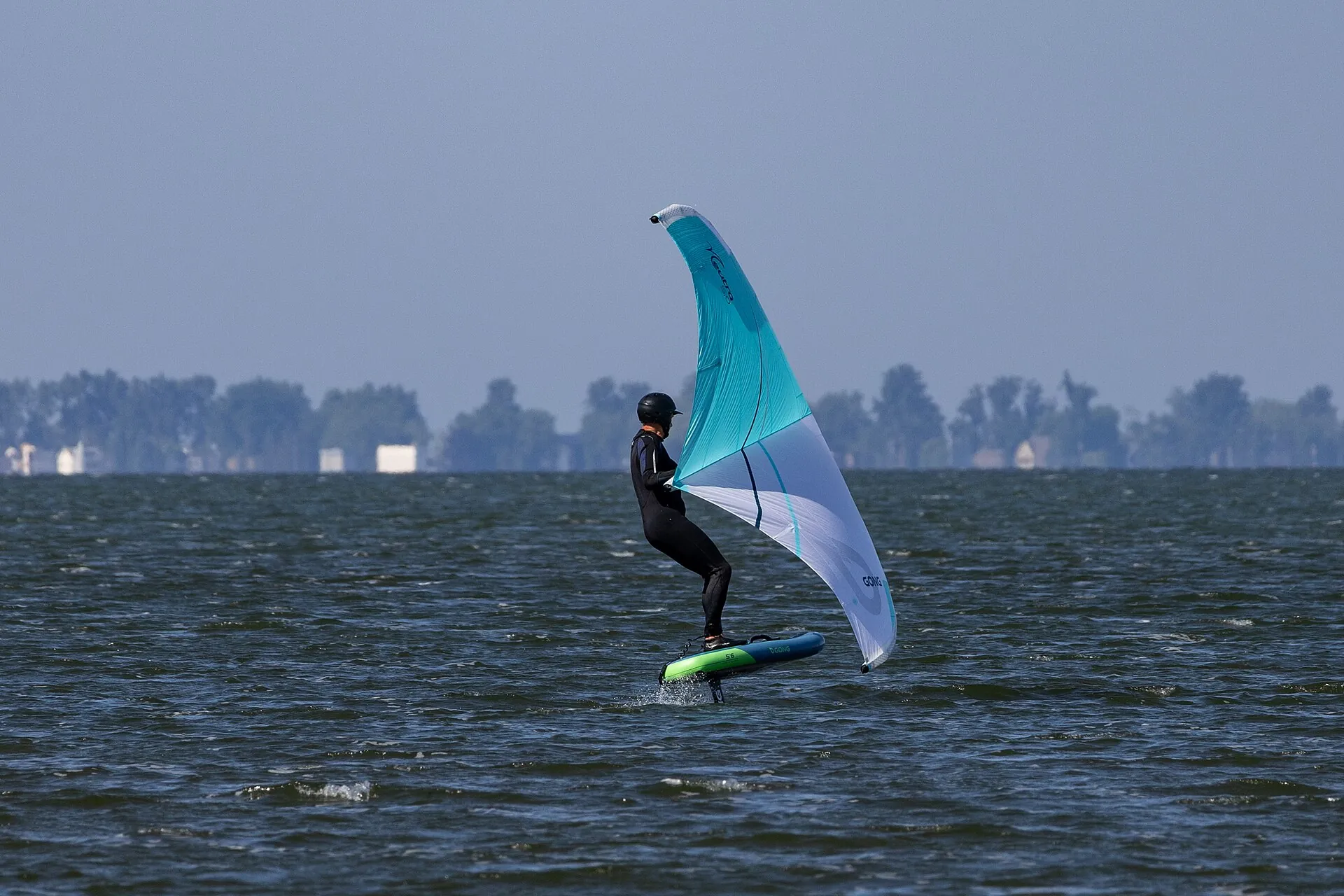
Wing foiling has become, in the space of a few years, the fastest-growing watersport in the UK. An inflatable wing held in your hands, a foil under the board, and you lift off the water in near silence. But before you're flying, there are steps to work through. Here's everything you need to know to get started properly, without getting hurt or giving up too soon.
What is wing foiling, exactly?
Wing foiling combines two elements: an inflatable wing held in both hands, which catches the wind to propel you, and a foil fitted under the board, which lifts you above the water once you're up to speed. Unlike kitesurfing, the wing isn't connected to any lines – it releases instantly if you let go, which makes managing safety a good deal simpler.
The result is a uniquely quiet, gliding sensation, rideable as soon as there's a bit of wind, on sea, lake or lagoon. For a full introduction to the sport (technique, gear, spots), see our wing foiling guide.
Wing foiling, kitesurfing or windsurfing: which is easiest to learn?
This is the question most beginners ask when they're weighing up wind-powered watersports. Here's how wing foiling stacks up.
| Discipline | Learning curve | Key advantage for beginners |
|---|---|---|
| Wing foiling | Quick: first flights after 5 to 10 sessions | Free-floating wing, no lines to manage, compact kit |
| Kitesurfing | Longer: kite rigging and control to master before you're even on the water | Very powerful once mastered, strong trick potential |
| Windsurfing | Technical: boom, sail and balance to coordinate from day one | Pure sensations, highly versatile kit in strong wind |
Wing foiling earns its reputation as the 'easy' discipline for two reasons: the wing doesn't need any complex rigging on the beach, and it isn't attached to you by lines that take fine control to learn, as in kitesurfing. If you've already tried SUP, surfing or kitesurfing, your progress will be even quicker thanks to the balance you've already built on a board.
That said, 'easier' doesn't mean 'effortless'. Flying on the foil takes coordination between piloting the wing and balancing on the foil, and the first sessions come with their fair share of falls. What you don't need, unlike classic surf foiling, is any surfing behind you before you start.
The kit you need to start wing foiling
A wing foiling set-up has three parts: the wing, the board and the foil. Each has its own considerations for a beginner:
- The wing: go for a generously sized wing with solid struts (a rigid frame) – it's more stable and easier to re-launch if it flips over in the water.
- The board: choose a wide, voluminous board. This is what lets you stand up and hold your balance before you even think about the foil. Inflatable boards suit this learning phase particularly well.
- The foil: a large front-wing foil, forgiving and progressive, lifts off at low speed and tolerates small piloting errors.
For a detailed buying guide, with selection criteria based on your weight and level, see our wing foiling gear page.
Your first steps: a step-by-step progression
The key to learning wing foiling successfully is not to skip the steps. Here's the logical order to follow:
- Master the wing on land: the wind window, neutral power, changing tack. Reckon on an hour or two on the beach before you head into the water.
- Stand up on a large board, without the foil: the goal here is to control the wing while holding your balance, without the added complexity of the foil.
- Introduce the foil in shallow water: at low speed, get a feel for your first accelerations and involuntary lift-offs.
- The first controlled flight: you lift off, you manage your flying height. It's the most rewarding step in the whole learning process.
- Tacks and gybes: learning to change direction without putting the board back on the water, so you can string runs together.
Full detail on each step, with time frames and drills, is in our complete guide to getting started in wing foiling.
A lesson with a qualified instructor for your first two or three sessions speeds up progress considerably and helps you avoid picking up bad habits that are harder to fix later.
Common mistakes beginners make in wing foiling
A handful of mistakes crop up again and again among new riders. Knowing them in advance will save you several sessions of frustration.
Fitting the foil too soon. By far the most common mistake. Many beginners want to be flying by their second session, without having settled their balance on a board without a foil first. The result is repeated falls and needless frustration. Give the 'big board, no foil' stage as much time as it needs.
Choosing a wing that's too small or a board that's too narrow. Out of impatience, or wanting kit that looks the part, some beginners buy gear designed for advanced riders. Kit that's too small for your level slows your progress right down.
Skipping wing handling on land. Jumping straight into the water without taking the time to understand the wind window makes every other stage of learning harder.
Trying to go it entirely alone, without ever taking a lesson. Even a single coached session can fix posture or habits that would otherwise take weeks to shake off on your own.
Safety: the basics before you start
The foil is sharp, and wing foiling is often practised on waters shared with other users. A few essential rules before your first session: wear a helmet and an impact vest, keep well clear of swimmers and bathing zones, and make sure the water's deep enough for your foil – at least a metre, more for a longer mast – so you don't strike the bottom while you're learning. The full set of safety rules, including local regulations, is on our wing foiling safety page.
Once you've got the basics down, the next step is finding a spot suited to your level. Our UK wing foiling spots page rounds up the best waters by region and by the conditions you're after.