
The SUP market has grown so wide that it's easy to get lost in it. All-round, touring, surf, race, yoga, fishing… every manufacturer has its own range and its own marketing names. The reality is simpler. There are five main families of SUP board, and the right one for you comes down to three things: your level, your weight and how you plan to use it.
Whatever board you choose, check the wind and tide with the Met Office before you head out, wear a leash and a buoyancy aid, and stay within a distance you can comfortably paddle back from. If you get into difficulty on the water, call 999 and ask for the Coastguard.
The 5 types of SUP board
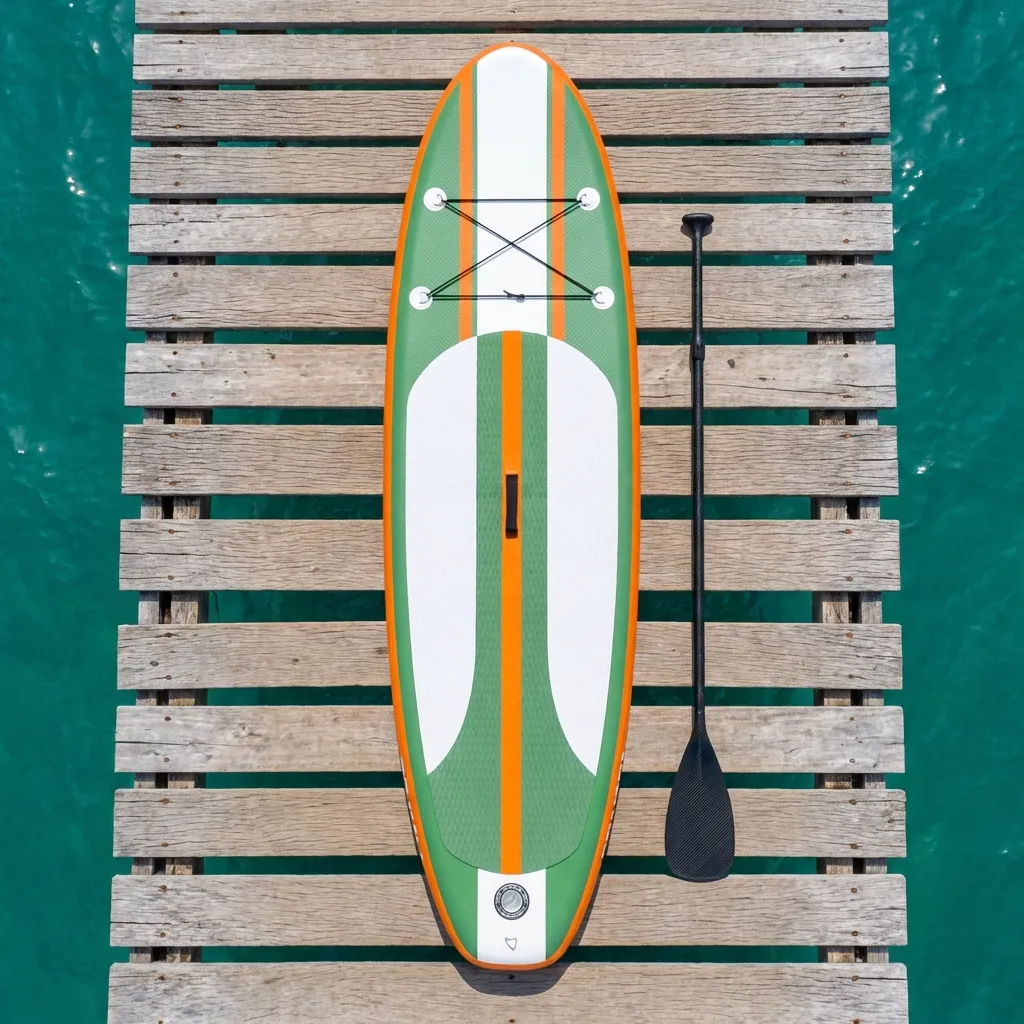
All-round SUP (the versatile option)
The Swiss army knife of paddleboarding. 10'6" to 11'6" long, 32 to 34 inches wide, with a volume of 250 to 300 litres. The shape is rounded at the nose and tail, which makes it stable in all conditions. It's the default choice for a beginner, and the best choice for most recreational paddlers.
Best for: flat-water touring, family outings, your first sessions, general all-round use. Price: budget-to-mid-range for a complete inflatable package.
Two all-round inflatables worth a look: the WattSup Bream 10.6, right in this size range, and the Zray X1 — see them at OutletSUP →.
Touring SUP
Longer (12'6" to 14') and narrower (30-32 inches) than the all-round, with a pointed nose that slices through the water. The touring board is built for distance and speed: it glides further with every stroke and holds a straighter line. The trade-off is less stability and a bit more technique required.
Best for: long outings (2-3 hours-plus), lake crossings, coastal touring, intermediate-to-advanced paddlers. Price: mid-range to premium.
SUP surf
Short (7' to 9'), narrow (28-30 inches), with a rounded or pin tail. The SUP surf board is built for catching waves: a dynamic shape, pronounced rocker (the curve from nose to tail) and reduced volume for manoeuvrability. It's a demanding board that requires a solid level of SUP skill and wave-reading.
Best for: SUP surfing in waves, experienced paddlers. Price: mid-range to premium.
SUP race
The longest (12'6" to 14') and narrowest (28-30 inches) of the SUP family. A pointed nose, a tapered shape, and minimal volume for the rider's weight. The SUP race board is a competition machine: fast, efficient, but unstable. It's one for experienced paddlers chasing pure performance.
Best for: racing, intensive training, advanced-to-expert paddlers. Price: premium.
SUP yoga / fitness
Wide (34 inches and up), very stable, with a flat deck and often a full-length non-slip pad built in. The SUP yoga board prioritises stability over glide. Volume is generous (300-plus litres) to support the rider's weight standing, kneeling or lying down without the board sitting too low in the water.
Best for: paddleboard yoga, meditation, fitness on the water, family use. Price: mid-range.
Summary table
| Type | Length | Width | Volume | Level | Typical price |
|---|---|---|---|---|---|
| All-round | 10'6" – 11'6" | 32 – 34" | 250 – 300 L | Beginner to intermediate | Budget to mid-range |
| Touring | 12'6" – 14' | 30 – 32" | 200 – 270 L | Intermediate to advanced | Mid-range to premium |
| Surf | 7' – 9' | 28 – 30" | 120 – 200 L | Advanced | Mid-range to premium |
| Race | 12'6" – 14' | 28 – 30" | 150 – 220 L | Advanced to expert | Premium |
| Yoga / Fitness | 10' – 11' | 34 – 36" | 300 – 350 L | All levels | Mid-range |
How to choose based on your profile
The volume rule
Volume matters more than anything else on the spec sheet. The higher it is, the more stable and buoyant the board. As a starting point, take your weight (kg) plus 100 to 150 litres minimum. A 75kg paddler needs a SUP of 175 to 225 litres. A 90kg paddler should look for 190 to 240 litres. More volume means more stability, which means more fun, especially as a beginner.
If you're torn between two volumes, take the larger one. A board that feels slightly too easy is a much better problem than one that has you swimming.
Width for stability
Width (in inches) determines side-to-side stability. Below 30 inches, the board feels lively and demands good balance. Above 34 inches, the board is very stable but slower to paddle. For a beginner, aim for 32 to 35 inches.
Inflatable or rigid?
For a first purchase, an inflatable is the sensible choice for the vast majority of paddlers. It packs into a rucksack, stores in a cupboard and starts at an accessible price, which is hard to argue with on value and practicality. A rigid board is an investment for regular paddlers with a garage and roof bars. For more detail, see our comparison of inflatable versus rigid SUP.
Budget: new or second-hand?
The second-hand SUP market is very active, especially for inflatables. A well-kept two-to-three-year-old inflatable typically costs noticeably less than the same board new. Check the condition of the drop-stitch (no bumps or soft patches), the valve (no leaks) and the seams of the carry bag. A second-hand rigid board needs more scrutiny (cracks, delamination).
To go further in choosing your SUP, see our guides on essential SUP accessories and paddle sizing.
FAQ: How to choose a paddle board
Which SUP is best for a complete beginner?
An inflatable all-round SUP of 10'6" to 11'6", between 32 and 35 inches wide, with a volume of at least 250 litres. It's the most versatile and most stable format for learning. A complete package (board, paddle, pump, leash and bag) sits at a modest, accessible price point.
What SUP volume do I need for my weight?
The rule of thumb: your weight in kg plus 100 to 150 litres minimum. A 75kg paddler needs a SUP of 175 to 225 litres. More volume means more stability and buoyancy. If you're torn between two volumes, always choose the larger one.
Can you surf waves on an all-round SUP?
Yes, but with limitations. An all-round SUP is too bulky and too wide for punchy waves. For SUP surfing, a dedicated 7' to 9' board with less volume works far better. An all-round board can catch small, soft waves but lacks manoeuvrability on anything with more power.
Which SUP suits paddleboard yoga?
A dedicated yoga SUP, wide (34 inches minimum) and very stable, with a volume of 300-plus litres. Width and a flat deck surface are the main things to look for. A yoga SUP is often supplied with a full-length non-slip pad built in.
How much should a good beginner SUP cost?
Entry-level inflatable packages (board, paddle, pump, leash and bag) sit at a modest price point. Premium brands cost noticeably more. A quality hard board is a bigger step up again, with carbon models sitting at the top of the range. On the second-hand market, a two-to-three-year-old inflatable is usually a good saving on the new price.