

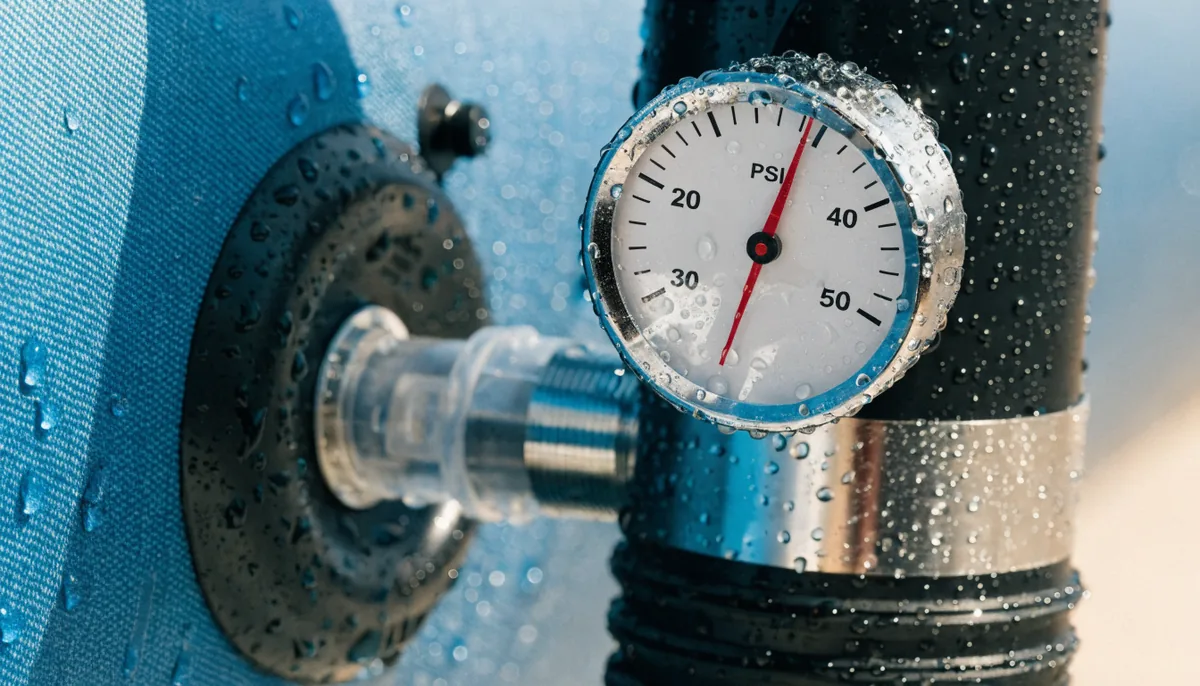
Pressure is what turns a floppy shell into a rigid board capable of carrying your weight. Too little air and the board bends underfoot; get the pressure right and it behaves almost like a hard board. The vast majority of inflatable SUPs are inflated between 15 and 18 PSI, but the only figure that really matters is the one printed by the manufacturer on the board itself.
Why the right pressure changes how rigid the board is
An inflatable SUP holds its shape thanks to thousands of internal threads running between the top and bottom sheets. That's drop-stitch construction. The higher the air pressure, the more tension those threads carry and the stiffer the board becomes. At 15 PSI, a good-quality board already offers the rigidity you need to paddle properly; below 12 PSI, it starts to bow under the rider's weight and loses both glide and stability.
Recommended pressure by board
The most common values
Most manufacturers recommend a pressure of between 15 and 18 PSI, roughly 1 to 1.2 bar. 15 PSI suits most riders for casual paddling. Heavier riders, or anyone paddling in choppy water, benefit from moving up to 17-18 PSI for extra stiffness. The maximum pressure, printed on the board, rarely exceeds 20 to 25 PSI and should never be exceeded.
Why you should always check the manufacturer's figure
Every board has its own pressure range, tied to its construction and the strength of its seams. The value printed near the valve, or in the manual, always takes priority over any general rule of thumb. Inflating beyond the maximum puts real strain on the seams, especially in hot weather. If in doubt, stick to 15 PSI: it's a safe value for almost every model.
The consequences of under- or over-inflating
Loss of rigidity
An under-inflated board bows in the middle, sits lower in the water and becomes unstable. Paddling takes more effort, steering feels vague and fatigue sets in quickly. It's the number-one cause of a disappointing first outing, often unfairly blamed on the board itself.
Risk to the kit
Go the other way and exceed the maximum pressure, and you put excessive strain on the seams and welds. Warm air expands under the sun and pressure climbs further still, and the risk of delamination or seam failure rises sharply. Staying within the manufacturer's range protects the board over the long run.
How to check pressure properly
Reading the gauge
The pump supplied with a SUP almost always has a built-in gauge. The needle often doesn't start moving until 5 to 7 PSI, by which point the board is already substantially full. That's normal, not a faulty pump. Read the value at rest, with the piston released, so you don't get a false reading.
An electric pump such as the Star Pump 8 stops automatically once it hits your target PSI, which takes the guesswork out of reaching the right pressure.
When to stop
Stop as soon as the needle reaches the manufacturer's recommended pressure, generally between 15 and 18 PSI. The last few PSI are always the hardest to push, and that's precisely the sign the board is nearing its optimal rigidity. There's no need to push past the stated maximum. For the full step-by-step method, see our guide to inflating your SUP correctly.
The most common inflation mistakes
The same mistakes come up again and again: trusting how the board feels rather than the gauge, stopping too early because the board "seems" firm, or overcompensating by overinflating "to be safe". Another common trap is inflating fully and then leaving the board in direct sun, which can push the pressure past the maximum. Finally, a valve left in the wrong position (it needs to be closed during inflation) lets air escape and gives the impression the board never reaches pressure. The kit matters too: our inflatable SUP buying guide favours packages that come with a reliable gauge pump.
FAQ
What pressure should you put in an inflatable SUP?
Most boards are inflated between 15 and 18 PSI (roughly 1 to 1.2 bar), with 15 PSI the reference value for casual paddling. Always follow the pressure printed by the manufacturer near the valve.
Can you inflate below the recommended pressure?
Technically yes, but the board will be softer, less stable and more tiring to paddle. Below 12 PSI it noticeably bows under weight. Aim for at least 15 PSI.
Can an overinflated SUP get damaged?
Yes. Exceeding the maximum pressure (often 20 to 25 PSI) puts excessive strain on the seams and welds, especially if the board heats up in the sun. The risk of delamination or seam failure increases. Stay within the manufacturer's range.
Why does my board still feel soft?
Usually because it's under-inflated: the gauge only really moves towards the end of the process, and many people stop too soon. Also check that the valve is properly closed and the seal is clean, or you'll lose air to a leak.
Should you adjust pressure for hot weather?
Yes. Heat expands the air inside and pushes pressure up. In hot weather, inflate towards the lower end of the recommended range and avoid leaving the board fully inflated in direct sun. In cold weather, pressure drops, so a small top-up may be needed.