

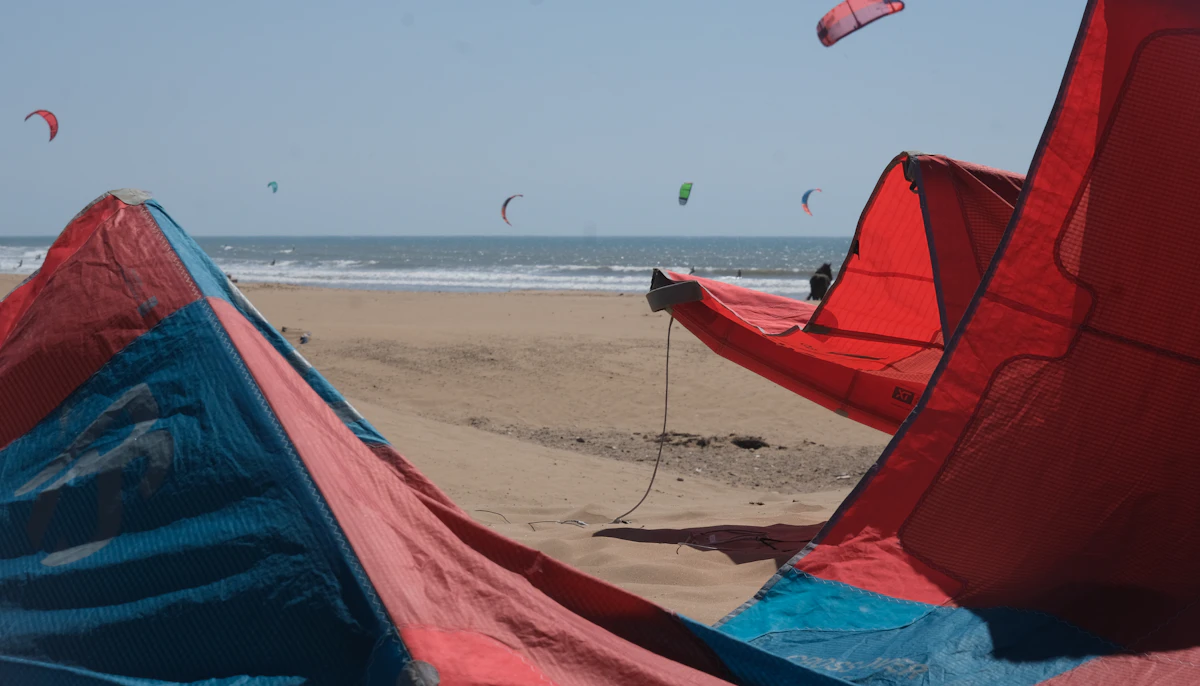
📍 Morocco, Atlantic coast
Essaouira and Dakhla taken separately, in more detail than our destinations overview: the wind, the water, the schools and what each trip actually involves.
Thermal wind on top of the trade wind, an open side-shore bay, and a fortified UNESCO-listed medina right behind the beach. Essaouira gives you riding and a town worth staying in, spring through autumn.
Kitesurf guide arrow_forward
A 20-mile sandbar cuts off the Atlantic swell, leaving flat water for miles – one of the best freestyle and freeride spots on the planet.
Windsurf guide arrow_forward
Essaouira is reached via Marrakech, by hire car or seasonal direct flight. Dakhla, further south and more remote, needs different planning – dedicated flights, schools with built-in accommodation.
Watersports safety arrow_forwardWhat to know before you book, for both Essaouira and Dakhla.
A trade wind boosted by a thermal effect, a side-shore bay, and a fortified medina right behind the beach.
Essaouira sits on Morocco's Atlantic coast, in the Marrakech-Safi region, roughly 2.5 hours by road from Marrakech. Two forces combine here to produce one of the most reliable wind regimes anywhere: the trade wind that runs down this stretch of coastline, and a strong thermal effect created by the temperature gap between the cool ocean and the fast-heating land, further sharpened by the proximity of the Atlas mountains. The wind, blowing north to north-east, hits the wide Essaouira bay side-shore, light in the morning before building steadily through the day to commonly reach 20-28 knots by the afternoon in peak season. Windless days are rare from spring through autumn.
View on Google Maps open_in_new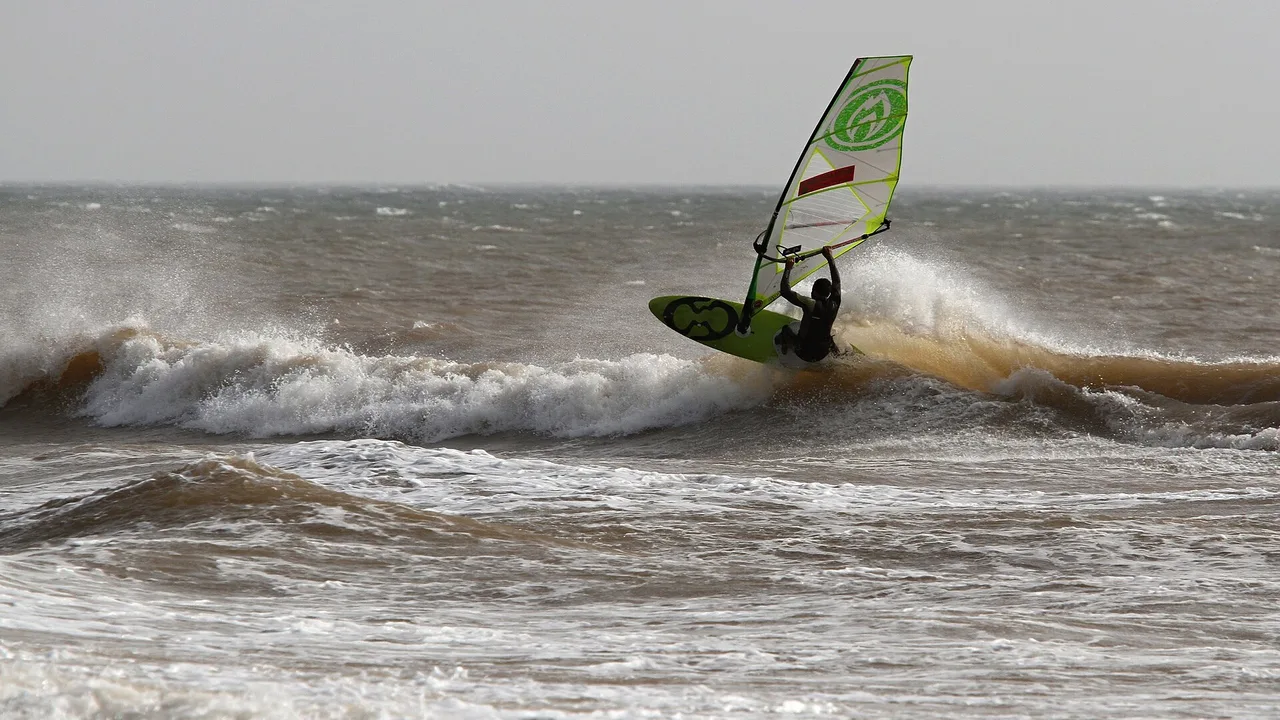
What sets Essaouira apart from most wind spots is the town itself. Its fortified medina, ringed by Portuguese-era ramparts and UNESCO World Heritage-listed, sits directly behind the beach and the busy fishing harbour. Between sessions, blue-and-white alleyways, thuya-wood marquetry workshops and grilled-fish stalls make a change from the usual beach resort. That's also why Essaouira draws as many travellers there purely for the town as it does riders there for the wind, with both crowds sharing the same beach.
ION CLUB Essaouira, part of the international ION CLUB network founded in 1985, runs kitesurf, windsurf and wing foil lessons with certified instructors, taught in several languages. Explora Watersports, on the bay for around a decade, teaches kitesurfing, wing foiling, surfing, windsurfing and SUP with IKO- and VDWS-certified instructors, in French, English, German and Spanish. Other operators such as Kite and Surf Essaouira round out the offer. All rent full kit by the day or week, a handy option given the distance from Europe.
The side-shore wind and choppy bay suit intermediate and advanced riders well, while the calmer mornings work better for beginners. Complete beginners often take a first lesson in late morning before the wind picks up, then build through several days as conditions steady out. Riders after more wave and fewer crowds head to Sidi Kaouki, about 12 miles (20 km) south, a wilder spot geared more towards surfing and wave-riding. See the full guide to Essaouira, Moulay Bouzerktoun and Sidi Kaouki.
A sandbar that cuts off the Atlantic swell, flat water across dozens of kilometres, and a territorial status worth understanding before you book.
Dakhla sits at the tip of a peninsula that reaches some 20 miles (30 km) out into the Atlantic, in southern Morocco. On its inner side that sandbar shelters a flat lagoon around 25 miles (40 km) long, cut off entirely from the open ocean's swell. The Atlantic can be a mess offshore and the lagoon will still be glassy, shallow across much of its surface. It's this exceptional geography, paired with a trade wind that blows 15-25 knots on more than 300 days a year, that's made Dakhla one of the most recognised freestyle and freeride kitesurf spots in the world.
View on Google Maps open_in_new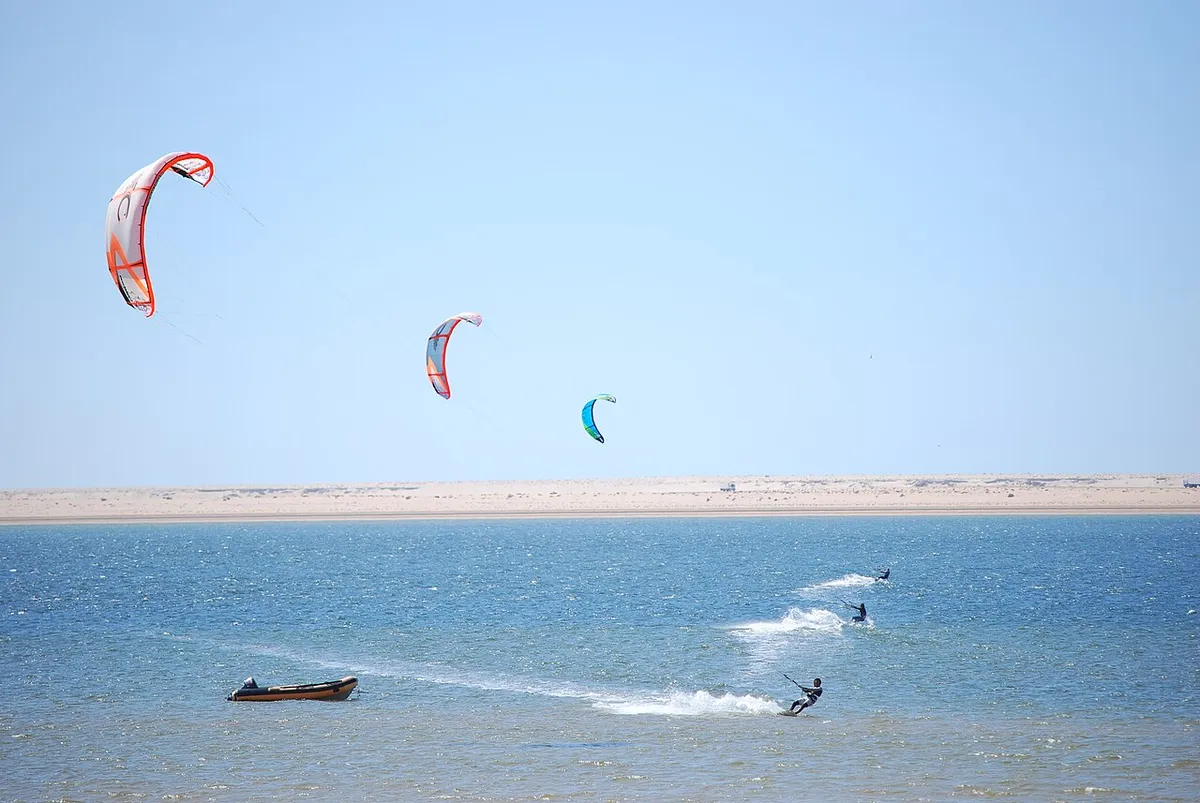
Worth knowing before you book: Dakhla sits in Western Sahara, a territory whose international status remains disputed between the Kingdom of Morocco and the Polisario Front, which claims the Sahrawi Arab Democratic Republic. Since a UN-brokered ceasefire in 1991, Morocco has administered the large majority of the territory, including the entire coastal zone around Dakhla. In practice, the destination is sold and run as a Moroccan destination by every kite school, hotel and tour operator on the ground, and visitors travel there on the same documents as for the rest of Morocco. As most travel guides note, it's sensible to stay within the western part of the territory, where the tourist infrastructure is concentrated, well away from the disputed inland border zones.
Dakhla Attitude, the first centre to open on the lagoon back in 2003, offers accommodation, lessons and rental on a large waterfront site. Lagon Energy – the former Ocean Vagabond Dakhla Lagoon, renamed in 2023 – and the Ocean Vagabond hotel at Lassarga are among the best-known kite camps in the area. ION CLUB Dakhla, also based on the lagoon at Lassarga, runs kitesurf, windsurf and wing foil lessons with Duotone gear. Several spots stand out within the lagoon: the main stretch, wide and shallow, ideal for learning; the Speed Spot, reachable at low tide, known for flat-water freestyle; and El Argoub, further south and much quieter. See the full Dakhla guide.
A few minutes from the lagoon, the ocean side is a different proposition altogether – Atlantic swell, proper waves and rawer wind, for riders after wave-riding or surfing rather than flat water. It's that dual character – lagoon on one side, ocean on the other, separated by a single strip of sand – that makes Dakhla unique among the world's major kite destinations.
Two separate airports, over 600 miles (1,000 km) apart – pick your destination before booking the flight.
Essaouira-Mogador Airport (ESU) takes seasonal Ryanair flights from Düsseldorf-Weeze, Madrid, Brussels-Charleroi, Marseille and Paris-Beauvais, plus domestic links to Marrakech via Royal Air Maroc. Since it doesn't reach every European city direct, most travellers route through Marrakech Menara (RAK), a far better-connected hub, then reach Essaouira via a roughly 2.5-hour drive or a short onward flight.
Dakhla Airport (VIL) is served by Royal Air Maroc, with a seasonal route from Paris-Orly and domestic flights from Casablanca, Marrakech, Agadir, Laâyoune and Rabat. Transavia runs a year-round service from Paris-Orly, topped up in season by Marseille. Ryanair launched a twice-weekly route from Madrid in January 2025, part of a multi-year partnership with Morocco's tourist board, and Binter Canarias connects Dakhla to Gran Canaria – a handy option for combining a Canary Islands trip.
Essaouira and Dakhla don't combine easily into one trip. Over 600 miles (1,000 km) separate the two towns, and the connection runs by air via Casablanca or Marrakech rather than by road. On the ground, most Dakhla kite schools offer built-in accommodation or airport transfer partnerships, a very different setup from Essaouira, where medina hotels and hire cars remain the norm.
A defined window in Essaouira, an almost year-round season in Dakhla.
The most reliable wind season runs April to October, peaking between June and August, when wind regularly tops 22-28 knots by afternoon. Winter, from October to March, is noticeably less consistent, with more frequent windless days – though it's a better window for surfing, with steadier swell hitting the spots nearby. Further south, near Agadir, winter is surf season: see our Taghazout surf guide.
Dakhla's season runs much longer. April to October is the strongest and most reliable stretch, but November to March still delivers rideable wind, just slightly less consistent. The mild winters typical of this Saharan latitude make it a realistic year-round destination, unlike Essaouira, where the off-season marks a real break.
The contrast between the two spots is stark. In Essaouira, water ranges from around 16°C in late winter to 20-22°C in late summer, so pack a 4/3mm wetsuit from November to April and a 3/2mm plus boots the rest of the year. In Dakhla, further south, it runs from around 16-18°C in winter to 20-23°C in summer – a 4/3mm from November to March, or a 5/4mm for long sessions, with a 3/2mm enough in the shoulder seasons. Despite the reputation, Dakhla isn't dramatically warmer than Essaouira in winter – the gap really opens up in summer.
Morocco's own emergency numbers, valid across the whole country, Dakhla included.
In Morocco, the police can be reached on 19 from any phone. The Protection civile, which covers medical emergencies and fires, answers on 15. 112 also works from a mobile phone, even without a Moroccan SIM card or credit, and routes through to the right service. Travel insurance covering medical evacuation is strongly advised for both destinations, particularly Dakhla, where the distance from major hospitals lengthens evacuation times in the event of a serious injury.
On kit and hazards, Essaouira has rocks and shallow patches along parts of the bay, so have a look at low tide before you ride over them. In Dakhla, the lagoon stays shallow and broadly safe, but the thermal wind can pick up quickly by late morning – local schools recommend riding with a buddy and checking the forecast before heading further out. Most schools at both spots rent full kit, which saves travelling with your own quiver on a long-haul flight.
What riders ask most before booking.
Two forces combine: the trade wind running down this stretch of Morocco's Atlantic coast, and a strong thermal effect driven by the temperature gap between the cool ocean and the fast-heating interior, amplified by the nearby Atlas mountains. Between them they produce a side-shore wind that blows almost daily from spring through autumn, with few windless days in peak season.
Yes. A sandbar close to 20 miles (30 km) long separates the lagoon from the Atlantic swell, leaving flat, shallow water across much of its surface. That's a big part of why Dakhla is rated one of the best spots in the world to learn and progress in kitesurfing.
Dakhla sits in Western Sahara, a territory whose international status remains disputed. Morocco has administered the large majority of it, including Dakhla, since the 1970s, and the destination is sold and run as a Moroccan destination by every kite school, hotel and tour operator on the ground. Visitors travel there on the same documents as for the rest of Morocco.
In Essaouira, ION CLUB Essaouira and Explora Watersports are among the most established schools, alongside operators like Kite and Surf Essaouira. On Dakhla's lagoon, Dakhla Attitude, Lagon Energy (formerly Ocean Vagabond) and ION CLUB Dakhla are among the best-known centres, with lessons and equipment rental for every level.
Essaouira-Mogador Airport (ESU) takes seasonal flights from several European cities, with Marrakech (RAK), about 2.5 hours by road, remaining the best-connected hub. Dakhla (VIL) is served by Royal Air Maroc and Transavia from Paris-Orly, with a twice-weekly Ryanair link from Madrid and a seasonal Transavia add-on from Marseille, plus a Binter Canarias route from Gran Canaria. Explore all our watersports destinations and our kitesurf guide too.

.JPG)