
Windsurfing is a wonderful sport, but a demanding one. The kit is powerful, the sea is unpredictable and errors of judgement cost you dearly. Most of windsurf safety comes down to a handful of habits: right of way, the wind, kit checks, self-rescue and knowing who to call. Worth reading before your first session, and worth a re-read every season.
Right of way on the water
In windsurfing, the right-of-way rules (the international rules of the road for sailing) prevent collisions. They're simple enough, but every windsurfer needs to know them.
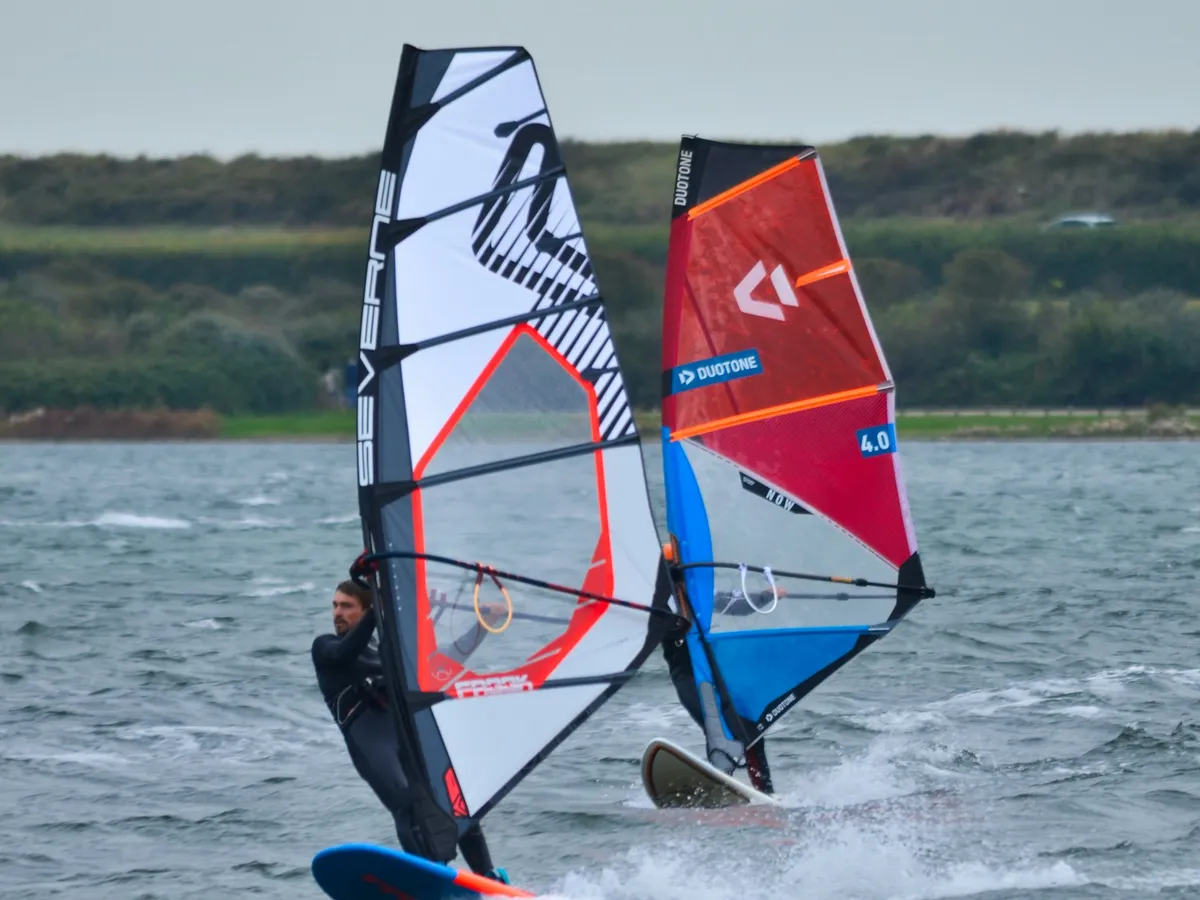
🔹 Rule 1: starboard has right of way over port
A windsurfer on starboard tack (right hand forward, sail on the left) has right of way. A windsurfer on port tack (left hand forward, sail on the right) must keep clear, by altering course or bearing away. Always check your tack as you set off.
🔹 Rule 2: the windward sailor keeps clear
If two windsurfers are on the same tack (both starboard or both port), the one to windward (upwind) must keep clear of the one to leeward (downwind). The leeward sailor, sailing closer to the wind, has less room to manoeuvre.
🔹 Rule 3: the overtaking sailor keeps clear
A windsurfer who is overtaking another must keep clear. The sailor being overtaken has right of way. Always pass to leeward of the sailor you're overtaking, with plenty of margin.
🔹 Rule 4: give way to less manoeuvrable craft
When you meet larger vessels, a windsurfer keeps clear of anything restricted in its ability to manoeuvre, and never crosses a marked shipping channel at speed. Treat swimmers, paddlers and moored boats with the same caution.
🔹 Rule 5: launching gives way to landing
The windsurfer launching from the beach gives way to the one coming in to land. Likewise, anyone sailing near the beach should not get in the way of another sailor's launch or landing.
When in doubt, always give way. Ten seconds lost is cheaper than a collision. On a busy day, drop your speed and keep your head up.
The wind: friend and foe
The wind is what powers you. But it can turn deadly if you misjudge it.
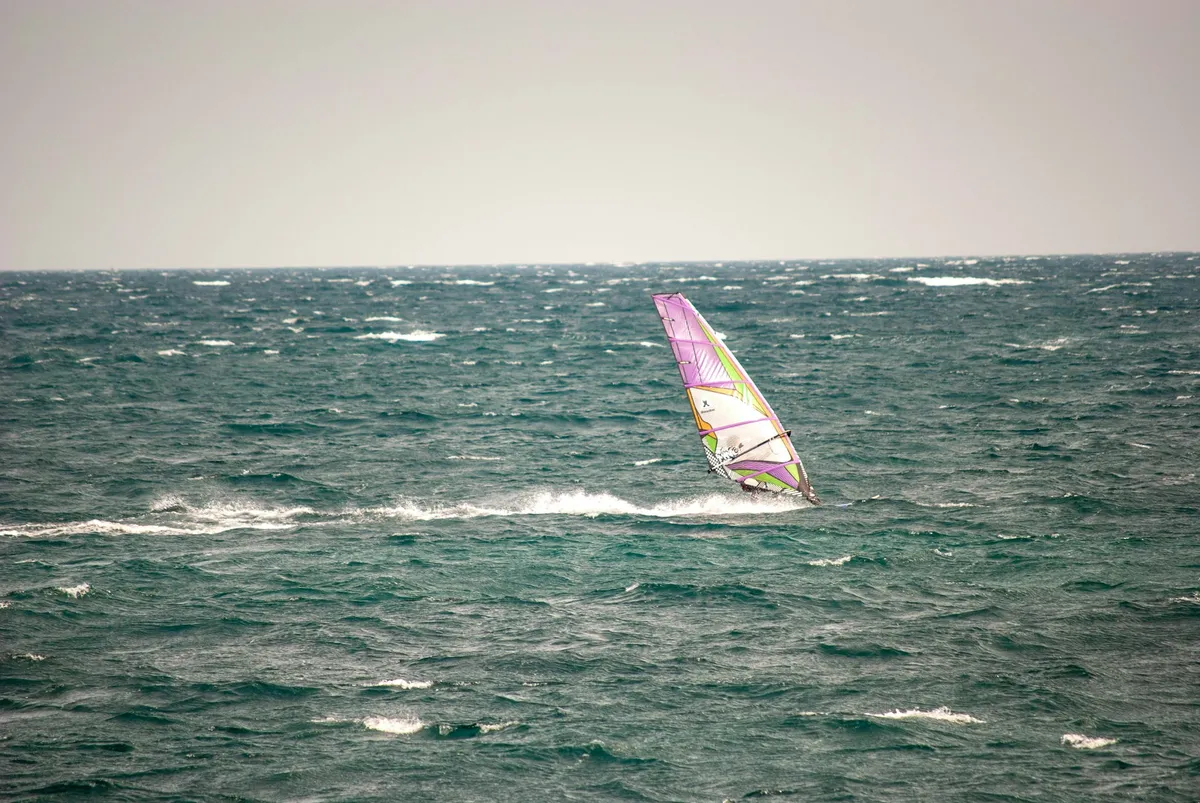
Recommended wind strength by level
- Beginner (0–6 months): 8 to 15 knots (9–17 mph) maximum. Use a big board and a small sail (4–5 m²).
- Intermediate (6 months – 2 years): 10 to 25 knots (12–29 mph). You can handle smaller sails and more responsive boards.
- Advanced (2 years-plus): 15 to 30-plus knots (17–35 mph). Planing, gybing and the waterstart under control.
- Expert: 30 to 45-plus knots (35–52 mph). Sailing in extreme conditions, only with the right kit and experience.
⛔ Offshore wind: the one that catches people out
An offshore wind (blowing from the land out to sea) is the number-one hazard in windsurfing, because it carries you away from the beach and gets no easier the further out you go. Even a light 10-knot offshore breeze can put you hundreds of metres out in minutes. Never sail in an offshore wind. Always check the wind direction before you rig up, and heed the orange windsock that flies on lifeguarded beaches to warn of offshore wind.
Gusts and unstable wind
Gusts can double the wind strength in seconds, which costs you control, breaks kit and puts you in the water hard. If the gusts are more than 50 per cent above the average (say, an average of 15 knots gusting 25), stay on the beach. Squalls (thunderstorms, cold fronts) arrive without warning, so keep an eye on the sky.
Before every session, work out the wind direction from the beach. If the wind is blowing from the land out to sea (offshore), don't sail. If it blows from the sea towards the land (onshore or side-shore), you're on safer ground. When in doubt, ask a local windsurfer or the beach lifeguards.
Checking your kit before every session
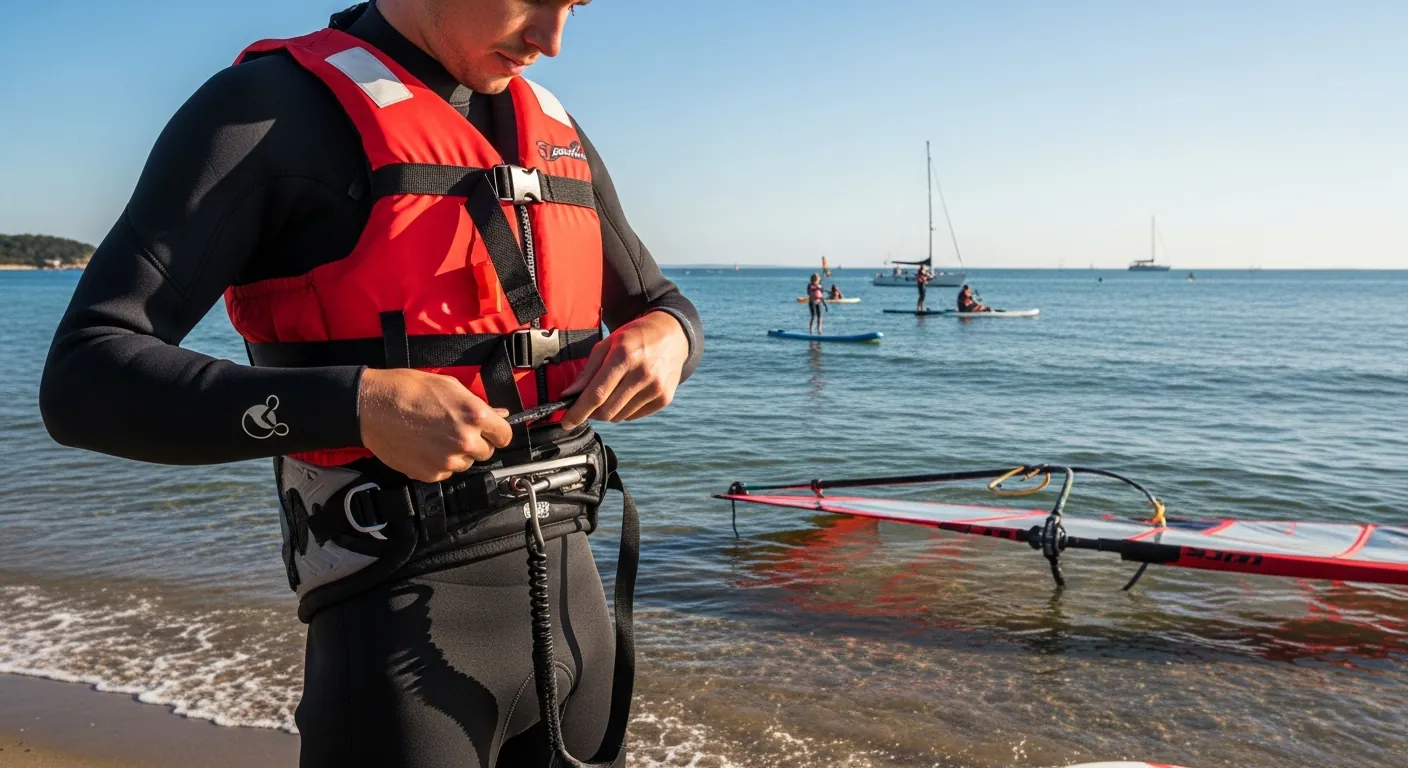
Kit that fails mid-session can put you in danger. Run through this safety check before every launch.
The mast and sail
- Mast: check for cracks, especially at the joint between the two sections. A cracked mast can snap while you're sailing.
- Sail: inspect the seams, eyelets and window (if fitted). A torn sail loses its power and can let go suddenly.
- Downhaul and outhaul tension: the sail must be correctly tensioned. A slack rig makes the sail unstable.
The boom and mast foot
- Boom: check the harness lines, extensions and the clamps. A damaged boom can fail under the load of the wind.
- Mast foot (universal joint): check for excessive play and cracks. The mast foot connects the rig to the board, so a failure here is about as dangerous as kit failure gets.
The board, fin and footstraps
- Fin: make sure it's properly bolted in and crack-free. A fin that lets go while planing causes an instant loss of control.
- Footstraps: check the screws and the state of the straps. Worn straps can give way mid-manoeuvre.
- Rig leash / mast-foot safety line: check the safety line that keeps the rig attached to the board, and the mast-foot fitting.
✅ A 30-second pre-session check
Mast OK → Sail OK → Boom OK → Mast foot OK → Fin bolted in → Footstraps OK → Safety line OK. If a single item is doubtful, don't sail until it's replaced or repaired.
Launching and landing safely
The launch area
Choose a clear area, free of swimmers and obstacles (rocks, groynes, other boards). Respect the swimming zones marked out by the beach flags on lifeguarded beaches. Never rig or launch near a group of people.
Launching
- Work out the wind direction and set your board across the wind.
- Carry the board (don't drag it) down to the water.
- Rig up in the water (not on the sand) to avoid damaging the kit.
- Check no windsurfer is coming in before you set off.
Landing
- Come back head-to-wind towards the beach.
- Slow down in good time.
- De-rig in the water, not on the sand.
- Clear the area quickly so you don't get in others' way.
Swimmers are the number-one cause of accidents during launching and landing. A boom spinning round at speed can injure someone badly. Always keep well away from swimming areas and watch for children running about on the beach.
The hazards of windsurf kit
The boom
The boom is the aluminium or carbon frame you hold. It's the number-one hazard for beginner windsurfers. In a fall or a loss of control it swings round hard and can strike your head, chest or teeth. Always keep a firm grip on both sides and never let go with one hand in a fresh breeze.
The mast
A carbon mast is stiff and sharp. If it breaks, the carbon splinters are cutting. Never put your fingers near a mast under load. In a fall, protect your head with your arms.
The fin
The fin is a sharp blade under the board. In a fall, never come down on the board. Always fall flat and away from the board. When carrying it, use a fin cover.
Lines under tension
The harness lines, footstraps and rig lines are under constant tension when the wind fills the sail. Never put your fingers into a mechanism under load. A line that snaps can whip round violently.
Other water users
Kitesurfers have lines 20 to 25 metres long that can cut. Boats don't always see you. Swimmers are unpredictable. Always keep a safe distance from every other water user.
⛔ Deadly traps to avoid
Never sail alone at a remote spot. Don't sail with damaged kit. Don't sail beyond your level. Don't sail under the influence of alcohol or medication. Don't ignore the signs of hypothermia – a real risk in cold UK water.
Self-rescue and getting back to shore
Self-rescue is the technique for getting back to land when you can no longer sail (a torn sail, the wind dropping, a kit failure, exhaustion). No other safety skill in windsurfing matters as much.
Self-rescue: step by step
- Get head-to-wind: set the board facing the wind so it doesn't drift.
- Lay the rig on the board: pull the sail out of the water and lay it across the board (in a cross).
- Sit on the board (on the windward side, on the folded boom) and use the rig as a makeshift sail.
- Steer the board by angling the sail: if the wind is pushing you towards land, let the sail open; if it's carrying you out, fold the sail down onto the board to cut the drift.
- Use your hands as paddles if the wind has dropped.
Recovering the sail
If your sail has dropped into the water and you can't uphaul it, use the scissor technique: set the sail square to the wind and use the wind's force to raise it gradually. If the wind is too strong, self-rescue rather than exhausting yourself.
Recovering the board
If you're in the water and your board has drifted off (a snapped or unclipped safety line):
- Don't swim after it if it's a long way off and you're tired.
- Use your rig as a float: lie on the folded sail while you wait for help.
- Signal for help: raise one arm and shout. Other windsurfers or the lifeguards will come.
Swimming back
If you do end up swimming for the beach, stay with your board. It floats, it's visible from a long way off, and lying on it and using your arms will get you in faster than swimming free of it.
Most windsurfing rescues around the UK involve sailors blown out by an offshore wind or unable to get back through exhaustion. Practise your self-rescue in calm conditions before you sail anywhere more committing.
Emergencies: who to call
Calling for help
In the UK, in any coastal or sea emergency, dial 999 (or 112) and ask for the Coastguard. HM Coastguard coordinates search and rescue around the UK coast, 24 hours a day, and tasks the RNLI lifeboats and rescue helicopters.
- 999 or 112 – ask for the Coastguard for anything on or near the water (a windsurfer blown out, an injury on the water, a kit failure). Both numbers work from a UK mobile, and 112 works across Europe.
- 999 – ask for the ambulance service for a medical emergency on the beach.
What to tell the emergency services
Call 999 and ask for the Coastguard, then give:
- Your exact position: the name of the beach, distance from shore, visual landmarks.
- The number of people in trouble.
- Their apparent condition (conscious, injured, hypothermic).
- The conditions: wind strength, sea state, drift.
- Your phone number for a call back.
Basic first aid
While you wait for help:
- Hypothermia: get the person out of the wind, remove wet neoprene if you can, wrap them in a survival blanket, and don't give alcohol.
- Heatstroke: move them into the shade, cool the skin, fan them.
- Injury: apply pressure to bleeding, and don't move anyone with a suspected fracture or head injury.
- Near-drowning: if the casualty isn't breathing, start rescue breaths and CPR as soon as they're out of the water.
Always carry your mobile phone in a waterproof pouch attached to your wetsuit or board. In an emergency it's your only way to call for help. Dial 999 and ask for the Coastguard.
Insurance and training in the UK
RYA membership and third-party cover
In the UK, the Royal Yachting Association (RYA) is the national governing body for windsurfing. RYA personal membership is worth having because it includes third-party liability insurance for your windsurfing, in case you injure someone or damage property. There's no legal requirement to be insured, but going without is a poor gamble.
Lessons and qualifications
Learning at an RYA-recognised training centre is the best way to pick up good habits and the safety rules under a qualified instructor. The RYA runs a structured windsurfing scheme from Start Windsurfing through to advanced levels.
Local rules and access
Some beaches, harbours and inland waters have their own rules on where and when you can windsurf: zoned areas, launch sites and set hours. Check with the local club, harbour authority or landowner before you sail somewhere new, and respect any signage.
New to windsurfing? Taking a course at an RYA-recognised centre is the best way to learn the safety rules with a qualified instructor. See our guide to getting started with windsurfing.
Weather, tides and staying alert
Before every session, always check:
The wind forecast
- Direction: onshore (safer), side-shore (ideal), offshore (dangerous).
- Strength: average and gusts, in knots. Check the Met Office marine forecast.
- Trend: is the wind due to build or drop over the next few hours?
Tides
The tides transform the conditions:
- A spot that works at high water can become unusable (shallows, rocks) at low water.
- Tidal streams can carry you a long way from your launch.
- Check the tide times and heights on Admiralty EasyTide or a tide-table app before you go.
Met Office weather warnings
Check the Met Office forecast and any National Severe Weather Warnings before you set off. The warning colours:
- 🟡 Yellow: be aware. Severe weather is possible; take care.
- 🟠 Amber: be prepared. There is an increased likelihood of severe weather; don't sail.
- 🔴 Red: take action. Dangerous weather is expected; stay ashore.
Never sail in a thunderstorm. A carbon mast makes an excellent lightning conductor. If you see lightning or hear thunder, come in at once and wait 30 minutes after the last lightning before going back out.
Looking for a safe spot for your next session? See our guide to the best UK windsurfing spots, our windsurf gear guide and our technique tips to keep progressing safely.
❓ Frequently asked questions about windsurf safety
Who has right of way in windsurfing?
The windsurfer on starboard tack (right hand forward, sail on the left) has right of way. The one on port tack must keep clear. On the same tack, the leeward sailor has right of way over the windward sailor. A windsurfer generally keeps clear of larger, less manoeuvrable vessels.
What is the maximum wind strength for windsurfing?
For a beginner, don't go out above 15 knots (17 mph). An intermediate can sail up to about 25 knots (29 mph). Above 30 knots (35 mph), only experts should be out. Never sail if the gusts are more than 50 per cent above the average wind.
What should you do in an offshore wind?
An offshore wind (from the land out to sea) is the number-one hazard in windsurfing. Never sail in an offshore wind, however light, and watch for the orange windsock on lifeguarded beaches. If you're caught out, self-rescue: lay the sail across the board and use it to work back to shore.