
📍 Dakhla, Western Sahara (Morocco)
This page goes deeper than the Dakhla section of our Morocco guide — spot by spot, camp by camp.
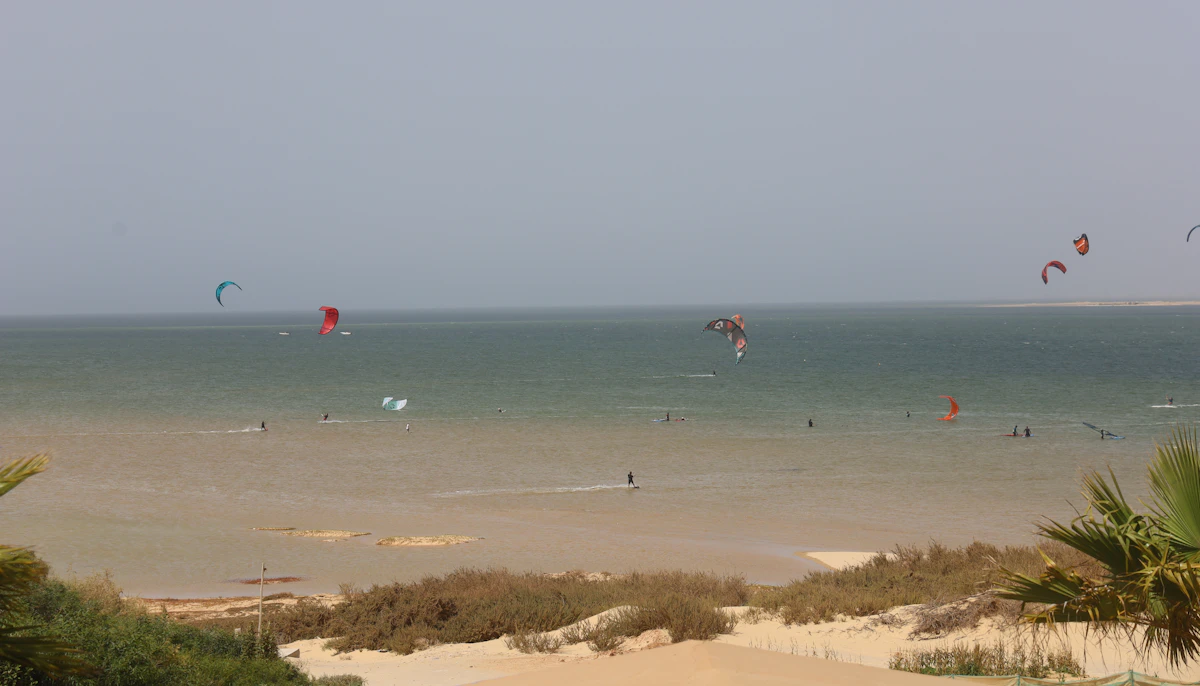
The Río de Oro peninsula blocks the Atlantic completely, leaving a flat, shallow, obstacle-free stretch of water regarded as one of the best learning and freestyle grounds in the world.
Kitesurf guide arrow_forward
The north-east trade wind blows around 300 days a year according to local operators, between 15 and 25 knots in season, with a summer peak when it regularly tops 25 knots.
Wing foil guide arrow_forward
Foum El Bouir, a right-hand point break 5km from town, works from October to March and has hosted rounds of the GKA Kite-Surf World Tour — the wave-riding complement to a lagoon trip.
Kitesurf safety arrow_forwardWhat to know before you book.
A 40km stretch of flat water, divided into zones that each have their own character.
The Río de Oro peninsula, a sand spit of around 40km running parallel to the coast, separates the lagoon entirely from the ocean. No swell gets in: what's left is a shallow expanse of water — you can often stand 300m from the shore at low tide — over a sandy bottom with no rocks or obstacles, and virtually no current. That combination, plus the reliability of the trade wind, is what earns Dakhla its reputation as the best flat-water spot in the world, as much for learning as for top-level freestyle.
View on Google Maps open_in_newNear the mouth of the lagoon, the Speed Spot serves up mirror-flat water behind its sandbanks, at its best at low tide — this is the freestyle and speed playground, better suited to intermediate and advanced riders. Further north, PK25 (kilometre point 25 on the national road) is both a beach and the camp that occupies it, home to a Duotone Pro Center. Strung out between the two are the zones that make up the local geography: Oyster Park with its flamingos, and the ultra-flat 'Jardiland' at low tide.
Around fifteen kilometres downwind of the camps, the White Dune — a white sand dune plunging straight into the lagoon, surrounded by water at high tide — is Dakhla's postcard view and the goal of the classic downwinder. ION CLUB operates a dedicated centre there. Dragon Island, whose silhouette resembles a dragon's head, is reached by boat (or on foot at low tide) and rounds out the day-trip options.
When the North Atlantic swell arrives, Dakhla becomes a wave spot too.
Around 5km from the town centre, reached by a tarmac road, Foum El Bouir (sometimes spelt Oum Labouir) is the reference wave: a right-hand point break of 1 to 3m that works from October to March, when North Atlantic swells run down the coast. The spot has hosted rounds of the GKA Kite-Surf World Tour, which tells you its calibre when the conditions line up.
View on Google Maps open_in_newAt the tip of the peninsula, the fishing village of Lassarga covers both bases: flat water and freestyle in the north-north-easterly wind from spring to autumn, then long point waves over sand from October to March. This is where Ocean Vagabond built its hotel, with an ION CLUB centre providing the coaching. Experienced riders after more committed waves push on to La Pointe d'Or, reachable by 4x4.
You don't book a hotel and then a school here — you book a camp that combines the two.
Nearly all the accommodation on the lagoon runs as all-inclusive camps, 25-30km north of town: half board or full board, an in-house school, kit storage, boat rescue cover and direct access to the water. It's the format that defines the Dakhla experience — you pick your camp the way you'd pick your spot.
Dakhla Attitude, the pioneer based at the Speed Spot since 2003, remains the biggest operation, with several tiers of accommodation, a spa and even a cable wakeboard park. Lagon Energy — formerly Ocean Vagabond Dakhla Lagoon, renamed in 2023 after a change of management — cultivates an eco-lodge feel. Dakhla Club is the most upmarket option, with a pool, spa and solid-build bungalows. PK25 and its Duotone Pro Center complete the line-up at kilometre 25, and ION CLUB coaches at both Lassarga and the White Dune. Most hire out recent kit, so there's no need to travel with your full quiver.
Direct flights from Paris, and a transfer arranged by the camps.
Dakhla airport is served non-stop from Paris-Orly by Transavia and Royal Air Maroc (around 5h45 in the air), and connected to Casablanca, Agadir, Marrakech, Rabat and Laayoune by Royal Air Maroc, as well as to Gran Canaria by Binter. From the UK and elsewhere, the simplest routing is to connect through Paris-Orly or Casablanca.
The airport practically touches the town, but the lagoon camps sit 25-30km to the north: allow 30 to 45 minutes for the transfer, almost always included or arranged by the camp when you book. Once you're there, everything is on foot between your accommodation and the water — one of the charms of the formula.
Dakhla lies in Western Sahara, a territory administered by Morocco: entry formalities are identical to those for the rest of the country, and the whole tourism industry operates under Moroccan administration. The currency is the dirham (MAD), French is widely spoken, and the nights are chilly despite the desert setting — pack proper warm layers for the evenings.
A long wind season with two very distinct faces.
This is high season: the north-east trade wind averages 20-25 knots from June to August, with gusts of 30-35 knots and wind probability above 90% at the height of summer. Small kites, flat water, long days — the set-up that made the lagoon's reputation. Book early: camps sell out across this window.
The wind drops to 12-18 knots: the ideal window for learning, progressing in wing foil or riding a bigger kite, with less crowded camps. It's also wave season at Foum El Bouir — versatile riders get the best of both worlds.
Upwelling from the Canary Current keeps the water between 16 and 22°C depending on the season, well below what the Saharan latitude might suggest. A 3/2mm wetsuit is a must from November to April; a shortie or a 2mm will do in summer. On strong-wind days, the wind chill out on the water justifies keeping the wetsuit on even with 27°C in the air.
What riders ask most before booking.
The Río de Oro peninsula, a sand spit of around 40km, separates the lagoon entirely from the Atlantic Ocean and blocks all the swell. What's left is a shallow stretch of water — you can often stand 300m from the shore at low tide — over a sandy, obstacle-free bottom with virtually no current.
Dakhla runs on all-inclusive camps set along the lagoon shore, 25-30km from town: Dakhla Attitude (the pioneer, based at the Speed Spot since 2003), Lagon Energy (formerly Ocean Vagabond, renamed in 2023), Dakhla Club (the upmarket option with a spa) and PK25 with its Duotone Pro Center. ION CLUB operates two centres, at Lassarga and at the White Dune.
Yes, on the Atlantic side. Foum El Bouir, around 5km from the town centre, is a right-hand point break that works from October to March with North Atlantic swells, and has hosted rounds of the GKA Kite-Surf World Tour. Lassarga, at the tip of the peninsula, switches between flat water in summer and waves in winter.
April to September-October, peaking from June to August: the north-east trade wind then averages 20 to 25 knots with gusts of 30-35, and wind probability tops 90% in July and August. From January to March the wind is lighter (12-18 knots), ideal for learning or for foiling.
Dakhla airport (VIL) has direct flights from Paris-Orly with Transavia and Royal Air Maroc (around 5h45 in the air), plus connections to Casablanca, Agadir, Marrakech and Rabat with Royal Air Maroc. Allow another 30 to 45 minutes for the transfer to the lagoon camps, usually arranged by the camp itself. Also check out Essaouira and the rest of Morocco, and our guide to the best kitesurf spots in the UK.