

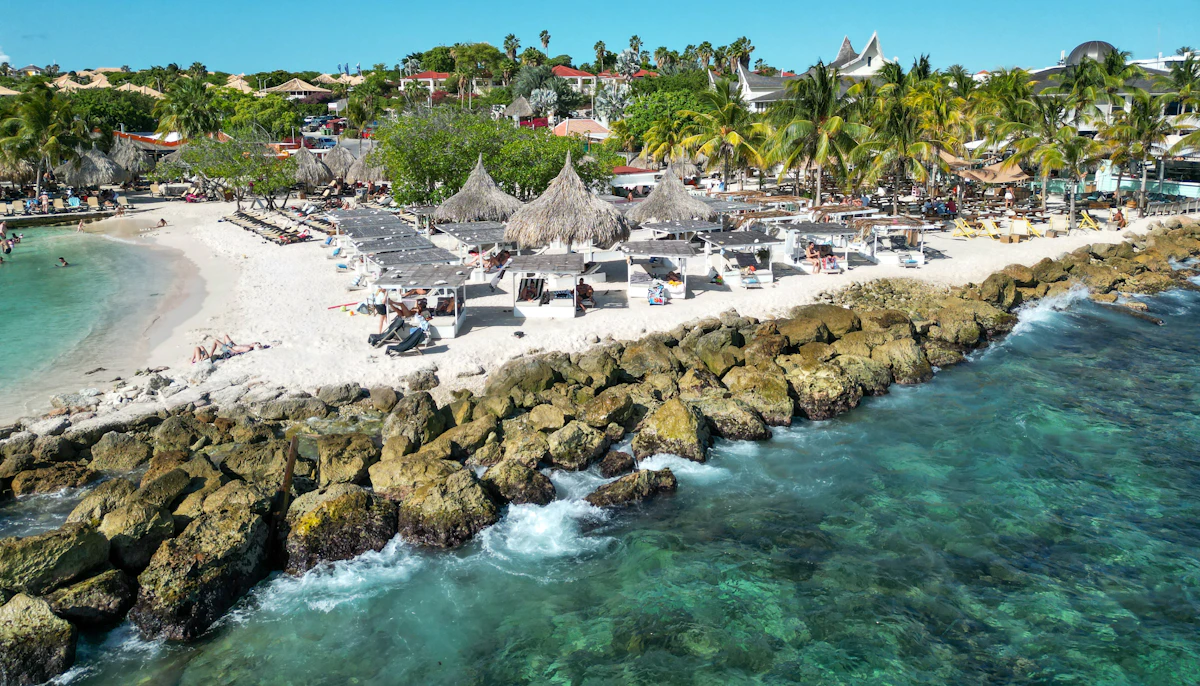
📍 Curaçao, Dutch Caribbean
Following our Bonaire and Aruba guides, this page is part of our Caribbean guide and completes the informal "ABC islands" trio: Aruba, Bonaire and Curaçao, three Dutch Caribbean destinations that combine easily into a single trip.
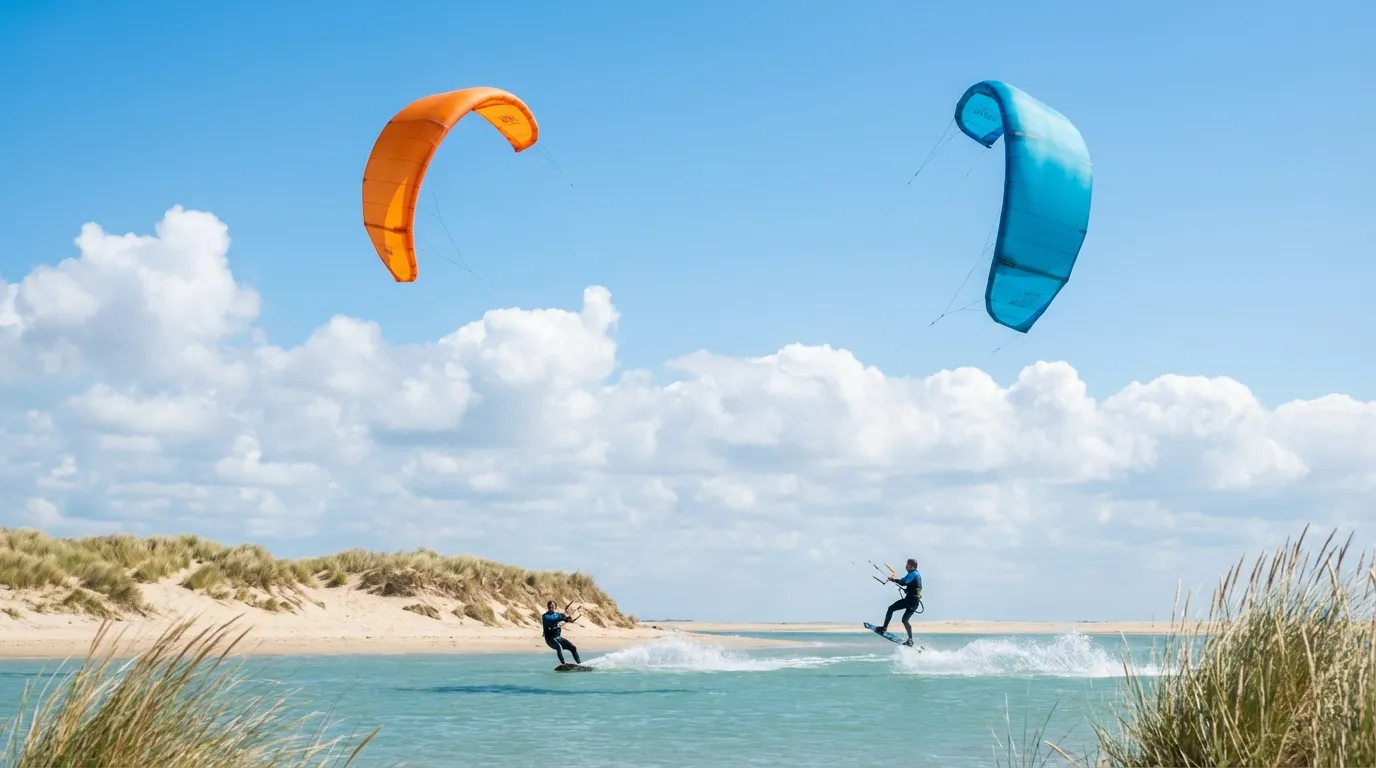
On the north-east coast, a shallow, flat bay swept by a steady trade wind of 15-25 knots, roughly 300 days a year. Three schools teach here, from complete beginner through to advanced.
Kitesurf guide arrow_forward
Near Jan Thiel, this calm lagoon, protected from swell, offers flat water ideal for beginners, SUP and freestyle, a world away from the busier north-east coast.
Windsurf guide arrow_forward
Roughly 40 miles off the coast of Venezuela, Curaçao sits outside the Atlantic's main hurricane belt — a real advantage for session reliability year-round.
Watersports safety arrow_forwardWhat to know before you book.
A shallow, flat bay, a trade wind that blows nearly every day, and three schools on site.
Sint Joris Bay, also spelled St. Joris Baai, sits on Curaçao's north-east coast, in the Sint Michiel area, about twenty minutes from Willemstad. It's the island's go-to kitesurfing spot: a shallow, sheltered bay with a stable bottom that lets you ride standing across a wide stretch of the water. The trade wind blows here with remarkable consistency, ranging from 15 to 25 knots depending on the season, with gusts reaching up to 30 knots — a reliability that gives Curaçao roughly 300 days of usable wind a year.
View on Google Maps open_in_newThe section of Sint Joris Bay where the schools cluster is known locally as Kitebeach. Three operators are based there: Nix Kiteboarding School, which pitches itself on the spot's accessibility and beginner-friendly conditions; Awa Salu Kiteboarding, founded in 2017 and a multiple TripAdvisor Traveler's Choice winner; and Gusty Kiting, the third operator on the beach. All three offer lessons and equipment rental, from complete beginner through to advanced, which saves travelling with your own quiver.
The shallow water, stable bottom and consistent wind make Sint Joris Bay particularly well suited to learning and progression, for beginners and for riders after back-to-back sessions without the lulls typical of a purely thermal wind. It's also a solid base for branching out into the island's other watersports, with Curaçao's kitesurfing scene staying concentrated around this one bay.
A sheltered stretch of water near Jan Thiel, popular for beginners, SUP and freestyle.
Spaanse Water, or Spanish Water, is a large lagoon east of Jan Thiel, roughly a fifteen-minute drive from Willemstad. Sheltered from swell and current by its near-enclosed shape, it offers flat water that contrasts sharply with the punchier conditions at Sint Joris Bay. It's a particularly good environment for beginners, wing foiling and flat-water freestyle, as well as guided stand-up paddle trips through the mangroves that line part of the lagoon.
Several schools based on the shores of Spaanse Water run windsurfing lessons, wing foil sessions and guided SUP outings, often in lighter wind that drops close to nothing in the mangrove-sheltered corners. For a balanced trip, plenty of riders split their time between the two: Sint Joris Bay for wind and kitesurfing, Spaanse Water for a relaxed session or a gentle first lesson.
Curaçao ranks among the Caribbean's top shore-diving destinations.
Kitesurfing and windsurfing remain the focus of this guide, but it would be a shame not to mention Curaçao's other big reputation: diving. The island has more than 38 dive sites accessible directly from the shore, a rarity in the Caribbean, where most well-known spots need a boat. Healthy reefs, excellent year-round visibility and a well-developed network of dive operators make it a natural complementary activity for lighter-wind days, particularly during the quieter September-to-November stretch when the kiting slows down.
A well-connected airport, with a handy air bridge to Aruba and Bonaire.
Curaçao International Airport, historically known as Hato, sits about 12km north of Willemstad, the capital. It has one of the longest commercial runways in the Caribbean, capable of handling wide-body aircraft, and is served by around twenty airlines. From the US, American Airlines, United and Delta run regular services; from Europe, KLM connects the island to Amsterdam Schiphol. Other international carriers, including Avianca, Air Canada and WestJet, round out the schedule. There's no direct flight from the UK; routing through Amsterdam is the most straightforward option.
Curaçao completes the informal "ABC islands" trio with Aruba and Bonaire, and it's Divi Divi Air, a regional carrier based at Hato, that ties the three together: around 95 flights a week out of Curaçao, with daily connections to both Aruba and Bonaire. That frequent air bridge makes a multi-island itinerary easy to put together — pairing Sint Joris Bay in Curaçao with Lac Bay in Bonaire or Fisherman's Huts in Aruba in a single two-week trip is entirely realistic.
Hiring a car is the most practical way to get between Willemstad, Sint Joris Bay in the north-east and Spaanse Water east of Jan Thiel. Since 2025, the official currency has been the Caribbean guilder, which replaced the Netherlands Antillean guilder and remains pegged to the US dollar; the US dollar itself is widely accepted in shops, restaurants and watersports schools, which simplifies things for most visitors.
A long wind season running December to August, driven by the so-called "Christmas winds".
This is the most reliable window of the year. The trade wind, sometimes nicknamed the "Christmas winds" for the way it typically strengthens in December, blows consistently between 15 and 25 knots, with gusts up to 30 knots. Peak consistency falls between May and July, when the wind blows at Sint Joris Bay on nearly every single day.
This is the quietest stretch for wind, with some days bringing little to no usable trade. Plenty of riders use this window to turn to diving instead, or to a relaxed session at Spaanse Water rather than relying on Sint Joris Bay. It's worth checking local forecasts before booking a trip built entirely around kitesurfing during this period.
Curaçao sits roughly 40 miles off the coast of Venezuela, which places it outside the Atlantic's main hurricane belt. Hurricanes here are exceptionally rare, even during the months that see the most storm activity elsewhere in the Caribbean (August to October), which makes Curaçao a reliable year-round destination for both kitesurfing and diving.
Curaçao's own emergency numbers, distinct from the UK's.
Curaçao runs its own emergency numbers, separate from those used in the UK or mainland Netherlands. Dial 911 for police and fire, 912 for ambulance, and 913 to reach the Coast Guard (Kustwacht) for any emergency at sea. Travel insurance covering medical evacuation is strongly advised for any trip to the Dutch Caribbean.
On kit: no wetsuit, no boots needed, since the water stays warm year-round. The three schools at Sint Joris Bay, as well as those at Spaanse Water, hire full kit by the day or week, so there's no need to drag a board bag through Amsterdam or a US connection.
What riders ask most before booking.
Yes. The water is shallow and flat across a wide stretch of the bay, with a steady trade wind around 15-25 knots, which makes it an excellent spot to learn under the eye of the several schools based on Kitebeach.
Three schools are based on Kitebeach, at Sint Joris Bay: Nix Kiteboarding School, Awa Salu Kiteboarding (founded in 2017, a multiple TripAdvisor Traveler's Choice winner) and Gusty Kiting. All offer lessons and equipment rental.
The Spaanse Water (Spanish Water) lagoon, east of Jan Thiel, offers sheltered flat water ideal for beginners, SUP and flat-water freestyle, with several schools based on its shores.
December to August, with steady trade winds of 15-25 knots, gusts up to 30 knots, and peak consistency in May-July. September to November brings a marked drop in wind.
Curaçao International Airport (CUR, Hato) takes flights from KLM, American Airlines, United, Delta, JetBlue and other international carriers, plus Divi Divi Air, which runs daily inter-island flights to Bonaire and Aruba. Explore our Bonaire guide and Aruba guide, plus the rest of our Caribbean guide.