

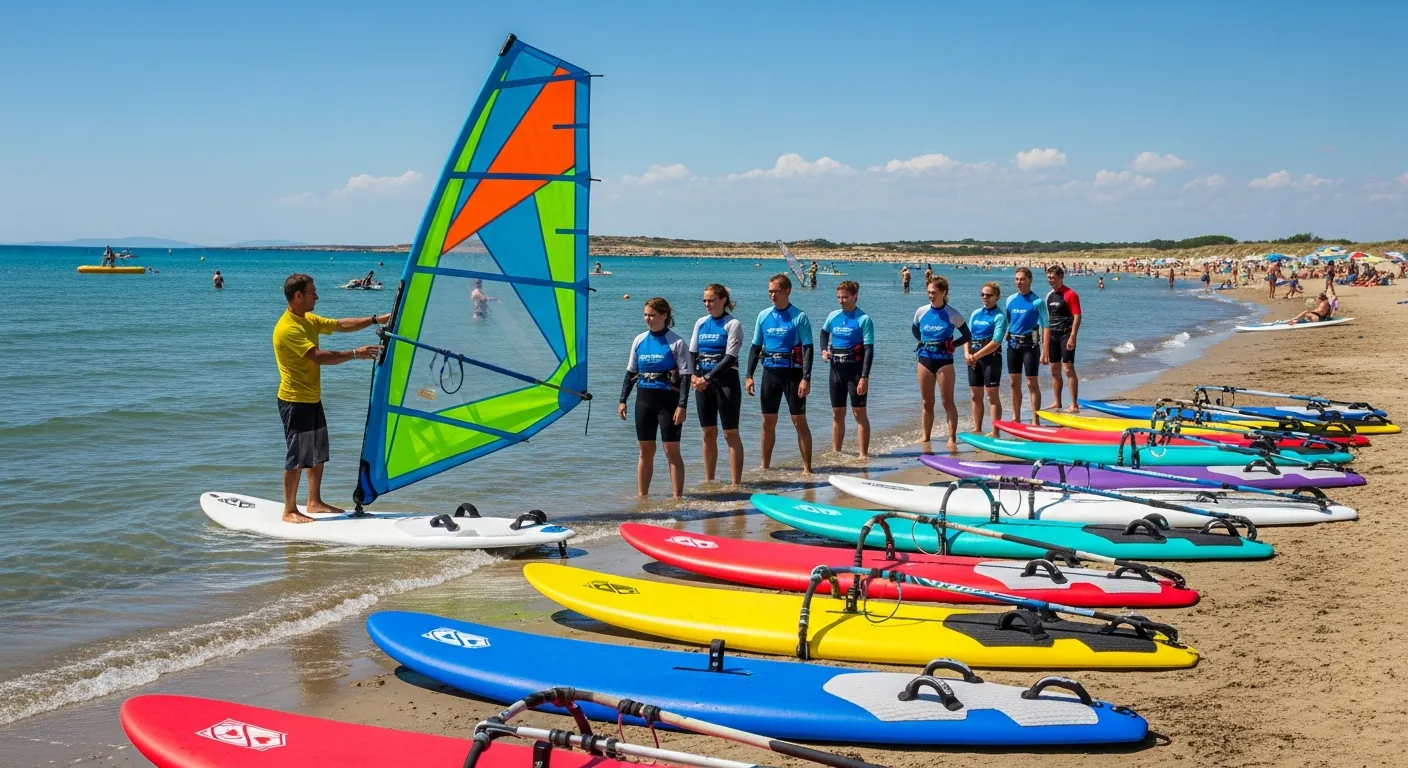
Windsurfing punishes self-teaching more than most board sports: the rig fights you, the kit is rarely the right size, and bad habits set in within a fortnight. A few days at an RYA centre, with an instructor who puts you on the right board for the day's wind, compresses all of that into structured progress. This guide covers the formats on offer, what a good school looks like, where to go and what it costs.
The types of windsurf course
👥 Group windsurf lessons
The most popular and accessible format. An RYA-qualified instructor teaches a group of 3 to 6 students. Each session lasts 2 to 3 hours, with a maximum ratio of 1 instructor to 6 students recommended by the RYA.
Typical format: the RYA Start Windsurfing course runs over 2 days, usually split into 2 to 3 sessions of 2 to 3 hours each. Theory (right of way, wind and weather, safety) is woven in alongside progressive time on the water.
Budget: £120 to £180 for a taster day, £200 to £290 for a full RYA Start Windsurfing course.
🎯 Private windsurf coaching
One instructor, one sailor, and a session built entirely around whatever is holding you back – the waterstart, the gybe, your first jumps, or getting race-ready. Most coaches film the session and send you away with a written progression plan.
Typical format: 1 to 2 hour sessions, 1 to 3 sessions booked together. Video review from the shore is what makes the difference, because the instructor can show you exactly what to adjust while it's still fresh.
Budget: £75 to £90 per hour. Reckon on 2 to 3 sessions for gains that stick.
🏕️ Windsurf camps and holiday courses
Book one of these and someone else handles the beds, the tuition, usually the food and often the lift to the water, so a full week of sailing takes no organising at all. They run on the south coast (Hayling Island, Portland, Poole Harbour) and abroad in Spain (Tarifa, Fuerteventura) and Greece.
Typical format: 5 to 7 days, 2 to 3 hours of tuition per day plus supervised free sailing, on-site or nearby accommodation, breakfast usually included, sometimes premium kit provided.
Budget: £350 to £700 for the week depending on destination and standard. UK-based courses at RYA centres offer excellent value for money.
🏆 Freestyle and wave windsurf courses
For confident sailors ready to level up: loops, duck gybes, waterstarts in waves and your first jumps. These courses are run by professional riders or specialist coaches, usually at wave spots.
Typical format: 3 to 5 days, 2 to 4 hours per day, systematic video analysis and mental coaching for pushing through new manoeuvres, run at wave spots or reliably windy venues.
Budget: £250 to £500 for a 3 to 5 day course. Advanced coaching costs more because it requires an expert-level instructor.
The progression of a beginner windsurf course
A beginner windsurf course follows a structured progression. These are the stages you'll go through.
Stage 1: Getting to grips with the kit and the beach start (day 1)
Your first proper look at the equipment: how to carry the board, rig the sail, position your feet. The instructor teaches you the beach start: uphauling the sail, getting into position, catching the wind and moving off. This step can take 1 to 2 hours before it starts to feel smooth.
Stage 2: Basic sailing and your first runs (day 1–2)
You'll learn to sail in a straight line, control the sail with your back hand and get your stance sorted. The instructor covers the rules of the water: right of way, sailing areas, hand signals. Your first runs between two marker buoys are a genuine thrill.
Stage 3: The tack (day 2–3)
The tack is the first manoeuvre that really matters – changing direction by turning the board through the wind – and it's the most technical thing a beginner attempts. The instructor breaks it down into steps: heading up into the wind, stepping in front of the mast, swapping feet, and setting off on the new tack. Expect 10 to 20 attempts before it clicks.
Stage 4: The waterstart (day 3–5)
The waterstart is the beginner's holy grail – getting back up on the board straight from the water, without hauling the sail up by hand. It requires a board with a universal mast foot and a sail with enough power. The instructor sets you facing the wind, you lift the board and rig together, and off you go. Nothing else on the course feels quite like it.
Stage 5: The gybe and sailing on (day 4–5)
The gybe changes direction with the wind behind you. Quicker and smoother than the tack, it's the manoeuvre you'll use 80% of the time once you're sailing independently. The final days of the course are spent repeating and bedding in these skills.
A 5-day course will take you from 'never touched a board' to sailing independently and tacking confidently. Staying consistent afterwards is the key: one session a week will lock in what you've learned. See our guide to getting started with windsurfing to keep progressing.
How to choose a windsurf school in the UK
The school you pick decides how safely and how quickly you progress. Check the following before you book.
Qualifications and accreditation to look for
- RYA-recognised training centre: the Royal Yachting Association is the UK's national governing body for windsurfing and sailing. RYA recognition is the number one guarantee of quality teaching, safety standards and well-maintained kit.
- RYA-qualified instructor: your instructor should hold an RYA Windsurfing Instructor qualification, the recognised standard for teaching windsurfing for payment in the UK.
- First aid training: instructors should hold a current first aid qualification.
- Public liability insurance: the school must be insured to run watersports tuition.
Quality markers
- Instructor-to-student ratio: the RYA caps windsurf groups at 6 students per instructor. Three or four means far more of the instructor's attention lands on you.
- Kit quality: a good school provides stable, wide beginner boards with a daggerboard, sails matched to your size and level (4 to 6m² to start), and wetsuits in good condition. Check the age and state of the hire fleet.
- Spot flexibility: the instructor should take you to the venue best suited to the day's conditions (wind, tide, shelter). A school that always sails the same spot regardless of conditions is a red flag.
- Theory built in: a well-run course includes theory: reading the wind, right of way, safety, weather. This is what separates a structured course from a loose 'session on the water'.
- What past students say: the RYA training centre listings are a good starting point, and recent social media posts show you the kit and the conditions the school actually teaches in.
Not sure which RYA-recognised centre to book? Drop us a line and we'll point you at schools we rate on the right stretch of coast for you.
The best UK destinations for a windsurf course
💨 Hayling Island (Hampshire): the south coast's number one
Level: All levels (dedicated beginner area)
Best season: April–October (reliable sea breeze)
Course price: £200–£290 (RYA Start Windsurfing)
Why it's worth it: A busy, well-established scene with several schools right on the Solent shoreline. Hayling offers a sheltered harbour side for beginners and more open, wavier water for intermediates. It's the most popular windsurfing beach on the south coast.
🌬️ Portland Harbour (Dorset): flat water at Olympic scale
Level: Beginner to advanced
Best season: Year-round
Course price: £180–£280
Why it's worth it: Home to the Weymouth and Portland National Sailing Academy, this vast enclosed harbour is one of the safest and most reliable windsurfing venues in the country, whatever direction the wind is blowing from.
🏖️ Rutland Water (East Midlands): the inland classic
Level: Beginner to intermediate
Best season: April–September (thermal breeze plus westerlies)
Course price: £150–£250
Why it's worth it: The UK's flagship reservoir venue, with several RYA-recognised centres, a huge fetch and consistently good sailing. No tide, no current, no waves: ideal for building technique.
🌊 Queen Mary Reservoir (Surrey): learn near London
Level: Beginner
Best season: Year-round
Course price: £150–£250
Why it's worth it: A structured RYA training centre a short drive from central London. No swell, no strong current: the flat water lets you focus on pure technique with steady, moderate wind.
🌬️ Rhosneigr (Anglesey, Wales): the wave-riders' spot
Level: Intermediate to advanced
Best season: April–October
Course price: £180–£280
Why it's worth it: A big bay with a range of exposures, so when one side isn't working the other usually is. Reliable south-westerly wind and genuinely good waves, with stunning scenery to match.
Discover all our UK windsurf spots with detailed guides: wind conditions, level required, access, recommended schools and the best times to go.
The best international destinations for a windsurf course
🇪🇸 Tarifa (Andalusia): the wind capital of Europe
Spots: Playa de Los Lances, Valdevaqueros
Best season: May–September (Levante and Poniente)
Course price: £180–£320 / week
Why it's worth it: Tarifa is Europe's wind capital: Levante (easterly) in the morning, Poniente (westerly) in the afternoon, with wind on around 300 days a year. Spots for every level, an international crowd and tapas in the evening. Tarifa is THE windsurf destination in Europe.
🇪🇸 El Médano (Tenerife, Canary Islands): year-round trade winds
Spots: El Cabezo, La Barca
Best season: Year-round (constant trade winds)
Course price: £220–£380 / week
Why it's worth it: A winter-sun escape with water at 19–22°C and steady force 4–5 trade winds nearly every day. El Médano is one of the best options for a windsurf course over the UK winter, without the cold water and grey skies.
🇪🇸 Fuerteventura (Canary Islands): flat water and waves side by side
Spots: Sotavento, Flag Beach, Corralejo
Best season: Year-round (constant trade winds)
Course price: £250–£450 / week
Why it's worth it: Escape the UK winter for water at 19–22°C and constant force 4–5 trade winds. Sotavento's lagoon gives dead-flat water with steady wind, ideal for beginners, while wave spots sit close by for the more advanced.
🇬🇷 Vassiliki (Lefkada, Greece): the Mediterranean's most reliable thermal
Spots: Vassiliki Bay
Best season: June–September (Eric thermal wind)
Course price: £220–£400 / week
Why it's worth it: A near-guaranteed daily thermal wind, light and glassy in the morning building to a stronger, gustier 'Eric' in the afternoon. One of the most established windsurf holiday spots in the Mediterranean, with excellent schools.
Course budget: UK vs abroad
Budget varies with destination, duration and course type:
In the UK
- 2-day RYA Start Windsurfing course: £200 to £290 (tuition only)
- Taster day: £120 to £180
- Private coaching: £75 to £90 per hour
- Course plus accommodation: £350 to £700 for the week
- Kit hire: £25 to £50 per day (usually included in most courses)
Abroad
- Tarifa (Spain): £180 to £320 / week plus accommodation (£45–£70/night)
- Fuerteventura (Canary Islands): £250 to £450 / week plus flights and accommodation
- El Médano (Tenerife): £220 to £380 / week plus flights and accommodation
- Vassiliki (Greece): £220 to £400 / week plus flights and accommodation
Good to know: UK courses in late spring (May–June) offer the best value: steady wind, lower accommodation prices, and quieter spots. Book 1 to 2 months ahead for the best availability.
When to book a windsurf course
Spring (April–June)
The best time in the UK: south coast sea breezes build in reliability, the water starts to warm up (12–15°C), spots are quiet and prices are lower. This is the ideal window for a beginner course.
Summer (July–August)
The water reaches its warmest (16–19°C) and the afternoon thermal is about as dependable as UK wind gets, which is exactly why everyone else is there too. Hayling Island and Poole Harbour fill up and accommodation prices peak, so book 2 to 3 months out.
Autumn (September–November)
September still holds 14–17°C in the water, the Atlantic starts sending proper wind again, and the summer crowds go home. If you already sail competently, this is the window worth taking leave for, with Rhosneigr and Tiree at their best.
Winter (December–March)
Head south: UK conditions are tough in winter (water at 7–10°C, wind less predictable). The Canary Islands (Fuerteventura, El Médano) and Tarifa are the best European winter alternatives: water around 19°C, constant wind and courses running year-round.
For a beginner windsurf course in the UK, May or June is hard to beat. The wind is steady, the water is warming up, spots aren't yet packed and prices are still reasonable. It's the sweet spot of the UK windsurf season.
What to pack for a windsurf course
The essentials
- A wetsuit suited to the season (often provided by the school, but your own will fit better)
- Neoprene boots if the water is below 15°C or the spot is rocky
- Waterproof SPF 50+ sun cream (wind and water reflection intensify UV exposure)
- A rash vest for sun and rub protection under the wetsuit
- A changing robe for the beach or car park
- A microfibre towel (dries fast, packs small)
- A peaked cap that stays put in the wind (better than a soft cap)
For your comfort
- Polarised sunglasses with a retaining strap (essential on the water)
- Flip-flops or beach sandals
- Comfortable clothes for after your session
- Ear plugs (to help prevent surfer's ear and swimmer's ear)
- An insulated water bottle: hydration matters, and wind dries you out faster than you'd think
- A dry bag for your phone and keys
Documents to bring
- Proof of travel or watersports insurance (check you're covered for windsurfing specifically)
- Your RYA membership card, if you have one
- Any medical information the school should know about
- Your RYA logbook, if you're working through the scheme and want your course logged
Progressing after your windsurf course
The course gets you moving. What you do in the weeks after it decides how far you go.
- Sail every week if you can: one or two shorter sessions will take you further than a single intensive week and then nothing until next summer.
- Off the water: core work and a balance board help, skateboarding or surfskating teaches you to carve, and pull-ups make uphauling a lot less brutal.
- Video: a friend with a phone on the beach will show you more about your stance in one clip than an hour of guesswork.
- Sailing your course venue again: familiar water means you can spend the session on technique rather than working out where the gusts and the shallows are.
- Joining a club: an RYA-affiliated club near you is the best way to sail regularly with other windsurfers. Sailing alongside others speeds up progress.
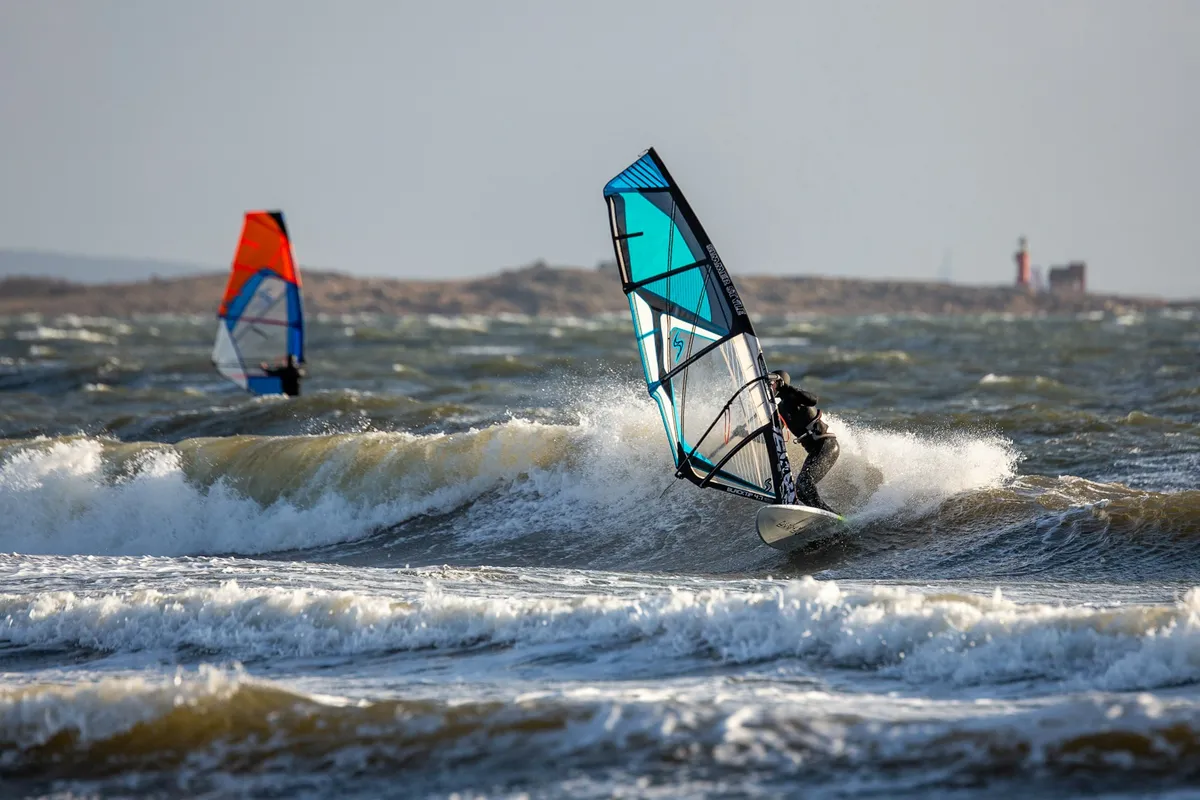
Back from your course? Keep progressing with our guides: getting started with windsurfing, core techniques, choosing your kit and windsurf safety.
❓ Frequently asked questions about windsurf lessons and courses
How much does a windsurf lesson or course cost in the UK?
Budget £120 to £180 for a taster day, and £200 to £290 for a full RYA Start Windsurfing course (typically 2 days). Accommodation is usually not included. Private tuition runs £75 to £90 per hour.
Where's the best place for a beginner windsurf course in the UK?
Hayling Island, Portland Harbour, Rutland Water and Queen Mary Reservoir all pair sheltered water with steady, moderate wind and an RYA-recognised school on site, which is exactly what a first course needs.
What's the best time of year for a windsurf course?
Late spring (May–June) and summer (July–August) are ideal for beginners: reliable wind, mild temperatures and warmer water. On the south coast, the sea breeze fills in most afternoons from April through September.