
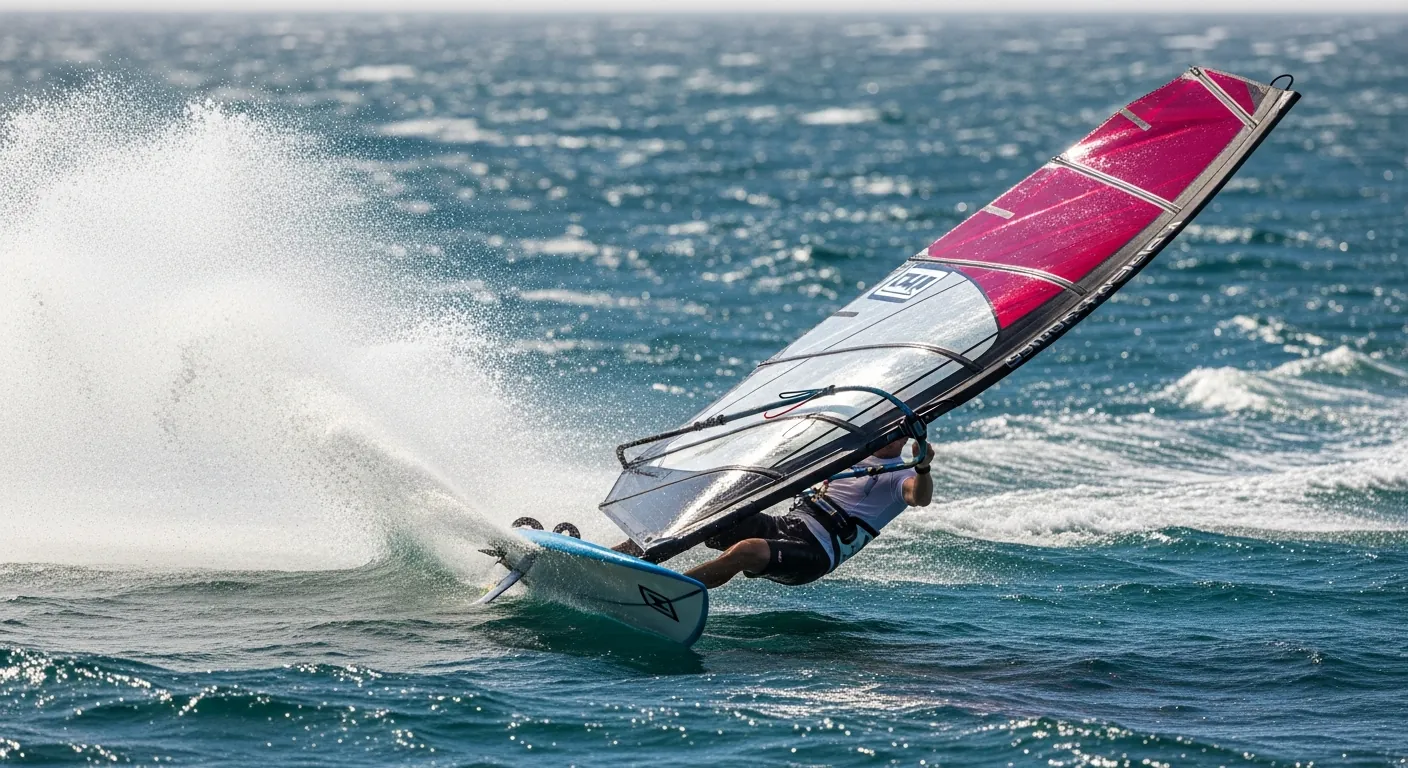
Windsurf technique comes down to a set of moves and positions that you build up over time. From the basic stance through to planing, each manoeuvre asks for coordination, an eye for the wind and a well-trimmed rig. These are the fundamentals to get down if you want to sail with confidence and keep progressing.
1. The basic stance: the foundation position
It all starts with a good stance – your position on the board – because every other manoeuvre is built on it. A correct stance gives you the balance, control and power you need for everything else.
🔹 Foot placement
Your feet belong in the footstraps. The front foot sits near the mast, the back foot by the fin. Feet are shoulder-width apart, angled across the board. As a beginner you can sail without the straps, and you probably should, to build your balance before you commit to them.
🔹 Body lean
Your body leans back to counter the pull of the sail. The stronger the wind, the more pronounced the lean. Your feet, hips and shoulders form a diagonal line, and you hang between the pull of the sail and the resistance of the board in the water.
🔹 Arms and sail
Front arm extended (near the mast), back arm bent (on the back of the boom). The sail is sheeted in (pulled towards you) to catch the wind. The front arm steers, the back arm controls the power. Keep both arms relaxed, because a rigid grip transmits every jolt and tires your muscles.
For a good stance, look ahead along your line and never down at your board. Your body naturally follows your eyes. Keep your shoulders open and facing the direction you want to go.
2. The waterstart: getting back on after a fall
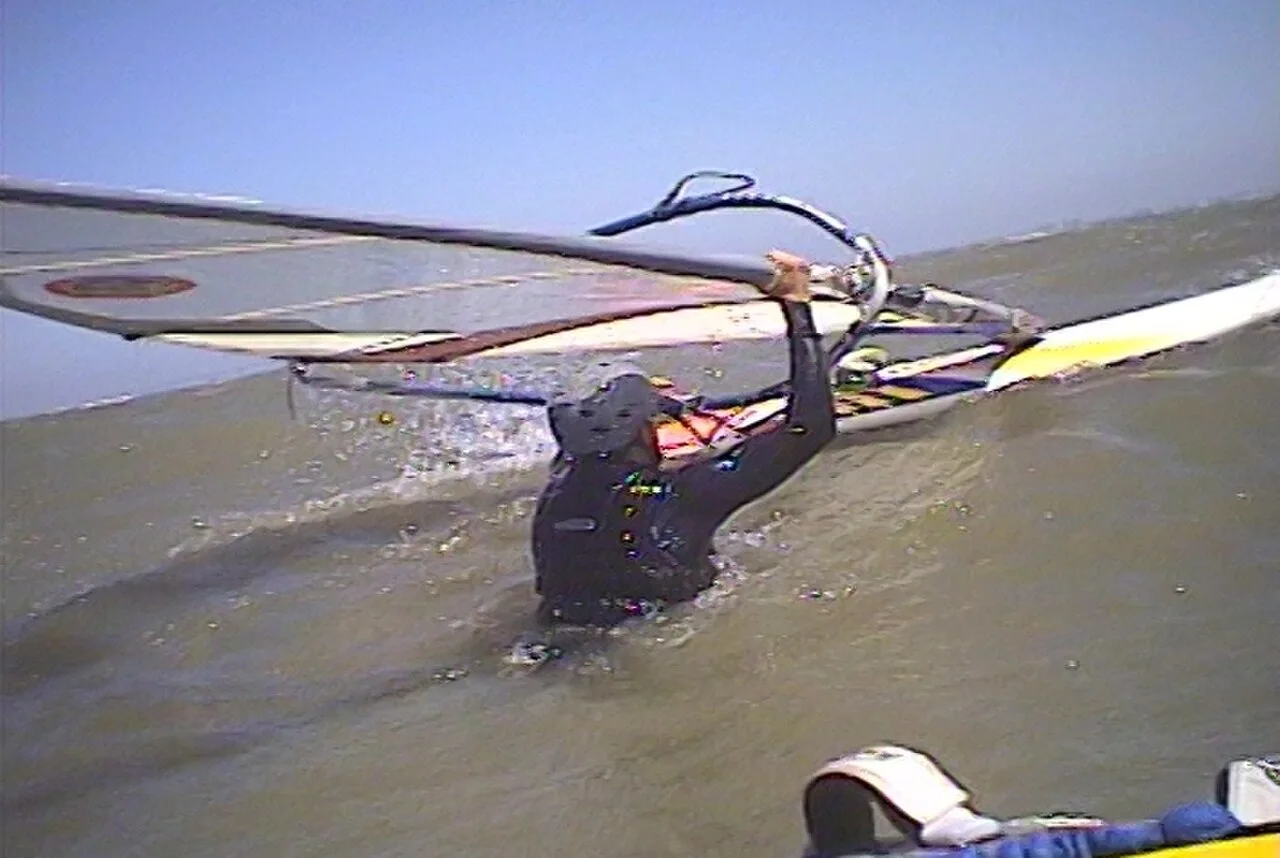
The waterstart is the technique that gets you going again after a fall. No skill matters more to an intermediate windsurfer, because without a reliable waterstart every fall means a long swim back to the beach. Nailing it transforms your windsurfing.
Setting up in the water
After a fall, stay calm. Get to the windward side of the board (the side the wind comes from), lie on your back with your feet towards the board. Check the sail is square to the wind – too far into the wind and it fills and pulls you, too far downwind and it catches nothing.
The lift phase
Grip the boom with both hands, arms extended. Sheet the sail in gradually and never quickly. The wind lifts you out of the water, and you let your body unfold one foot after the other until you're standing on the board.
🔹 Step 1: set the sail square to the wind
The sail should sit at 90° to the wind direction. Too far into the wind and it pulls before you're ready. Too far downwind and it generates no power at all.
🔹 Step 2: the controlled lift
Arms extended, sheet in slowly. Your body comes out of the water bit by bit. Don't force it – let the wind do the work. If it isn't happening, reset the sail and start again.
🔹 Step 3: standing up
As soon as your feet touch the board, find the footstraps, lean back and sheet in. The move needs to be smooth, because hesitation puts you straight back in the water.
Drill: practise the waterstart in shallow water (1 to 1.5 metres) at first. You can put a foot down if it goes wrong, which takes the frustration out of it. Pick a spot with a steady breeze of 10 to 15 knots (12–17 mph) – any lighter and there's no power, any stronger and it's no place to be learning.
3. The beach start: setting off from the shore
The beach start is the technique for setting off in shallow water, without a swim. It's easier and quicker than the waterstart, and it's what we'd point a beginner towards.
Getting set up
Hold the board with one hand (windward side) and the rig with the other, mast angled into the wind. Step onto the board, front foot into the front strap. The sail is sheeted out (eased) so it doesn't unbalance you.
Moving off
Push the board out with your front foot. When the water reaches your ankles, sheet the sail in gradually. The wind drives you forward: place your back foot and settle into the basic stance. The beach start is often a beginner's first taste of 'real' sailing.
4. The tack: changing course through the wind
The tack is the manoeuvre for changing direction by turning the board through the wind. It's the first change of course beginners learn, and more accessible than the gybe because it happens at low speed.
🔹 Step 1: the approach
Sail close-hauled (about 45° off the wind). Set up your tack by checking you have space around you. Ease the sail slightly to slow down.
🔹 Step 2: bringing the sail across
Let go of the boom with your back hand and grab the mast. Bring the sail across over the front of the board (the windward side) to the other side. Your feet pivot on the board, the front one becoming the back one and vice versa.
🔹 Step 3: sailing on
On the new side, take the boom again (front hand near the mast, back hand behind), sheet in and settle back into your stance. The board has turned through 180°.
Common tacking mistakes
- Moving the sail across too slowly: the board stalls and you drift. The move needs to be continuous and smooth.
- Not enough wind: a tack needs a minimum of wind to work. In very light air, paddle instead.
- Not looking ahead: before you even bring the sail across, look towards your new line. Your body follows your eyes.
5. The gybe: the downwind turn
The gybe is the change of direction away from the wind. It's more advanced than the tack but much faster, because the board never stalls. The gybe is your gateway to dynamic, freeride windsurfing.
How the gybe works
Unlike the tack, which happens with the bow into the wind, the gybe happens on a broad reach or running (wind on the back quarter). The board pivots while carrying its speed, and the sail passes round the back of the board.
🔹 Step 1: the set-up
Sail on a broad reach with speed. Take your back foot out of the strap and place it on the leeward rail (a momentary 'strapless' position). This foot becomes your pivot.
🔹 Step 2: the carve
Press on the inside rail (the side you're turning towards) with your back foot. The board carves round. At the same time, throw the boom across to the other side by passing it over your head and behind you.
🔹 Step 3: the exit
Once the sail is across, put your back foot back in the strap, sheet in and settle into your stance. You're now sailing the other way, without having lost any speed.
Work on the gybe first at low speed in light wind (10 to 12 knots / 12–14 mph). Don't attempt your first gybe in strong wind – groove the move in gentle conditions first. Repetition builds the muscle memory.
6. Planing: skimming at full speed
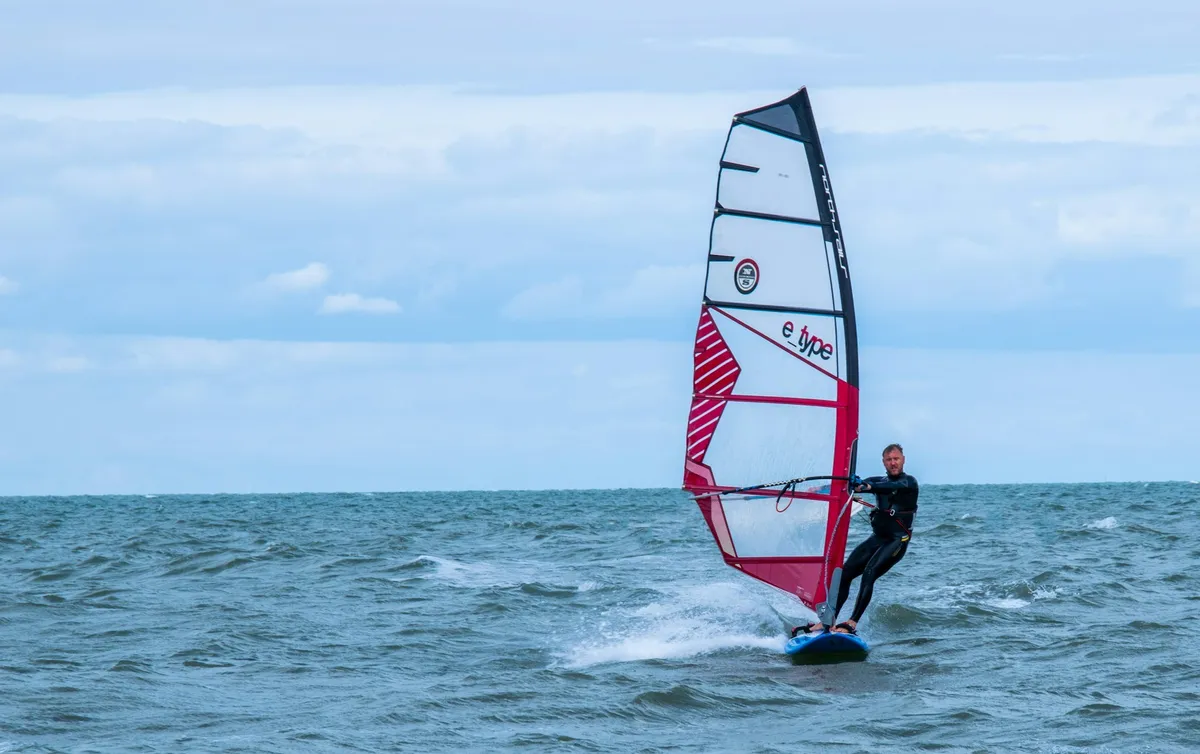
Planing is the magic moment when the board lifts up and skims across the surface of the water. It's what every windsurfer is chasing, and the sense of speed and freedom is what makes the sport so addictive.
What you need to plane
Planing needs:
- About 15 knots (17 mph) minimum (it varies with your kit: short, wide boards plane more easily)
- A correctly sheeted sail – eased too far and there's no power, sheeted too hard and the board brakes
- A low, weight-back body position: the stronger the wind, the further back your weight goes
- The footstraps in use: essential for staying stable at speed
The planing position
On the plane your body is well back, almost lying down. Arms are extended, the sail sheeted right in. Your body forms an almost straight line between the boom and your feet. The harder you're planing, the further back your weight shifts to keep the nose out of the water.
Tuning your kit
To make planing easier, move the footstraps back a couple of centimetres and set your harness lines so the pull comes through your hips, not your arms. The harness is essential for planing: it transfers the sail's pull into your body and frees up your arms.
For your first plane, chase balance rather than maximum power. Once you're up, settle your position before you try to go faster. The speed comes naturally as your confidence grows.
7. Pumping: making speed with your body
Pumping is the technique of generating speed with body movements, rather than waiting for the wind. It's what gets you onto the plane in light wind, and what rebuilds speed after a manoeuvre.
How pumping works
Pumping combines two movements:
- Bending and extending the legs: bend your knees, then drive them straight explosively. This shifts your weight fore and aft on the board, making it accelerate.
- Working the sail: sheet the sail in and out in rhythm with your legs. Each pump pulls the board forward.
The rhythm of pumping
Effective pumping is rhythmic and continuous. Reckon on 1 to 2 cycles per second. Too slow and nothing happens; too fast and you waste the energy. Find the rhythm that gets the board moving, and expect it to change with the wind and your kit.
When to pump
- To get onto the plane when the wind is marginal (12 to 15 knots / 14–17 mph)
- To rebuild speed after a tack or a gybe
- To reach an area when the wind drops off briefly
- In slalom racing, where pumping is the main means of propulsion
Pumping is hard graft, working your legs, core and back. Build your fitness with squats, planks and some cardio. A fit windsurfer pumps for longer and more effectively.
8. Sailing upwind: making ground against the wind
Sailing upwind (or 'pointing') is the ability to make ground against the wind direction. Without it you're paddling home, or waiting for a tow.
The principle of tacking upwind
You can't sail straight into the wind, because the zone roughly 45° either side of it is the no-go zone where the sail can't fill. To make ground upwind you tack back and forth, alternating close-hauled legs on port and starboard to zigzag your way up.
The upwind technique
To sail close-hauled (upwind):
- Sheet the sail right in, until it sits almost in line with the board
- Edge the board to windward, driving the windward rail down so the leeward rail lifts
- Move your front foot forward: this helps the board point up towards the wind
- Look along your line rather than at the wind, and your body adapts naturally
The fin's role
The fin is crucial for sailing upwind. It stops the board slipping sideways. A bigger fin points higher upwind but costs you straight-line speed, and every windsurfer settles that trade-off to suit their own priorities.
Want to know how well you're pointing? Line yourself up against a building or a tree on the shore. Two minutes of close-hauled sailing should visibly close the gap; if it hasn't, adjust your course or your sail trim.
9. Common mistakes and how to fix them
Mistake 1: bent, tense arms
The problem: many beginners sail with their arms bent and clamped on the boom. This transmits every jolt, tires the muscles and reduces control.
The fix: extend your arms and let the harness take the load. If you have no harness yet, extend your arms as much as you can and use your legs as shock absorbers. The boom isn't a pull-up bar, it's a set of handlebars.
Mistake 2: looking at the board
The problem: with your eyes down you sail reactively, so the board tells you what has happened instead of you deciding what happens next.
The fix: pick something ahead of you and hold it. Balance follows the eyes.
Mistake 3: over-sheeting the sail
The problem: an over-sheeted sail makes the board heel over (lean too far) and kills speed.
The fix: sheet until the sail is taut but not maxed out, and ease off if the board starts to heel. You feel the right trim through the harness, as a balanced, steady pull.
Mistake 4: weight too far forward
The problem: weight on the front foot buries the nose, which brakes the board and can cause a 'catapult' (being thrown forward over the front).
The fix: move your weight back gradually, especially as the wind builds. On the plane, your weight should be clearly on the back foot.
Mistake 5: not using the harness
The problem: sailing without a harness once the wind builds tires your arms in minutes and makes control impossible.
The fix: hook into the harness as soon as the wind allows (from 12 to 15 knots / 14–17 mph). Set your harness lines so the position is comfortable and the pull comes through your centre of gravity (your hips).
10. Suggested progression by level
🟢 Beginner (sessions 1 to 30)
Goal: beach start, sailing in a straight line, first tacks, a basic waterstart.
Focus: the basic stance, foot placement, reading the wind, handling the rig on dry land. Getting started with windsurfing – our complete guide to starting out.
🟡 Intermediate (sessions 30 to 100)
Goal: a reliable waterstart, a basic gybe, first attempts at planing, sailing upwind.
Focus: harness, footstraps, tuning your kit, basic pumping, pointing. Explore the best windsurf gear to match your progression.
🔴 Advanced (sessions 100+)
Goal: a carve gybe at speed, stable planing in strong wind, effective pumping, sailing in all conditions.
Focus: timing, flow, adapting to different venues. Explore the best UK windsurfing spots to test your skills.
Want to structure your windsurfing progression? Read our guide to getting started, explore the right gear for your level, or browse the best UK spots to keep progressing.
❓ Frequently asked questions about windsurf technique
What is the basic stance in windsurfing?
Feet in the footstraps, body leaning back, arms extended, sail sheeted in. Your body forms a line through the arms, sail and legs, with your weight set to counter the pull of the sail. Your eyes look ahead along your line.
How do you get your waterstart right in windsurfing?
Set the sail across the wind, lie back with your feet towards the board and pull yourself up by sheeting in gradually. Patience is the key: don't sheet in too fast, let the wind lift you up naturally. Practise in shallow water to take the frustration out of it.
What is the difference between a tack and a gybe in windsurfing?
A tack turns the board through the wind, moving the sail across the front: it is the most accessible change of course. A gybe turns the board away from the wind, with the board pivoting and the sail passing round the back: faster but more technical, one for intermediates.
How do you get planing in windsurfing?
You need wind (about 15 knots / 17 mph minimum), a correctly trimmed sail and a low, weight-back position. The harness is essential. Pumping helps you get up onto the plane by generating extra speed. Settle your position first, then chase the speed.