
Windsurf kit costs more than a surfboard and takes up more of the garage, but it also covers far more ground – the right set-up will sail anything from a light breeze to a proper blow. Board, sail, mast, boom and wetsuit all have to work together. What follows is how to get each call right from the outset, without overspending or ending up in the wrong category of kit altogether. We deal in sizing and criteria here rather than prices.
1. The board: the foundational choice
Unlike surfboards, windsurf boards are grouped by discipline. Four categories cover the market, and only one of them really suits a beginner.
Freeride (recommended for beginners)
Volume: 160 to 240 litres
Width: 75 to 95 cm
For whom: all beginners, all-round sailing
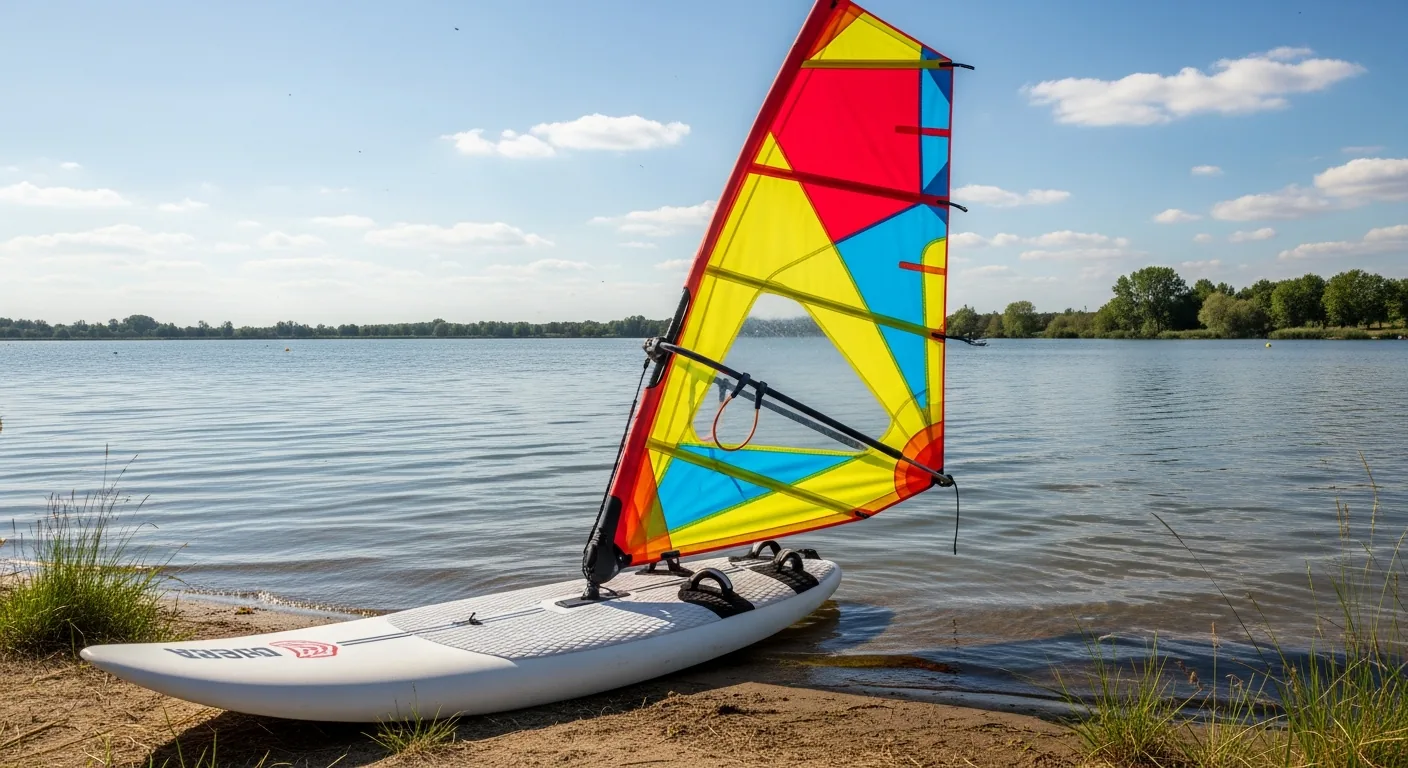
The number-one choice for learning. Wide, stable and with generous volume that lets you stand up from your very first sessions. Freeride boards are forgiving, planing easily and staying stable both upwind and on a reach.
Formula / course (a beginner alternative)
Volume: 180 to 240-plus litres
Width: 90 to 100-plus cm
For whom: heavier riders (over 85 kg), light wind (force 2 to 4)
Even more voluminous and wider than freeride boards, formula shapes are the most stable on the market. Ideal for heavier riders or anyone who often sails in light wind, at the cost of being bulky and awkward in waves.
Freestyle
Volume: 95 to 130 litres
Width: 65 to 78 cm
For whom: intermediate/advanced riders working on tricks
Too small and unstable for a beginner. Freestyle boards are built for manoeuvrability and tricks (loops, spins). Save them for when you have your waterstart and planing dialled.
Wave (avoid as a beginner)
Volume: 70 to 110 litres
Width: 55 to 65 cm
For whom: expert riders in waves
The smallest and most technical boards. A wave board demands excellent rig control and proper surf. Not remotely suited to learning.
The volume rule: how to work out your ideal volume
As a beginner, add 80 to 110 litres to your body weight in kg to get your starting volume; if in doubt, or if you are heavier, aim for the top of the range. For example:
- 60 kg → 140–170 litres
- 70 kg → 150–180 litres
- 80 kg → 160–190 litres
- 90 kg → 170–200 litres
Never skimp on volume. A board with more volume than you strictly need will progress you faster, because it points upwind more readily, sits steadier at the start and drops you in less often. The move to something smaller happens naturally once you're planing regularly.
2. The sail: power and handling
The sail is the engine of your rig. Size is measured in square metres (m²) and chosen to suit the wind and your weight.
4.0 to 5.5 m² sail (recommended for beginners)
Wind: force 3 to 5 (12 to 22 knots / 14–25 mph)
For whom: all beginners, 55–85 kg
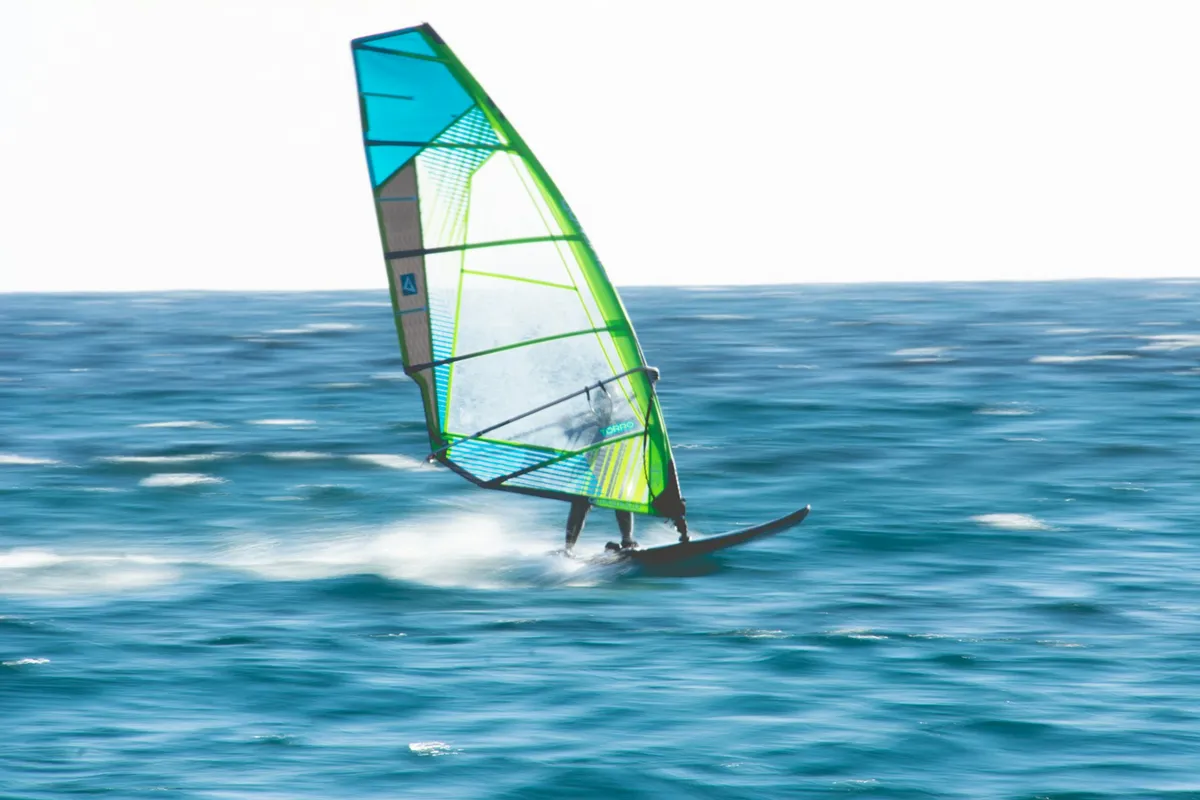
The beginner's sweet spot. Powerful enough to get you moving in a moderate breeze, light enough to be easy to uphaul and control. Battened sails (5 to 7 battens) strike a good balance of power and stability. Look for no-cam or soft-cam freeride sails for ease of use.
5.5 to 6.5 m² sail (light wind / heavier riders)
Wind: force 2 to 4 (8 to 16 knots / 9–18 mph)
For whom: 80 kg-plus, or frequent light-wind sailing
More power for heavier riders or lighter-wind venues, though in a fresh breeze (force 5-plus) they become hard for a beginner to control.
7.5-plus m² sail (avoid as a beginner)
Wind: force 1 to 3 (5 to 12 knots / 6–14 mph)
For whom: experienced riders in very light wind
Too powerful and heavy for a beginner. Hard to uphaul, hard to manage in the gusts and tiring to handle. Start small and work up.
Sail size by weight and wind
| Rider weight | Sail (light wind, 8–15 kn) | Sail (moderate wind, 15–22 kn) |
|---|---|---|
| 55–65 kg | 4.0–4.5 m² | 3.5–4.0 m² |
| 65–75 kg | 4.5–5.5 m² | 4.0–4.5 m² |
| 75–85 kg | 5.5–6.5 m² | 4.5–5.5 m² |
| 85–95 kg | 6.5–7.5 m² | 5.5–6.0 m² |
3. The mast and the boom
The mast
The mast transmits the sail's power to the board. Two main materials:
- Aluminium: fine for starting out. Heavier and less stiff than carbon.
- Carbon / composite: lighter, stiffer and better at transmitting power. An upgrade for later on.
Mast length needs to match the sail. As a rough guide:
- 4.0–4.5 m² sail → 370–390 cm mast
- 5.0–5.5 m² sail → 400–430 cm mast
- 6.0–6.5 m² sail → 430–460 cm mast
IMCS (Indexed Mast Check System): every mast has an IMCS value (16 to 34). Check it against the sail (marked on the leech). Too soft and the sail is unstable; too stiff and the sail sets too flat, with less power.
The boom
Material: aluminium (beginner) or carbon (experienced)
Size: adjustable, compatible with most 4.0–6.5 m² sails
The boom is the frame you hold to control the sail. Aluminium is the way to start, being strong, affordable and perfectly good enough. Check the clamps fit your mast diameter (48 mm is the SDM standard; reduced-diameter RDM masts run about 36 mm).
4. Fins
The fin is fitted under the board and provides directional stability. It has a direct effect on your line, your planing and your handling.
- Freeride fin (recommended): 40 to 55 cm for boards of 180 to 240 litres. A good balance of upwind grip and manoeuvrability, and what most freeride boards come with as standard.
- Race/formula fin: 55 to 70 cm. Longer, with more directional stability upwind but less agile in turns.
- Wave fin: 22 to 35 cm. Built for manoeuvrability in waves and far too small for a beginner board.
Fixing systems: Tuttle Box (the modern standard), Power Box or Deep Tuttle. Check your board and fin match. Most recent freeride boards use the Tuttle Box system.
Don't change the original fin until you have the basics dialled. The fin your board comes with is matched to its volume and width. Only once you're planing regularly should you experiment with smaller fins (more speed) or larger ones (more upwind grip).
5. The wetsuit for windsurfing
Unlike surfing, where you spend a lot of time waiting in the water, windsurfing keeps you moving – uphauling, sheeting in, shifting your weight – so the wetsuit needs to be more flexible, and often thinner, than a surfing suit. In UK water, though, warmth still comes first.
3/2mm steamer (summer: June–September)
Sea temperature: roughly 15–18°C
Brands: O'Neill, Rip Curl, Xcel, Mystic
Even at the height of a UK summer the sea rarely gets truly warm, so a 3/2mm steamer is the sensible standard. On a warm, light day some sailors drop to a shorty.
4/3mm (spring and autumn: April–May, October)
Sea temperature: roughly 10–14°C
Brands: O'Neill, Mystic, Ion, C-Skins
The workhorse for most of the UK season, usually with 3mm boots on the colder days. Choose a suit with stretch panels at the shoulders to keep your arms free.
5/4mm with hood (winter: November–March)
Sea temperature: roughly 6–9°C
Brands: O'Neill, Xcel, Mystic, C-Skins
Essential for winter sailing, with 5mm boots and gloves and, ideally, a hood. You don't fall in as much as when surfing, but spray and start-up dunkings soon chill you. Warmth keeps your sessions safe as well as comfortable.
A good wetsuit is the single best investment for sailing UK waves through the seasons. For windsurfing, put stretch across the shoulders and back ahead of sheer thickness, because you're in constant motion.
6. The essential accessories
The harness
The harness transfers the sail's pull from your arms into your body, cutting arm fatigue by 70 to 80 per cent. Sailing without one in any real wind makes for a short session.
- Seat harness: recommended for learning. More comfortable, it sits low without riding up, and makes the waterstart easier to learn.
- Waist harness: more popular with advanced riders. Less bulky, but less comfortable over a long session.
- Brands: Ion, Mystic, Dakine, O'Neill
The footstraps
The footstraps are built into the board. As a beginner you won't use them for several weeks. They hook your feet in once you're planing and starting on the more advanced manoeuvres.
The uphaul
The cord attached to the mast that you use to pull the sail up out of the water:
- Often supplied with the sail
- Choose one with a padded handle to save your hands
Boots and cold-water extras
For winter sailing on UK waters:
- 3mm boots: enough for a mild autumn
- 5mm boots: for December to March, when the sea is around 6–9°C
- Add gloves and a hood in the depths of winter | Brands: O'Neill, Ion, Mystic
New or secondhand: the case for each
In windsurfing, buying secondhand makes even more sense than in surfing, because the kit is expensive and dates slowly.
Worth buying secondhand
- The board: check for cracks, delamination (bubbles in the sandwich) and the state of the footstraps. Polyester (durable) boards stand up better than lightweight carbon ones.
- The sail: inspect the monofilm (clarity), the stitching and the battens and cams. Avoid a sail with tape on the panels.
- The mast and boom: check the mast for kinks or cracks, and that the boom clamps work properly.
Worth buying new
- The wetsuit: for hygiene and comfort
- The harness: for hygiene and to guarantee a perfect fit
- The uphaul: it's a small item, and a comfortable handle is worth having
Where to find secondhand kit in the UK
- Specialist forums and clubs: the UK windsurfing community (such as club noticeboards and dedicated forums) is a great source of well-kept kit.
- Online marketplaces: plenty of complete rigs turn up secondhand. Always check the condition before you commit.
- Local windsurf shops: some take trade-ins and resell them.
- Windsurf schools and centres: they refresh their kit every couple of seasons and sell on the old stock.
Windsurf brands worth knowing
These are among the most trusted and popular names in windsurfing.
Starboard
A global leader in windsurf boards. A full range covering freeride, formula and wave, with a strong reputation for quality and good resale value.
Fanatic
Excellent all-rounders, especially in freeride and entry-level ranges. Very common on the secondhand market, which makes a first board easy to find.
JP Australia
Board specialists with a strong freeride and freestyle-wave line-up. Well built and widely raced, with a loyal following among improving riders.
Duotone
A leading sail brand with a broad freeride and wave range. Their sails are known for easy handling and a wide wind range, ideal as you progress.
Severne
A sail specialist with strong freeride and wave ranges. Light, easy-handling sails with excellent build quality – a good bet for beginners.
Goya
A respected name in wave and freeride sails and boards, with a reputation for quality and durability that holds its value well secondhand.
See our windsurf hub for complete guides by topic, including our advice on your first sessions, the fundamental techniques and the best UK spots.
Looking after your windsurf kit
Well-cared-for kit lasts 5 to 10 years:
- Rinse with fresh water after every session (board, sail, mast, boom)
- De-rig after every session: don't leave the sail tensioned on the mast (it deforms)
- Dry in the shade: sun degrades the sail's monofilm and the board's resin
- Store flat or on a rack: never stand your board on its end (it distorts the shape)
- Check the footstraps: screws and fittings before every session
- Protect your sail: keep it in its bag, out of sun and damp
- Grease the boom clamps: a little vaseline on the screws and clamp mechanisms
Got your kit? Time to progress. Read our guide to getting started with windsurfing and our advice on the fundamental techniques, and brush up on staying safe in our windsurf safety guide.
❓ Frequently asked questions about windsurf gear
Which windsurf board should a beginner choose?
A wide, stable board of 180 to 240 litres is ideal for learning. Freeride and formula shapes give the best balance of stability and volume. For a 75 kg adult, a wide board (around 80 cm) within the range given by the volume rule in section 1 lets you stand up and sail from your very first sessions.
What sail size does a beginner windsurfer need?
A sail of 4.0 to 5.5 m² is a good starting point. It has enough power in a moderate breeze (force 3 to 4) while staying easy to handle and to uphaul. The ideal size depends on your weight: 55–65 kg needs 4.0–4.5 m², 65–80 kg needs 4.5–5.5 m², and 80 kg-plus needs 5.5–6.5 m².
Should you buy windsurf gear new or secondhand?
Secondhand is well worth considering when starting out, especially for the board and sail, as the kit is durable and slow to date. Check the board for cracks and delamination, and the sail's monofilm and battens. Buy your wetsuit, harness and uphaul new for reasons of hygiene, fit and safety.
What wetsuit do you need to windsurf in the UK?
In UK water, use a 3/2mm in summer, a 4/3mm with boots through spring and autumn, and a 5/4mm with a hood, boots and gloves in winter when the sea drops to around 6–8°C. Because windsurfing keeps you active, prioritise stretch across the shoulders and back.