

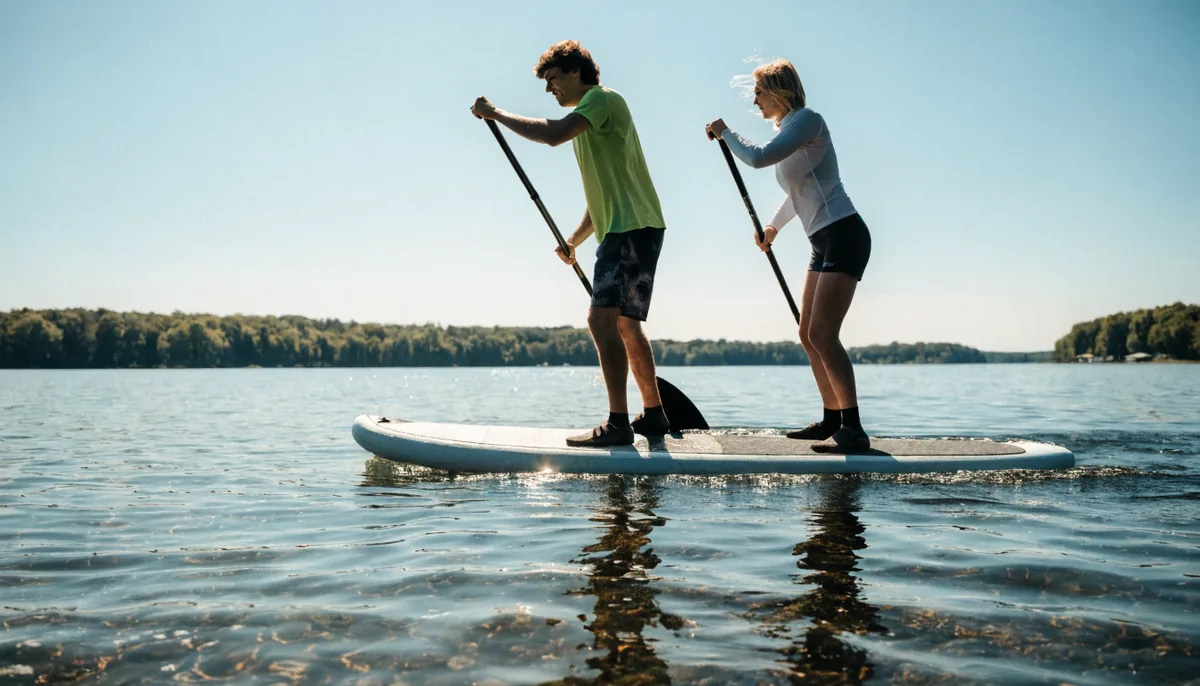
Wider, longer and more stable than a standard SUP, a tandem paddleboard lets two people paddle on a single board. It's a practical format for a couple or a parent paddling with a child, provided you understand what it offers and where it shows its limits.
What is a tandem paddleboard actually good for?
A tandem paddleboard solves one problem: sharing an outing without doubling the kit you have to carry and inflate. It suits a relaxed paddle for two just as well as a parent-and-child trip, or simply solo use by someone after extra stability.
What to check before you buy
Length and width
A tandem board typically runs longer than 3.5m, against 3.2–3.5m for an all-round board. The width stays close to a good all-rounder (about 86cm, or 34in): it is the length, the volume and the maximum load that make the difference. That extra size is essential to carry two people without tipping the balance.
Volume and payload
Apply the volume rule from our paddleboard buying guide (rider weight plus 100 to 150 litres) to the combined weight of both paddlers: for two 80kg adults that means at least 260 to 310 litres. Check the manufacturer's maximum load too, and keep a margin over your combined weight. For wider kit advice, see our guide to SUP kit.
Stability for two
How the weight is distributed matters as much as total volume: it's best to put the lighter paddler at the front and keep a gentle pace at first, while you both find your balance together.
Who a tandem board suits
Couples
This is the most natural use: two adults paddling together, each putting in a share of the work, for a shared outing rather than side by side on two separate boards.
Parent and child
The wide format also works well for paddling with a child sitting or standing at the front. See our guide to paddleboarding with children for the specific safety points to bear in mind.
Occasional group outings
For a holiday or a one-off session with friends, a single tandem board avoids investing in two full boards while still covering most needs.
The limits of a tandem paddleboard
Heavier and bulkier to carry than a standard board, a tandem also loses manoeuvrability and speed when paddled solo. It's not the best format for technical progression or sporty paddling either, where an individual board remains the better choice.
Worth comparing honestly: a two-person inflatable kayak, such as the WattSup COD 2P, gives two paddlers a seated, more stable ride than a tandem SUP and is worth a look if stability matters more to you than paddling standing up — see it at OutletSUP →.
FAQ
Can two people really paddle together effectively?
Yes, as long as you and your partner sync your stroke rate. It takes a short adjustment period, but two co-ordinated paddlers move a tandem board efficiently.
Is a tandem paddleboard more stable?
Yes, the extra width and volume usually give better stability than a standard SUP, particularly at a standstill or paddling slowly.
Can you use it solo?
Yes, a tandem board works fine paddled solo: its extra stability can even reassure a beginner, at the cost of a bit of manoeuvrability.
What size should two adults look for?
Aim for a length of at least 3.5m and a volume of at least your combined weight plus 100 to 150 litres (260 to 310 litres for two 80kg adults), with a maximum load that leaves a margin over your total weight.
Is it a good option for a holiday?
Yes, it's a good compromise for a couple's or family holiday, letting you share one board rather than transport two.