

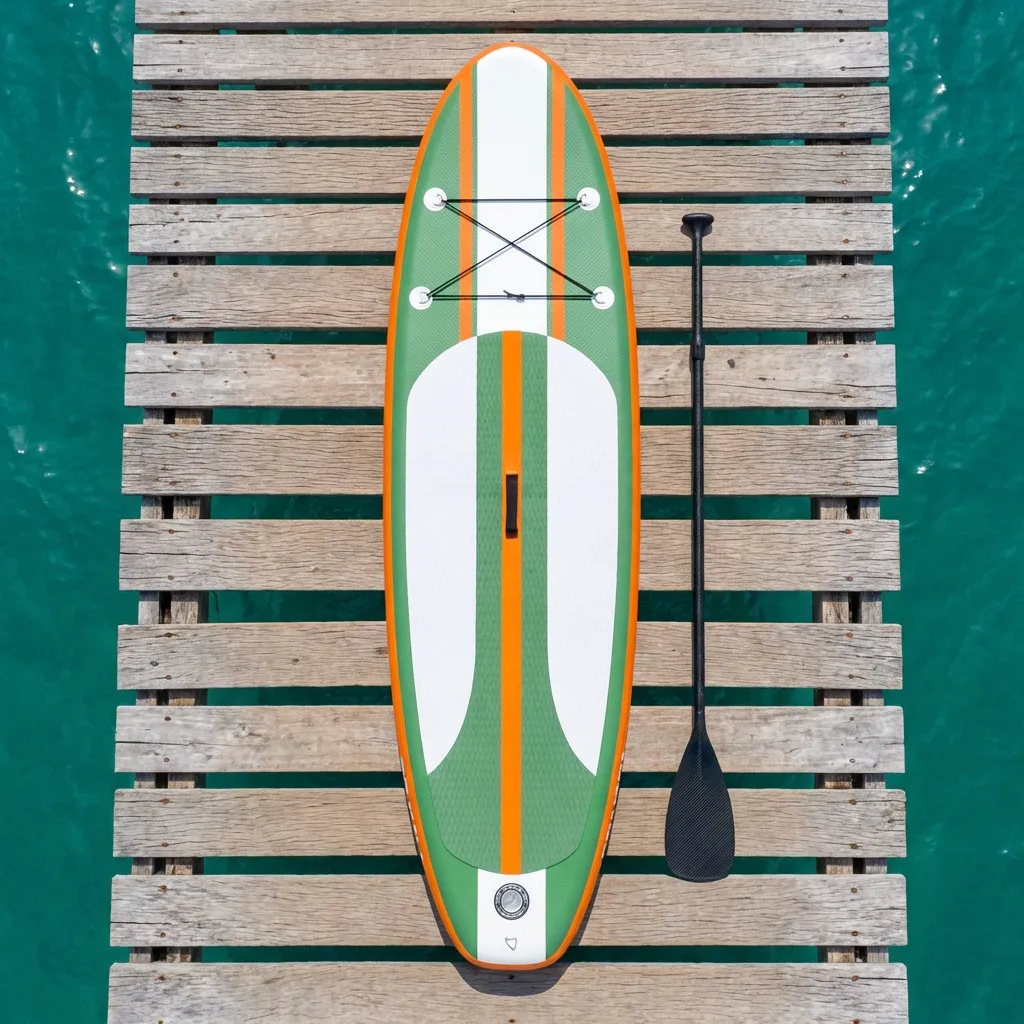
The size of your SUP board is the factor with the biggest impact on your comfort and how quickly you progress. A board that's too small will have you spending more time in the water than standing on it. A board that's too big will be stable but slow and hard to manoeuvre. The right size comes down to three things: your weight, your level, and the type of paddling you're aiming for.
Volume: the number that matters most
Volume, measured in litres, determines how buoyant the board is. The higher the volume, the higher the board sits in the water and the more stable it is. It's the first thing to check before any purchase.
Working out your ideal volume
Work it out like this: ideal volume = rider's weight (kg) plus an allowance based on level.
| Level | Allowance | Example: 75kg rider |
|---|---|---|
| Complete beginner | + 150 L | 225 L minimum |
| Confident beginner | + 120 L | 195 L minimum |
| Intermediate | + 100 L | 175 L minimum |
| Advanced | + 70 L | 145 L minimum |
| Expert / competition | + 30 to 50 L | 105-125 L minimum |
If you're torn between two volumes, always go for the larger one. It's far more frustrating to fight an unstable board than to find your board a little too easy. You can always size down later as you improve.
Width: stability vs speed
Width is measured in inches (1 inch = 2.54cm). It determines the board's side-to-side stability.
Under 30 inches: a narrow, fast board, but unstable. One for competitors and advanced paddlers.
30-32 inches: a good balance of stability and speed. For intermediate paddlers looking to build pace.
32-35 inches: the comfort zone for beginners. Wide enough to stay stable without sacrificing all your speed. It's the width of most all-round SUPs on the market.
Over 35 inches: a very wide, ultra-stable board. Typical of SUP yoga and family boards. You trade speed for maximum stability.
Length: glide vs manoeuvrability
Length affects the board's ability to hold a straight line and its cruising speed.
Under 10': a short, very manoeuvrable but slow board. More geared towards SUP surfing.
10'6" – 11'6": the all-round standard. A good balance of manoeuvrability and glide. Perfect for touring on flat water and leisure sessions.
12'6" – 14': a long board with excellent straight-line glide. For touring, long-distance paddling and competition.
A beginner who only paddles lakes or calm sea doesn't need a board longer than 11'6". The extra length adds nothing in terms of stability and makes the board harder to turn.
Recommended size by profile
| Profile | Length | Width | Min. volume |
|---|---|---|---|
| Light beginner (< 60kg) | 10'0" – 10'6" | 32 – 33" | 200 L |
| Average beginner (60-80kg) | 10'6" – 11'6" | 32 – 35" | 250 L |
| Heavier beginner (> 80kg) | 11'0" – 12'0" | 33 – 36" | 300 L |
| Intermediate (touring) | 11'6" – 12'6" | 30 – 32" | 180-220 L |
| Advanced (touring) | 12'6" – 14' | 28 – 30" | 150-200 L |
| SUP surf | 8' – 10' | 28 – 30" | 120-180 L |
| SUP yoga | 10' – 11' | 34 – 36" | 300+ L |
Two boards at opposite ends of the size spectrum: the compact Skiffo Suncruise 10.2 for average beginners, and the longer Coasto Nautilus 11'8" for touring paddlers — see them at OutletSUP →.
Is a paddleboard that's too big a problem?
No. A board that's a bit big is more stable and easier to get to grips with. It will simply be a little slower and less manoeuvrable. That's a far better trade-off than a board that's too small, which makes paddling impossible and puts beginners off. Most SUP buying mistakes come from an undersized board.
To go further in choosing your SUP, see our guide on how to choose a paddleboard and our comparison of inflatable versus rigid.
FAQ: paddleboard sizing
How do I work out the ideal SUP volume?
Ideal volume = rider's weight (kg) plus 100 to 150 litres for a beginner. Example: 75kg + 150 L = 225 L minimum. An intermediate paddler can go down to +100 L, an advanced paddler to +70 L. The less experienced you are, the more volume you need.
What width of SUP suits a beginner?
Between 32 and 35 inches (81 to 89cm). The wider the board, the more stable it is. Below 30 inches, a board demands good balance and isn't recommended for beginners.
Is a paddleboard that's too big a problem?
No. A board that's a bit big is more stable and easier to get to grips with. It will simply be a little slower and less manoeuvrable. That's a far better trade-off than a board that's too small, which makes paddling impossible.
What length SUP suits touring?
Between 12'6" and 14' for long-distance touring. The longer the board, the further it glides with each stroke and the better it holds a straight line. For outings of 1-2 hours on a lake or calm sea, 11'6" is more than enough.
Does SUP size differ between inflatable and rigid?
No. The dimensions (length, width, volume) are the same whatever the construction type. The difference lies in stiffness and glide, not in size.