

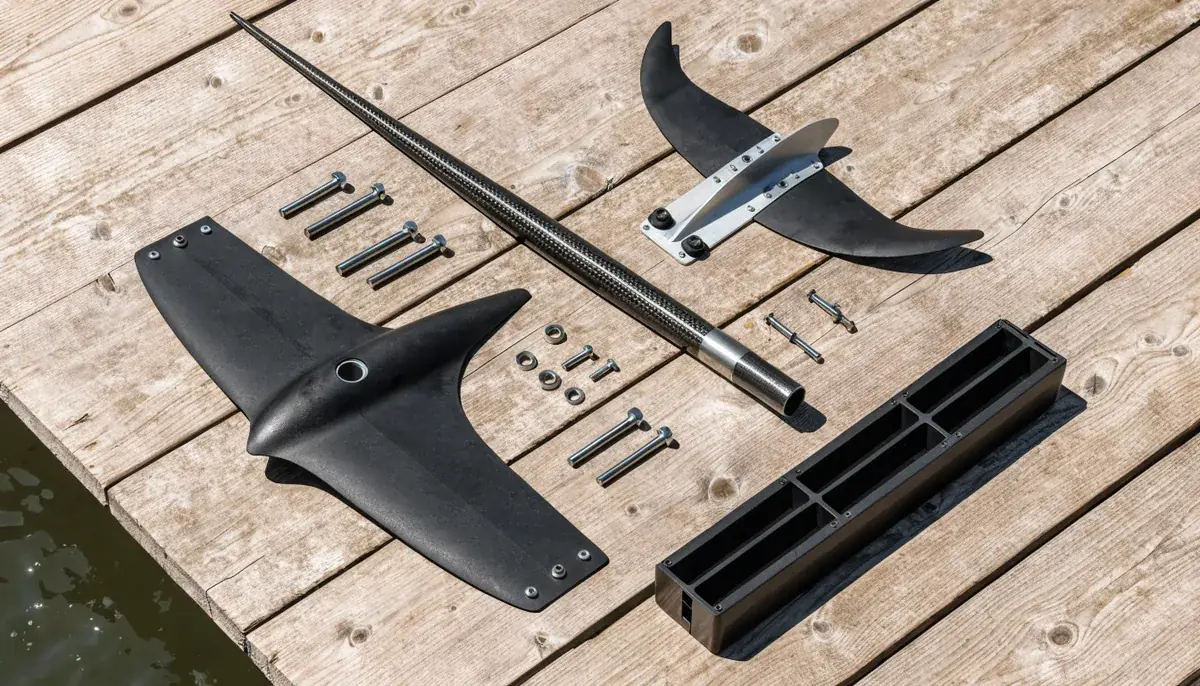
A foil is made up of four parts that shape the whole way it behaves: the front wing, the rear stabiliser, the fuselage and the mast. Sizing them well for your level and discipline makes learning enormously easier. Before you start sizing them, though, it's worth knowing how these components actually generate the lift that gets the board flying – our dedicated guide breaks down the physics.
The criteria common to every discipline
Board volume
To learn, reckon on your body weight plus 20 to 40 litres of volume. An 80kg rider is therefore looking at a board of 100 to 120 litres, depending on whether they wing, surf or kite foil.
Mast length
For a beginner, a mast of 70 to 85cm is the sweet spot: shorter is more forgiving of ride-height errors and softens the impact of 'touch-downs' (the wing brushing the water). As for material, aluminium is heavier but robust and affordable, while carbon is lighter and more responsive, if more fragile and more expensive.
Front wing area
To start, aim for an area of 1,200 to 1,800cm² depending on your size. A big front wing gives lift at low speed and better stability, two things that count for a lot while you learn.
The fuselage
The fuselage links the front wing to the rear stabiliser. A long fuselage adds stability (ideal for learning); a short one favours manoeuvrability for more experienced riders.
What changes with the discipline
| Discipline | Front wing | Mast | Fuselage | Board |
|---|---|---|---|---|
| Wing foil | 1,500–1,800cm² | 70–85cm | 70–75cm | Weight + 30–40L |
| Surf foil | 1,500–2,000cm² | 60–75cm | 70–80cm | Weight + 20–30L |
| Kite foil | 1,200–1,500cm² | 80–90cm | 65–75cm | 100–140L |
Wing foil
Wing foil adds a handheld inflatable wing on top of the foil: 4 to 6m² depending on your size and the wind for a beginner.
Surf foil
Surf foil needs very high-lift front wings (often above 1,500cm²) to make the most of the energy in soft, gutless waves.
Kite foil
Kite foil lets you run smaller front wings and longer masts (90cm and up) to favour speed, since the kite provides the power.
Aspect ratio: a key idea to grasp
Aspect ratio (AR) is the relationship between the wing's span and its width. Short and wide (a low AR) means the foil lifts off early and holds a steady line sideways, which is what you want while you're learning. Long and thin (a high AR) carries its glide much further and goes faster, but it asks more of the rider.
Brands to look at: Armstrong, F-One, AFS and Gong build complete, modular foil systems, while Duotone and North are strong choices on the wing side. Whatever the badge, size the parts to your weight and level first, and buy into a system you can grow with rather than chasing the lightest, highest-aspect wing.
FAQ
What is the difference between wing foil, surf foil and kite foil gear?
Wing foil uses a high-volume board and a handheld wing. Surf foil uses a small board and draws its energy from the wave. Kite foil uses a very small board towed by a kite, with smaller, faster wings.
Aluminium or carbon mast?
Aluminium is heavier but cheaper and more robust, which makes it ideal for learning. Carbon is lighter, stiffer and more responsive, but more fragile and more expensive.
Why choose a short mast to start?
A short mast (70 to 80cm) limits how far you fall, reduces the leverage on the board and is more forgiving of pitch errors (porpoising).
What is the aspect ratio of a foil wing?
It's the ratio of the wing's span to its width. A low ratio is stable and lifts at low speed; a high ratio glides for longer and goes fast, but asks for more technique.
What board volume for a 75kg wing foiler?
To learn in comfort, a board of around 105 to 115 litres is recommended, that's the rider's weight plus 30 to 40 litres. See also our foil safety guide and our beginner's guide.