
Foiling carries risks the other board sports simply don't: sharp edges under the water, speed that builds fast and a blade that's invisible from the surface. A few simple rules let you ride with real confidence. This is honest safety advice, because the foil deserves respect.
Why foiling demands extra care
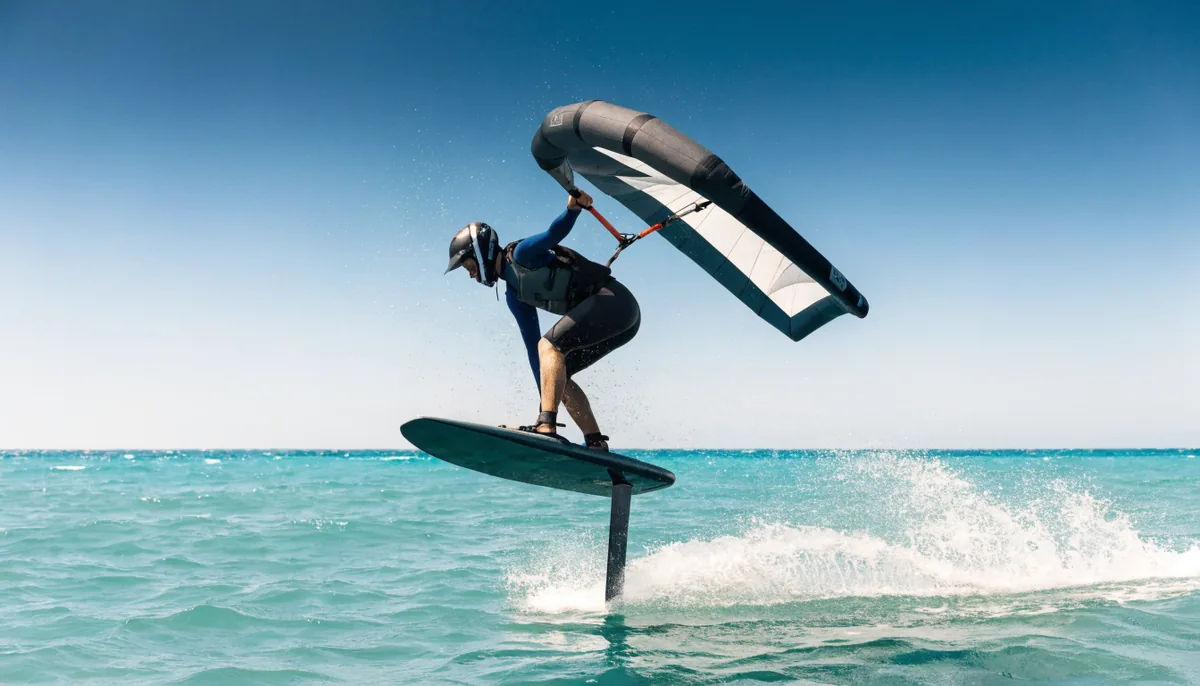
The wings and mast have very thin, sharp trailing edges that can cause deep cuts in a collision. A foil can also carry real speed – over 25 mph in wing foil and beyond 35 mph in kite foil – which makes any impact potentially serious. This is demanding kit that warrants proper protective gear.
The protective kit we recommend
The helmet
A helmet isn't legally required for recreational foiling, but professionals and schools recommend one without exception, because it dramatically cuts the risk of a head injury in an impact with the board or the foil.
The impact vest
An impact vest or 50-newton buoyancy aid protects your chest and ribs in falls onto the water or onto the kit. It also adds useful flotation while you learn.
Boots and leash
Neoprene boots protect your feet from cuts when handling the kit in the water or on the beach. A leash (often a coiled one) is essential so you don't lose your board, which drifts away fast in any wind.
Treat the foil as sharp, because it is. Handle it slowly, keep your body upwind of it, and never let anyone stand on the downwind side of your board on the beach.
Minimum water depth
Always allow at least 1.5 metres of water to foil in. A standard mast is 70 to 90cm long, so you need margin to avoid catching the bottom, especially where there are waves.
Handling your kit safely
Always carry your board under your arm with the foil pointing into the wind (upwind), so that a gust catches the board and blows it away from you rather than into you.
What to do in a wipeout
The golden rule of a wipeout is to push yourself as far from the board as you can. Never grab at it to save the fall, and never try to steer where you land – getting clear of the kit and the foil's wings comes before everything else.
In any coastal emergency in the UK, dial 999 (or 112) and ask for the Coastguard. Give your exact location, the number of people in trouble and the casualty's apparent condition.
Sharing the water
Foilers are usually faster than everyone else in the water, and the foil is a hidden hazard, so the responsibility to keep clear sits with you.
⛔ Keep clear of swimmers
Never foil near swimmers, bathers or other water users – a wing tip travelling at speed does the damage of a blade, and nobody on the surface can see it coming. Steer well clear of the RNLI red-and-yellow bathing area at all times, as that zone is for swimming only.
🔹 Use the right zone and launch away from people
On lifeguarded beaches, non-powered craft belong in the black-and-white chequered flag zone, not the swimming area. Launch and land well away from other people, give way to slower users (swimmers, SUP, human-powered craft), and check the orange windsock for an offshore wind that could blow you out to sea.
Getting the kit right matters for safety too. See our guide to foil gear to choose a forgiving setup, and our beginner's guide for a safe path to your first flights.
FAQ
Is a helmet compulsory for foiling?
It's not legally required for recreational foiling, but schools and experienced riders regard it as essential.
How much water depth do you need to foil?
Always allow at least 1.5 metres of water. A standard mast is 70 to 90cm long, and you need margin for waves and safety.
How do you carry your foil safely on the beach?
Always carry the board under your arm with the foil pointing into the wind, so that if a gust catches it, the board is blown away from you rather than into you.
Can you foil near swimmers?
No. The foil acts like a blade under the water, invisible from the surface. Keep well clear of the RNLI red-and-yellow bathing area, and launch and land away from other water users.
What should you do if you lose your balance in flight?
Don't try to save it. Push yourself away from the board, as far as you can, to avoid landing on the foil's wings.