

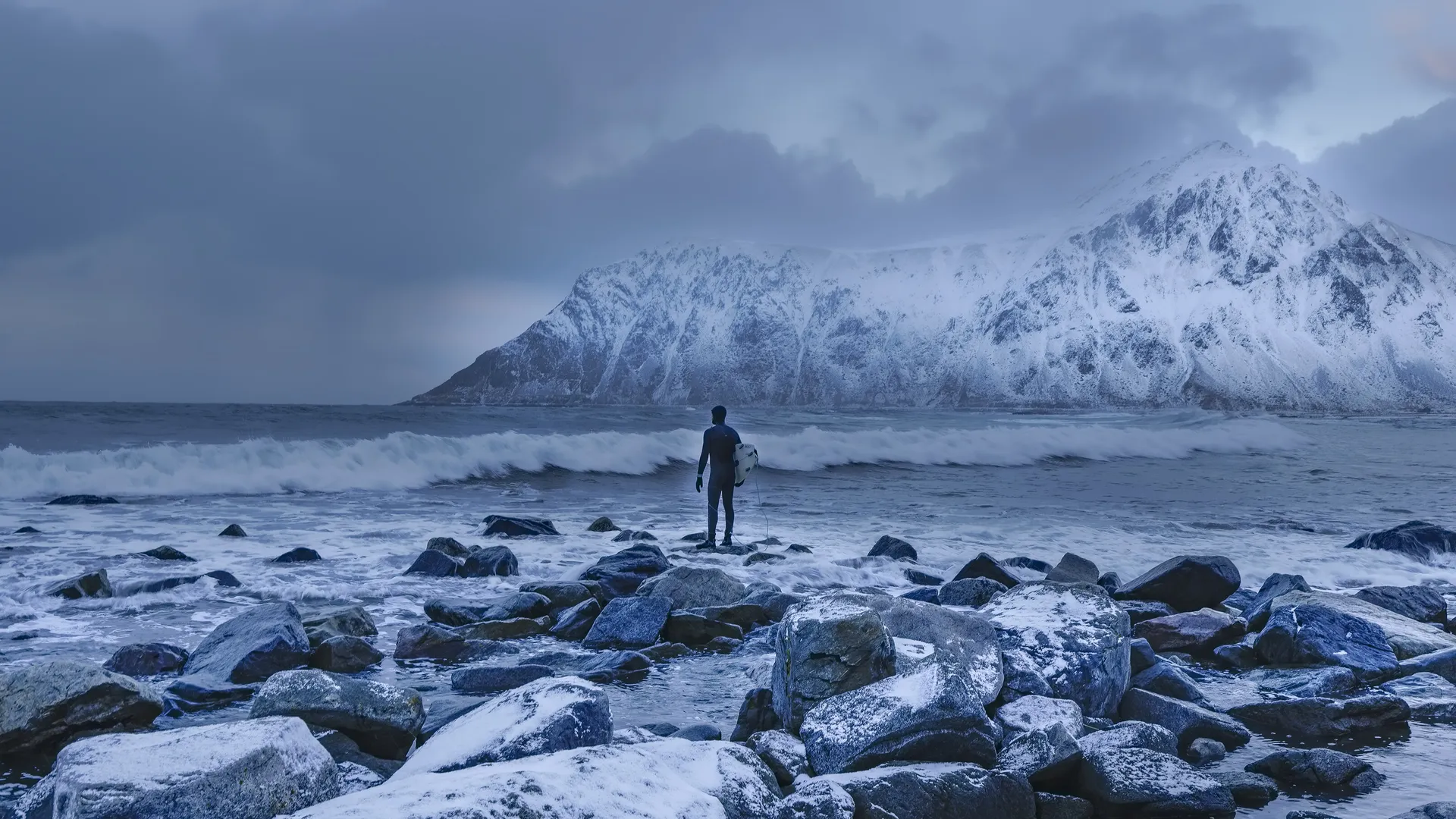
📍 Norway, Lofoten and Jæren
Photo: Lofoten Islands, February 2024 – Scosse / Wikimedia Commons, CC BY 4.0, cropped
Norwegian surfing happens in two main places a long way apart: the Lofoten Islands, above the Arctic Circle, and the Jæren coast just south of Stavanger. They differ in light, access, rules and how cold the sea gets, so pick the region before you pick the dates.
Unstad's point breaks draw experienced surfers in autumn and winter; Flakstad, just to the west, is the gentler beach. Remote, dramatic, and dark in midwinter.
Lofoten arrow_forward
Long sandy beaches and boulder points a short drive from Stavanger Airport, with a surf school at Bore and a winter surf ban in the bird-protection areas.
Jæren arrow_forward
The sea drops to around 4-5°C in a Lofoten winter. At sea, Norway's coast radio answers on 120; 112 is the police.
Safety and rules arrow_forwardThe essentials before you book, and what we couldn't pin down.
Two neighbouring bays on the outer coast of the islands, one for experienced surfers on its best days, one for learning.
Lofoten's surf comes from storms in the Norwegian Sea. According to Arctic Norway, the regional tourist board, surfing reached Unstad in 1963, when local men who had gone to sea tried it in Australia and came home to make boards in woodwork lessons at the local school. It stayed a pastime until the 1990s; Visit Lofoten links the change to better wetsuits, which made the cold water surfable.
At the end of the road at Unstad, on Vestvågøy, about 23 minutes' drive from Leknes, a long sandy beach is flanked by a right and a left point break over a stony bottom, as Visit Lofoten describes it. The left is the wave that draws surfers from around the world. In summer the waves are generally gentle and suit beginners; from autumn the bay produces what Visit Lofoten calls some of the best waves in northern Europe. Arctic Norway is clear that on the toughest days Unstad is only for capable surfers.
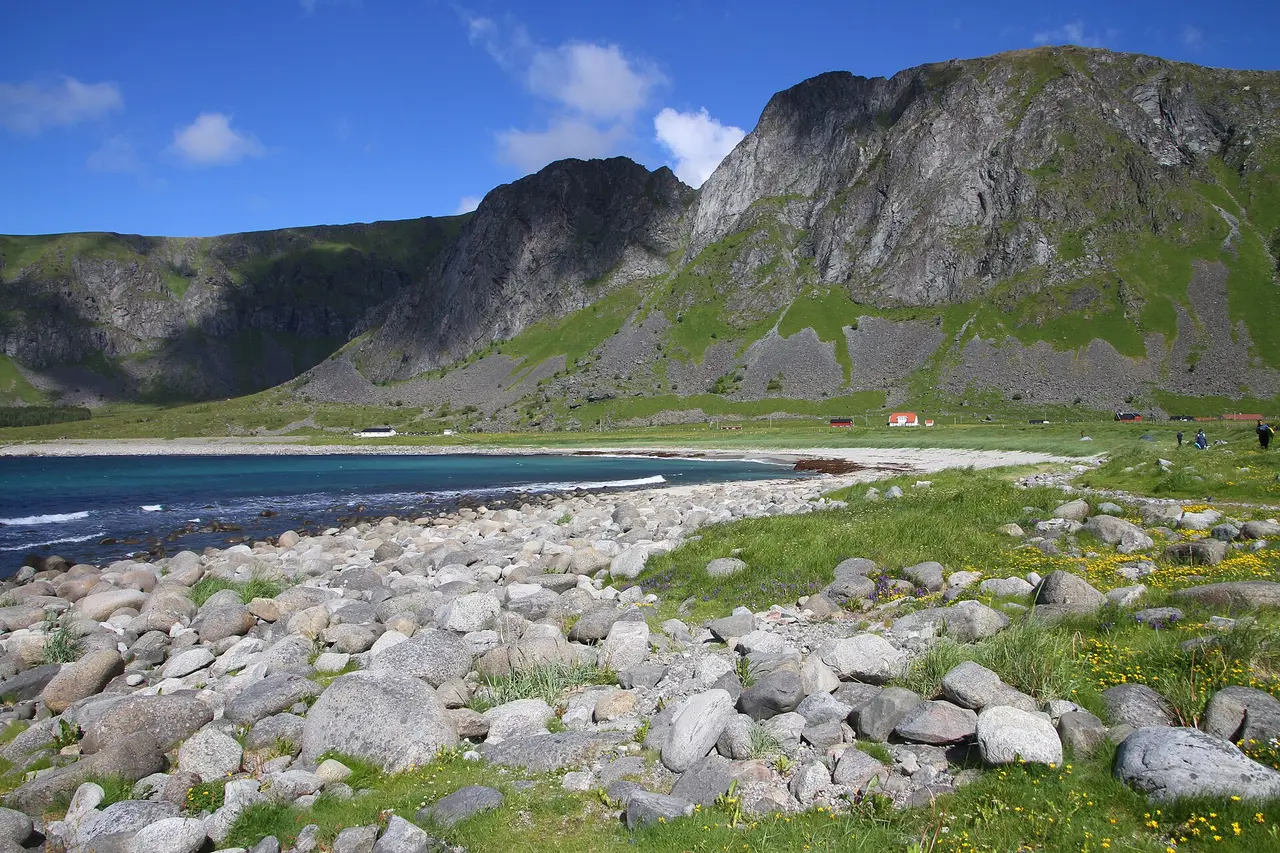
Unstad Arctic Surf is the operator on the beach. Visit Lofoten lists accommodation for up to 55 people, a café and restaurant, rentals, a surf school and a sauna. Its small-group beginner lesson, as listed on Visit Norway, takes up to six people (minimum two), lasts about three to four hours with all equipment included, and has its start time confirmed 24 hours ahead because of the tides. Arctic Norway adds that it takes beginners to Flakstad when Unstad is too much.
View Unstad on Google Maps open_in_newA little further west, between Leknes and Reine, Flakstad is a sandy beach for beginners and intermediates, with waves that are often smaller than Unstad's. Lofoten Beach Camp runs surf courses for all ages and rents boards there, along with summer camping and a beach bar; the camp describes Flakstad as a safe beach without rocks or currents. Conditions still change with the swell, so ask before you paddle out.
View Flakstad beach on Google Maps open_in_newVisit Lofoten puts the most powerful swells between September and April. Summer has longer gaps between swells and smaller waves, but warmer water and the midnight sun, which Visit Lofoten dates from 28 May to 14 July (it varies a few days from place to place). The other end of the year is the polar night: a sunrise and sunset table for Leknes gives no sunrise from 9 December to 4 January, and only about three hours between sunrise and sunset by mid-January. Visit Norway's own warning is worth repeating: conditions are not world class every day, and storms and rough weather are common. Mid-winter air is below freezing with snow on the ground.
Norway's most commercialised surf coast, a protected landscape with its own seasonal rules.
The Jæren coast runs about 70 km from Tungenes in the north to Sirevåg in the south, around 25 km of it sandy beach and the rest stone and moraine shore, according to Fjord Norway. Visit Norway describes surf ranging from gentle beaches for beginners to boulder points for advanced surfers, calls it the most commercialised surf area in Norway, and notes that it hosted Eurosurf, the European surfing championship, in 2017 and 2018. Large parts of the coast are a protected landscape with bird and plant protection areas, and that shapes when and where you can surf (see the rules below).
Borestranden, in Klepp, is a 3 km beach that Visit Norway counts among the best surf beaches in the country. You can surf it all year; summer tends to be less windy with smaller waves, which suits beginners, while autumn and winter suit more experienced surfers. The same listing warns that the undercurrents here can be extremely strong. It is also the only Jæren beach with a hotel and a campsite. Bore Surf Senter, on the beach, runs beginner courses, courses for more experienced surfers and equipment hire, and its beginner course promises a free second course if you don't stand up the first time.
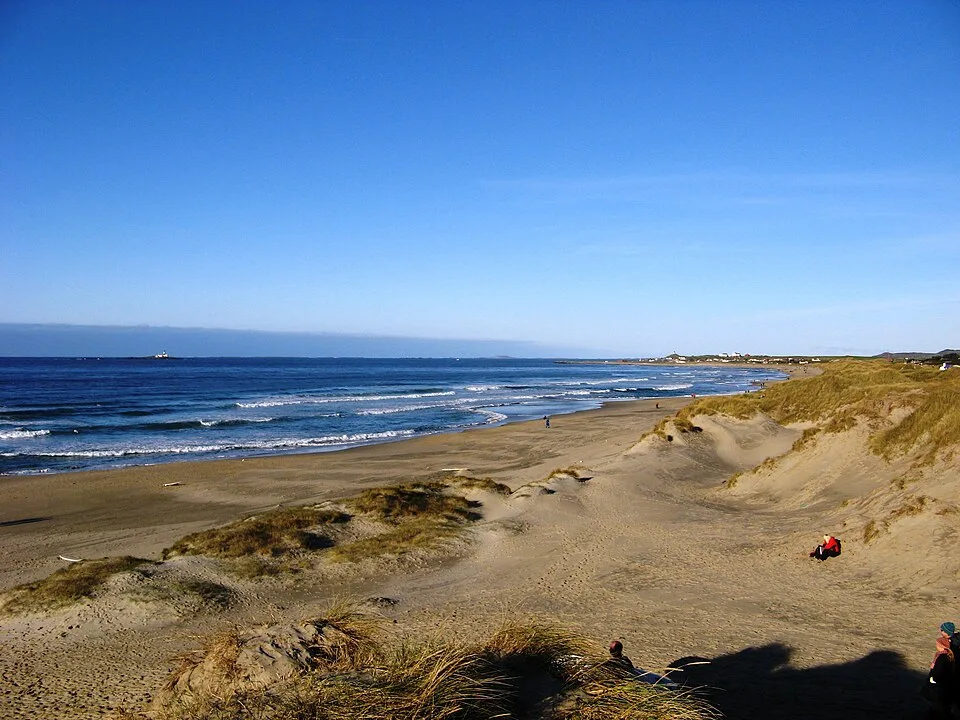
A travel guide on Finn.no suggests Sola, Bore, Brusand and Hellestø for a first go, in summer and early autumn, and names spots such as Boblå and Pigsty for experienced surfers. Hellestø lies south-west of Stavanger Airport at Sola. Orrestranden, in the middle of the coast, is one of the long sandy beaches, and the visitor centre at Orre explains the protected beaches. We haven't described each beach's wave in detail: the sources we read don't, and a beach break here changes with every storm.
View Borestranden on Google Maps open_in_newFjord Norway says kiting is allowed only at five beaches: Sola, Hellestø, Byberg, Bore and Brusand. Bore Surf Senter runs a weekend beginner kitesurfing course and is open about what it can do: not everyone gets up on the board in two days. Our kitesurfing guide covers the basics before you book.
A third, smaller surf area on the Nordfjord coast.
Between the two main regions, the Stad peninsula in Nordfjord has its own scene. Visit Norway says most of the waves are at Ervikstranda, a sandy beach open to south-west and north-west swells, and that Hoddevik, 20 to 30 minutes south, has clear water framed by 300-metre mountains. We haven't researched Stad in depth, so treat this as a pointer rather than a guide.
Daylight, water and the Jæren winter ban, month by month.
Choose Lofoten for the Arctic setting and, if you're experienced, Unstad's autumn and winter swells, accepting two flights or a long ferry, short days in winter and colder water. Choose Jæren if you want an easy trip from the UK (direct flights to Stavanger, beaches a short drive from the airport), learning in summer, or slightly warmer water; just remember the bird-protection areas close to surfing from October to March.
| Months | Water near Lofoten (Leknes) | Water off Stavanger | What to know |
|---|---|---|---|
| Jan-Mar | about 4-5°C | about 5-6°C | Lofoten swell season; no sunrise at Leknes until 4 January. Jæren bird-area surf ban in force. |
| Apr-May | about 4-6°C | about 6-9°C | Lofoten swells tail off after April. The Jæren ban ends on 31 March. |
| Jun-Aug | about 9-13°C | about 12-16°C | Smaller waves, the best time to learn. Midnight sun in Lofoten from 28 May to 14 July. |
| Sep-Oct | about 10-12°C | about 12-15°C | Autumn swells return. Jæren bird-area ban starts on 1 October. |
| Nov-Dec | about 7-8°C | about 8-10°C | Lofoten swell season; the sun stops rising at Leknes from about 9 December. |
The water figures are monthly averages over the past ten years from seatemperature.info, a site that combines satellite data with observations; it isn't an official series, and Leknes is the nearest data point to Unstad rather than the beach itself. Lofoten's swell months come from Visit Lofoten, the daylight dates from Visit Lofoten and a Leknes sunrise table, and the Jæren ban from the protection regulation described below.
Thick neoprene, and a warm place to change.
For a Lofoten winter, Visit Lofoten recommends a 6/5mm wetsuit with 7mm gloves and boots, which the surf schools and rental outlets can supply. It also suggests changing somewhere warm, indoors or in a heated car, so you don't start the session cold, and keeping moving on the beach if you chill. Visit Norway says wetsuits, boots and gloves are a must for winter surfing in Norway generally. We found no official wetsuit advice specific to Jæren; with the sea around 5°C in late winter and 16°C at its warmest in August, plan your kit on the same cold-water logic. Our wetsuit guide explains the thicknesses.
Two flights to Lofoten, one to Jæren.
The quickest way to Unstad is to fly to Bodø and change to a Widerøe flight to Leknes, the airport for the western islands; Widerøe also flies Bodø to Svolvær, better placed for the east. Leknes Airport is about 1 km from the town centre, with taxis but no buses, according to its Wikipedia entry, so a hire car or taxi covers the last 23 minutes to Unstad. Visit Lofoten also lists Harstad/Narvik Evenes, 170 km from Svolvær, as another way in. By sea, Torghatten Nord's car ferry crosses from Bodø to Moskenes in roughly three to three and a half hours.
Stavanger Airport, Sola sits about 11 km south-west of the city, and Hellestø beach lies just south-west of the airport. Its route list includes London Gatwick and Manchester (Norwegian) and Aberdeen (SAS and Widerøe); routes change, so check before you book. From the airport the beaches run south along the Nasjonal turistveg Jæren, the national scenic route along the coast.
Norway is outside the EU but inside the Schengen area. The FCDO says British travellers can stay without a visa for up to 90 days in any 180-day period across Schengen, that your passport must have been issued less than 10 years before you arrive and be valid for at least 3 months after you leave, and that the EU's Entry/Exit System is being rolled out at Schengen borders. Check the FCDO's Norway page before you travel.
Norway's own rescue service, numbers and access rules.
Norway splits its emergency numbers by service. Sjøfartsdirektoratet, the Norwegian Maritime Authority, prints them in its 2025 paddling leaflet as 110 fire, 112 police, 113 ambulance and 120 coast radio (Kystradio); Store norske leksikon lists 120 as the number for incidents at sea. 112 also works as the common European emergency number. VHF channel 16 is the international distress channel if you're with a boat that carries a radio.
Search and rescue is co-ordinated by Hovedredningssentralen, the Joint Rescue Coordination Centres, in Bodø and at Sola near Stavanger. The dividing line between them is the 65th parallel, so Lofoten falls to JRCC Bodø and Jæren to JRCC Stavanger. HRS describes a co-operative model in which government agencies, volunteer organisations and private companies contribute. The best-known volunteer at sea is Redningsselskapet, the Norwegian Society for Sea Rescue, which has 58 rescue boats at 50 locations along the coast and on two lakes. We found no lifeguard service described for Unstad or the Jæren beaches, so don't assume one.
The Jærstrendene protection regulation (FOR-2003-12-12-1675, last amended 2013) bans bølgjesurfing (wave surfing) and seglbrett (windsurf boards), along with jet skis and other water motorsports, in the sea areas of the bird-protection areas from 1 October to 31 March (§ 3 B, point 6 d). Those areas reach 500 m out to sea (§ 1, point 7 c) and include the stretches named Sandebukta–Børaunen–Einersvika in Randaberg, Rott and Håsteingruppa in Sola, Reve hamn–Orre and Vik–Skeie in Klepp, and Nærlandssanden–Obrestad, Øyrvika and Raunen in Hå. The exact boundaries are on the regulation's maps, so check the signs at the beach. The regulation itself doesn't mention kiting; Fjord Norway's visitor information includes kiting in the winter ban too. The same regulation bans motor vehicles on land in the landscape area and camping or tents in the dunes.
Norway's Small Boats Act (småbåtloven, § 23 a) requires everyone in a leisure boat under 8 metres to wear suitable flotation when outside on deck and the boat is under way. The Act defines a leisure boat broadly, as any floating device intended for and capable of moving on water, but we found no official source saying whether that reaches a surfboard, kiteboard or SUP, so we don't draw a conclusion. Sjøfartsdirektoratet's paddling advice, written with the Norwegian paddling federation and Redningsselskapet, is plain for SUP: always wear an approved buoyancy aid. We found no national rule written specifically for surfing.
Norway's right of access, allemannsretten, set out in the Outdoor Recreation Act (friluftsloven), lets you walk and stay on uncultivated land, and the Norwegian Environment Agency (Miljødirektoratet) counts beaches as such land. You can pitch a tent at least 150 metres from the nearest inhabited house or cabin and stay up to two nights in the same place, longer in the mountains or far from settlements. Local rules come on top: at Jæren, the protection regulation bans tents in the dunes and in the bird-protection areas. Municipalities manage access locally, so look for signs at Unstad and Flakstad too.
For the general principles of rips, cold water and surf etiquette, see our surf safety guide.
What surfers ask most before a trip.
Unstad in Lofoten is the best-known wave, a pair of point breaks that come alive with autumn and winter swells. Flakstad next door is the beginners' beach. In the south, the Jæren beaches near Stavanger, with Borestranden among the best known, are the easiest to reach from the UK.
September to April for the most powerful swells, according to Visit Lofoten; summer for smaller waves, warmer water and the midnight sun. Around the turn of the year the sun doesn't rise at Leknes for nearly four weeks.
Around Lofoten, roughly 4-5°C in late winter and 13°C in August; off Stavanger, around 5°C and 16°C. For a Lofoten winter, Visit Lofoten recommends a 6/5mm suit with 7mm gloves and boots.
Yes, mostly in summer. Flakstad in Lofoten and beaches such as Bore, Sola, Brusand and Hellestø at Jæren are suggested for first sessions, and Unstad Arctic Surf, Lofoten Beach Camp and Bore Surf Senter all teach beginners. Take a lesson: the water is cold, and Visit Norway warns of extremely strong undercurrents at Bore.
Not in the bird-protection areas: surfing and windsurfing are banned in their sea areas from 1 October to 31 March. Elsewhere on the coast the regulation doesn't stop you, but check the signs, since the zone boundaries are set on maps.
120 reaches Norway's coast radio for emergencies at sea; 112 is the police, 113 an ambulance and 110 the fire service. Rescue at sea is co-ordinated by the Joint Rescue Coordination Centres in Bodø and at Sola.