

📍 Ibiza and Formentera, Balearic Islands
Two islands, one channel between them, and a very varied offer: advanced-level kite and wing foil in southern Ibiza, beginner-friendly conditions in its bay, and turquoise water that's calm almost year-round in Formentera.
Southern Ibiza mostly gets garbí (south-west) and llevant (east), with more ground swell on llevant days. The tramontana blows from land out to sea at Es Cavallet, making it the direction that calls for the most caution in the area.
See destinations arrow_forward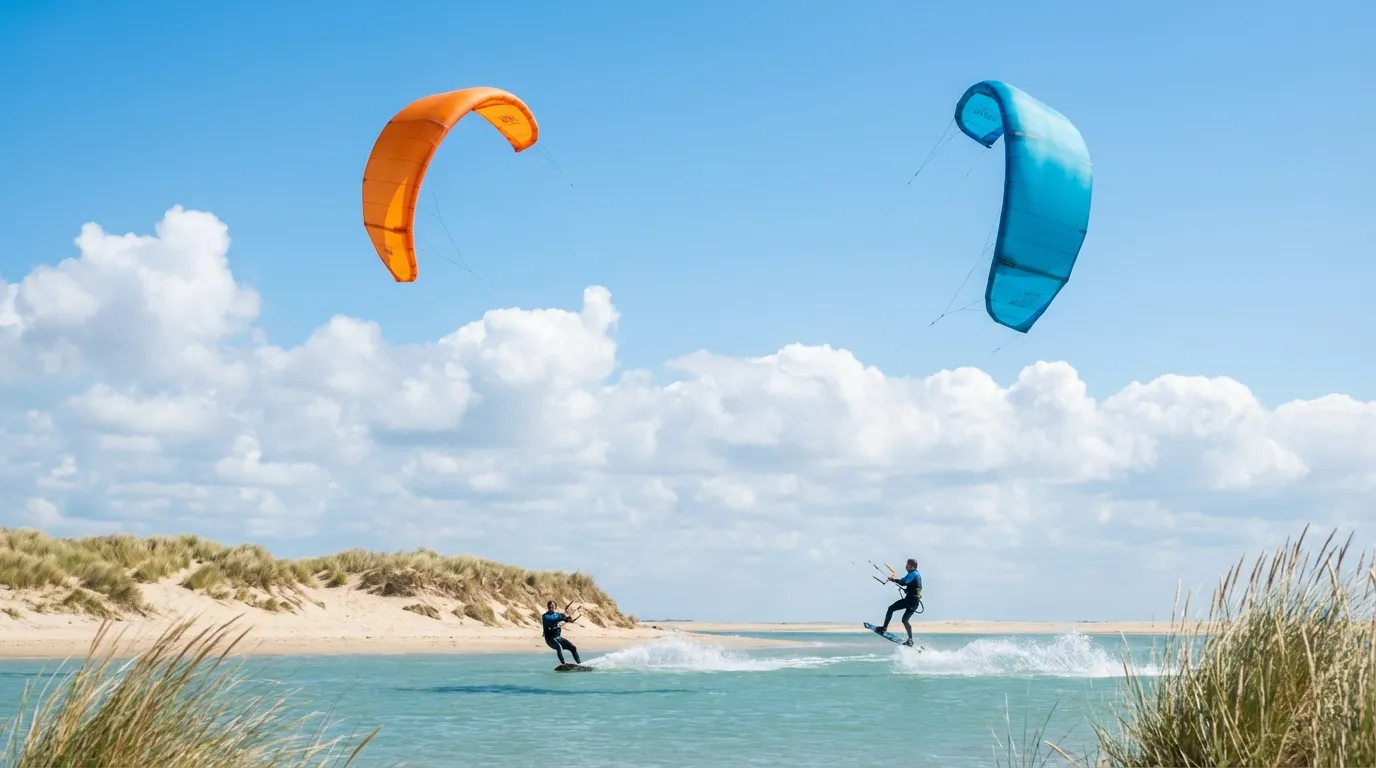
Ses Salines, Es Cavallet and Cala Martina hold the highest-level kite and wing foil; Talamanca is the calm bay for SUP, kayak and light sailing; and in Formentera, Ses Illetes and Migjorn are the go-to spots for paddle boarding on flat water.
Kitesurfing guides arrow_forward
Ses Salines and Es Cavallet sit inside a natural park: anchor only in marked sand zones, use the marked channels to enter and exit, and respect the kite restrictions in bathing zones. In an emergency, call 112 or Salvamento Marítimo (900 202 202, VHF channel 16).
Water safety arrow_forwardHow the wind blows, what the water's like, and which wetsuit to pack.
Es Cavallet and Ses Salines, neighbouring beaches separated by the small es Codolar spit, inside a natural park with its own regulations; Cala Martina, a little further north, in Santa Eulària.
Es Cavallet is the best-known kite and wing foil beach in southern Ibiza, with open space and easy access from the car park. The garbí (south-west) usually brings the cleanest conditions, blowing onshore from the sea; the llevant (east) also works, though with more ground swell that can complicate the water start for beginners. The tramontana (north), on the other hand, blows offshore on this stretch of beach: it's the trickiest direction, because a gear failure will carry you away from the coast quickly — avoid it unless you have experience or ride with boat support.
View on Google Maps open_in_new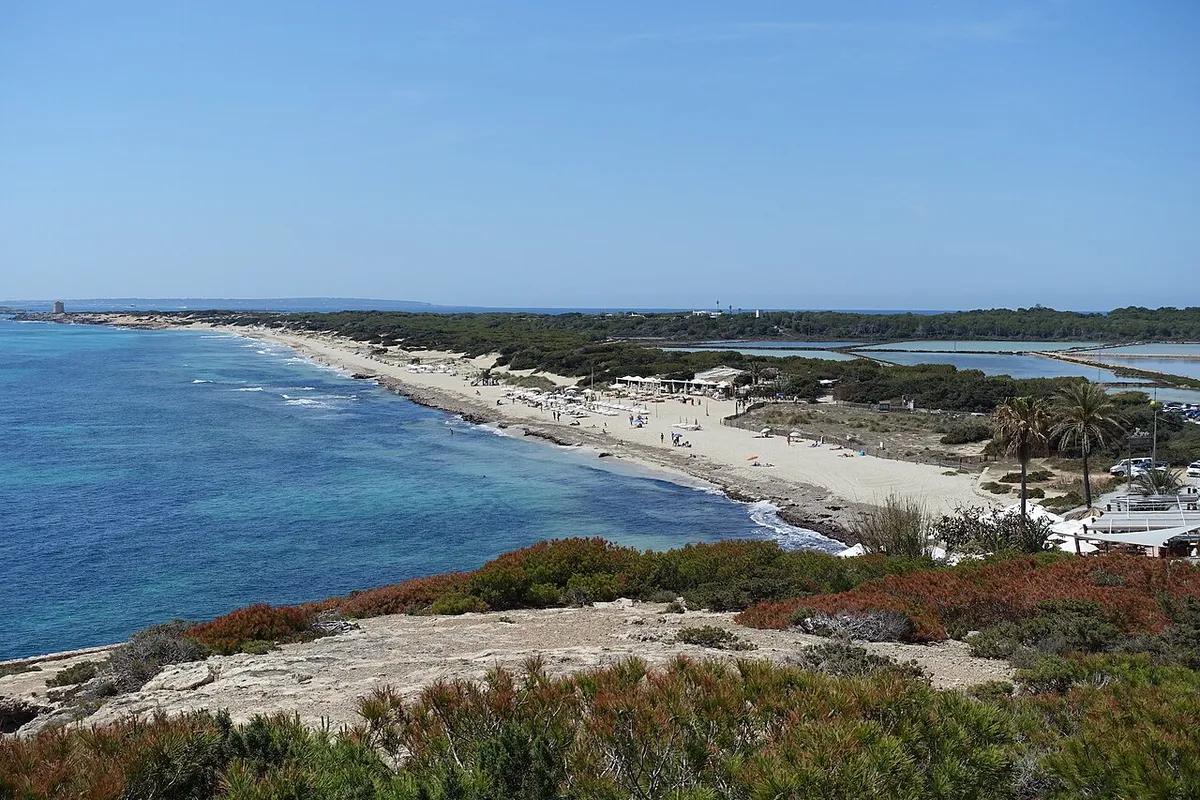
Ses Salines is the neighbouring beach to the north, a little more sheltered by the terrain, with a marked anchoring zone for pleasure boats near the fitted-out buoys. It shares the same wind pattern as Es Cavallet, but being closer to the village of Sant Jordi and the old salt ponds, it tends to see more bather traffic at the height of summer, which limits the space available for kiting even further at that time of year.
View on Google Maps open_in_newCala Martina, in the municipality of Santa Eulària des Riu, is another reference spot for kitesurfing and wing foiling in Ibiza. The garbí (south-west) arrives clean and the water stays relatively flat, as both Spain's official tourism portal and a specialised kite guide to the island agree. It's a small beach with heavy occupancy in high season, suitable for beginners with a school and for confirmed riders on their own, though it's worth checking the available space and any seasonal restrictions on site before rigging up.
View on Google Maps open_in_newFrom 1 May, once the bathing season is under way, Balearic regulations ban flying a kite within 200 metres of shore in bathing zones. In practice, that rules classic kitesurfing out at Es Cavallet, Ses Salines and Cala Martina for much of the summer, and it's why many local riders switch to wing foiling, which needs far less bather-free space and has become the dominant wind sport on the island between May and September. Outside that window, from October to April, kiting is free to run again and the area regains its reputation among kitesurfers who travel to Ibiza outside peak season.
A short walk from the centre of Ibiza Town, with a much gentler breeze than the south coast.
Talamanca occupies a bay of about 900 metres on the other side of Ibiza Town's harbour, facing Dalt Vila: shallow, sheltered from strong winds and with a gentler south-component breeze than on the south coast, as the Ajuntament d'Eivissa itself describes — it also notes lifeguard cover in summer and nearby sailing schools. It's above all a bay for SUP, kayaking and light sailing, and also sits close to a valuable posidonia reef. The reduced swell and gentle breeze also make it manageable for beginners taking their first windsurfing or wing foiling lessons, with a school based right on the beach that has worked in the area for years.
View on Google Maps open_in_new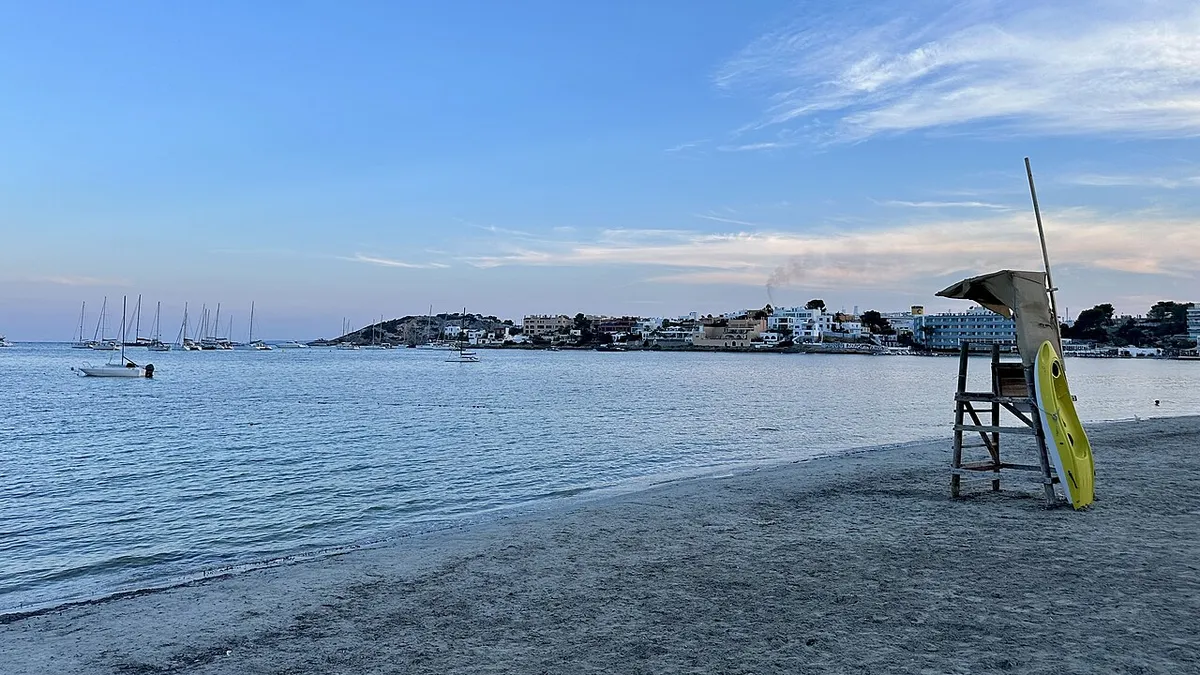
Once you're comfortable at Talamanca, the logical next step is to try Es Cavallet or Ses Salines when the garbí is settled, or cross to Formentera for a day of paddle boarding in turquoise water. Having such different spots so close together on one island is one of Ibiza's big advantages over other Mediterranean wind destinations.
A 30-minute ferry ride from Ibiza, the smallest of the Pitiusas islands holds some of the clearest water in the Mediterranean.
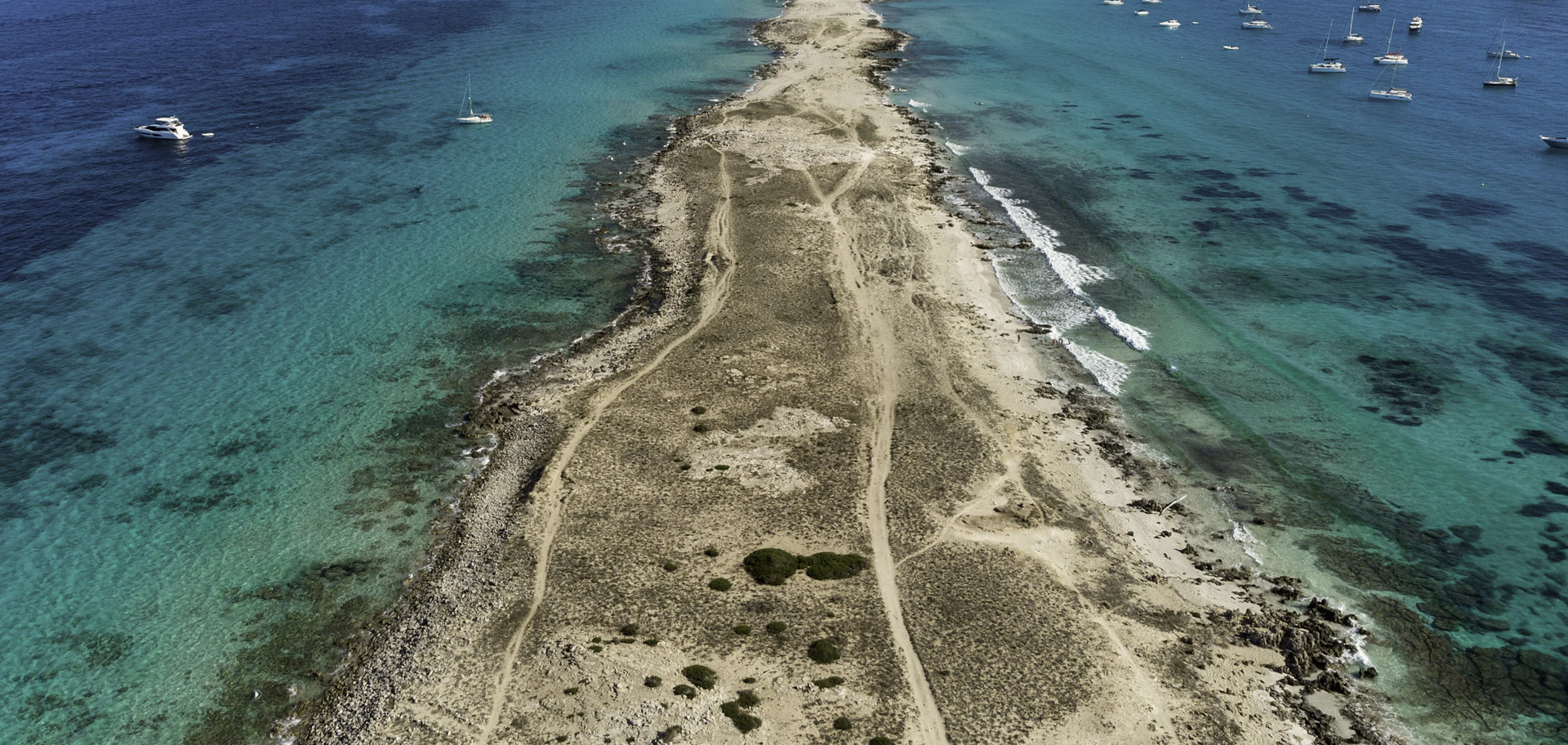
Ses Illetes is a narrow sand spit at the northern tip of Formentera, facing La Savina, protected by a chain of islets that cuts the swell almost completely in summer. The result is an almost tropical turquoise water colour and a surface so flat that the beach has become a national reference for paddle boarding. There's a certified school right on the beach offering kayaking, paddle boarding, snorkelling, kitesurfing and wing foiling, with private lessons, beginner courses and gear rental; it's also the most convenient launch point for paddling out to the islet of s'Espalmador.
View on Google Maps open_in_newOn the island's south coast, Migjorn stretches for several kilometres of fine white sand, with water just as intensely turquoise but somewhat more exposed than at Ses Illetes. It's a good option for paddle boarding and kayaking when the wind is calm, and since it's so long there's always a more sheltered stretch somewhere depending on the day's orientation. It also forms part of the area protected by the Ses Salines natural park at its eastern end.
View on Google Maps open_in_new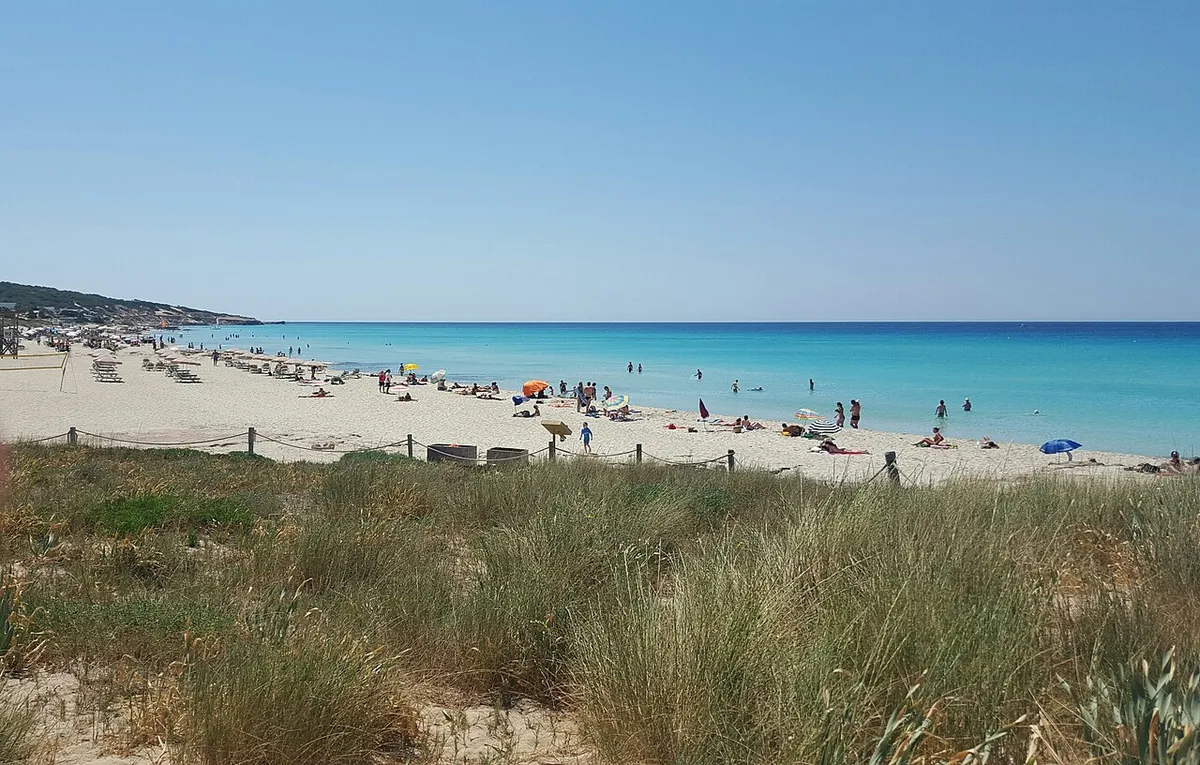
Outside the bathing season, with fewer bathers on the shore and more easterly-component wind, Ses Illetes also works for kitesurfing and wing foiling; there's a specialised school on the island that operates mainly from September/October to March/April, when there are fewer people and conditions are steadier. At the height of summer, though, the 200-metre rule leaves paddle boarding, kayaking and snorkelling as almost the sole activities.
If you're after a completely different profile within the archipelago, the almost-closed bay of Fornells is the classic windsurfing reference point in the Balearics.
While Es Cavallet and Ses Illetes are beaches open to the sea, in Menorca the Bay of Fornells is practically a lake of flat water protected by a narrow mouth, with the tramontana funnelling straight down its own axis almost all year round. It's an ideal profile for anyone looking to learn windsurfing or wing foiling without open-Mediterranean swell, and a good complement if your Balearic trip takes in more than one island.
Ses Salines, Es Cavallet and part of Migjorn lie inside the Parc Natural de Ses Salines d'Eivissa i Formentera, one of the most protected marine areas in the Mediterranean.
The park began life as an Area of Special Natural Interest in 1991, became a state Nature Reserve in 1995, and reached its current Natural Park status under Balearic law in 2001. It covers the sea channel between Ibiza and Formentera, with around 2,750 hectares of land and more than 14,000 hectares of sea, which together make up close to 85% of the protected area. The park's central value lies in its Posidonia oceanica seagrass meadows, among the best-preserved in the whole Mediterranean and declared a UNESCO World Heritage Site in 1999: they oxygenate the water, keep it clear, and slow the erosion of beaches and dunes.
Inside the park, anchoring is only allowed in marked sand zones, never over posidonia; there are designated buoy fields, for example off Ses Salines beach, in the Bahía de s'Alga at s'Espalmador, and in the southern zone of Caló de s'Oli in Formentera. Jet skis are banned throughout the park, as is spearfishing, and scuba diving requires prior authorisation. If you're riding kite or wing foil through the area, avoid crossing over mooring buoys and anchored boats, and don't land or launch on the dune vegetation, another of the park's protected habitats.
Beyond the regulations, posidonia is the reason the water at Ses Salines, Es Cavallet and Ses Illetes is so clear: without it, these beaches wouldn't have the colour or water quality that made them famous. Respecting the anchoring zones and avoiding dragging fins or anchors along the seabed is, in practice, the most direct way to look after your own spot.
Always choose an official school, with qualified instructors and well-maintained gear.
At Talamanca, the local windsurf school has been giving beginner lessons in the bay itself for years. In the south of the island, several kitesurf schools based near Es Cavallet and Ses Salines offer kite courses and wing foil lessons, with boat support for outings in stronger wind. Since wing foil established itself as the summer alternative to kite, a specific community of schools and clubs dedicated almost exclusively to the discipline has sprung up, with week-long beginner courses and board and wing rental.
At Ses Illetes, the beach's certified school brings paddle boarding, kayaking, snorkelling, kitesurfing and wing foiling together under one roof, with private or small-group lessons and guided trips out to s'Espalmador. For anyone after kite outside the bathing season, there's a specialised school on the island with more than 25 years' experience in watersports, offering two-hour introduction courses, six-hour basic courses and advanced training with video and a support boat. The Club de Surf Formentera, based at the island's Centro de Deportes Náuticos, rounds out the offer with light sailing and other disciplines.
Ibiza has its own airport; Formentera can only be reached by sea, almost always via Ibiza.
Ibiza Airport (IBZ) receives direct flights from numerous Spanish and European cities, with a very wide choice in high season and a much reduced one in winter. It's about 15-20 minutes by car from both Es Cavallet and Ses Salines to the south, and from Talamanca in Ibiza Town.
There's no airport in Formentera: you get there by boat from Ibiza Town to the port of La Savina, with crossings of around 30 minutes depending on the operator and type of vessel. Several companies run the route year-round, with more frequent sailings in summer; if you're travelling with SUP or windsurf boards, it's worth confirming the boarding conditions for bulky gear in advance.
In Ibiza, renting a car makes it easy to get between Talamanca, at the north of the bay, and Es Cavallet or Ses Salines to the south, in under half an hour. Formentera is much smaller and flatter: it's easy to get around by bike, scooter or rental car from La Savina, with Ses Illetes just a few minutes from the port and Migjorn a little further south.
The calendar calls the shots: summer is for paddle boarding, wing foil and lessons; the rest of the year, classic kitesurfing takes back over.
From June to September the schools are running at full capacity, with water between 24 and 26 °C. It's the best window for beginner lessons at Talamanca or Ses Illetes, for wing foil in southern Ibiza and for paddle boarding in Formentera, but classic kiting stays restricted close to shore by the bathers regulation.
April-May and September-October are the best dates for anyone coming specifically to kitesurf: fewer bathers, steadier easterly-component wind and no 200-metre restriction. With water between 18 and 21 °C, a 3/2 mm suit is the logical choice.
Most schools close or scale back their activity heavily between November and March, and flight and ferry availability shrinks accordingly. Winter kitesurfing in Ibiza and Formentera is left almost exclusively to local riders with their own gear, 4/3 mm wetsuits and boots.
What riders ask most before coming to the Pitiusas.
Not on the whole beach, and not at any time of year. Ses Salines and Es Cavallet are part of a natural park, and Balearic regulations also ban flying a kite in bathing zones within 200 metres of shore during the bathing season, which starts on 1 May. That's why kiting is concentrated in autumn, winter and spring, while in summer the usual alternative is wing foil, which needs less clear space.
The garbí (south-west) usually gives the cleanest conditions and blows onshore from the sea. The llevant (east) also works but raises more ground swell. The tramontana (north) blows from land out to sea on this beach, making it the most dangerous direction: a gear failure can carry you away from the coast quickly, so it's best avoided unless you have plenty of experience, or ride with boat support.
Only in marked sand zones; anchoring over posidonia is banned throughout the Parc Natural de Ses Salines d'Eivissa i Formentera, which protects one of the best-preserved seagrass meadows in the Mediterranean, a UNESCO World Heritage Site. Jet skis and spearfishing are also banned there, and diving requires prior authorisation.
Talamanca, in the bay of Ibiza Town, is the calmest option: it's a bay of about 900 metres, shallow and sheltered, with a gentler south-component breeze than on the south coast, lifeguard cover in summer and nearby sailing schools, as the Ajuntament d'Eivissa itself describes. It's mainly SUP, kayaking and light-sailing territory, though the reduced swell also makes it manageable for first windsurfing or wing foiling lessons, with a school based right on the beach.
Ses Illetes is a sand spit protected by a chain of islets facing La Savina, with turquoise water that's almost always calm in summer: ideal for paddling, less so for riding wind. Kiting stays limited close to shore in the bathing season under the same 200-metre regulation that applies in Ibiza. In autumn, winter and spring, with fewer bathers and more easterly-component wind, the area opens back up to kitesurfing and wing foiling. To compare with other islands, check out the destinations guide.


