
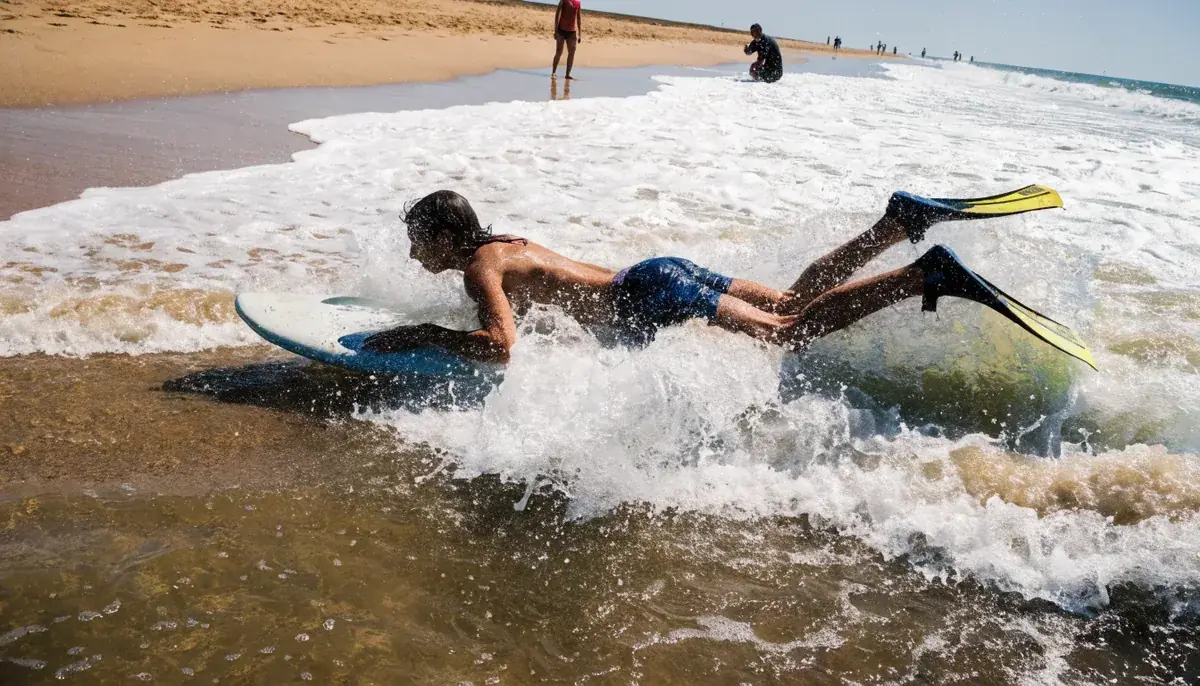
Bodyboarding is one of the fastest wave sports to learn: lying prone lowers your centre of gravity and gives an immediate sense of speed, often from your very first session. This is how to approach your first waves with confidence.
Bodyboarding really is accessible from day one
Unlike stand-up surfing, bodyboarding is done lying down (the 'prone' position), which makes balance far simpler. Your first glides in the whitewater (already-broken waves under about a foot) are possible within the first half-hour. That's what makes it as popular with children from six or seven as with adult beginners.
The right position on the board
Where to put your hands
At take-off, both hands hold the nose (the front of the board). Once you're gliding, the hand on the inside of the wave stays on the nose while the outer hand slides down onto the rail, level with your elbow, to steer your line.
The role of your chest and legs
Your chest should stay centred on the board – not too far forward (you risk pearling, or burying the nose) and not too far back (you lose speed). Your legs do the finning: keep them close to the surface to cut drag.
Finning and catching the wave
Wearing swim-fins lets you catch two or three times as many waves as finning with your hands alone. To catch a wave, centre your chest, keep your hands on the nose and kick hard underwater the moment the wave lifts you – the '0 to 60' technique, a short, powerful burst of finning to match the speed of the wave.
First spots and progression
Start in a gentle patch of whitewater where you can stand, before working out towards the green waves further out. Two or three coached sessions are usually enough to catch your first waves with confidence. Powerful beach breaks such as Fistral or Croyde are superb once you've got the basics, but it's best to learn on a mellower, forgiving beach first.
The most common mistakes
The most frequent is skimping on wax on the nose and rails, which lets your hands and chest slip and makes the board hard to control. Next comes forgetting the leash, which is essential if you don't want to lose your board after a wipeout. Finally, many beginners push onto hollow waves too soon, before they have locked in their wave-catching in the whitewater.
Bodyboarding for beginners: FAQ
Do you need to be able to swim to bodyboard?
Yes, you must be a confident swimmer and comfortable in the water, even when you start out somewhere you can stand.
Where do you put your hands on the board?
At take-off, both hands hold the nose (the front of the board). Once you're gliding, the hand on the inside of the wave stays on the nose and the outer hand moves down onto the rail to steer.
Do you use wax on a bodyboard?
Yes, rub wax onto the nose for your hands and along the rails for your elbows and chest, so you don't slip on the board.
What is the difference between surfing and bodyboarding?
Bodyboarding is done lying prone on a short, flexible board with swim-fins, which gives a much faster learning curve than stand-up surfing.
Are swim-fins essential for a beginner?
Not for your very first whitewater glides where you can stand, but they become essential as soon as you head out to catch green waves. See our guide to bodyboard gear.