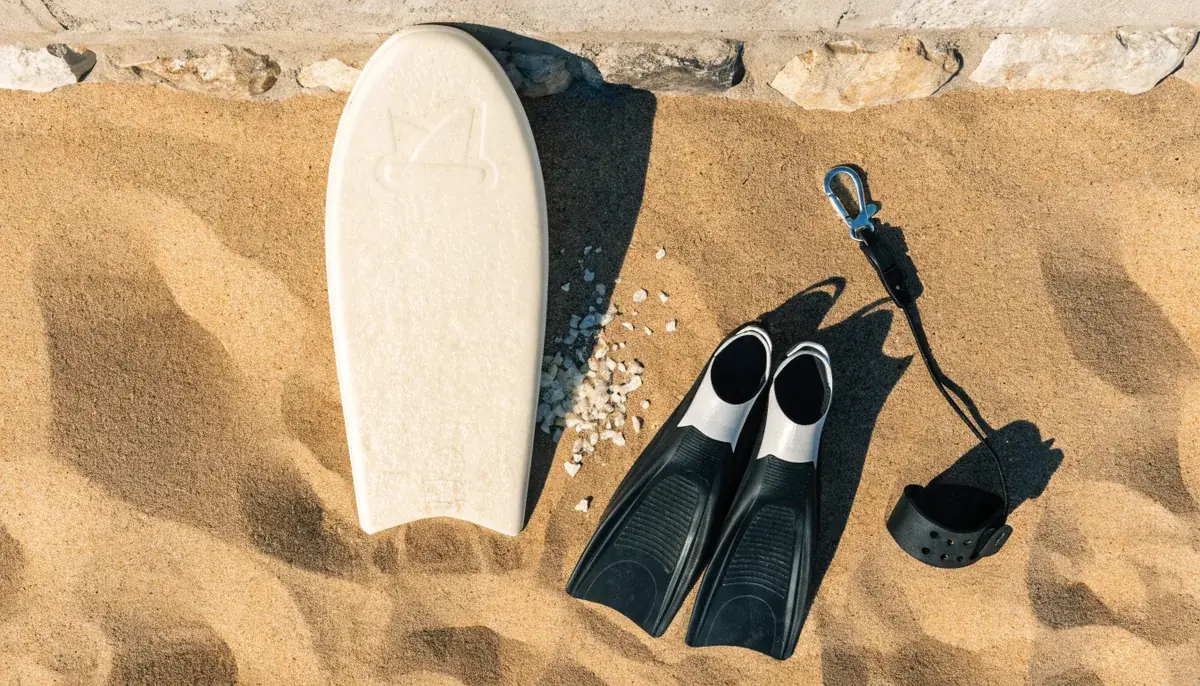
Three things are all you need to start bodyboarding well: a board in the right size, a suitable pair of swim-fins and a leash. This is how to choose each one without going wrong.
Choosing the right board size
Size comes down mainly to your weight and height. Stood on its tail, the board should reach between your navel and the bottom of your chest. Board length is measured in inches, from around 36" for children up to 44" and more for bigger riders.
Rider weight to board size
| Rider weight | Beginner size |
|---|---|
| 25-30kg | 36" |
| 40-43kg | 38.5" |
| 55-60kg | 40.5" |
| 65-70kg | 41.5" |
| 75-80kg | 42.5" |
| 85-90kg | 43.5" |
Understanding the cores
PE (polyethylene) core
The PE core is the softest and most forgiving. It's ideal for learning and for the cool to cold water around the UK, keeping a lovely flex, though it loses a little stiffness in very powerful or warm-water waves.
PP (polypropylene) core
Lighter, stiffer and faster than PE, PP is also more durable and less affected by temperature swings. It's the standard for tropical water and for more advanced riders.
Which core for the UK?
For most UK beginners, a PE core is the natural choice – it suits our water temperatures and forgives the inevitable early mistakes. Step up to PP once you're chasing more speed and drive in powerful, hollow waves.
Swim-fins and leash: the must-have accessories
Symmetrical swim-fins
Short and wide, bodyboard fins are built for explosive propulsion. Symmetrical models are recommended for beginners because they load both legs evenly. Wear them with neoprene fin socks and add a fin tether so you don't lose one in a wipeout.
The bicep leash
In bodyboarding you mostly use a bicep leash (a coiled bicep leash), roughly 24 to 32 inches long, to keep your arms free when finning without risking your board drifting off after a fall.
Wax, wetsuit and cold-water extras
Rub wax onto the nose for your hands and along the rails for your elbows and chest so you don't slip. For the UK, a 3/2mm wetsuit covers summer, a 4/3mm suits spring and autumn, and a 5/4mm with a hood, plus boots and gloves, handles winter water down around 6–8°C.
Brands worth knowing
Among the best-known bodyboard brands are NMD, Pride, VS (Versus), Science, Custom X and Hubboards. Their ranges span forgiving beginner shapes right through to high-performance boards, so it's worth trying a few and asking at your local surf shop what suits your weight and the waves you ride. Many boards feature stringers (carbon or fibreglass rods set into the core to add stiffness).
Bodyboard gear FAQ
How do I choose the right board size?
Stood on its tail, the board should reach between your navel and the bottom of your chest. If in doubt, size up slightly for a little more float at the start.
PE or PP for a beginner in the UK?
PE is excellent for learning in the UK's cool to cold water because it flexes and forgives errors. PP is better in warmer water or when you want more speed and stiffness.
Wrist leash or bicep leash?
The bicep leash is the most popular because it keeps your arms free when finning. Wrist leashes often come on entry-level boards.
Do you need fin socks with swim-fins?
Yes, neoprene fin socks of 2 to 3mm are strongly recommended to prevent blisters and keep your feet warm, especially outside summer on UK coasts.
What is wax for on a bodyboard?
It stops you slipping. Apply it to the nose for your hands and along the rails for your elbows and chest; without it, controlling the board is much harder.