

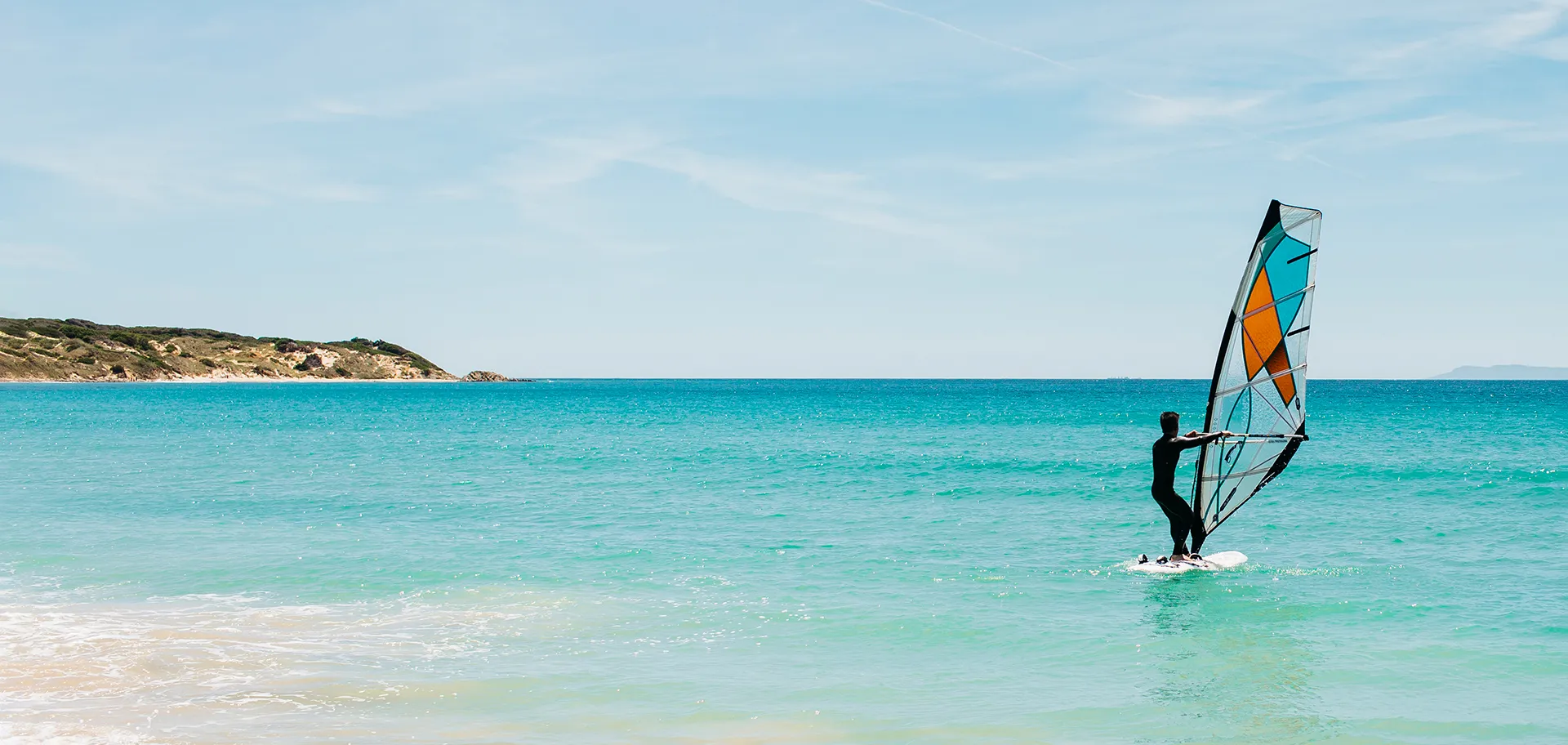
You want to get out on the water, feel the pull of the wind in your arms and glide across the surface. Windsurfing gives you all of that, and it asks a fair bit in return. Between choosing the kit, those first hours afloat and the long haul towards planing, there's a lot to get your head round. Here's the order to do it in, from your first rig to your first glides on the plane.
Windsurfing today: a sport on the way back
Through the 2010s, plenty of people thought windsurfing was in decline against the boom in kitesurfing and foiling. That is not what has happened. The last few years have brought a real revival. Kit sales have picked up in shops across the UK and Europe, makers are releasing more and more accessible ranges, and the spots are drawing their crowds of enthusiasts once again.
Several things explain the comeback. First, the second-hand market has grown, so a complete beginner package now costs far less than it did a decade ago. Second, boards and sails have moved on, and learning is far gentler for it. Boards are wider and steadier, and sails have a deep, self-filling profile. It all points the same way: making a beginner's life easier.
Windsurfing also has an advantage that fashion can't take away: it's a sport you can do at any age, on just about any stretch of water as long as there's a bit of wind, and it offers a feeling of freedom that's hard to match. No ski lift, no lift pass, no set timetable. You check the wind, you load your trailer or roof rack, and off you go.
The ideal kit to get started
This is where a lot of beginner windsurfers make their first mistake: buying too small, too twitchy, too ambitious. Three sessions, three struggles, and the board ends up at the back of the garage. Beginner kit needs to be generous. Very generous.
The board: volume, stability, funboard vs. progression board
Volume comes first. It's measured in litres and determines how much your board floats. For an adult beginner, we recommend a big-volume board sized to your weight. As a rule of thumb, take your weight in kilos and add 80 to 110 litres. If you weigh 75kg, aim for a board of roughly 155 to 185 litres in those first weeks.
Width matters just as much. A beginner board is generally between 80 and 100cm wide. That width gives you the sideways stability you need to get up, stand and start sailing without spending your whole time falling in.
On category, opinion splits two ways. A pure funboard (140-170 L) is too little for a genuine beginner. It sinks at the slightest wobble and already demands a solid waterstart technique. A progression board (180-240 L) floats even when stationary. You can sit on it, start again from scratch without stress, and learn with an uphaul rather than an acrobatic waterstart. That's the one you want.
The sail: size by weight and wind
Choosing the sail is closely tied to your spot's average wind and your build. For a beginner, the ideal range sits between 4.5 and 6.5 m². Here's a practical guide:
- Under 65kg: 4.5 to 5.0 m² for wind of 15-20 knots (17-23 mph)
- 65 to 80kg: 5.5 to 6.0 m² for wind of 12-18 knots (14-21 mph)
- Over 80kg: 6.0 to 6.5 m² for wind of 12-18 knots (14-21 mph)
Whatever you do, don't start with a sail that's too small 'to be on the safe side'. An under-sized sail won't carry you, you won't have enough power and you'll struggle on every water start. Better a slightly big sail you can ease off when the wind builds than a tiny one that does nothing at all.
The mast and the boom
The mast has to be compatible with your sail. Two parameters: the length and the carbon percentage. The length is marked on the sail (400, 430, 460cm and so on). Stick to that figure. The carbon percentage affects flex and weight. To start with, a mast at 30-50% carbon is plenty. Full-carbon masts are lighter and more responsive, but also much dearer and more brittle. You don't need one now.
The boom is the bar you hold. Again, the size needs to match your sail. Most booms are adjustable, so they'll fit a range of sail sizes.
Buy new or second-hand?
| Criterion | New | Second-hand |
|---|---|---|
| Outlay for a complete package | Higher | Much lower |
| Warranty | Yes, manufacturer | No |
| Risks | None | Inspection needed |
| Who it suits | Comfortable budget | 90% of beginners |
Things to watch on second-hand kit: cracks in the board (tap it, a hollow sound means delamination), the state of the mast foot, deformed sail battens, corrosion on the metal parts, wear on the boom lines. Don't be shy about asking for a test session before you buy.
Clubs and centres also sell off their hire kit when they refresh the fleet, and it's usually well-maintained gear at sensible prices. Community groups and specialist forums are full of listings too.
Learning to windsurf: the steps
Progressing in windsurfing is a succession of steps. Each one you tick off opens the next. Skip a step and you risk stalling, or even hurting yourself. Here's the path, in order.
Lessons or self-taught?
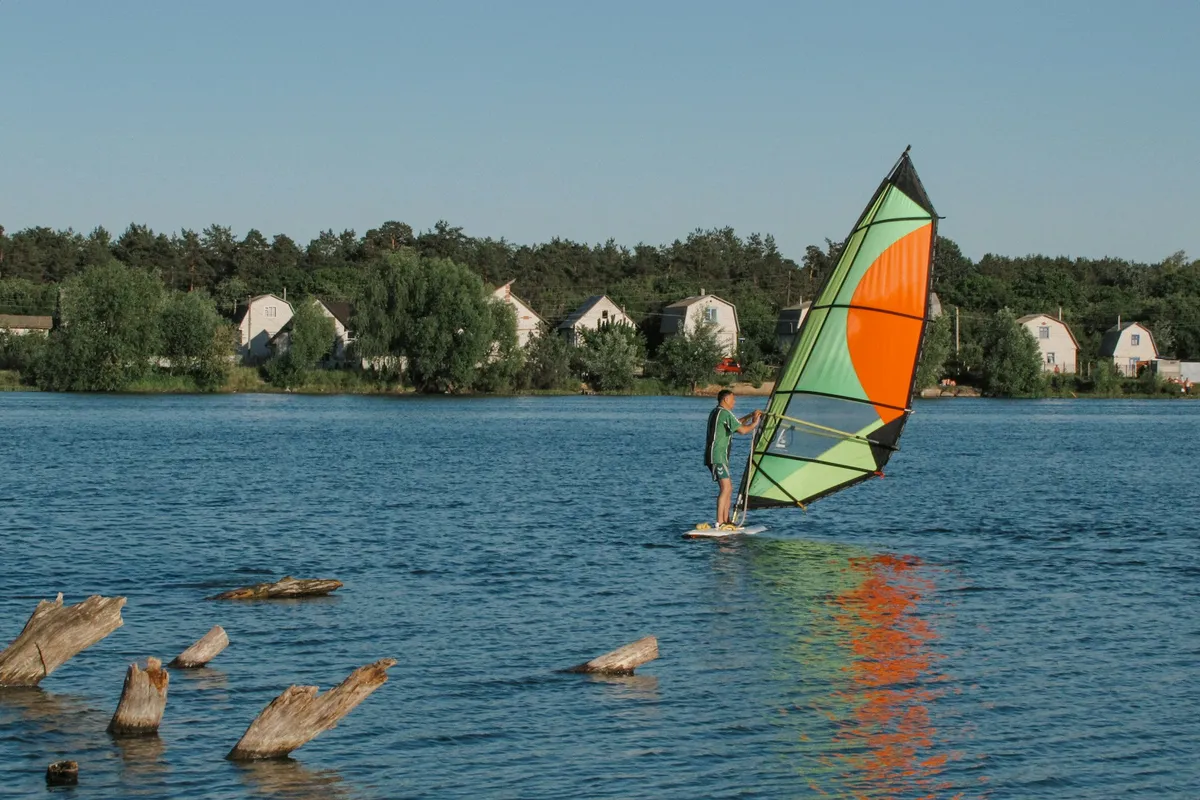
Taking lessons at an RYA-recognised centre saves you a huge amount of time. An instructor spots your mistakes straight away, corrects them before they become habits, and gives you the right technique from the off. Three or four sessions are enough to build solid basics: rigging, setting off under sail, tacking and getting back to your starting point.
Learning on your own is possible. Plenty of riders have done it. But it takes more time, more patience, and above all a real ability to analyse yourself. The risk is picking up bad habits that then take a very long time to unlearn.
Mastering the tack
The tack, or turning through the wind, is the basic manoeuvre that lets you change direction by bringing the nose of the board through the wind. It's the first thing you need to master before you think about anything else.
Come up head to wind, let the sail out completely, shift your weight forwards onto the board and push the boom forwards to pivot it. The sail crosses to the other side, you reposition your feet, reset the sail and off you go. Simple on paper. In practice it takes a few hours on the water for the movement to become natural.
The classic beginner error is rushing the rotation, at which point the board stops, slides backwards, and you end up in the water. Take your time. One clean tack beats three botched ones that tire you out and take you further from the shore.
The first gybe
The gybe is the next step. It's the manoeuvre that lets you change tack by passing downwind. It's quicker than a tack, smoother, and it becomes essential as soon as you start carrying a bit of speed.
Sailing along, head up slightly to control your speed, then bear away firmly and pass downwind. Unhook your back foot and bring it near the mast foot, change hands on the boom, flip the sail across to the other side, reposition your back foot, reset the sail and off you go.
The big trap is the timing. Too slow and you lose all your speed. Too fast and you lose your balance. The right rhythm is the one that keeps the board moving throughout the manoeuvre.
Progressing towards planing
Planing is the holy grail for a beginner windsurfer. It's that magic moment when your board lifts, comes partly out of the water and starts to glide at real speed with minimal resistance. The feeling changes completely: gone is the sound of water dragging, in comes the whistle of the wind and pure acceleration.
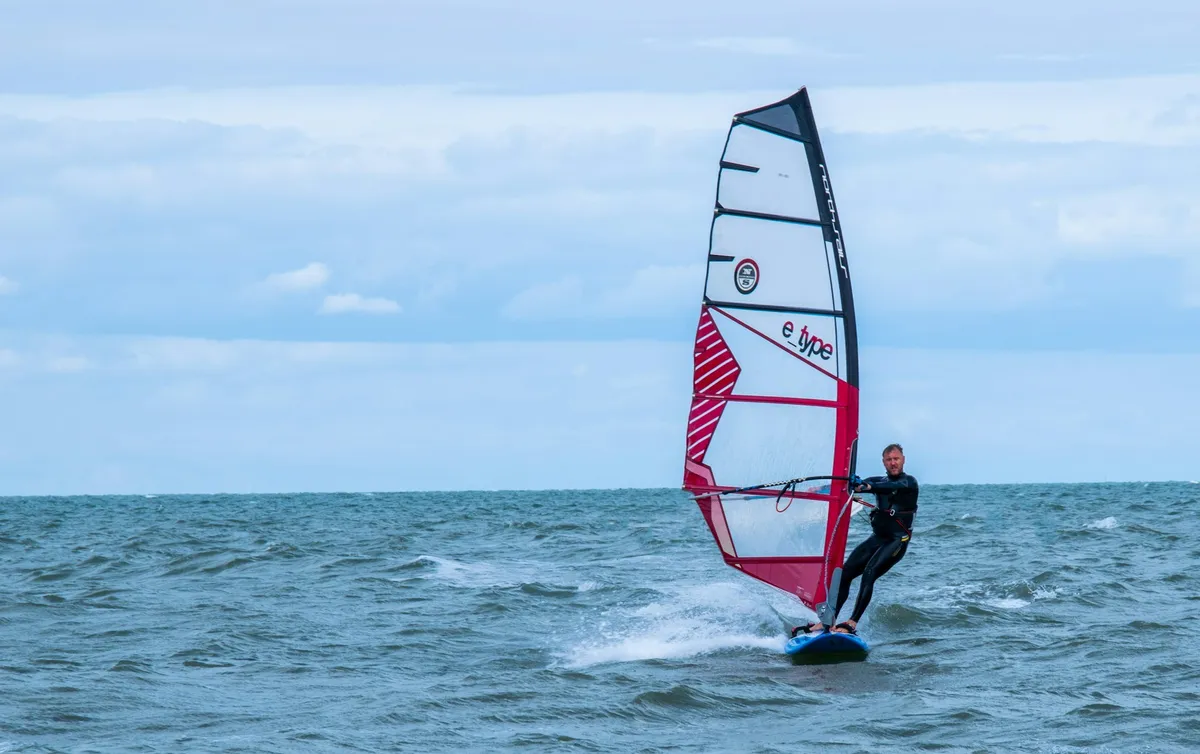
To get planing you need three things: enough wind (minimum 15 knots / 17 mph), a suitable board (wide beginner boards plane with difficulty; you'll feel the beginnings of planing in strong wind, but real planing comes when you move to a smaller board, 130-160 L), and the right stance (feet back, lean back, ease the sail slightly to accelerate).
Don't fixate on planing too early. Focus on solid basics: working upwind, linking your tacks, gybing cleanly. Planing will come naturally once you have the level and the kit for it.
The best spots to start in the UK
The UK is a superb playground for a beginner windsurfer. Here are the spots that combine suitable conditions, welcoming facilities and reliable wind.
West Kirby Marine Lake (Wirral)
Enclosed, flat and shallow, West Kirby's marine lake is one of the best learning venues in the North West. The wall keeps the chop out, and a busy club runs regular sessions. The perfect place to nail your first tacks with the safety of a bank close by.
Portland Harbour (Dorset)
One of the largest man-made harbours in the world, Portland is well sheltered and home to a national sailing academy. Flatter water and steady breeze make it a superb spot to progress. Keep an eye on the busier racing areas.
Rutland Water (East Midlands)
A large inland reservoir with no waves and a thermal breeze on warm afternoons. Ideal for learning far from the tides and currents of the coast. There's a watersports centre on site with kit hire and tuition.
Hayling Island (Hampshire)
A windsurfing heartland with sheltered harbour water on one side and open sea on the other. The Hayling Island shore offers something for every level. Mind the tides and the currents through the harbour entrance.
West Wittering (West Sussex)
The wide, shallow bay at West Wittering gives huge amounts of space at low tide, with reliable wind and generally welcoming conditions. Aim for the shoulder seasons to dodge the summer crowds.
To go further, read our complete windsurfing guide and our windsurf gear section.