

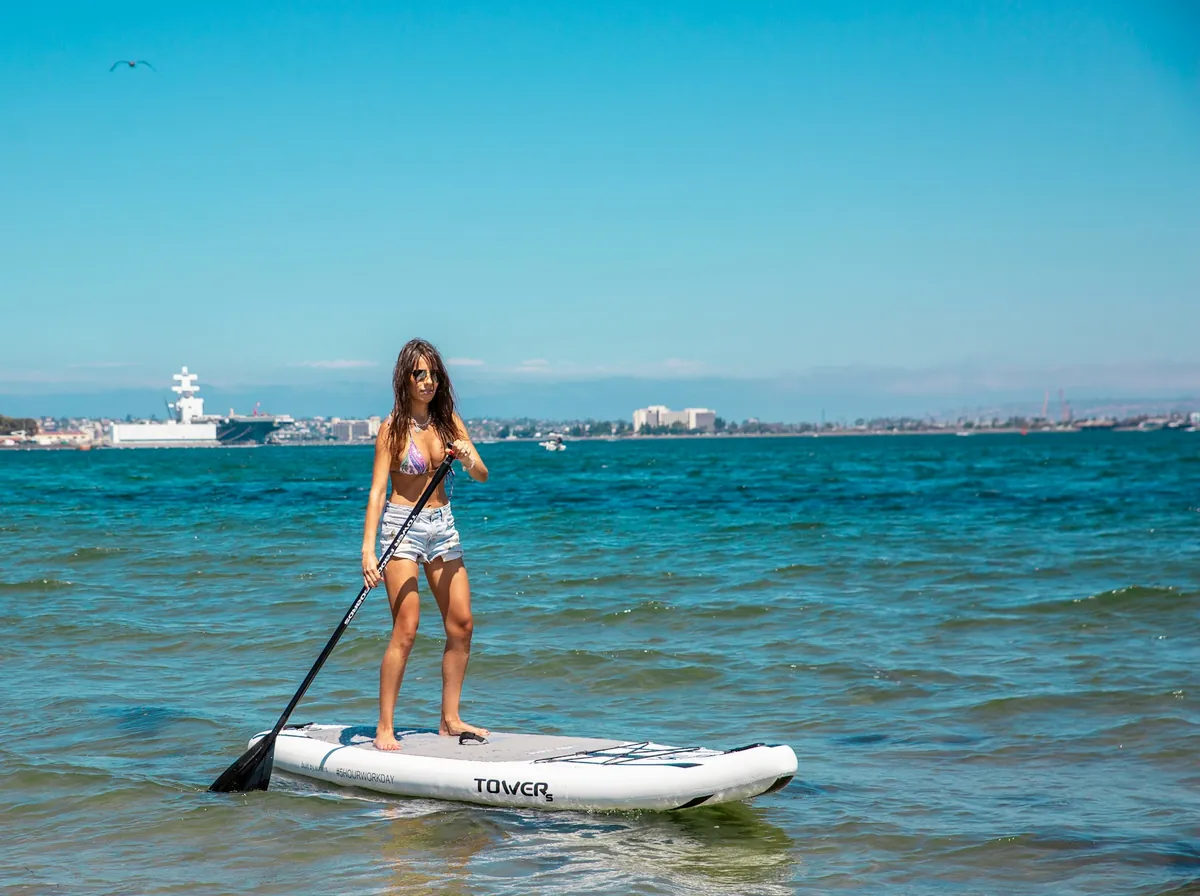
This page is a way in, not one more guide. To protect yourself from the sun on a SUP you need three things: sunglasses that stay on and filter well, a sunscreen suited to water, and something to cover what sunscreen does not. Each already has its own detailed guide on Matosurf; here you get the order to read them in and what changes when you are standing on a board.
Why paddleboarding has its own kit
On a SUP you spend a long time standing, facing the water, with no roof or deck to shade you. Our sunglasses guide names SUP among the activities where glare is a real issue, and we point you to it for the lens detail. Health authorities do not treat sunscreen on its own either: the NHS advises spending time in the shade between 11am and 3pm from March to October, covering up with a wide-brimmed hat and long-sleeved tops, and wearing sunglasses and at least factor 30 sunscreen with at least 4-star UVA protection, re-applied frequently.
The kit, piece by piece
| Piece | What matters on a SUP | Where to read the detail |
|---|---|---|
| Sunglasses | Category 3 lenses, polarised to cut glare off the water, a frame that floats or is held by a strap | Sunglasses for surf and SUP |
| Sunscreen and stick | Water-resistant cream, a stick for the face, filters suited to fragile waters | Sunscreen for surf and water sports |
| Body cover | Long sleeves, hat or cap, in line with official advice | NHS |
Polarised sunglasses for SUP: the essentials in a few lines
The sunglasses guide explains the detail; here is what to take in before you read it.
- Lens category is the first criterion, ahead of brand and colour. For SUP in bright weather, the guide settles on category 3.
- Polarisation cuts glare off the water. Its documented downside: it can black out LCD screens, which matters if you check a phone or a GPS watch.
- "Floating" is a yes-or-no promise: a frame floats or it sinks. Read the listing, and test in a bucket of salt water before counting on it. A strap remains a useful backstop.
- Rinse the lenses in fresh water after the session, without wiping them while they carry salt or sand.
We do not recommend a specific model here: that is the guide's job, which explains how to read a listing rather than naming a winner.
Sunscreen: do not skim it
The sunscreen guide covers filters, so-called "reef-safe" creams, the routine before a session and top-ups. Two points are worth the detour for a paddleboarder: the face stick, which limits runs into the eyes, and the spots people forget (the back of the neck, the lips). Re-application is covered in the guide; the NHS gives its own pointers on the page cited above.
What order to kit up in
- Read the sunglasses guide first if you have no pair for water sports, because they are the piece most easily lost and the one that needs a buoyancy check.
- Move on to the sunscreen guide and choose one product for the face and one for the body.
- Add a hat or cap and long sleeves for sessions where shade is scarce.
Before you set off: three checks
The sunglasses have their strap on and, if they are meant to float, you have checked that at least once. The stick and the sunscreen are in a bag you can reach, not at the bottom of the boot, so you can top up on the beach between outings. And you have looked at whether you paddle at times when shade is scarce; if so, a hat and long sleeves are not a luxury.
What this page does not do
It compares no products and does not repeat the buying lists in the guides, which are the only ones to rely on for detail. We have deliberately placed no buying link here: the only product connected to this subject on Matosurf is a pair of camera glasses that never go in the water, which adds nothing to a SUP kit. The rest of the kit is in the list of essential SUP accessories, and safety on the water has its own page: SUP safety.