

Stand-up paddleboarding has become one of the most accessible watersports of the last few years. There's no need to wait for perfect waves or spend months mastering your balance before you start having fun. You pump it up, you paddle, you stand up – and you glide. It looks simple, and largely it is, but SUP still calls for a little basic know-how so you can avoid nasty surprises and progress with confidence.
What is SUP (stand-up paddleboarding)?
SUP, short for stand-up paddleboarding, is the practice of standing upright on a board and propelling yourself with a paddle. Its roots go back to Polynesian outrigger canoes, but the version we'd recognise today took shape in Waikiki in the 1940s and 1950s, when local surf instructors – the famous 'Beach Boys' – began standing and paddling on their longboards to keep an eye on their pupils from a raised vantage point.
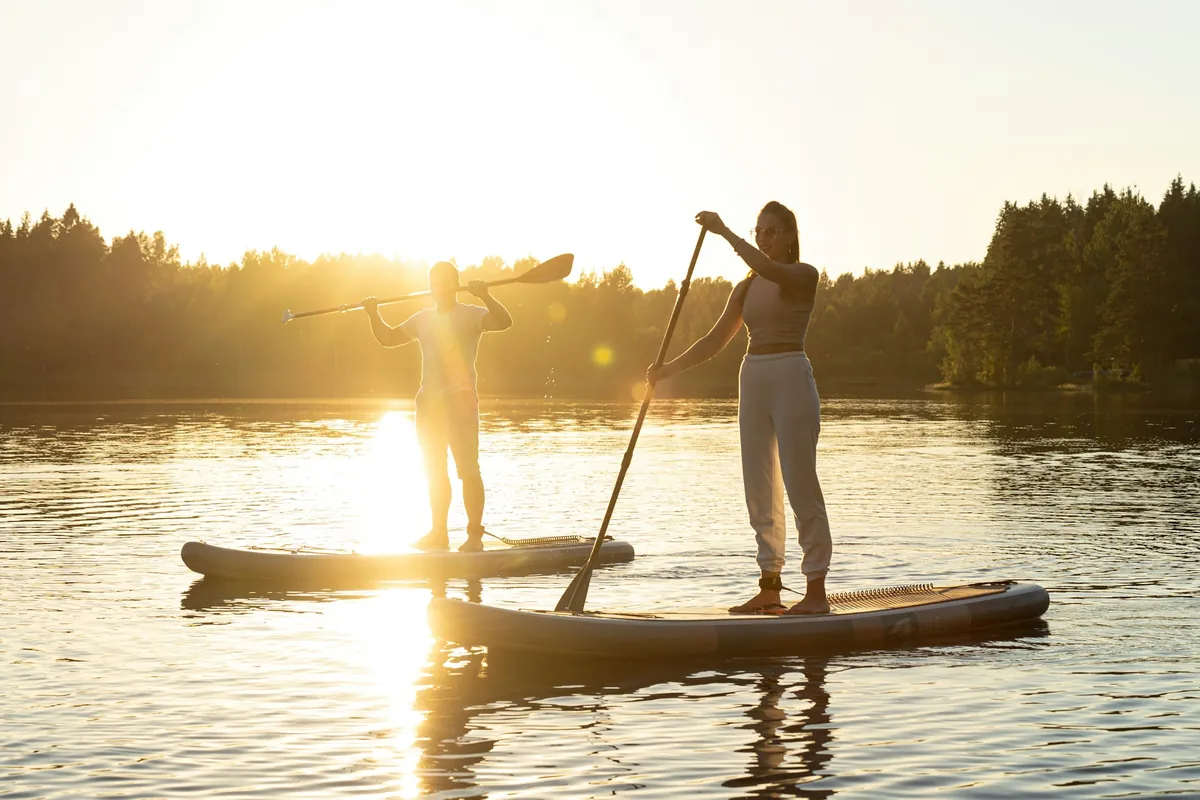
Today SUP spans several disciplines: touring (flatwater), SUP surfing, SUP racing, SUP yoga and even SUP fishing. For a beginner, flatwater touring is the ideal way in. It asks for no particular fitness and lets you build confidence on the board quickly.
The kit has become far more affordable too. Where you once had to invest in a bulky, expensive hard board, today's inflatable boards strike an excellent balance between performance, transport and value. That shift is why stand-up paddleboarding is now one of the most popular watersports in the UK, on the coast as well as on lakes, lochs and rivers.
Choosing your first SUP board
Choosing the board is the most important step for a beginner. An unsuitable board makes learning frustrating, even off-putting. Here are the criteria that actually decide it.
Inflatable or hard board?
It's the question that always comes up. Both options have their pros and cons, and there's no universal answer.
An inflatable board (iSUP) packs down into a rucksack, travels easily in a car boot and shrugs off knocks thanks to its drop-stitch construction. It's more forgiving on rocks, jetties and clumsy handling – all common with beginners. The trade-off is the inflation time (roughly 5 to 10 minutes with a hand pump) and a rigidity slightly below that of a hard board, which you notice in pure glide.
A hard board (epoxy foam or carbon) glides better, is more responsive and needs no inflating. But it's bulky, easily damaged on impact and needs roof bars or a suitable vehicle to transport. For occasional use, or to store the board in a flat, the inflatable is far and away the more practical choice.
If you're starting out and don't have dedicated storage space, go for a good-quality inflatable SUP. You can always move to a hard board later, once you know exactly what you're after.
Recommended dimensions for beginners (10'6" to 12'0", 32-35 inches wide)
The board's size directly governs stability and how easy it is to learn on. For a beginner, the ideal dimensions sit between 10'6" and 12'0" long, with a width of 32 to 35 inches (roughly 81 to 89cm).
A wide board offers more side-to-side stability, letting you stand up sooner and hold your balance even when the water is a little choppy. Boards under 30 inches wide are best left to experienced paddlers chasing speed and glide.
Length affects load capacity and how well the board tracks in a straight line. Below 10'6", a board becomes hard to steer for an average-weight adult. Above 12'0", it gains speed but loses manoeuvrability – less handy for learning to turn.
Volume and stability
Volume, expressed in litres, determines the board's buoyancy. The higher the volume, the more weight the board carries without sinking. For a beginner, aim for a minimum of 250 litres for someone weighing 70 to 80kg. Add roughly 4 to 5 litres per extra kilogram.
Under-sizing the volume is the classic buyer's mistake: the board sits low, becomes unstable, and the beginner blames their own lack of talent when the kit is simply wrong for them. Don't skimp on volume, especially if you plan to carry gear (a dry bag, a water bottle, a dog).
Looking for a board that ticks these boxes? The WattSup Bream 10.6 sits right in the beginner-friendly range (10'6", 281L) – see it at OutletSUP →.
The essential kit
Beyond the board, a few pieces of kit are needed to paddle safely and comfortably.
The paddle (length, material, adjustment)
The paddle is your engine. Its length and material have a direct bearing on how enjoyable the paddling is and how much your muscles tire.
To find the right length, hold the paddle upright in front of you: with your arm stretched above your head, the handle should reach your wrist. Most adult paddles measure between 180 and 210cm and are adjustable, which is handy if several people of different heights share the same board.
On materials, you'll mainly find aluminium, fibreglass and carbon. Aluminium is cheap but heavy. Fibreglass offers a good weight-to-price balance. Carbon is light and stiff, but its cost suits regular paddlers. For a beginner, a fibreglass or reinforced-aluminium paddle does the job perfectly.
The leash
The leash connects your ankle to the board. It's a non-negotiable piece of safety kit. If you fall, the board can drift away fast in the wind or current. Without a leash, you risk a long swim away from your only means of flotation.
There are two main types: the straight leash and the coiled leash. The coiled leash is preferable for flatwater because it drags less in the water and creates less resistance. The straight leash tends to be used in SUP surfing, where it needs to absorb the pull of the waves.
The buoyancy aid
A buoyancy aid is strongly recommended on every session, and essential if you aren't a confident swimmer or the weather is changeable. The RNLI advises always carrying a means of flotation and a way to call for help. If you get into difficulty in or near the water, call 999 and ask for the Coastguard.
Choose a buoyancy aid made for watersports: it should allow complete freedom of movement so you can paddle without restriction. Inflatable belt packs are compact and comfortable but need the CO2 cartridge checked regularly. Foam buoyancy aids are bulkier but never fail.
Beyond the buoyancy aid, think about a paddle leash, neoprene boots if the bottom is rocky, and of course sun protection. Water reflects UV, and sunburn creeps up faster than you'd think even on a cloudy UK day.
Your first strokes on the water
The moment you've been waiting for: you're on the bank, the board is pumped up and the paddle is in hand. Here's how to approach your first sessions.
Standing up on the board
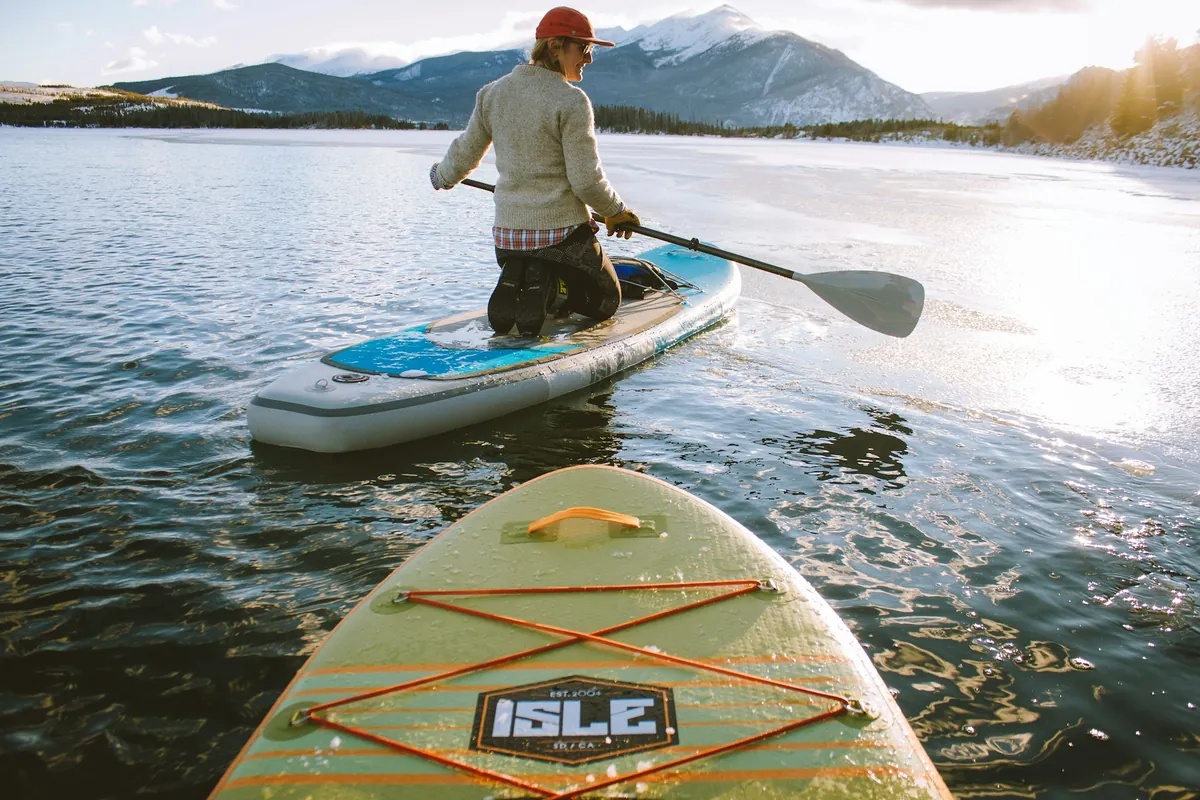
Always start on your knees. Paddle for a few minutes in this position to get a feel for the board, understand how it reacts to your movements and build confidence. Pick calm water, with no current or strong wind, for your first attempts.
When you're ready, lay the paddle across the board in front of you, a hand either side of the shaft. Place one foot then the other side of the central carry handle, feet hip-width apart, and rise slowly with a straight back. Fix your eyes on the horizon, not on your feet. That's the number-one beginner's error: looking at the board upsets your balance.
Keep your knees slightly bent and your bodyweight spread evenly across both feet. Arms relaxed, paddle ready. If you feel yourself tipping to one side, don't fight it with your torso – just shift one foot a few centimetres. The board will follow.
The basic strokes
The SUP stroke isn't like a kayak stroke. The blade enters the water well ahead of you, near the nose of the board, and comes back along the rail as it pushes the water. The movement comes from your hips and core, not your arms. Keep the top arm stretched, the lower arm bent, and rotate your torso on each pull. This is the so-called torque stroke.
To go straight, switch sides every 3 to 5 strokes. Beginners tend to paddle on the same side throughout, which makes the board turn constantly. Notice your weaker side and make yourself work both evenly.
The reverse stroke (pulling backwards) is for braking or backing up. Plant the blade near your foot and pull towards the back. Simple and effective.
How to turn
There are several turning techniques, but the most beginner-friendly is the sweep stroke. Place the blade in the water well ahead of the nose, on the opposite side to the direction you want, and trace a wide arc around the board to the tail. The wider the arc, the tighter the turn.
For a quick turn on the spot, combine a forward stroke on one side with a reverse stroke on the other. The board pivots on itself. Practise this manoeuvre in calm water before venturing into busier areas.
Where to paddle in the UK
The UK offers a wonderful variety of paddling spots. Here are a few pointers to help you find your ideal patch of water.
On the coast, sheltered bays and harbours make the safest starting points – think Poole Harbour, the Salcombe estuary or the sheltered corners of the North Devon coast. Always check the tide times and, above all, the wind direction before you set off. An offshore wind, blowing from the land out to sea, is the single biggest danger for a paddleboarder: it can push you out fast and make the return exhausting.
Inland, lakes and lochs are perfect learning grounds. Windermere in the Lake District, Llyn Padarn in Snowdonia and Loch Lomond offer calm water and breathtaking scenery. Be aware, though, that these spots can get very busy in summer. Head out early to enjoy flat water and near-total peace.
Slow-flowing rivers and canals are another option, but they call for a little experience in reading current. Never take on a river in spate or with a strong flow as a beginner.
For every outing, check the Met Office forecast, tell someone your plan and check any local rules for the water. Some nature reserves restrict SUP access at certain times of year. When in doubt, ask at the local club or hire centre.
To go further, read our complete stand-up paddleboarding guide and our getting started section. For a stunning first-timer's lake, see our guide to paddleboarding on Windermere.