Not all bodyboards are created equal, and getting it wrong shows up as frustration in the water: a board too small to give you lift, rails so hard they let go without warning, or a tail shape that doesn't suit how you ride. This guide walks through the criteria that decide it, whether you're just starting out or looking to move up a level.
The basics: core material and size
Before getting into the finer points of shape, two criteria set the tone for everything else: the core (the material inside the board) and the size relative to your build. Our bodyboard gear guide covers PE, PP and EPS cores in depth, along with a height-to-size chart, so we won't repeat all of that here – in short, a PE core suits beginners well in cooler UK water, while PP offers more versatility as you progress.
With those basics covered, two less commonly explained factors make all the difference to how a board actually behaves on a wave: rail shape and tail shape. That's what this guide focuses on.
Rail shapes: how they shape your ride
The rails are the edges of the board – the part that contacts the water through a turn. Their thickness and angle determine how much hold and forgiveness the board offers.
Soft rails
Thicker and more rounded, soft rails offer progressive hold and forgive positioning mistakes. This is the recommended choice for beginners: the board is less likely to release suddenly, which cuts down on unexpected spin-outs mid-turn.
Hard rails
Thinner and sharper, hard rails give a sharper hold and allow for tighter, faster turns. The trade-off is that they demand a more established technique – mishandled, they let go more abruptly. Save them for intermediate to advanced riders.
Single or double stringer
Stringers are reinforcements – often carbon or graphite – built into the core to add stiffness. A double stringer board responds faster in turns and suits riders after more precision. A single stringer is softer, more forgiving, and generally better suited to beginners.
Rule of thumb: the newer you are, the more you'll benefit from soft rails and generous flex. Stiffness and sharp hold are worth chasing once your turning technique is already solid.
Tail shapes: which back end should you choose?
The tail (the back of the board) has a direct effect on control and hold through tight turns. Four shapes dominate the market.
| Tail shape | How it rides | Best suited to |
|---|---|---|
| Crescent | Versatile, a good balance of hold and control | Beginner to intermediate |
| Bat tail | More lift and speed in a straight line | Intermediate to advanced |
| Mono channel | Extra hold in hollow, fast-breaking waves | Advanced, powerful surf |
| Symmetrical crescent | Identical performance regular and goofy | Dropknee or stand-up riders |
For a first board, the crescent tail remains the safest bet: it's the most common shape on beginner boards, because it behaves predictably across most wave types. Bat and mono channel tails are more specialist choices, worth considering once you've settled on your riding style and the type of spot you ride most.
Beginner or committed rider: which board profile suits you?
The right board depends as much on your level as on where you want your riding to go.
Starting out: look for a wide, rounded nose (for lift and easy wave-catching), soft rails, a crescent tail, and a PE or PP core depending on the water temperature. The goal is maximum forgiveness while you're still learning to read waves and position yourself.
Moving towards green waves (unbroken waves): a pointier nose improves penetration into the wave, and a more technical tail shape (bat or mono channel, depending on your style) starts to become worth considering.
Committed riders: the shape tightens up, stiffness increases (EPS core, double stringer), and tail choice comes down to discipline (prone, dropknee) and the type of wave you ride most.
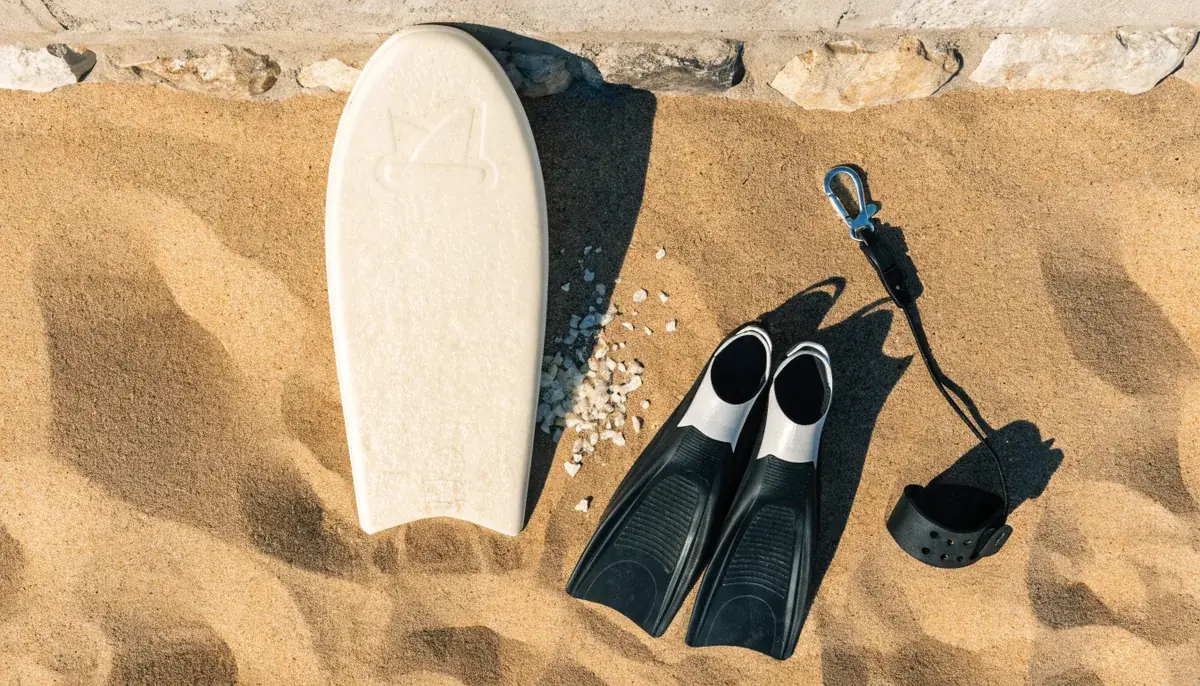
Beyond the board itself, don't overlook the accessories: fins and a leash matter just as much for comfort and safety in the water. Our bodyboard gear guide covers these in full, sizing chart included.
Once you're kitted out, head for the beach: our guide to getting started in bodyboarding walks through the progression step by step, from whitewater to your first green waves.