

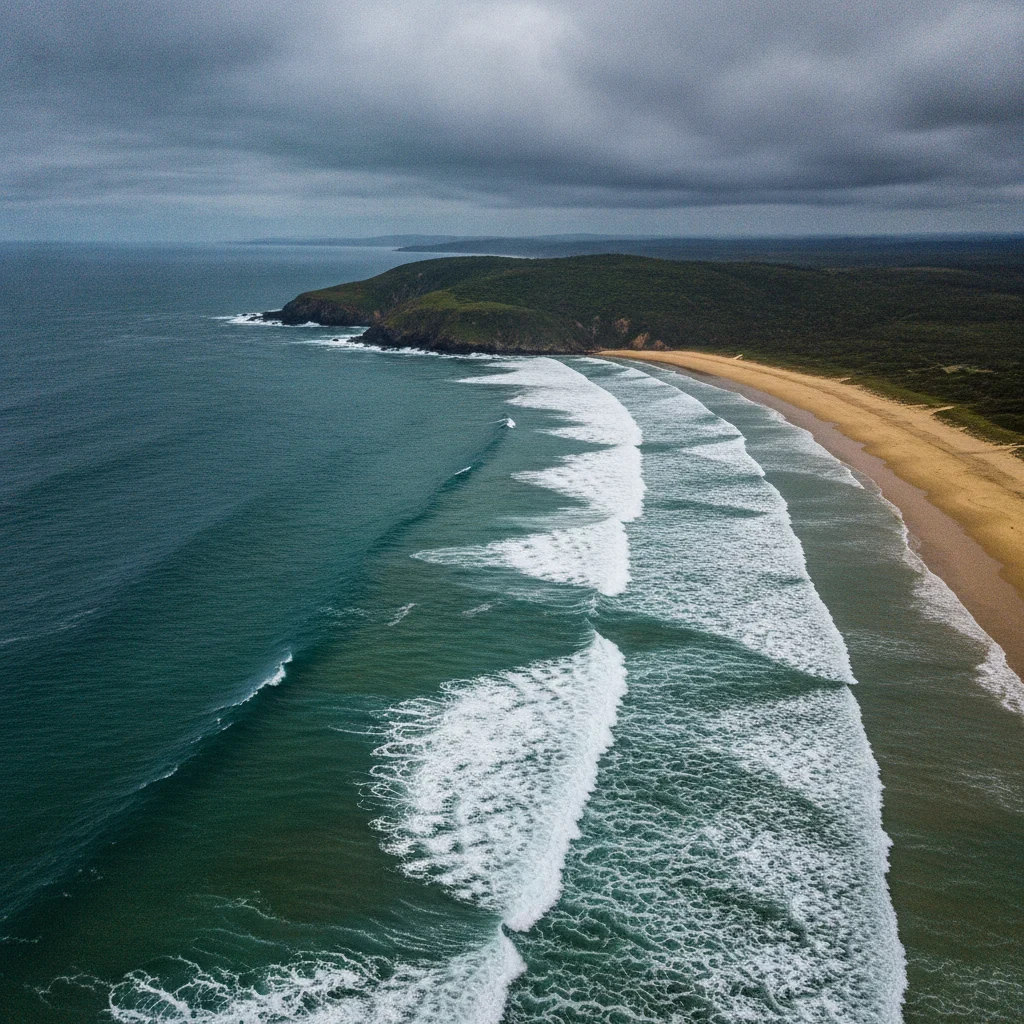
A wave breaking on the beach has often travelled several days and several thousand kilometres to get there. It wasn't born on the spot: it was born out at sea, sometimes on the far side of the ocean, driven by the wind. Here, step by step, is how a simple breath of air over the water ends up becoming the wave you're surfing – and how that differs from what decides the shape of the wave once it reaches your local break.
Wind: the engine behind every wave
Every wind-generated wave – which is to say almost every wave you'll ever surf, bar the rare seismic wave (tsunami) – forms the same way: wind rubs across the surface of the water and hands over some of its energy. That transfer first raises tiny ripples on the surface, then, as the wind keeps blowing, those ripples build into disorganised chop: short, choppy little waves running off in several directions at once.
The harder the wind blows, the more energy it can pass to the water, and the bigger the waves it produces. But wind strength on its own doesn't explain why some storms whip up an exceptional swell while others produce almost nothing. Two other factors are at work.
Fetch and duration: why some swells are bigger than others
Marine forecasters use three variables to estimate the size of the waves a storm will generate: wind speed, fetch and duration.
📏 Fetch
Fetch is the distance over which the wind blows continuously, in roughly the same direction and at roughly the same strength, across open water. A strong wind blowing over just 50 km (30 miles) will never build the same swell as an equally strong wind blowing across 1,000 km (620 miles) of open ocean: the bigger the fetch, the more room the water has to bank the wind's energy.
⏱️ Duration
It's not enough for wind to blow hard and over a long fetch – it also has to blow for long enough. A gust lasting a few minutes, however violent, doesn't have time to hand over much energy to the water. A depression that sits over the same patch of ocean for several days, on the other hand, can build a serious swell even with only moderate wind.
When the wind blows hard enough, over a wide enough fetch, for long enough, the sea reaches a state oceanographers call a fully developed sea: it has soaked up everything that particular wind can give it, and it won't grow any further, however much longer the blow lasts. It's this combination of the three factors – wind, fetch, duration – that explains why certain North Atlantic storms generate the swell that, a few days later, arrives to break on the coasts of Cornwall, Devon and Wales.
From disorganised chop to swell
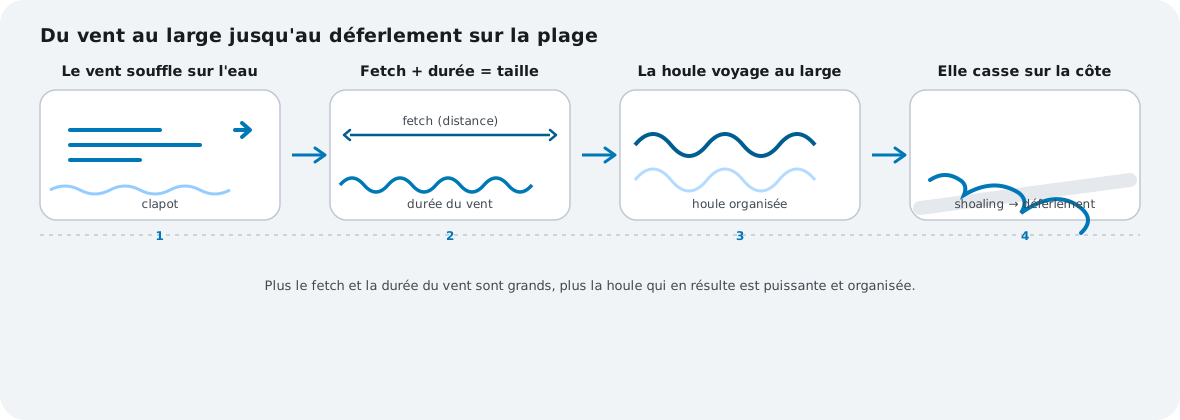
For as long as the wind keeps blowing over it, the sea stays choppy: short, steep, disorganised little waves peeling off in slightly different directions depending on the gusts. This is what's known as a wind sea, easy to spot by its hashed-up, unpleasant surface.
Once those small waves leave the area where they were generated – because the wind drops, or because they've travelled on ahead of it – they stop being fed by the local wind and start to organise themselves. The longest waves (those with the greatest period, the time between two crests) travel faster than the shorter ones and gradually take the lead: the chaotic chop sorts and smooths itself out into swell, a series of regular, parallel lines capable of crossing an entire ocean while losing very little energy.
Windswell vs groundswell
Not all swells are equal, and the difference shows up directly in their period. Our guide to wave types looks at that from the beach; here we come at it from the source.
💨 Windswell
Generated by wind that's close by and fairly recent, with limited fetch or duration, windswell has a short period, generally under 10 seconds. It hasn't had time to organise itself properly, so the waves arrive closer together, less regular, and lose energy quickly once the wind eases off.
🌊 Groundswell
Produced by a powerful, long-lived storm, often thousands of kilometres from the spot, groundswell has had time to sort its waves out over distance: its period usually runs to 12–16 seconds or more. A swell at that period carries energy deep down, several hundred metres below the surface, which makes it far more powerful, cleaner and more regular once it reaches the coast than any windswell of the same reported height.
On a marine forecast, two swells listed at the same height won't give you anything like the same session if their periods differ. A 1.5 m swell at 8 seconds will be soft and underpowered; the same height at 14 seconds will produce noticeably hollower, faster waves.
The swell's journey across the ocean, and why it breaks on the coast
Once organised, swell can cover huge distances while losing very little energy, provided it stays in deep water – meaning a depth greater than roughly half its wavelength, at which point it still can't feel the seabed. That's how a storm out beyond Newfoundland can generate the swell that, a few days later, breaks on the beaches of Cornwall or North Devon.
The journey ends once the swell reaches increasingly shallow water as it nears the coast. This is called shoaling: as it starts to feel the bottom, the wave slows down, its wavelength shortens and, to conserve its energy, its height builds. The wave gets steeper and steeper until its slope goes beyond what it can hold – as a rule of thumb, once the wave's height reaches around a seventh of its wavelength, or the water depth becomes roughly equal to its height. At that point, the wave breaks.
It's this same underwater terrain – sandbanks, a rocky point, a reef – that also decides how the wave breaks once it gets there: that's the whole subject of our guide to wave types in surfing (beach break, point break, reef break), which picks up exactly where this one leaves off.
❓ Frequently asked questions about how waves are formed
What causes waves?
Wind blowing across the surface of the water. As it rubs against the water, it transfers energy that first forms disorganised chop, then, if the wind blows hard enough, for long enough and over a big enough distance, that chop organises into swell that can travel thousands of kilometres.
What is fetch in marine weather?
Fetch is the distance over which the wind blows continuously, in a fairly constant direction and strength, across open water. Along with wind speed and duration, it's one of three factors that determine the size of the swell generated: the greater the fetch, the more powerful the swell can become.
What's the difference between windswell and groundswell?
Windswell has a short period, generally under 10 seconds: it comes from wind that's close by and recent, and produces less organised waves. Groundswell has a period of 12 to 16 seconds or more: it comes from a distant storm and has had time to organise itself while crossing the ocean, producing waves that are more powerful, cleaner and more regular.
Why do waves break when they reach the beach?
In deep water, a wave can't feel the seabed. As it nears the coast, it moves into increasingly shallow water – this is shoaling. Its speed decreases, its wavelength shortens and its height increases, until the wave becomes too steep to stay stable and it breaks.
Do tides cause waves?
No. Tides are caused by the gravitational pull of the Moon and the Sun, and raise or lower the general sea level over several hours. Waves, by contrast, are generated by wind and are measured in seconds. Tides do, however, affect how waves break at a given spot, by changing the depth of water above the seabed.