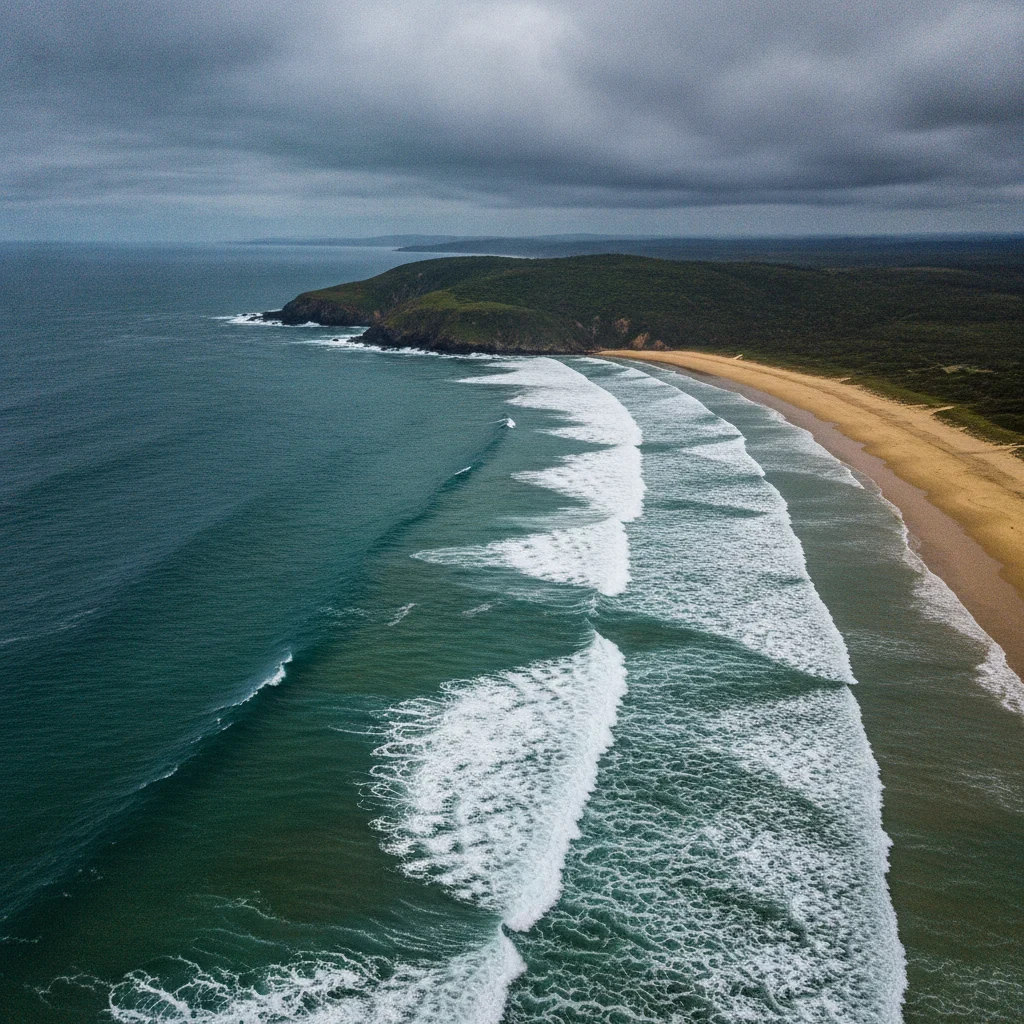

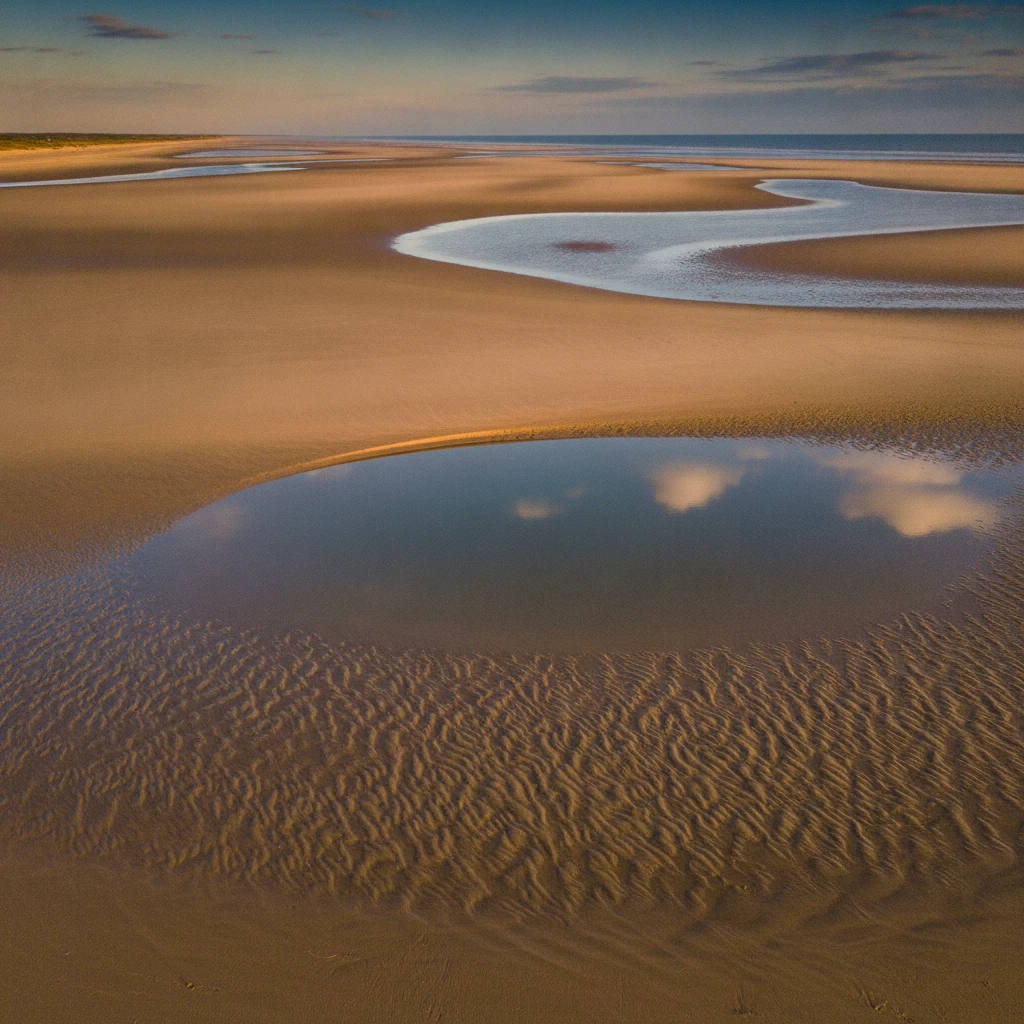
Twice a day, the sea rises, then falls again, sometimes uncovering hundreds of metres of sand. On a surf, kitesurf or paddleboarding spot, that single movement changes everything: the depth of the water, the strength of the currents, which sandbanks are exposed. But what actually moves all that water? The answer isn't out in the ocean – it's up in the sky, and it comes mostly from the Moon, not the wind that shapes your waves.
The Moon: the main driver of the tides
Tides are caused by gravity. Every massive object pulls on every other object, including the water in our oceans, and although the Moon is small, it's close enough to Earth for its pull to be felt across entire bodies of water. Where the ocean faces the Moon, it's tugged very slightly towards it, forming a bulge – a rise in sea level of anywhere from a few tens of centimetres to several metres, depending on the coastline.
What's less intuitive is that a second bulge forms exactly opposite the first, on the side of the Earth facing away from the Moon. This happens because the Moon also pulls on the solid Earth itself, slightly more strongly than it pulls on the water furthest away – that difference effectively leaves the far-side water behind, and it piles up into a second bulge. So at any given moment there are two water bulges on Earth, one facing the Moon and one directly opposite it.
Because the Earth takes roughly 24 hours and 50 minutes to complete one rotation (a little longer than a solar day, since the Moon is also moving along its own orbit), every point on the coast passes through both bulges once per rotation. That's why most coastlines see two high tides and two low tides a day.
The Sun: a second player, but a weaker one
The Sun is roughly 27 million times more massive than the Moon, but it's also about 390 times further from Earth – and gravitational pull falls away very quickly with distance. Put the two together and the Sun's tidal influence works out at only around 46% of the Moon's, a little under half. The Sun never creates tides on its own, then, but it does reinforce or weaken the Moon's effect depending on how the three bodies line up.
Spring tides and neap tides: the tidal coefficient
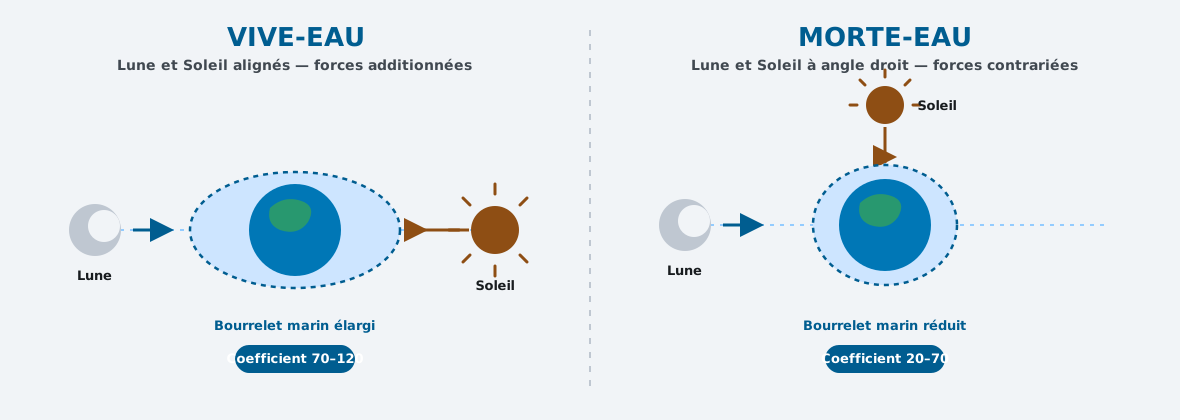
Over the course of the lunar month, the relative positions of the Moon, Earth and Sun keep shifting – and the size of the tides shifts with them.
🌕 Spring tides
At the new moon and the full moon, the Moon, Earth and Sun are roughly in line. The Moon's and Sun's pulls add together, producing a more pronounced bulge: the sea rises higher and falls lower than average. These are spring tides, with a big tidal range and powerful tidal currents.
🌗 Neap tides
At the Moon's first and last quarters, the Moon and Sun sit at a right angle to each other as seen from Earth. Their pulls partly cancel each other out, so the sea bulge is more modest: these are neap tides, with a smaller range and weaker currents.
French tide tables express this range with a handy shorthand: the tidal coefficient, a unitless number between 20 and 120. Below 70, it's classed as a neap tide; above 70, a spring tide. The higher the coefficient, the bigger the gap between high and low water – and the stronger the currents that come with the rising or falling tide. It's a French convention rather than something you'll see on a standard UK tide table, but the underlying idea – a single number for how big today's tide is – is well worth knowing if you ever check tide times on the French coast.
A high coefficient (spring tide) means more sand exposed at low water, but also stronger rip currents. Our surf safety guide covers how to spot a rip current and what to do if you get caught in one.
Why tides aren't the same everywhere
The two-bulge theory predicts a fairly uniform tidal range across the whole planet, but in practice, the range varies hugely from one coastline to the next: from just a few centimetres in the Mediterranean to over 14 metres in the Bay of Fundy in Canada, or up to 15 metres in the bay around Mont-Saint-Michel – one of the largest tidal ranges in Europe. The difference comes down to the shape of the coastline and the ocean basin: a bay that narrows gradually can funnel and amplify the incoming tide, while an almost enclosed sea like the Mediterranean simply doesn't have the room to build up a large range.
What tides change for surfing, kitesurfing and paddleboarding
Unlike waves, which are born from the wind and measured in seconds, as our guide to how waves are formed explains, the tide changes the general sea level over several hours. It's never created a single wave in its life, but it changes almost everything else about a spot:
- The depth of water above the seabed, which changes where and how waves break – a beach break can look completely different at high tide compared with low tide.
- Which sandbanks and rip channels are exposed, since they form and fill in again over the tidal cycle.
- Current strength, which is stronger at spring tides – worth factoring into your entry and exit points when paddleboarding or kitesurfing.
- Access to the spot itself: some beaches and tidal lakes are only usable at certain states of the tide.
That's why most surfers, kitesurfers and paddleboarders check the tide times and range before every session, just as routinely as they check the wind and swell forecast.
❓ Frequently asked questions about tides
What causes tides?
The gravitational pull of the Moon, backed up by the Sun. The Moon, being far closer, pulls on the oceans roughly twice as strongly as the Sun does. This pull slightly deforms the mass of water and creates two bulges – one on the side facing the Moon, another on the opposite side – which the Earth's rotation carries past every point on the globe roughly twice a day.
Why are there two high tides a day?
Because there are two water bulges, not one: one on the side of the Earth facing the Moon, and another on the opposite side. As the Earth spins on its axis roughly every 24 hours and 50 minutes, every point on the coast passes through both bulges, giving most coastlines two high tides and two low tides a day.
What are spring tides and neap tides?
Spring tides happen at the new moon and full moon, when the Moon, Earth and Sun are roughly aligned: the Moon's and Sun's pulls add together, producing large tides with a big tidal range. Neap tides happen at the first and last quarter moons, when the Moon and Sun sit at right angles to the Earth: their pulls partly cancel each other out, and the tides are smaller.
How do you read the tidal coefficient?
French tide tables express tidal range using the tidal coefficient, a number between 20 and 120 that shows how big a given tide is compared with an average one. Below 70, it's a neap tide, with a modest range. Above 70, it's a spring tide, with a big range. The higher the coefficient, the higher the sea rises and the lower it falls, and the stronger the tidal currents.
Do tides cause waves?
No. Waves are generated by wind, as explained in our guide to how waves are formed, and are measured in seconds. Tides raise and lower the general sea level over several hours. They don't create waves, but they do change the depth of water above the seabed, which changes how waves break at a given spot.