

📍 Palau, Sardinia, Italy
Photo: Lory2k / Wikimedia Commons, CC BY 3.0
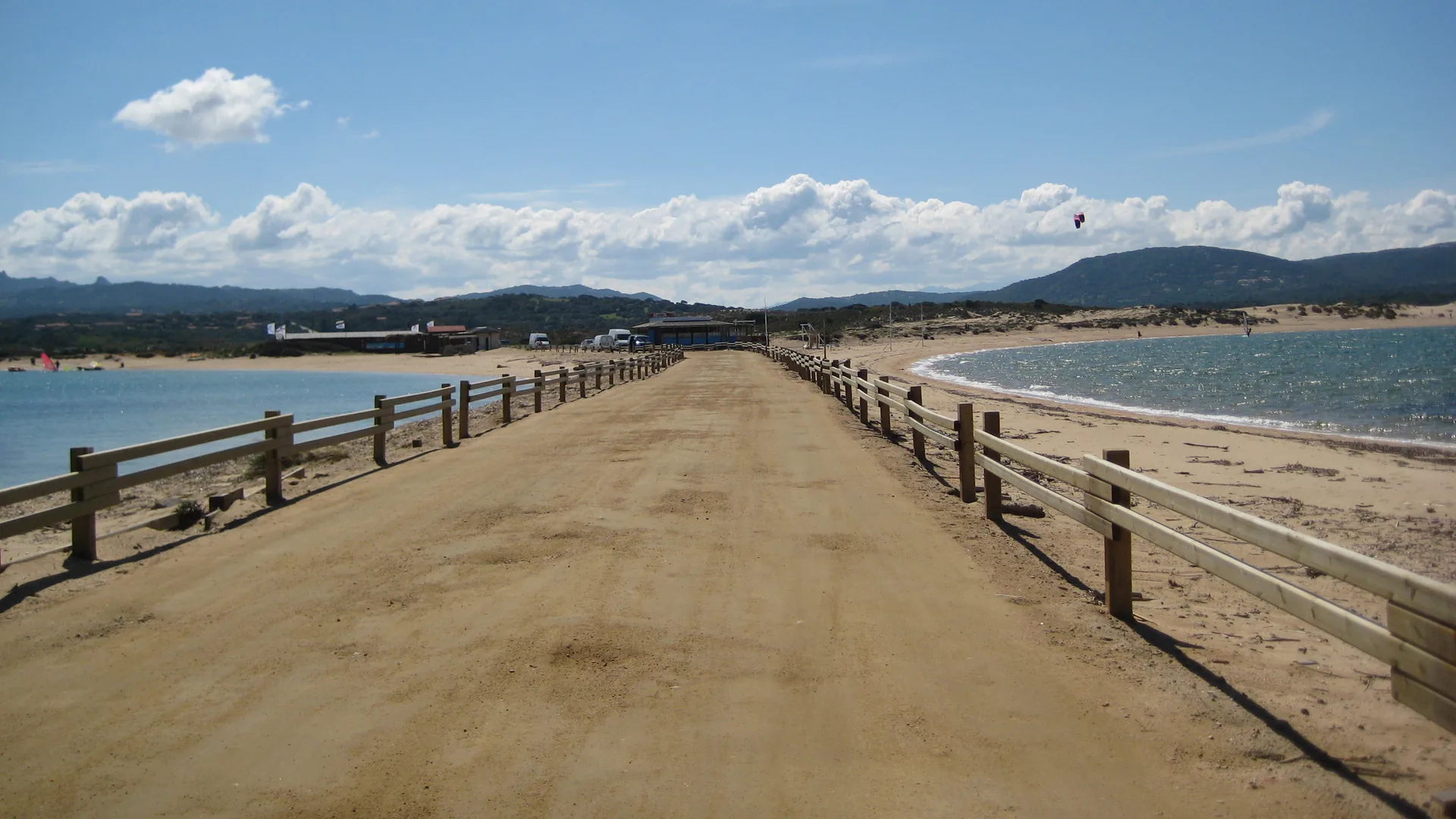
An isthmus between two stretches of water, in the Strait of Bonifacio, between Palau and Santa Teresa Gallura.
The sandbar linking the mainland to the Isola dei Gabbiani (Isuledda) separates two bodies of water. Spot guides describe one side as staying smoother and the other as more exposed to chop, depending on the day's wind — always confirm on site, never from an old write-up.
Spot geography arrow_forward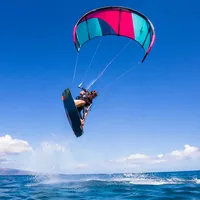
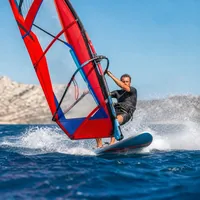
Porto Pollo is first and foremost a wind spot: windsurfing is the historic activity here, wing foiling has grown, and kitesurfing is mostly associated with Porto Liscia, west of the isthmus. It is not a groundswell surf destination.
Which sport to practise arrow_forward
A 200 m band off sandy coastline (100 m off rocky coastline) is reserved for swimming, and transit is forbidden there outside marked launch corridors. Check the day's signage before you rig up.
Safety & regulations arrow_forwardWhat can be stated about Porto Pollo's geography, and what still counts as spot-level observation.
Porto Pollo sits between Palau and Santa Teresa Gallura, on the northern coast of Sardinia, near the mouth of the Liscia river. Its appeal rests on an isthmus that links the mainland to the Isola dei Gabbiani, also called Isuledda, and separates two bodies of water. This geography offers a genuine choice depending on the wind and the activity of the day, rather than a promise of uniform conditions.
A scientific study conducted in the strait between Corsica and Sardinia describes a north-westerly wind, the mistral, channelled and accelerated by the orography of the Strait of Bonifacio. That study describes the mechanism at the scale of the strait; it does not provide daily measurements specific to the Porto Pollo beach. Local centres add that the hills around the site further boost the wind locally — an operator's observation, which should not be elevated to institutional weather data.
One local centre also cites the tramontana, ponente and scirocco among usable directions, with a force range it markets as 4 to 8 Beaufort. Without a published measurement series, Matosurf does not repeat that figure as a statistic. What can be stated is this: Porto Pollo benefits from several wind regimes, and the strait's relief can boost north-westerly episodes — always check local forecasts before choosing your bay and kit size.
| Name | What can be stated |
|---|---|
| Porto Pollo | The name of the site as a whole and, in specialist guides, of the bay east of the isthmus — historically associated with windsurfing. |
| Porto Liscia | A distinct bay west of the isthmus according to specialist sources, straddling Palau and Santa Teresa Gallura; the zone most often associated with kitesurfing. Never merge it into "Porto Pollo". |
| Isola dei Gabbiani / Isuledda | Two names used for the peninsula linked to the mainland by the isthmus. |
| Barrabisa | A local usage name for the Porto Liscia beach in some kitesurf guides; no precise administrative boundary was found, so it is presented as a usage name, not a third, standalone spot. |
The directional labels "Baia di Levante" and "Baia di Ponente", sometimes seen elsewhere, were not found in a mapped administrative source: Matosurf does not use them as sub-spot titles until confirmed.
Historic windsurfing, kitesurfing mostly at Porto Liscia, wing foiling on the rise — and not a surf trip.
Windsurfing is the most solidly documented activity at Porto Pollo. Local centres offer lessons, rental and storage; specialist guides describe a contrast between smoother water on the leeward side and chop, or even small wind waves, on the other side depending on the day's flow. The seabed and beaches are described as sandy in the spot guide consulted, but no consistent bathymetry for the whole area was found: don't assume a constant depth from this. On a first trip, ask a centre where the permitted launch point is that day, especially during the peak swimming season.
Specialist guides single out the bay of Porto Liscia, west of the isthmus, as the zone associated with kitesurfing, while describing the Porto Pollo bay to the east as mainly dedicated to windsurfing. Two Capitaneria di Porto di La Maddalena ordinances specifically govern windsurfing, kitesurfing and teaching at Porto Pollo and Porto Liscia; the Palau municipal maritime-domain regulation cites them and states that kitesurf teaching is permitted only on Porto Liscia beach. The full, up-to-date text of those ordinances was not found. So don't treat this split as mere tourist advice: check it on arrival with the school, on the signage, and against the corridors actually installed on the day of your session.
Wing foiling is offered as lessons, and sometimes rental, by several centres on the site. Spot descriptions allow for water that is sometimes smooth and sometimes choppy depending on the side of the isthmus and the day's wind, but they do not support guaranteeing an isolated wing-foil zone or a corridor dedicated to the discipline. Check the day's setup before rigging up.
SUP is offered for rental or within the activity offering of some operators on the site. Porto Pollo remains known first and foremost for the wind, though: SUP mainly makes sense during calm slots, with particular attention to the forecast, sports traffic and swimming zones. No distinct local rule specific to SUP was found in the texts consulted.
The sources examined document Porto Pollo for windsurfing, kitesurfing, wing foiling, SUP and sailing, with small wind waves in some configurations. They do not document regular groundswell surf or a dedicated surf offering. Porto Pollo can occasionally offer choppy water, but it should not be presented as a surf destination on a par with an established Sardinian wave spot.
See also: Lo Stagnone, the shallow lagoon near Marsala, in our Sicily guide, for another Italian wind spot.
A spot where the side of the isthmus and the day's wind regime matter more than rider level alone.
| Profile | Recommendation | Why |
|---|---|---|
| Absolute beginner | Book a lesson; don't attempt an unsupervised launch. | The site can see strong wind, and access is governed by swimming zones and corridors. Several local centres advertise beginner courses. |
| Progressing beginner | Choose the side and time slot with the school; favour moderate conditions. | Local sources describe smoother water configurations on one side of the isthmus, but wind strength varies widely with the regime. |
| Intermediate | Interesting for alternating control on smoother water with navigating chop. | The double bay allows for different sea states; that's no guarantee, and the zone's regulations still come first. |
| Advanced, strong wind | A relevant spot with suitable kit, an accurate read of the forecast, and strict respect for the zones. | The Strait of Bonifacio is affected by orographic wind acceleration; strong episodes change the level of commitment quickly. |
Operators with an official page live at the time of verification — hours, stock and zones should be reconfirmed before booking.
| Operator | Activities | Published location |
|---|---|---|
| Wind Porto Pollo | Kitesurfing, windsurfing, wing foiling lessons. Rental not explicitly confirmed on the page reviewed. | Strada Isola dei Gabbiani, Palau |
| PKS Porto Pollo | Lessons and rental for kite, wing foil, windsurf, SUP and e-foil. | Località Porto Pollo, 1 (kite); Strada per Isola dei Gabbiani (wing/windsurf/SUP), Palau |
| Sporting Club Sardinia | Sailing, windsurfing, kitesurfing, wing foiling, SUP and surf listed; separate "lessons" and "rental" sections, availability to confirm. | Località Porto Pollo, Palau (OT) |
Always confirm hours, stock, teaching zones and rental terms directly with the centre before booking.
The Capitaneria di Porto di La Maddalena rules to know before launching.
The general rule applying to the coastline under the Capitaneria di Porto di La Maddalena, which covers Palau and Santa Teresa Gallura, reserves a band of 200 m from sandy coastline and 100 m from rocky coastline for swimming. Within this band, bathing safety ordinance no. 072/2026 forbids transit by craft — explicitly naming windsurfing and kitesurfing — except where exceptions or dedicated arrangements apply.
Launch corridors, where authorised and installed, are public. The text specifies a width of 20 m, which may be reduced to 10 m or increased subject to authorisation, over a length at least equal to the swimming band, i.e. 200 m. Windsurf boards must cross them at reduced speed with the utmost care; for powered craft, the limit is three knots. Swimming is forbidden within them.
Rule of thumb. Never cross a swimming zone or a corridor based on a map, memory or an old guide. Locate the buoys, signage and access points actually open on the day of your session; if in doubt, ask the school or the local authority for instructions.
The Regione Sardegna defines a summer bathing season running from 1 April to 31 October. The Capitaneria's safety ordinance applies, for its main rules, a bathing season running from the third week of May to the third week of September, with a lifeguard service required during that period. These two calendars don't cover the same thing: don't infer an automatic ban or permission outside either period from their overlap.
Those ordinances are no. 38/2016, amended by ordinance no. 20/2017: they are issued by the Capitaneria di Porto di La Maddalena, not by the town hall, even though it is the municipal maritime-domain regulation that lists them. The current full text and zone mapping were not found during this research, so this page deliberately does not state a precise corridor position, a zone reserved exclusively for one discipline, a mandatory leash, or a specific school arrangement. Check these points against on-site signage or with the Capitaneria and the schools.
In a maritime emergency, the Capitaneria lists 1530; the single national emergency number is 112.
A realistic practice window, not a month-by-month wind promise.
The simplest window for planning a trip generally runs from spring to autumn. One specialist guide places the visiting season from April to October and mentions particularly frequent planing days around April, May, October and November; that guide dates from 2016, however, and does not replace up-to-date local wind statistics.
Local operators, for their part, describe year-round practice, associating the ponente with summer and the scirocco with late summer and autumn. There is therefore a gap in the strength of evidence: no institutional wind dataset measured at Porto Pollo was identified that would solidly rank the best months. This page does not claim that spring or autumn are "windier" than July-August without local measurement to back it up.
| Period | What can be said | Water, indicative average |
|---|---|---|
| April–May | A realistic window for a trip; check forecasts and schools. | ~15.0°C (April), ~17.6°C (May) |
| June–August | Warmer water, but check crowding, corridors and parking. | ~21.4°C (June), ~24.6°C (July), ~25.5°C (August) |
| September–October | A good option subject to forecasts and centres being open. | ~23.8°C (September), ~21.0°C (October) |
| November–March | Not to be presented as a school or guaranteed-service season without direct confirmation. | ~13.5°C (February) to ~18.2°C (November) |
The temperature figures rely on a secondary provider that states it aggregates in-situ observations and satellite data over ten years. They are useful for preparing your kit but are not a regulatory wetsuit recommendation: no legal thickness requirement was found in the sources consulted. Ask your chosen centre for advice based on the forecast, exposure time and your own tolerance to cold.
Air access via Olbia, and a car to carry boards, wings and wetsuits.
Olbia Costa Smeralda Airport (OLB) is the most logical air access point for the area. Its operator places Palau 44 km from Olbia. A route planner estimates the airport-to-Porto Pollo road journey at around 45.7 km and 51 minutes; these figures are indicative and vary with traffic.
From Palau, Porto Pollo is reached by road heading north-west; the beach is signposted from the SS 133bis, crossing the Liscia river bridge. A car remains the most direct way to carry boards, wings and wetsuits. The regional network is mainly road-based; bus timetables should be checked directly with the operator before relying on them for bulky gear.
The municipal car park at Porto Pollo has 420 spaces. It is paid daily from 1 April to 31 October, 8am to 8pm, at €1.00 per hour for a car, €1.50 for a motorhome and €0.50 for a motorbike, according to the municipal page reviewed. This source does not measure saturation: it guarantees neither availability nor a congestion level. Plan for parking, but don't treat it as a reservation.
The most common doubts before a wind-sports trip to Porto Pollo.
Yes, provided you start with a school and let the instructor choose the zone and time slot. Porto Pollo offers beginner courses in windsurfing, kitesurfing and wing foiling, but the wind can be strong and swimming zones and launch corridors must be respected.
For planning a trip, the practical window generally runs from April to October. The available sources do not provide sufficient local institutional statistics to guarantee that one month is windier than another: build in a margin when choosing your dates, and check the forecast before you leave.
Yes, schools offer kitesurfing within the Porto Pollo complex. Specialist guides, however, single out Porto Liscia, west of the isthmus, as the kite zone: always check the signage, the open corridor and the school's instructions on the day of your session.
No thickness is required by the rules consulted. Published average water temperatures are around 15°C in April, 21.4°C in June and 25.5°C in August; choose your wetsuit based on the forecast, the wind and your own tolerance to cold.
Porto Pollo is first and foremost a windsurfing, kitesurfing and wing foiling spot. The sources consulted sometimes describe chop or small wind waves, but not a destination with regular groundswell surf; don't choose Porto Pollo for a dedicated surf trip.