

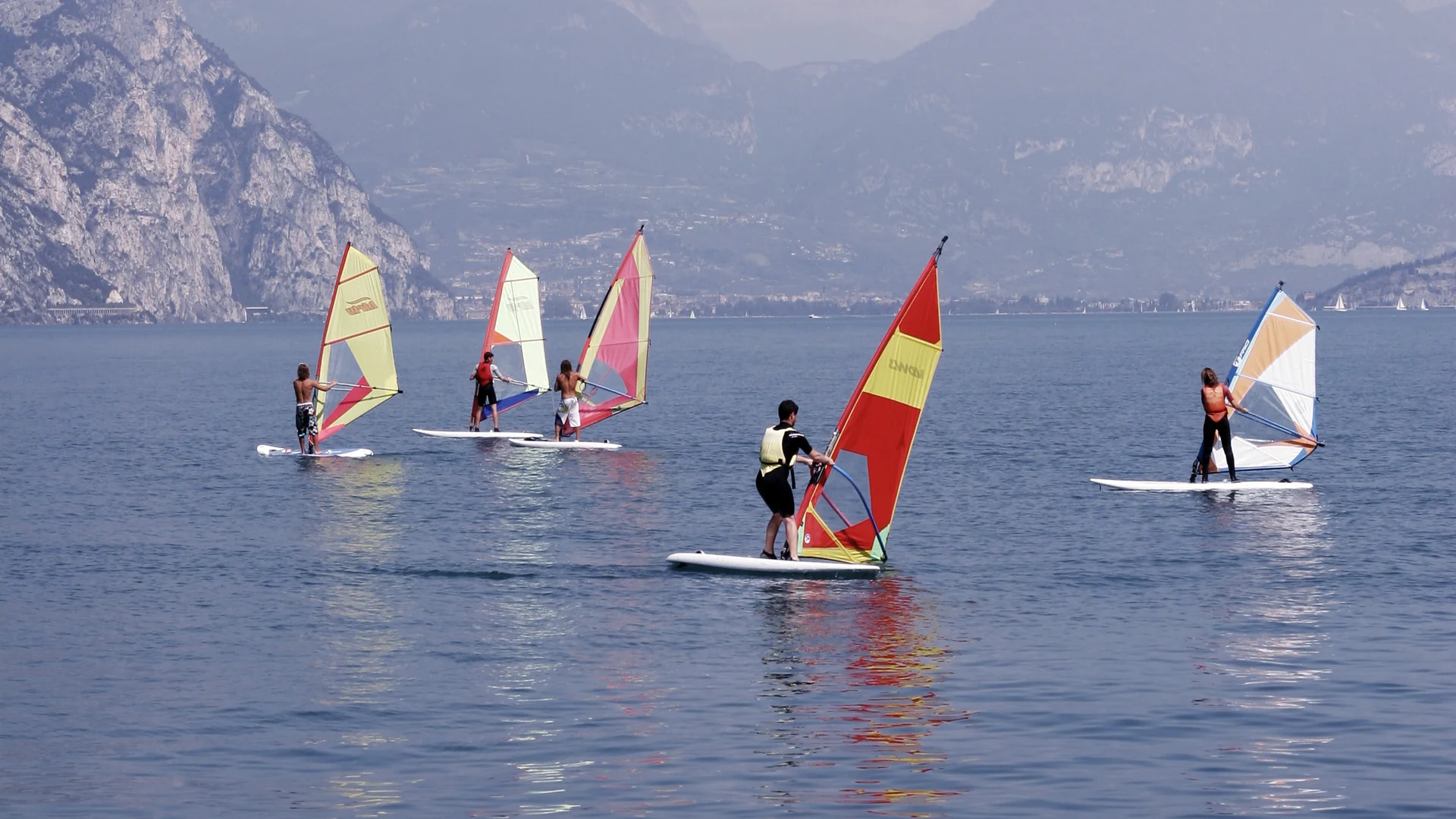
Italy isn't one watersports country — it's several, loosely tied together by a coastline and a lot of mountains. A thermal lake in the Alps, a wind-exposed isthmus in Sardinia, a shallow Sicilian lagoon built for learning: each answers a different kind of trip. This guide is here to help you pick where to go and when, before you head to the full destination guide for the details.
Why Italy has more than one kind of wind
Two very different wind systems drive most of what's covered here. On Lake Garda, around Riva del Garda and Torbole, a daily thermal cycle takes over on fair-weather days: the northerly Pelèr typically blows through the morning, and the southerly Ora picks up from around midday through to sunset, as documented by the local tourism board Garda Trentino. On the Sardinian coast, Porto Pollo — between Palau and Santa Teresa Gallura — gets a more open-water kind of exposure, with conditions that can differ noticeably from one side of the isthmus to the other. In Sicily, Lo Stagnone, the Marsala lagoon, adds a third profile: shallow water closed off by the Isola Grande, with a thermal wind several local schools describe as regular in season, making it a reference site for learning to kitesurf. Further north, Liguria is a different story again: a wave coast rather than a wind one, at its best from autumn into winter, with Varazze among the spots named by Italy's national tourism board, Italia.it.
Where to go, by discipline
| Destination | Setting | Best for |
|---|---|---|
| Lake Garda (Trentino) | Alpine lake, Pelèr/Ora thermal wind | Windsurfing, supervised kitesurfing, SUP |
| Porto Pollo, Sardinia | Exposed isthmus, open sea | Windsurfing, kitesurfing, wingfoil |
| Lo Stagnone, Sicily | Shallow lagoon, thermal wind, nature reserve | Kitesurfing, windsurfing, wing foiling, SUP |
| Liguria (Varazze, Levanto…) | Coast, autumn–winter swell | Wave surfing |
Lake Garda — Riva del Garda and Torbole
Lake Garda sits at the heart of most windsurf and kite trips to northern Italy, largely because its wind is unusually predictable for a lake. The Pelèr sets in from the north through the morning, and the Ora, from the south, generally takes over from around midday until sunset on settled days — a pattern the local tourism authority Garda Trentino tracks closely. SUP is well established here too, and kitesurfing is possible but locally regulated, with rules specific to the Garda Trentino area. Read the full Lake Garda guide.
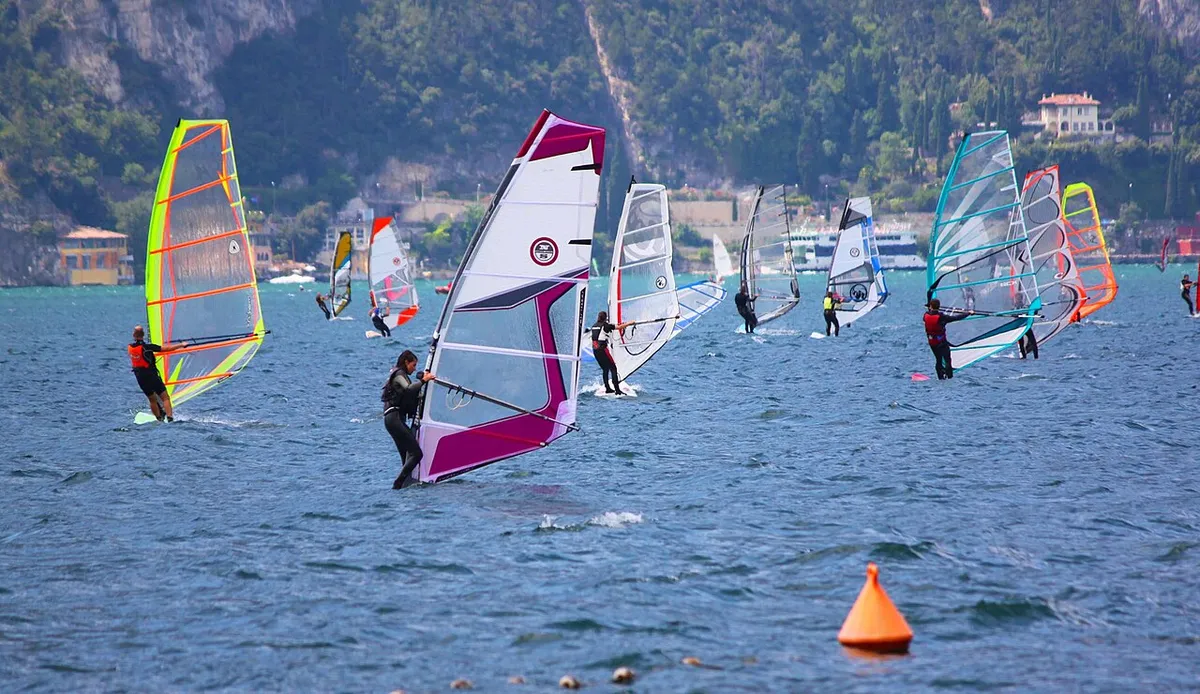

Porto Pollo, Sardinia
Porto Pollo sits between Palau and Santa Teresa Gallura, near the mouth of the Liscia river, on a sandy isthmus that reaches out to the Isola dei Gabbiani. Sardinia's official tourism board, SardegnaTurismo, describes it as a consistently wind-exposed setting used for sailing, windsurfing and kitesurfing, with conditions that can differ from one side of the bay to the other — sometimes flat water, sometimes a livelier, wave-friendly stretch. Read the full Porto Pollo guide. Over 100 km south, on the Sulcis coast, Porto Pino is a very different spot: white dunes, a summer regulation worth knowing about, and a wave-focused profile rather than flat water. Read the full Porto Pino guide.
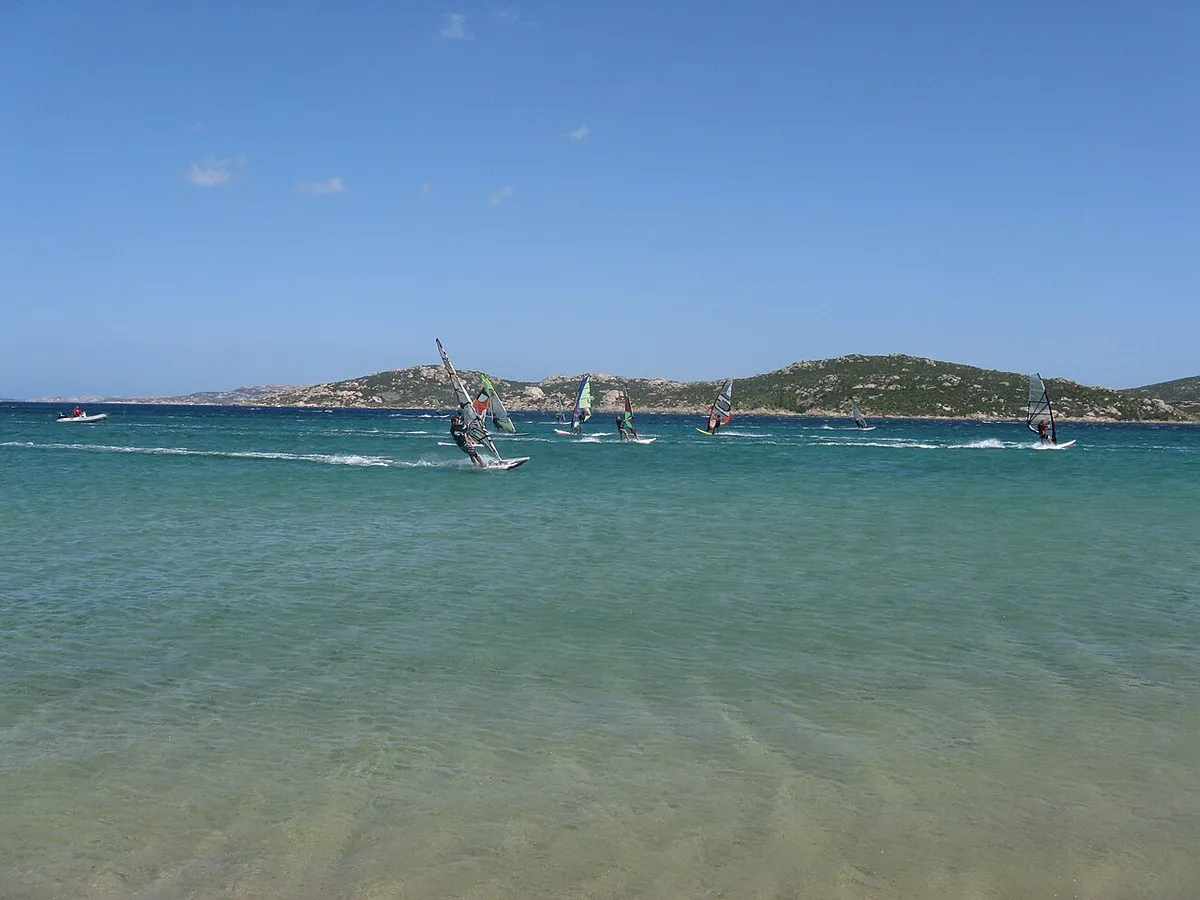

Sicily — Lo Stagnone, the Marsala lagoon
Between Marsala and Trapani, on Sicily's west coast, Lo Stagnone is a shallow lagoon closed off by the Isola Grande, lined with saltpans and windmills. Several local schools describe a thermal wind that's regular in season, making it one of Europe's most documented kitesurf and windsurf learning sites — inside a regional nature reserve whose rules must be respected. Read the full Sicily guide.
When to go windsurfing and kitesurfing in Italy
Garda and Porto Pollo don't run on the same calendar. The Pelèr/Ora cycle needs settled weather to show up reliably, and Garda Trentino describes it as strongest in summer — outside a stretch of fair days, check the local forecast rather than assuming the pattern will appear. Porto Pollo's exposure is more a feature of the site than a narrow season, though a current forecast still matters before any session. Liguria's surf, by contrast, is really an autumn-to-winter proposition, when swell builds along the Riviera di Ponente — and Sardinia has its own recognised wave coast too, around Capo Mannu, which we'll cover in its own guide.
The one thing to get right: there's no single Italian rule
Italy doesn't set one national distance or launch rule for wind and kite sports. Rules sit in layers: a national framework, then a local ordinance from the Capitaneria di Porto (the coastguard authority) covering that stretch of coast, and sometimes municipal or protected-area restrictions on top. Lake Garda adds another layer again — its shoreline is split between Trentino, Veneto and Lombardy, so the kitesurf rules Garda Trentino publishes (an approved lift provider, a minimum distance from shore, set seasonal hours) apply to that stretch of the lake, not the whole thing. Always check the current rule on your destination's own guide before you launch. For a maritime emergency, call 1530 (the Guardia Costiera's free number) or 112, the emergency number that works everywhere in the EU.
Gear notes
Water temperature swings a long way across the country and the year. Off Sardinia and in the northern Mediterranean, sea-surface readings sit around 13°C in the depths of winter and can climb past 26–27°C in high summer, based on NOAA's offshore climatology. A 4/3mm or thicker suit covers the cold end of that range, a 3/2mm handles the shoulder seasons, and a lycra top can be enough in summer. For Lake Garda, skip the sea-temperature maths altogether and check a current reading instead — the Alplakes research platform publishes up-to-date lake temperature data and forecasts.
FAQ
It depends mostly on your discipline. Lake Garda, around Riva del Garda and Torbole, is the reference for windsurfing and supervised kitesurfing thanks to its daily thermal wind. Porto Pollo, in Sardinia, offers open-water wind exposure for windsurfing, kitesurfing and wingfoil. Lo Stagnone, the Sicilian lagoon at Marsala, adds a third profile: shallow water and a thermal wind described as regular in season, both well suited to learning. Liguria and Sardinia also hold Italy's best-known surf spots, on a different calendar from the wind destinations above.
It depends on the area and the level of instruction. The Pelèr/Ora rhythm, documented by Garda Trentino, makes planning easier: the northerly wind tends to dominate the morning, the southerly takes over around midday. For kitesurfing, Garda Trentino requires an approved lift provider, a minimum distance from shore and set time slots — rules specific to that part of the lake, worth checking before every session.
No. Italy doesn't set a single distance threshold that applies nationwide. Rules sit in layers: a national framework, a local ordinance from the Capitaneria di Porto covering that stretch of coast, and sometimes municipal or protected-area restrictions on top. On a lake like Garda, the authority also changes depending on the shore. Always check the current rule on your destination's own guide before you go out.
It depends on the destination. At Lake Garda, the Pelèr/Ora thermal cycle needs settled weather and shows up most reliably in summer, according to Garda Trentino. Porto Pollo stays open to the wind year-round, provided you check a current forecast. For surfing, Liguria is mostly an autumn-to-winter destination, when swell is at its most consistent.
112 is the single emergency number that works across the whole European Union, Italy included. At sea, the Guardia Costiera also runs 1530, a free number dedicated to maritime emergencies, which connects you to the relevant maritime authority.