

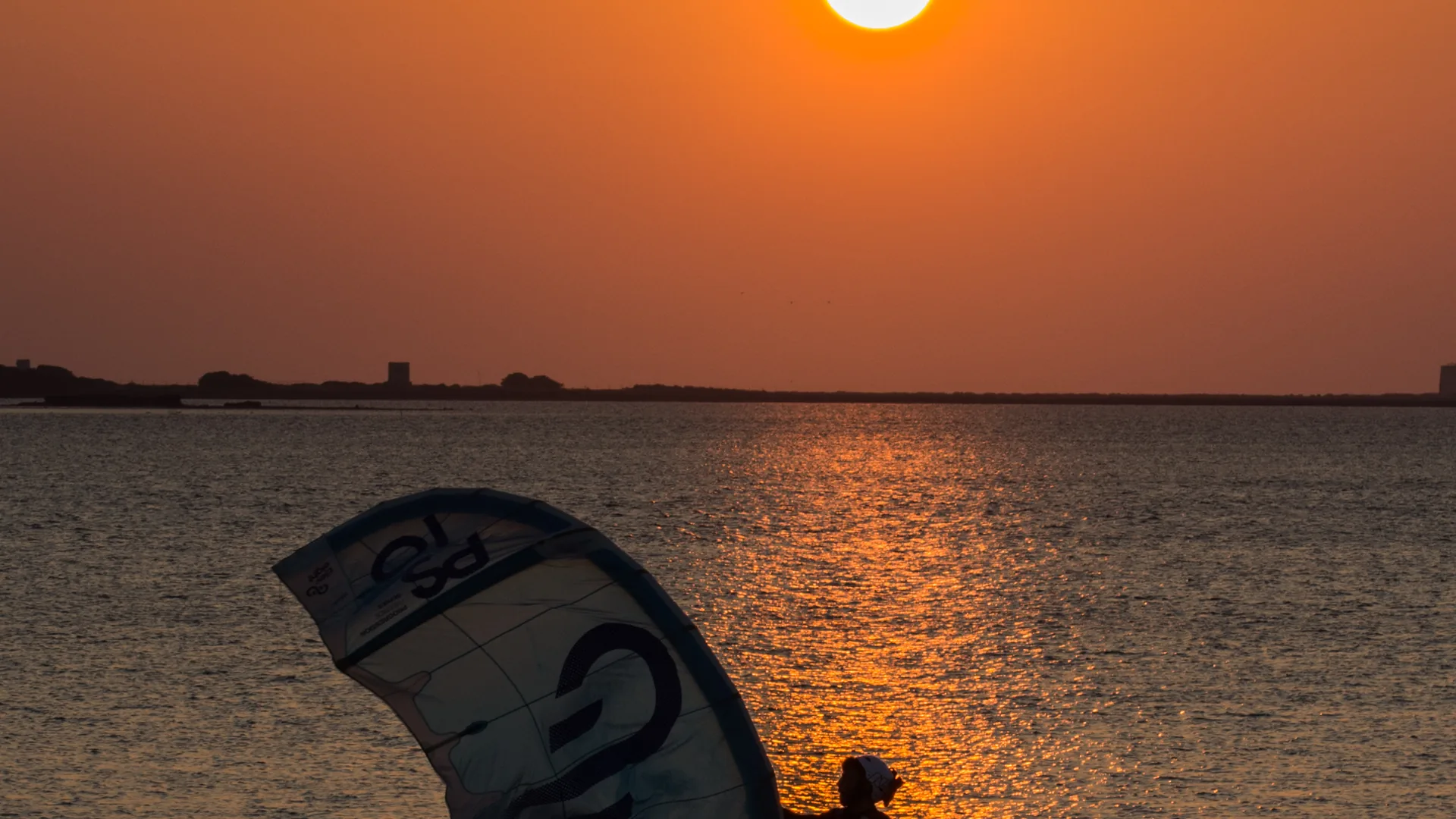
📍 Marsala, Sicily, Italy
Photo: Gianclaudio Marino / Wikimedia Commons, CC BY-SA 4.0
Between Marsala and Trapani, on Sicily's west coast, the lagoon that built Italy's kitesurf reputation.
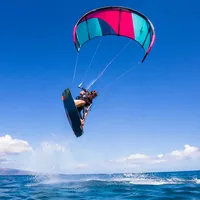
The lagoon is closed off by the Isola Grande, which separates it from the open sea. Average depth sits around 1 m according to the geographic sources reviewed, with 20-30 cm shallows in the north and deeper stretches to the south — plenty of room to learn standing up.
Spot geography arrow_forward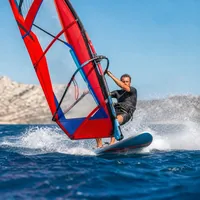
Kitesurfing is the most documented discipline, but several schools also offer windsurfing, wing foiling and SUP. It's not a groundswell surf destination: the lagoon is closed off, with no open-sea waves.
Which sport to practise arrow_forward
Lo Stagnone sits inside the Riserva Naturale Orientata "Isole dello Stagnone di Marsala". An ordinance from the Ufficio Circondariale Marittimo di Marsala sets distance and equipment rules specific to kitesurfing, to check before every session.
Safety & regulations arrow_forwardWhat can be stated about Lo Stagnone's geography, its islands, saltworks and wind.
Lo Stagnone di Marsala is Sicily's largest lagoon, on the island's west coast, between Cape San Teodoro and Cape Boeo (Lilibeo), within the municipality of Marsala, Trapani province. According to Wikipedia, a sand deposit closed off a stretch of sea that was once open, forming the current lagoon and its barrier island, the Isola Grande (also called Isola Lunga), which separates it from the open sea. Three smaller islands sit inside: San Pantaleo, home to the Phoenician archaeological site of Mozia, Santa Maria and Schola.
The geographic sources reviewed describe an average depth of around 1 m, with a minimum of 20-30 cm in the northern part and a maximum around 3 m in the south. Several kitesurf schools and spot guides, on the other hand, describe a lagoon that never exceeds 1-1.4 m, even in the deepest zones they actually use. These two descriptions don't necessarily contradict each other — one is the lagoon's overall depth, the other is the zone schools actually work in — but no single, institutionally sourced bathymetry was found to settle the question: don't rely on one figure, and check the actual depth with your school on the day.
The lagoon holds the coastal saltpans of San Teodoro, Genna and Ettore e Infersa, still worked using traditional methods according to Marsala's official tourism portal. Several windmills (mulini a vento), historically used to pump water and grind salt, dot the landscape; some have been restored and are still set in motion for public openings. This saltpan-and-windmill scenery isn't just backdrop: it sits inside the reserve's protected boundary, which is why the navigation rules below apply.
A spot built around kitesurfing, but not limited to it.
Lo Stagnone is one of Europe's most documented kitesurf learning spots, thanks to the combination of shallow water and a thermal wind several local schools describe as near-daily in season. Specialist spot guides stress this teaching advantage: you can stand up in many spots, which limits drift risk if your kit fails. The same guides also flag the risks that come with shallow water: don't jump high over a bottom that's sometimes close, wear booties to protect against rocks and seagrass, and stay alert to the occasional jellyfish.
Several schools on site explicitly advertise windsurfing, wing foiling and SUP alongside kitesurfing — that's the case for Salina Kite School and WaterSports Academy, which offer all four disciplines for lessons and rental, and for Stagnone Kitesurf, which adds windsurfing and SUP to its kite offering. A dedicated windsurf school, run by a Federazione Italiana Vela-qualified instructor, is also based facing Santa Maria island according to the search results reviewed. This range is real, even though the site's tourism marketing stays heavily focused on kitesurfing.
Lo Stagnone is a lagoon closed off by the Isola Grande: it doesn't receive open-sea swell. No source reviewed documents wave surfing at the site. Don't choose Lo Stagnone for a dedicated surf trip.
A spot built for learning, but where reserve regulations apply to everyone, beginner or advanced.
| Profile | Recommendation | Why |
|---|---|---|
| Absolute beginner | Book a lesson; don't rig up alone. | The local ordinance requires specific supervision within the first 200 m inside the reserve; schools know the on-foot protocol to follow. |
| Progressing beginner | Use the shallow water to rack up sessions under supervised independence. | Spot guides present exactly this teaching advantage as the site's trademark. |
| Intermediate | A good spot to progress safely, respecting corridors and swimming zones. | The thermal wind is described as regular in season, without institutional statistics specific to the site. |
| Advanced, freestyle | Valued for flat water, less so for open-sea performance. | Flat water and steady wind suit freestyle and freeride; it's not a wave spot. |
Operators with an official page live at the time of verification — hours, stock and zones should be reconfirmed before booking.
| Operator | Activities | Published location |
|---|---|---|
| Salina Kite School | Lessons and rental for kitesurfing, windsurfing, wing foiling and SUP, all levels. | C/da Spagnola 112/q, Marsala |
| WaterSports Academy | Kitesurfing, windsurfing (incl. foil and wing), wing foiling and SUP, individual lessons and rental. | Lo Stagnone di Marsala |
| Stagnone Kitesurf | Kitesurfing (IKO/FIV), windsurfing, surf instruction and SUP; kite equipment rental. | C/da Birgi Clemente, Lo Stagnone, Marsala |
| Kite Tour Stagnone (KTS) | Kitesurf lessons only (base, advanced, IKO assistant), from age 12. | Contrada Spagnola 86a-87, Marsala |
Always confirm hours, stock, teaching zones and rental terms directly with the centre before booking.
A regional nature reserve plus a maritime ordinance specific to kitesurfing: two layers of rules to know before launching.
Lo Stagnone sits inside the Riserva Naturale Orientata "Isole dello Stagnone di Marsala", one of Sicily's earliest protected areas, established in 1984 by regional decree (D.A. no. 215 of 04/07/1984) over roughly 2,012 hectares. It's managed by the Libero Consorzio Comunale di Trapani (the former Provincia Regionale di Trapani), according to the Regione Siciliana's protected-areas portal. The site is also listed under the EU's Natura 2000 network, as a Special Area of Conservation ("Isole dello Stagnone di Marsala") and a Special Protection Area ("Stagnone di Marsala e Saline di Trapani").
On the maritime side, the competent authority is the Ufficio Circondariale Marittimo di Marsala, part of the Capitaneria di Porto di Trapani — a different authority from the one covering Porto Pollo in Sardinia, which sits under the Capitaneria di La Maddalena: every stretch of Italian coast has its own competent Capitaneria. Based on the cross-checks made for this page, this office issued a bathing-safety ordinance in 2019 (no. 1/2019) that sets rules specific to kitesurfing, detailed by a local specialist school in its own write-up of the text.
What this write-up of Ordinance 1/2019 describes: practice allowed from age 14, in daylight and favourable conditions only; under-18s must be under the direct responsibility of an adult. Sailing is only permitted beyond 300 m from shore generally, reduced to 200 m inside the nature reserve, with a two-stage protocol: on foot or holding the board between 0 and 100 m, then progressing perpendicular to the shore towards the 200 m mark with the kite powered or body-dragging beyond that. Kit must include a certified helmet, a maritime-authority-approved vest, a quick-release system and a line-cutting tool. Hydrofoil use is said to be banned in the reserve due to shallow depth, and launching from jetties with the kite powered up is said to be forbidden.
What the same write-up says about schools: instructors must hold an FIV, IKO or VDWS qualification and wear a red "INSTRUCTOR" vest, students wear an identifiable colour vest; a first-aid post within 100 m, a rescue means (or a floating platform inside the reserve), a coordination plan approved by the maritime authority, and a named staff declaration filed with the office.
A note on the source. This detailed description comes from a local kitesurf school's own presentation of Ordinance 1/2019 on its site, not from the Guardia Costiera's official text consulted directly: that primary text was not found during this research. A local press article (tp24.it, 2024) confirms this ordinance exists, alongside earlier rules dating back to 2000, while noting that enforcement on the ground is said to be uneven. So check these figures and requirements directly with the Ufficio Circondariale Marittimo di Marsala or your school before any session, rather than relying on this page alone.
In a maritime emergency, the Guardia Costiera lists the free number 1530, staffed 24/7 nationwide; the European single emergency number 112 also works in Italy.
A thermal wind documented by schools, without an institutional statistic specific to the site.
Local schools place the most reliable window from May to September, with a thermal wind that, per their own marketing, sets in five to six days a week and typically reaches 10-20 knots on summer afternoons. Some specialist spot guides widen that window to March-October, while another claims the site stays windy year-round, including winter, thanks to varied wind directions. These commercial or community sources disagree on how wide the season really is, and no institutional measurement series specific to Lo Stagnone was identified to settle it. Always check a current forecast before booking a trip.
Late in the season, several guides mention stronger episodes linked to the Sirocco (a warm south-easterly wind out of North Africa) and the Mistral/Maestrale (a cooler north-westerly): these are different regimes from the summer thermal wind, worth planning for with suitable kit if you ride in autumn.
| Period | What can be said | Water, indicative average |
|---|---|---|
| March–April | Early season per some guides; wind less established than in summer. | ~14.3°C (February, the year's low) to ~16°C |
| May–September | The window most cited by local schools for thermal wind. | ~16.2°C (spring) to ~25.6°C (August, summer peak) |
| October | End of the window per some guides; Sirocco and Mistral episodes possible. | ~22°C (autumn average) |
| November–February | Presented as rideable by some operators, but with no confirmed school opening; check directly. | ~15.6°C (winter average) to ~14.3°C (February) |
The temperature figures rely on a secondary, non-institutional sea-data provider, which places Marsala's annual average around 19.2°C and the comfortable swimming season (above 20°C) between June and November. They help with packing, but don't replace a current local forecast.
The nearest airport sits just a few kilometres from the lagoon.
Trapani-Birgi "Vincenzo Florio" Airport (TPS) is the most direct air access point: according to Marsala's official tourism portal, it sits about 14 km from central Marsala and 20 km from Trapani, in the Birgi district — south of the lagoon itself. Wikipedia describes it as roughly equidistant between the two towns. No official road-route figure specific to the lagoon was found, but several schools based on site quote a drive of roughly 15-20 minutes from the airport — figures consistent with the site's immediate proximity, to confirm against your own route.
A car remains the most practical way to carry boards, wings and wetsuits: several schools have their own on-site parking. The local network is mainly road-based between Marsala, Trapani and the lagoon; bus timetables should be checked directly with the operator before relying on them for bulky gear.
The schools listed above each have their own access point to the lagoon, with on-site parking and rigging space according to their official pages. No consolidated figure for the site's total parking capacity was found: check directly with your chosen school, especially in peak season.
The most common doubts before a wind-sports trip to Lo Stagnone.
Yes, that's a big part of its reputation. Shallow water and a thermal wind that's more reliable in summer make it one of the most documented kitesurf and windsurf learning spots around, provided you go through a school: the lagoon is also a nature reserve, with precise distance and equipment rules that apply from your very first manoeuvres.
Local schools place the most reliable window from May to September, with a thermal wind they describe as near-daily. Some spot guides widen that window to March-October, or even claim year-round wind thanks to autumn and winter regimes. These sources disagree on how wide the season really is, and no institutional wind statistic specific to the site was found — always check a current forecast before you go.
Yes. The lagoon sits inside the Riserva Naturale Orientata "Isole dello Stagnone di Marsala" nature reserve, and the Ufficio Circondariale Marittimo di Marsala, part of the Capitaneria di Porto di Trapani, has issued a bathing-safety ordinance (no. 1/2019) setting distance, age and equipment rules specific to kitesurfing. The full ordinance text was not found on the Guardia Costiera's own site during this research: the detail given here comes from a local school's description of it, and should be checked with the maritime authority before any session.
Kitesurfing is the most documented discipline, but several schools on site also offer windsurfing, wing foiling and SUP for lessons and rental. It is not a groundswell surf destination, though: the lagoon is closed off by the Isola Grande and doesn't get open-sea waves.