

Photo: Marin0110 / Wikimedia Commons, CC BY-SA 4.0
From the thermal Maestral to the Bura, every Croatian spot has its own character — and its own rules, where any exist.
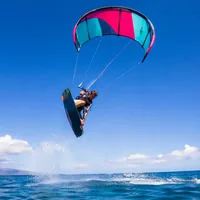
A flat, shallow lagoon, Croatia's benchmark for beginners, with a tougher winter Bura available for those who want it.
Nin in detail arrow_forward
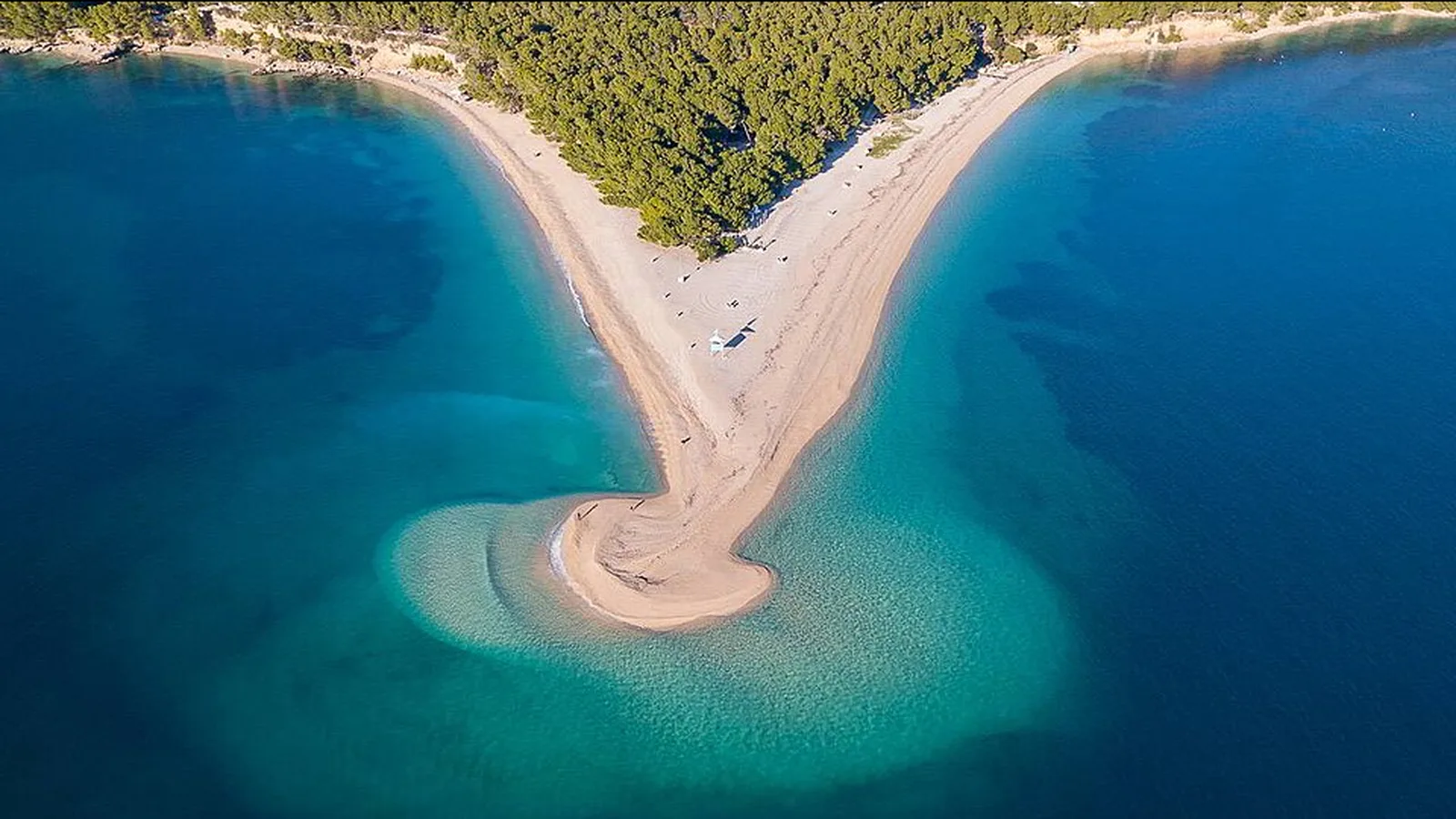
The most photographed sand cape in the Adriatic — but the main beach is closed to kiting in July-August.
Zlatni Rat in detail arrow_forward
The narrowest point of the peninsula, a genuine venturi that doubles wind strength in the Korčula channel.
Viganj in detail arrow_forwardFive lesser-known spots with thinner documentation — and at least one school attribution to correct on each.
The other spots in detail arrow_forwardThree spots, two Adriatic winds, no single national law.
Flat, shallow water a few kilometres from Zadar, Croatia's benchmark for beginners.
At Nin, on Ždrijac beach, the dominant summer wind is the Maestral (north-west sector), light to moderate, according to the local camp and several spot guides; the Bura (north-east), rarer but noticeably stronger, blows mostly in spring and winter. One spot database, however, gives the best — and strongest — wind season as November to April (22.8-knot average), i.e. the Bura season: the "best wind" months and the "best beginner season" don't necessarily line up, and both readings are reported here rather than collapsed into one.
The inner lagoon is flat, with a very shallow sand-and-mud bottom, ideal for learning; the northern part, beyond the sandbank, gets choppier. The Bura is described there as cold and gusty, requiring more experience — a genuine hazard on the days it blows, but a secondary wind, not the everyday summer condition. The water warms up gradually (13-15°C in March, 22-24°C in June, 24-26°C in July-August, about 18-19°C in November): a wetsuit is needed off-season and in winter (for riding the Bura), while boardshorts or a shorty are enough from June to September.
See on Google Maps open_in_newSurfmania and Kiteboarding Croatia, both based at the Surfmania Pavilion on Ždrijac beach, teach here, in a dedicated kite zone monitored by a safety boat. Nin sits about 15 km from Zadar; Zadar Airport is roughly 27-29 km away, a 30-minute taxi ride.
Regulations: Nin's lagoon and wetland are described by several sources as a protected, bird-rich habitat (235+ recorded species), referred to loosely as "Natura 2000" or an "ornithological reserve" — without an official decree number or exact boundary that could be verified, and without certainty over whether that protection covers the Ždrijac sand beach itself rather than only the inner marshland. The "kite zone" has no identified official regulatory basis: it's an operational practice run by the schools (a monitored zone, a safety boat), not a harbour-master ordinance.
Croatia's most photographed sand cape — but not for launching a kite at the height of summer.
The Maestral, thermal, blows across the channel between Brač and Hvar: it picks up by mid-morning and builds to 18-28 knots in the afternoon (another source gives 15-25 knots — a range spread rather than a real contradiction), for 2 to 6 hours of rideable wind most days. The best season runs May to October, with June-August the most reliable months; the water reaches about 24°C in high season.
The water is deep right off the pebble beach — not a flat lagoon like Nin — with current and boat traffic flagged as real hazards; the beach gets very crowded in high season. That's why this spot leans intermediate to advanced, mainly because of the deep water, the current, and the launch situation (see below), rather than wind strength alone.
See on Google Maps open_in_newRegulations: launching and landing from Zlatni Rat's main beach is banned in high season (July-August) — a rule reported consistently across several independent kite-travel sites, though no official harbour-master ordinance number could be traced. During that window, launching is only possible from two private, fee-based spots: Kite School Bol (about €25/person/day) and Kite School Active Bol (about €20/person/day, with a floating platform that makes an otherwise very difficult launch on this stretch possible). Yellow Cat Kiteboarding School also operates on site. Unrelated to kiting: the seabed around Zlatni Rat carries a protected Posidonia seagrass zone, with a no-anchoring rule for boats.
The peninsula's narrowest point, wind doubled by a channel effect facing Korčula.
Viganj sits at the narrowest point of the Pelješac peninsula, in the channel facing the island of Korčula — a genuine wind funnel that, according to spot guides, roughly doubles the ambient wind strength. The thermal Maestral (north-west/west) blows 20 to 30 knots at its afternoon peak in summer (one source gives a wider 12-25 knot range for the "ideal" wind — read as the usual range rather than a contradiction of the channel's peak). The Bura (north-east) and Jugo (south) also occur, especially off-season (May, September); the Bura there is explicitly described as cold, gusty, and capable of becoming dangerously strong.
The wind picks up at different times depending on the month: around noon in June-July, around 2pm in August, 3-4pm from September onward. June to August remains the most reliable period; May and September "shouldn't be neglected" for wind, but bring more Bura and Jugo variability. The water is deep, the beach pebbly, with chop and small waves; several reviews flag a very narrow launch area ("there's only room for one kite," per one comment), along with crowding, boat traffic and currents as concrete hazards distinct from wind strength alone. Guides advertise "all levels," but that cramped launch zone and the channel-accelerated wind make this, in practice, a less beginner-friendly spot than the label suggests.
Water Donkey Windsurfing and Kitesurfing Centre (IKO-standard lessons, Nobile equipment rental) and LIBERAN Surf (a surf school/camp) are long-established here. The water, the warmest of the three spots on this page (Dalmatia's southern tip), reaches about 24°C in season. The nearest airport is Dubrovnik, about 137 km/2h20 by road — the longest journey of the three spots, with no ferry shortcut. No regulation specific to Viganj was found — treat this as an observed absence rather than a certainty that no rule exists.
Thinner documentation — and a school attribution to correct on three of the five.
Two distinct spots on the island of Krk, not to be confused. Punat, in a sheltered bay, is worked by the Bura, reportedly boosted one to two Beaufort by the surrounding hills according to one spot guide; another source also describes a summer (June-September) north-east thermal pattern there, coexisting with the Bura rather than contradicting it. Baška, more open, facing Senj, is a Bura-specific spot: the terrain above Senj is said to channel even a weak north-east flow up to rideable strength. Baška's own wind statistics, though, place the most reliable season outside summer (March leading, about 9 knots average; June-October rated weak) — a real downside for anyone planning to come specifically at the peak tourist season.
At Punat, the bay is protected, the water flat to choppy, the beach pebbly, with a fenced launch area (an explicit instruction to close the fence after entering the water) and breakwaters/rocks flagged as hazards. Baška produces rideable bump-and-jump chop on a Bura. No kite school actually based on Krk could be confirmed: several guides attribute "Croatia's top three schools" to the spot, but checking each one individually places them elsewhere (Viganj/Pelješac, Ljubač near Zadar, Blace on the Neretva delta) — none is genuinely on Krk. Rijeka Airport (RJK) sits directly on the island, near Omišalj, about 30 km from Punat/Baška by road (via the Krk bridge). No regulation specific to Krk was found.
At Istria's southern tip, Cape Kamenjak is worked by the Bura (gusty as it comes off the land) and by the Jugo (which brings more waves); the Maestral there is described as offshore and irregular. The spot hosts a windsurf freestyle competition (EFPT) every autumn, a sign the Bura is particularly reliable that season — in summer, wind statistics for the peninsula drop to a 4-5 knot average, against 8 knots in winter. The coast is rocky (sea urchins on the rocks: boots recommended), the water entry is described as tricky, and the southern bay sees heavy boat traffic in summer — the northern bay is reserved for the windsurf school and swimmers.
Several sources agree: this isn't a beginner spot, partly because there's no kite school on site (only a windsurf school operates, in the northern bay). Camping Stupice, inside Cape Kamenjak Nature Park, is the safest launch point named. The site sits inside that nature park (a vehicle entry fee applies, wild camping is banned), but no kitesurf-specific restriction was found inside the park. Access: Pula Airport, about 18-25 km/30 min by road — one source cites 10 km, which more likely measures the distance from Pula town than from the airport, and shouldn't be repeated.
The least documented of the five, worth treating carefully. The wind here is thermal, from an east/south-east sector, Jugo-compatible, with the eastern end of the beach catching the steadiest afternoon wind; the best season is said to be May-September, though no knot-range figure could be sourced. The beach is pebbly, the water flat to choppy; no specific hazard (rocks, current, shipping lane) could be documented — an absence of information, not a finding of no hazard. The water ranges from 15°C in winter to 25°C in summer.
One spot guide names a kite school (Kanza Kiteschool) as present at Žnjan — but Kanza's own site lists only three locations (the Neretva delta, Sardinia, Grado in Italy), with a Slovenian contact number; Žnjan appears nowhere on it. The local beach site (znjan.com), for its part, states as of 2026 that a windsurfing and "possibly kitesurfing" operation is merely planned, not yet open. The honest statement for this page is therefore: Žnjan is an informal spot with no confirmed resident school as of 2026, with a possible windsurf/kite concession announced as a project by the beach authority itself. Access: Split Airport, about 20 km/22 minutes by taxi. No regulation specific to Žnjan was found.
This is the least-substantiated of the five: the credible sources actually describe Savudrija, a little south-west of Umag near the Slovenian border, rather than Novigrad or Umag town themselves. At Savudrija, the rigging area is sheltered, with a launch that goes "over a wall and through a 50 m lull into strong wind" — fairly pleasant bump-and-jump conditions, in a direction sheltered from the Bura. On a Bura, guides instead point to Umag town itself, where a powerful wave forms near the lighthouse. Novigrad's own community spot page has received no contributions ("no one has edited this spot yet"): its content should be treated as an unverified template, not an established fact.
No kite school was found in Novigrad, Umag or Savudrija. Access: Pula Airport, about 74-75 km/51 minutes by road from Novigrad (Umag is slightly closer). No kite-specific regulation was found; the municipality of Novigrad has adopted a 2024-2028 maritime-property management plan, but no watersports-related content could be identified within it. This spot is therefore presented here in less detail than the other four, for lack of sufficient documentation — a gap worth stating rather than papering over with guesses.
Two spots on the island's west coast, both driven by a thermal west/north-west wind — a Maestral-type pattern, even though no source names it that precisely for Pag. A third location, Sabunike, is mentioned once as "safe for freeriders and beginners," with no further detail. The best months for Šimuni are said to be June-September per one spot guide; but Veli Sikavac's own wind statistics, drawn from the same family of data, show the opposite — January-May and November-December rated "ok," June-October rated weak, with a winter peak. One possible, unconfirmed explanation is that Šimuni's beach gets so crowded in summer that kiting is effectively pushed aside in favour of windsurfing there: one spot guide states plainly that "in summer only windsurfing [is possible], since the beach is too packed." Both readings are reported here rather than resolved.
Hazards named at Šimuni: swimmers and boat traffic, worst in June-August. Veli Sikavac's water ranges from 6°C in winter to 24°C in July-August. No kite school could be confirmed on the island: one guide attributes "North Kiteboarding Club Croatia" to Šimuni, but that club is actually based in Kućište, on the Pelješac peninsula, over 150 km to the south — not on Pag. Zadar Airport is the nearest (about 69 km/1h09), though one spot guide incorrectly lists Split, Pula and Dubrovnik without mentioning Zadar at all — a clear error in that source, not to be repeated. No regulation specific to Pag was found.
Croatia has no equivalent to France's Division 240.
No single national law governs kitesurfing in Croatia. Where rules exist, they come from the local harbour master (lučka kapetanija) or from on-site rules set by schools and municipalities. That's the case at Zlatni Rat, where the high-season launch ban on the main beach is widely documented in practice without a traceable official text; at Nin, Viganj and the five secondary spots (Krk, Premantura, Žnjan, Novigrad-Umag, Pag), no kitesurf-specific ordinance was identified at all.
A rule observed at one spot never automatically applies to another, even on the same island or coastline: always check on-site signage and, when in doubt, ask a local school before rigging up.
Worth checking yourself before booking a lesson: several online spot guides attribute well-known schools to Krk, Žnjan or Pag island that, once checked against the school's own site, turn out to be based elsewhere in Croatia (Viganj, Ljubač, the Neretva delta, or Kućište). This page doesn't repeat those attributions.
In an emergency, dial 112.
What riders ask most before coming to Croatia.
The Nin lagoon (Ždrijac beach), near Zadar: flat, shallow water, a kite zone monitored by a safety boat, and a summer wind (the Maestral) gentler than the winter Bura.
Not from the main beach: launching is banned there in high season. You then need to go through one of the two paid spots (Kite School Bol or Kite School Active Bol) that give access to the water.
The Maestral is an afternoon thermal wind, steady and fairly gentle, dominant in summer. The Bura is a cold, gusty katabatic wind, more common off-season and in winter, that demands more experience.
The spot sits at the narrowest point of the Pelješac peninsula, in the channel facing Korčula: this funnel effect significantly boosts the Maestral, with afternoon peaks of 20-30 knots in summer.
Not consistently. Several online spot guides attribute well-known schools (actually based in Viganj, Ljubač, or the Neretva delta) to these three spots when they aren't there. Always check with the school's own site before booking.