

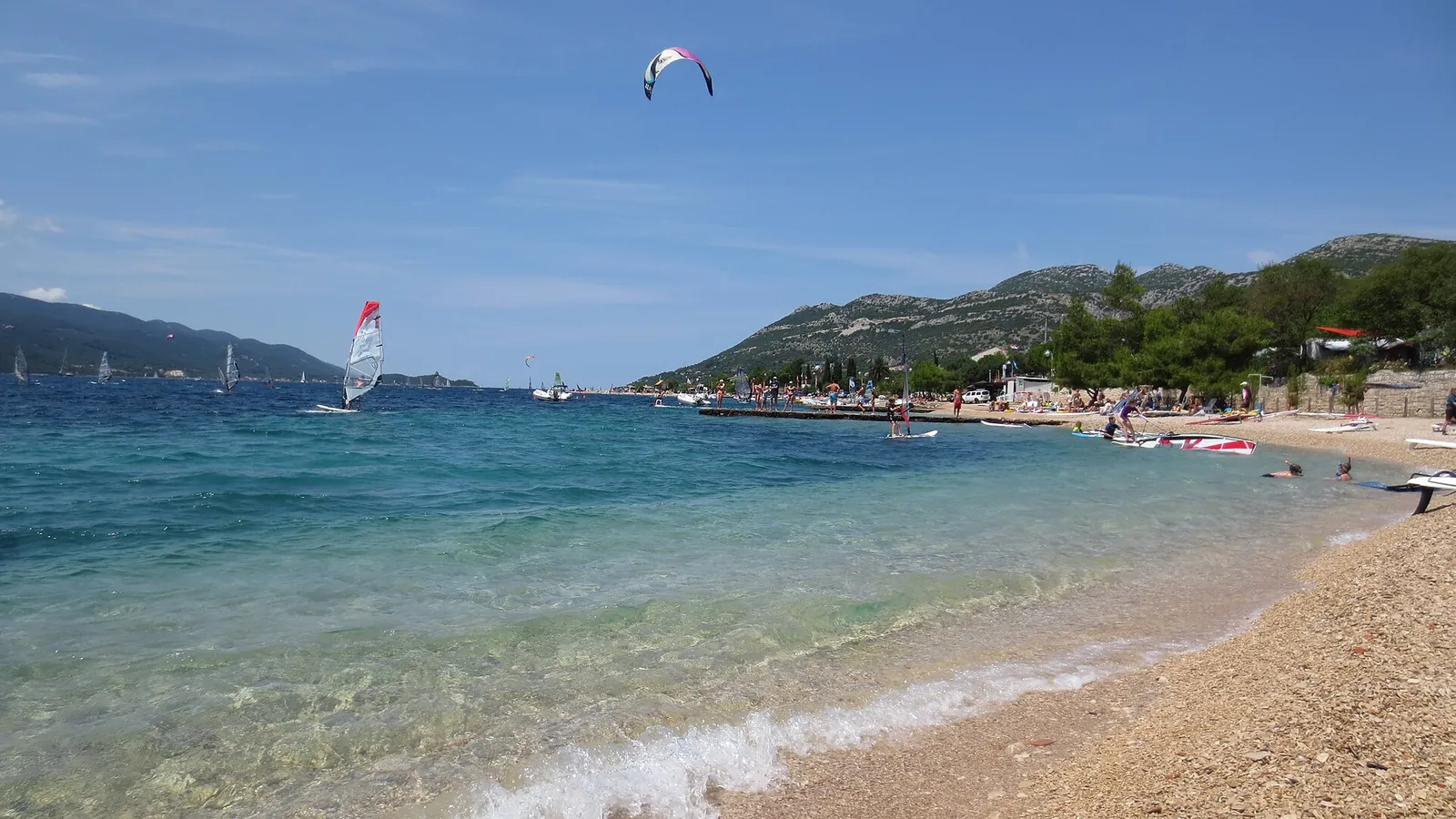
📍 Viganj, Croatia
Photo: ModriDirkac / Wikimedia Commons, CC BY-SA 4.0
A windsurfing village facing Korčula, where kitesurfers share a narrow launch.
An afternoon thermal, funnelled between the peninsula and Korčula.
Viganj's reputation rests on the Maestral, a north-westerly thermal. Mornings are often calm or bring a light easterly or southerly; the Maestral fills in around 1pm and holds through the afternoon. Sources disagree on its strength: one recent guide gives 15-20 knots as typical, another 8-15 knots (20 on good days), a third 15-25 knots in the afternoon. The season runs from May to September, peaking June to August, and in spring the bigger gap between land and sea temperatures can produce stronger thermals than midsummer.
Every spot guide describes the narrow Pelješac Channel, between the peninsula and Korčula, as a funnel that speeds up the Maestral (a venturi effect). Only one gives a figure – roughly 20% – and no public meteorological measurement backs that up. This site's Croatia hub mentioned a wind 'roughly doubled' and 20-30 knots at its peak, but this research found neither, so the page sticks to the ranges above.
The Maestral blows cross-shore from the right, sometimes a touch cross-onshore or cross-offshore depending on the day; one guide reports around 50 metres of wind shadow close to the beach before it blows cleanly. The Bura (north-east), strong and gusty, is the other wind to know about: guides advise staying on the beach once the wind swings north-east. The Jugo (south) also gets a mention, with no reliable Viganj-specific range.
Shared water, a narrow beach.
Viganj is a windsurfing spot first: the campsites along the shore open straight onto the water, and a shallow strip close in is used for beginner lessons. Kitesurfing happens too, mostly from the pebble beach at Ponta (Ponta Liberan), below the church of St Liberan, and along towards Kućište.
The kite launch is the tricky part. One guide describes two small pebble spits, built up by hand, where you launch and land through a narrow corridor, even in summer; others flag a small launch area, trees and huts on the beach, swimmers and plenty of windsurfers. The main riding area is over 2 m deep, so kite lessons run from a boat rather than on foot.
No official separation between windsurfers and kitesurfers was found at Viganj: it's settled by beach, by school and by habit. On arrival, ask the schools where to launch and read the beach signage before you rig.
What the schools say on their own sites in 2026.
LIBERAN Surf & Camp offers windsurfing and kitesurfing lessons and rental. It describes itself as a school and campsite 'with a lasting tradition of 30 years' at Viganj, with a kite school of more than 15 years and IKO-trained kite instructors. It sits a few metres from the Antony Boy campsite, whose own site points to it.
Water Donkey describes itself on its own site as a windsurfing and wing foiling school, with SUP as well, and lists no kitesurfing. Older listings, and this site's Croatia hub, still present it as a windsurfing and kitesurfing centre; this page follows the school's own, more recent site.
Other names turn up in spot guides, such as Juta Wind Adventures and FootLoose SurfClub, but their current operation at Viganj couldn't be confirmed on a site of their own during this research. Check directly with the school before booking.
A national regulation on personal watercraft, no Viganj-specific ordinance.
Croatia's navigation safety regulation (Pravilnik o sigurnosti pomorske plovidbe, Narodne novine 52/2025) classes windsurf boards and kiteboards as personal watercraft ('osobna plovila', Article 45). Article 49 lets them sail freely from sunrise to sunset within 300 m of the coast, except inside a managed bathing area ('uređeno kupalište'), where only pedalos and paddleboards are allowed. Beyond 300 m, the text requires the organiser, rental provider or activity holder to provide an escort by a motorised craft. How that applies in practice to a lone rider crossing the channel isn't documented, so ask the schools.
Lučka kapetanija Dubrovnik (Dubrovnik harbour master) is the maritime authority, and its Orebić branch office covers Pelješac's south coast out to the middle of the channel, according to the ministry's organisational decree (Narodne novine 97/2020, amended in 2023). No municipal ordinance or harbour-master order specific to kitesurfing or windsurfing at Viganj was found – an observed absence, not a guarantee that no local rule exists.
At Viganj, the crowded part is the shore, not the open water.
The hazards riders report are mostly on the beach – pebbles and rocks (wear footwear; sea urchins are reported too), obstacles on the shore, swimmers, windsurfers and small boats sharing the same area. Further out, the Pelješac Channel separates the peninsula from Korčula and remains a shipping route, crossed among others by the Orebić–island ferries. The tide is negligible.
On a Bura, stay ashore. In an emergency at sea, call 195, the free number of the maritime rescue coordination centre (MRCC Rijeka), or 112; you can also call for help on VHF channel 16.
Dubrovnik or Split, by road or with a ferry.
From Dubrovnik Airport, allow about 135 km and 2hr 15min to 2hr 45min by road over the Pelješac Bridge, opened in 2022, which avoids crossing Bosnia and Herzegovina. From Split Airport, the all-road route is about 210-220 km, a little over 3 hours; the alternative uses the Jadrolinija ferry between Ploče and Trpanj (about a 1-hour crossing), though summer queues mean it isn't reliably quicker.
Viganj is about 7 km west of Orebić, where a car ferry crosses to Dominče, near Korčula town, in around 20 minutes. Ferry and catamaran timetables change with the season, so check them with the operators before you travel.
The water warms through the season: about 18°C in May, 22°C in June, 25-26°C in July and August, 24°C in September, and 11-14°C in winter. A shortie or a thin wetsuit does the job in summer; bring something thicker in spring and autumn.
See Ponta on Google Maps open_in_newWhat riders ask most before coming to Viganj.
Both, though windsurfing has always dominated. Kitesurfing mostly launches from Ponta beach, through a narrow, busy launch; kite beginners learn from a boat, because the main riding area is deep.
May to September, peaking June to August, when the thermal Maestral fills in around 1pm. Guides most often put it at 15-20 knots in the afternoon; spring can bring stronger thermals.
No municipal permit or Viganj-specific ordinance was found; Croatia's 2025 regulation permits free sailing by day within 300 m of the coast outside managed bathing areas, and beyond that only with a motorised escort provided by the organiser or rental provider.
Dubrovnik is closest: about 135 km, 2hr 15min to 2hr 45min via the Pelješac Bridge. Split is about 210-220 km, a little over 3 hours by road, or via the Ploče–Trpanj ferry.
195, Croatia's free maritime search and rescue number (MRCC Rijeka), or 112. VHF channel 16 works too.