📍 Bol, island of Brač, Croatia
Photo: Alex Proimos / Wikimedia Commons, CC BY 2.0
An afternoon thermal funnelled between Brač and Hvar, and the best-known pebble spit in the Adriatic.
A protected pebble spit with windsurf centres spread out on either side.
Zlatni Rat, the pebble spit that juts into the sea west of the town, is about 2 km from Bol's centre along the seafront promenade. According to the Municipality of Bol, it has been protected since 1964, first as a 'natural landscape reserve', and today holds the status of significant landscape (značajni krajobraz); the protected area now covers 12 hectares. The tourist board adds that the spit reaches up to 500 m out to sea and that its tip keeps changing shape with the wind, waves and currents.
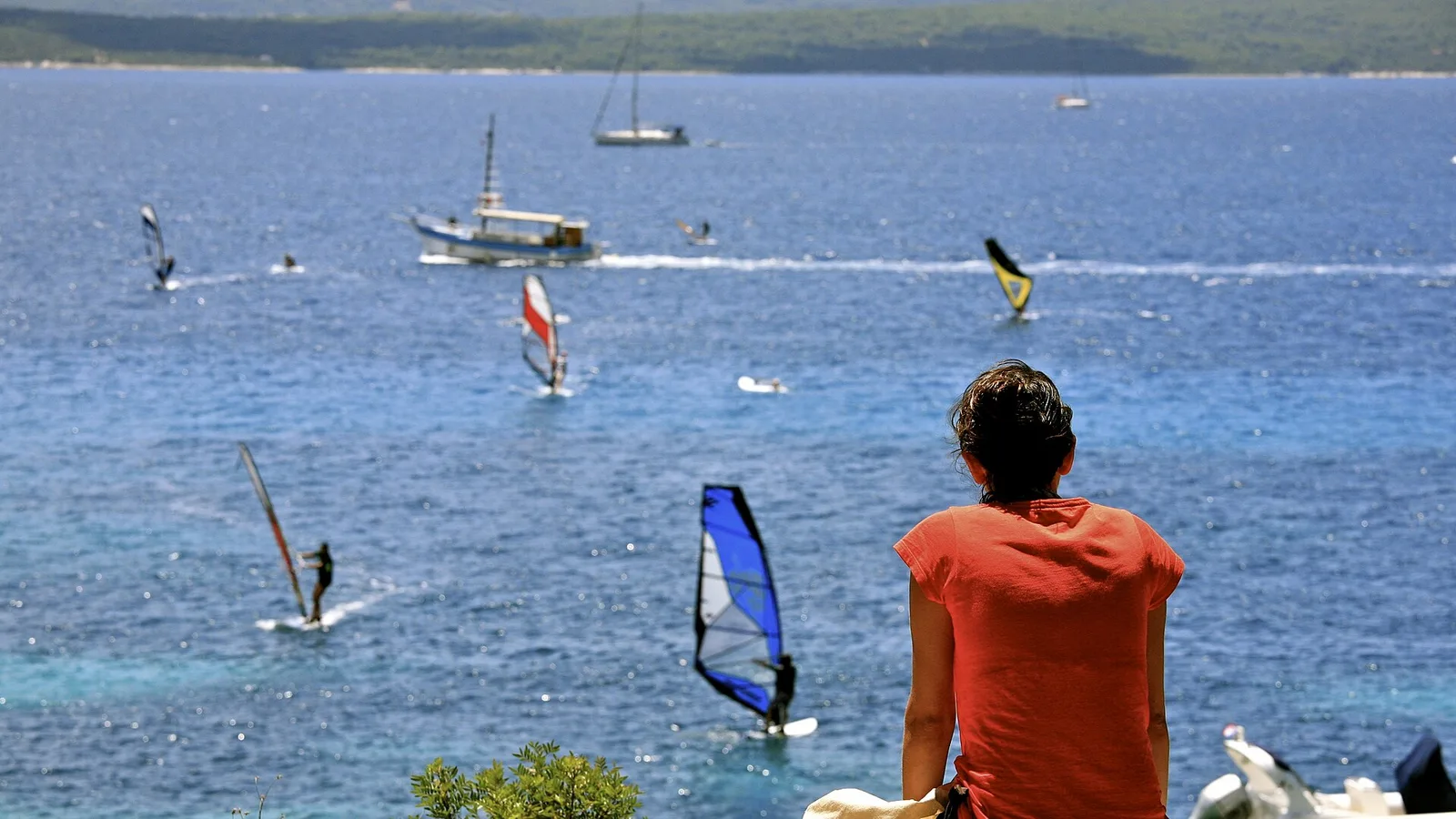
To the south, the island of Hvar closes off the Hvar Channel (Hvarski kanal). The Bol tourist board attributes the whole spot to this stretch of sea and the wind that funnels through it. Bol has built its name as a windsurfing destination and hosts several competitions every year.
The centres aren't grouped on a single beach. Big Blue Sport is on Borak beach, below the hotel of the same name, on the promenade between the town and Zlatni Rat – the tourist board's windsurf webcam is even called 'Borak & Potočine'. Active Bol is at Camp Aloa, on the other side, between Bol and Murvica. This research couldn't pin down a single name for 'the windsurf beach' at Bol, so ask your centre where it launches.
See on Google Maps open_in_newEveryone agrees on the timing, not on the strength.
In summer the day often follows the same cycle, as a Bol hotel operator describes it: a light easterly breeze in the morning, gentle enough for beginners, a lull around midday, then the Maestral settling in from the north-west in the afternoon. The tourist board adds that this thermal is boosted by a venturi effect as it crosses the channel between Brač and Hvar, and that it blows along the coast, out towards the open sea.
On strength, the sources differ markedly. The hotel operator gives 'around 4 Beaufort', or 11 to 16 knots; the tourist board says 15 to 25 knots; a kite spot database gives 18 to 28 knots, with 2 to 6 hours of rideable wind most days. No official measurement series (DHMZ, Croatia's meteorological service) specific to Bol was found, so rig for the bottom of the range rather than banking on the top of it every afternoon.
The season runs mostly from May to September, with June-August the most consistent period according to most guides; some stretch it from April to October. No official water-temperature series for Bol was found either: regional averages put it at about 24-26°C in July-August, warm enough for a shortie or no wetsuit at all in high summer.
Five names on the tourist board's list show uneven evidence of current activity.
The Bol tourist board refers to 'four surf centres' but lists five names under windsurfing and kitesurfing schools – Big Blue Sport, Zoo Station Bol, Bol BIC Centar, Kite School Bol and Active Bol. According to the board, the centres rent out complete kit, store your gear during your stay and run courses for beginners and experienced riders alike.
Recent activity couldn't be checked to the same standard for all of them. Big Blue Sport (Borak beach) was offering windsurf slots for autumn 2026 on a booking platform. Active Bol (Camp Aloa) lists windsurfing, kitesurfing, wing foiling and SUP on its own site, but its latest dated offer goes back to summer 2023; its place on the tourist board's current list is the most recent sign of life. Kite School Bol teaches kitesurfing, wing foiling and e-foiling. For Zoo Station Bol and Bol BIC Centar, no evidence of activity was found beyond that list, so contact them before planning your trip around either.
What the tourist board says, and what it doesn't.
Kitesurfing isn't banned at Bol. According to the tourist board, you can launch and land on Zlatni Rat itself outside the season, but not in peak season. You can still ride around the spit then, provided you launch and land about 2 km away at the Žuti Mačak (Yellow Cat) windsurf centre, next to a small pebble beach. The same text mentions a dedicated kitesurfers' beach, a school and a rescue service.
Three caveats are worth keeping in mind. The tourist board doesn't say which months it means. A kite spot database, on the other hand, gives July-August and points riders during that window to the designated schools only, Kite School Bol near Zlatni Rat and Active Bol at Camp Aloa – so the two sources don't name the same launch point. No regulatory text behind the rule (a municipal decision, a harbour master's order, a concession) could be traced, so its public source remains the tourist board. And the Yellow Cat centre's current activity couldn't be confirmed independently, so check on site before relying on that launch point.
The tourist board itself says the spot isn't the best suited to beginner kitesurfers because the wind blows along the coast and out towards the open sea. If you're learning to kite in Croatia, the Nin lagoon is the simpler option.
A national 300 m rule, and a local authority in Bol itself.
Croatia's maritime navigation safety rulebook (Pravilnik o sigurnosti pomorske plovidbe, NN 52/2025, published on 21 March 2025) classes windsurf boards and kiteboards as 'personal craft' (osobna plovila, Article 45). Its Article 49 lets them sail freely, from sunrise to sunset, within 300 m of the shore, except inside an organised bathing area (uređeno kupalište). Beyond 300 m, the text provides for sailing where the organiser or rental operator arranges an escort by a motorised vessel; how that provision applies to an independent rider isn't spelled out in the text.
The competent authority is the Split harbour master's office (Lučka kapetanija Split), which, according to the Croatian Ministry of the Sea's official list, has a branch office (ispostava) in Bol. This research found no harbour master's or municipal ordinance specific to windsurfing at Bol. These are Croatian rules and bear no resemblance to French or Spanish regulations, or to RNLI flag zones. If you're unsure about a launch corridor or a bathing area, ask your centre or the Bol branch office.
Fly to Split, then catch a boat – which one depends on your board bag.
The usual gateway is Split Airport (SPU), then the port of Split. Two crossings reach Brač: the Jadrolinija Split-Supetar car ferry (line 631, about 50 minutes), then the road over to Bol on the other side of the island; or the direct Split-Bol catamaran (Krilo, about 55 minutes), a mainly summer service. Frequencies change with the season and the day of the week, so check the timetable for your date with the operator.
With boards and several sails, the car ferry is usually the least restrictive option; on a catamaran, check the rules for oversized luggage in advance. Brač Airport (BWK), about 14 km from Bol, only has seasonal flights. The other option: the centres rent out complete kit, which saves travelling with your own, and also offer to store your own gear during your stay, according to the tourist board.
This isn't a lagoon – the risk comes from the depth and from everyone else on the water.
At Bol, the water gets deep very close to the shore, according to several guides, so you won't be able to stand up to get back on the board as you would in a lagoon. In summer, Zlatni Rat is packed with swimmers, and the tourist board lists boat hire, pedalos, jet skis and parasailing behind a boat around the spit. Stay out of marked bathing areas and give other craft a wide berth.
In an emergency at sea, call 195, the free number of Croatia's maritime search and rescue service, staffed 24 hours a day at the Rijeka coordination centre (MRCC Rijeka). 112 remains the general emergency number, and VHF channel 16 the distress channel at sea.
What windsurfers ask most before coming to Bol.
In the afternoon, in summer: the north-westerly Maestral settles in after a lull around midday. The season runs mostly from May to September, with June-August the most consistent period according to most guides.
The sources don't agree: about 11-16 knots according to a local hotel operator, 15-25 knots according to the tourist board, 18-28 knots according to a kite spot database. No official measurements specific to Bol were found.
Yes, but according to the tourist board, launching and landing on Zlatni Rat aren't allowed in peak season; they take place about 2 km away instead, at the Yellow Cat windsurf centre. Outside the season, you can launch from Zlatni Rat.
The centres run beginner courses; the light morning breeze suits learners better than the afternoon Maestral. The water does get deep very close to the shore, though, and the spot is very busy in summer.
Take the Jadrolinija Split-Supetar ferry (about 50 minutes) and then the road to Bol, or the direct Split-Bol catamaran (about 55 minutes), a mainly summer service. Always check the timetable for your date.