

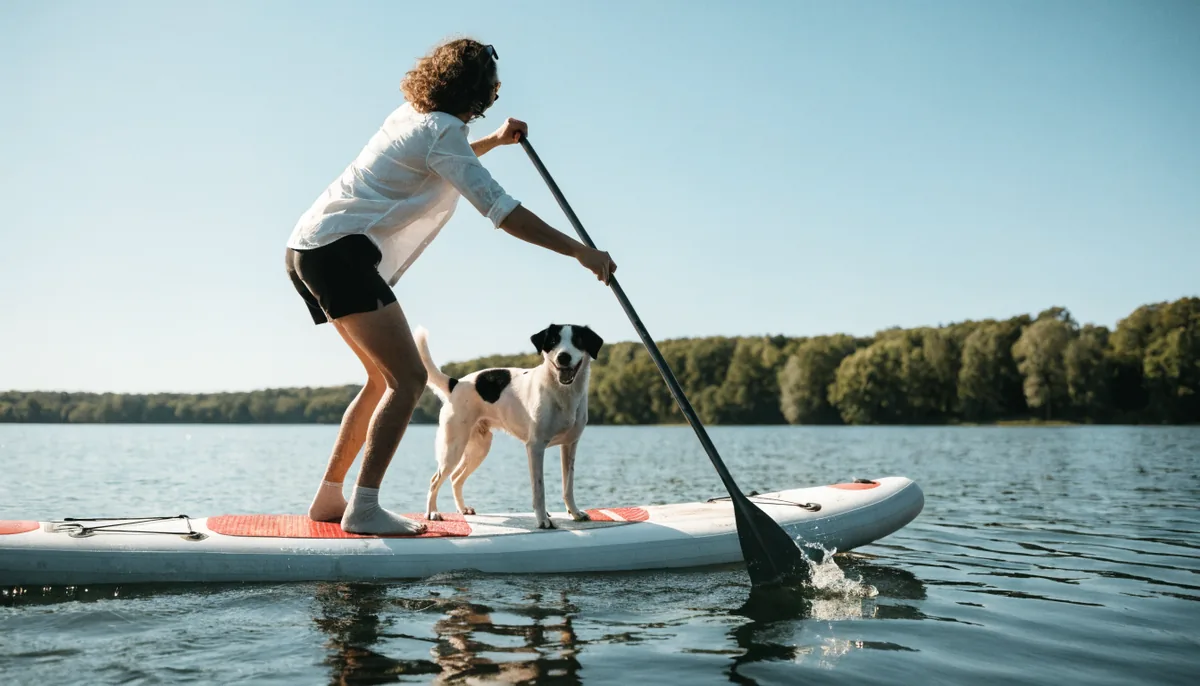
A dog can happily join you on a paddleboard, as long as you go at their pace and follow a few simple rules. Between choosing the board, getting them used to it gradually and sorting the safety kit, here's how to turn the outing into a bit of shared fun rather than a stressful one for your pet.
Is paddleboarding with a dog really that easy?
Yes, provided you don't rush it. A curious dog that's happy in the water usually settles onto a stable board fairly quickly, especially if those first outings go well. It isn't an activity that suits every dog, though: an anxious, water-shy or older dog is perfectly content without it. The point is to respect your dog's temperament rather than trying to recreate the photos you've seen on social media at any cost.
Choosing the right board
Width and stability
A dog that shifts about, shakes itself or changes position unsettles the board far more than a still adult does. It's better to go for a wide model, at least 32 inches, so you keep a comfortable margin. All-round inflatable SUPs generally offer this stability without sacrificing manoeuvrability.
Total weight to account for
Your dog's weight adds to yours and to any kit on board. For a larger dog, it's better to choose a board with generous volume rather than the most compact model in the range: an under-sized board becomes unstable and sinks under the load, which unsettles the dog as much as the owner.
How to get your dog used to a paddleboard
First tries on land
Before you even put the board in the water, lay it on the grass or sand and let your dog explore it freely, sniff it, climb on and off at their own pace. Pair the moment with treats or a fuss to build a positive association. This step, often skipped, makes all the difference once you're afloat.
First outings on calm water
Choose flat, sheltered water, such as a lake or a chop-free cove, for those first outings. Stay near the bank, move slowly and let your dog settle wherever they feel most comfortable, usually towards the front or the middle of the board. A short, successful outing beats a long one that tips over into stress.
Essential safety
A buoyancy aid for your dog
A buoyancy aid matched to your dog's shape is the most important precaution, even for a strong swimmer: it prevents exhaustion after a long swim in the water and gives you a handy grab handle to haul them back onto the board quickly. Choose a snug fit, neither too loose nor too tight, with a solid handle on the back.
Conditions to avoid
Steer clear of strong wind, chop and fast-flowing water: a stressed dog can jump at any moment, and these conditions make a quick recovery harder. Excess heat is another risk to watch, as is water that's too cold outside the warmer months. Always choose a calm-water outing over a choppy sea, and check the Met Office forecast before you set off. If in doubt, our paddleboard safety guide covers the essentials.
The most common mistakes
The most frequent is forcing a dog aboard when it's showing signs of reluctance, which builds a lasting mistrust of the board. Next comes choosing a model that's too narrow or too light for the dog's size, which makes the outing uncomfortable for everyone. Finally, plenty of owners skip the buoyancy aid on the grounds that their dog swims well: strong swimming never replaces basic safety.