

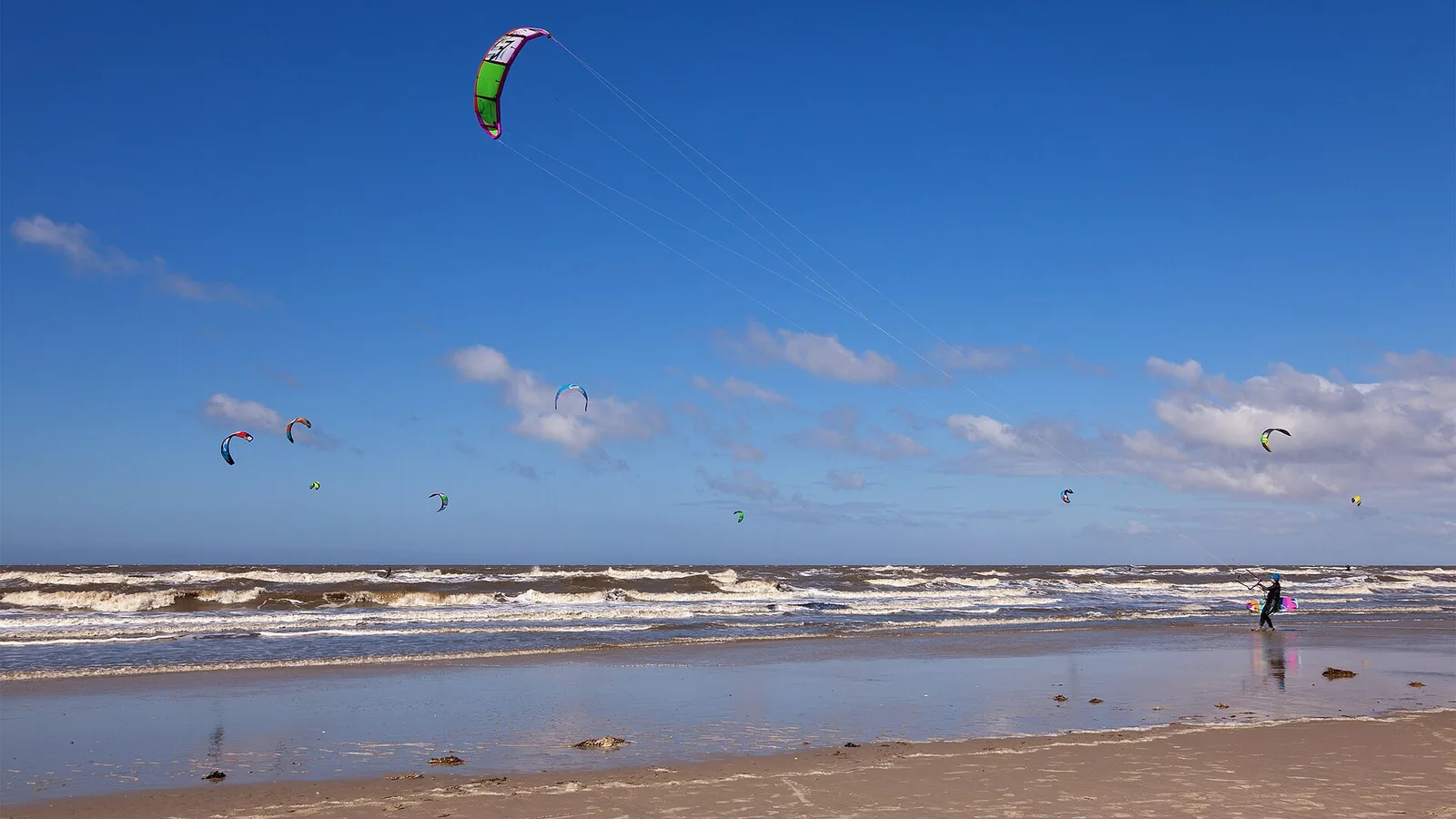
📍 St. Peter-Ording, Germany
Photo: Unukorno / Wikimedia Commons, CC BY 3.0
A huge tidal beach inside a national park, with kiting allowed in a mapped zone and kept away from the bathers.
Waves and the event ground in the north, flat water and a standing area in the south.
St. Peter-Ording's tourism board describes a sandy beach 12 km long and up to 2 km wide, split into five sections, with 13 stilt buildings (Pfahlbauten) on the sand for restaurants, lifeguards, beach-chair hire and toilets. The town sits behind it in four districts, from north to south: Ording, Bad, Dorf and Böhl. Kiting centres on two of the beach sections, Ording and Böhl.
Ording is the largest and busiest section, with the water-sports school, the event ground, a sports area and the big beach car park, according to the tourism board. The local school Kitesurfing Experience calls it the main beach and doesn't recommend it for beginners: in strong wind the waves get big and the standing area is limited. Its bathing area is marked off by two rows of posts, visible from a long way off, and a chain of buoys, which the national park's leaflet says has done a lot to separate surfing from swimming. Further north is Ording Nord, a quieter section with a naturist bathing area.
Böhl is the calm end of town. The tourism board says its beach is popular with families because high tide leaves shallow water there; the old bathing spot silted up over the years, which is why you can now drive onto it. Kitesurfing Experience, which teaches there, describes a large standing area with waist-deep water, kept flat in every wind by the sandbanks offshore. It also lists the Südstrand, which it describes as usable only around high tide, inside an enclosed tidal channel with salt marsh around it.
Horse riding is allowed in designated areas on the beach between Dorf and Böhl, and you need a riding badge for it. Expect horses at the water's edge on that stretch and give them plenty of room when you launch.
See St. Peter-Ording on Google Maps open_in_newThree layers of rules, from the federal regulation down to the buoys off the bathing area.
The waters off St. Peter-Ording are federal waterways inside the national park, so the first layer is federal. The Nordsee-Befahrensverordnung (NordSBefV), the regulation on navigating the North Sea national parks, came into force in April 2023. Its § 6(2) bans craft pulled by a kite or a wing, kitesurfing and wingsurfing included, everywhere it applies, except in the permission zones listed in section A of its Annex 3. There are 52 of them: 30 in Lower Saxony and 22 in Schleswig-Holstein. Zone 18 is St. Peter-Ording, defined by a polygon of coordinates.
Several zones in the annex only open around the tide: List on Sylt from three hours before to three hours after high water, Hörnum from three hours before to three hours after low water. The St. Peter-Ording entry carries no time window. Breaking § 6 is an administrative offence under the federal waterways act, and the regulation itself is due to be re-evaluated ten years after it came into force.
The second layer is local. The tourism board says a water-sports zone has been set up on the beach between the bathing areas of Bad and Ording, marked by buoys, posts and signs, and that you must stay at least 50 metres from the seaward edge of the bathing area and from anyone swimming. Further south, in the bay north of the Süd bathing area, the municipality, the riders' association BoardSPOrt e.V., the Schutzstation Wattenmeer and the national park administration agreed a kite area in the lee of the spit and the dunes. The ecologically sensitive inner part of that bay is closed off by a chain of buoys, and the national park leaflet is blunt about it: no use at all inside the line, to protect resting and breeding birds.
The third layer is the bird protection around the edges. The same leaflet's map marks Schutzzone 1 areas, where entry is forbidden, at the northern and southern ends of the beach. At the northern end, the regulation's Annex 2 lists the Tümlauer Bucht as a special protection area; unless the annex says otherwise, protection runs from 15 April to 1 October, and in that period you may not go into it outside the fairways. The national park also asks water users to keep 500 metres from seal haul-outs where possible.
| Layer | Set by | What it means on the water |
|---|---|---|
| Federal kite zone | Nordsee-Befahrensverordnung, Annex 3, section A, zone 18 | Kitesurfing and wingsurfing allowed inside the mapped zone; no tidal window for St. Peter-Ording |
| Bathing areas | Tourism board and municipality | Posts, buoys and signs; at least 50 m from the bathing area and from swimmers |
| Bay north of the Süd bathing area | Municipality, BoardSPOrt e.V., Schutzstation Wattenmeer, national park | Kite area in the lee of the spit and dunes; inner bay behind the buoy chain closed |
| Bird protection | National park law and the regulation's Annex 2 | Schutzzone 1 off-limits; Tümlauer Bucht closed outside the fairways from 15 April to 1 October |
The annex coordinates are written for charts, not for the beach, and the regulation says the zones go onto the official sea charts of the Federal Maritime and Hydrographic Agency (BSH). On the day, the posts, buoys and signs are your reference. The leaflet with the local map is published by the national park administration (LKN.SH) in Tönning.
You can drive onto two sections of the beach, and everyone pays the visitor levy.
You can park on the beach itself at Ording and Böhl, between 7:30am and 10:30pm, from mid-March to the end of October. The speed limit on the sand is 30 km/h, normal road-traffic rules apply, buses and lorries aren't allowed, and overnight parking or sleeping in a vehicle is banned. The car parks have been camera-controlled since 2025. When the tourism board's parking page was read on 3 October 2026, a day ticket from 9:30am cost €15 at Ording and €9 at Böhl, with cheaper morning and evening rates. The beach car parks can be closed when there's a risk of flooding.
Parking doesn't include the Kurabgabe, the visitor levy that every guest in St. Peter-Ording pays. If you stay overnight, your host issues the guest card; day visitors buy a day card online, at the beach entrances, at the parking machines or at a tourist office. The tourism board lists €4 per day from 1 April to 31 October (and over Christmas and New Year) and €3 for the rest of the year. Accompanied children under 18 pay nothing. Staff check the card at the beach entrances.
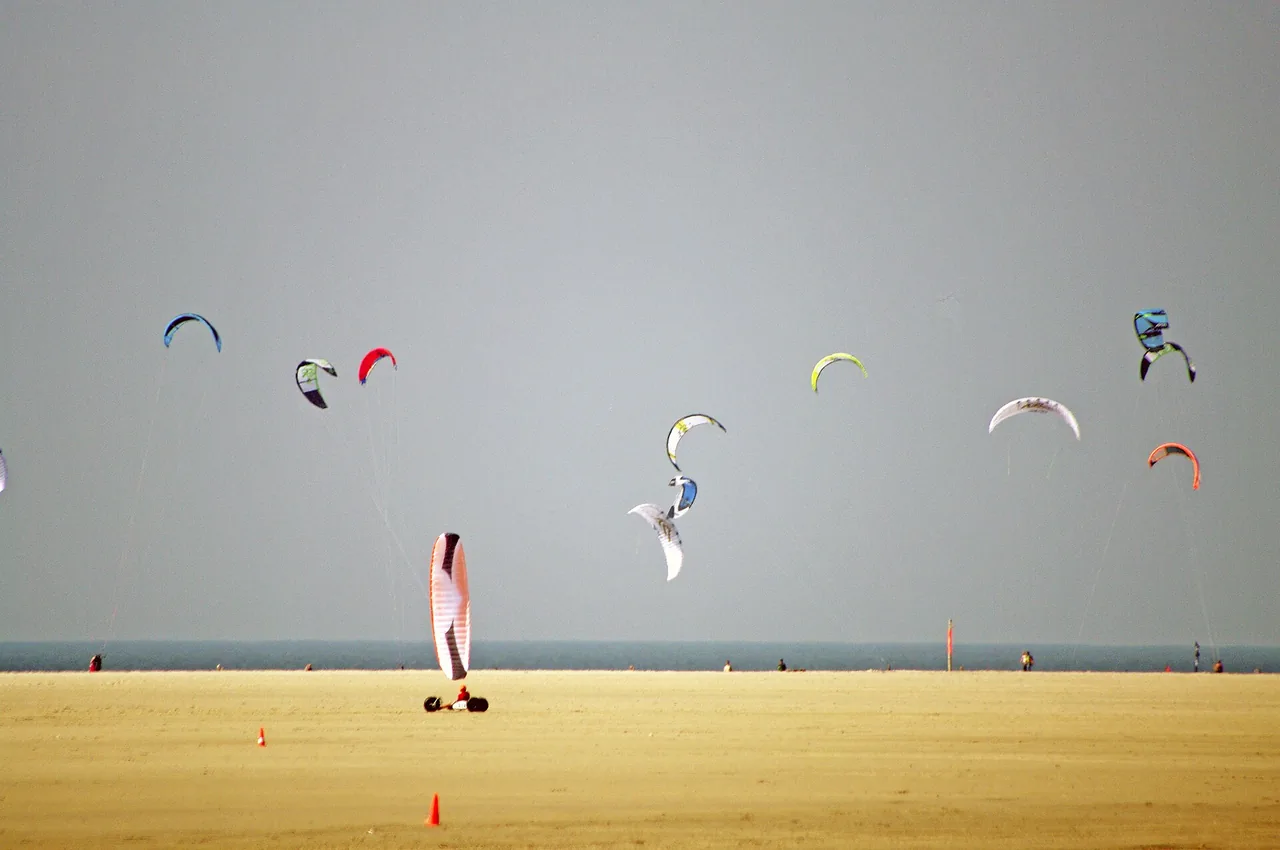
The beach rules matter if you bring more than a twin-tip. Beach sailing and kite buggies are allowed only in their designated areas, and kite landboarding is banned on the beach, as is riding a bike on the sand. Drones are banned throughout the national park, so no filming your session from the air. Dogs stay on a lead everywhere except the marked dog areas at Bad and Ording Nord, and you may only walk on the dunes where it's signposted.
Plan around the tide table first and the forecast second.
This is the Wadden Sea, so the tide decides where the water is. The tourism board publishes the official tide times of the Federal Maritime and Hydrographic Agency (BSH) for St. Peter-Ording, and warns that around new and full moon, spring tides and storm surges can push high water above normal and flood the whole beach, beach car parks included. Some spots only work around high water, as the Südstrand does. On the mudflats, the tourism board warns that setting off at the wrong time, strong currents and poor visibility can quickly become life-threatening; don't walk out on the Watt without a guide if you don't know it.
For wind, Windfinder's St. Peter-Ording station (observations from December 1999 to August 2026) gives an annual average of west-south-west at 12 knots, with 18-knot gusts. The beach faces the open sea to the west, so that prevailing direction comes in from the water; an east wind blows offshore, which on a sandbank this wide means a long way back if anything goes wrong. The tourism board's own weather station on Ording beach feeds Windfinder, and the board points kiters to it for the forecast. This research didn't find a source-backed month-by-month wind breakdown, so none is given here.
| Month | Sea temperature, monthly average |
|---|---|
| April | about 8°C |
| May | about 12°C |
| June | about 16°C |
| July | about 18°C |
| August | about 18.5-19°C |
| September | about 16-17°C |
| October | about 13-14°C |
These figures come from two sea-temperature aggregators (meerestemperatur.de and wassertemperatur.org) that broadly agree; they aren't an official series. The schools found here open their season between late March and May, and Kitesurfing Experience lends extra-warm wetsuits for its April and May courses, which tells you what the water is like in spring.
Three operators with a confirmed 2026 season.
Surfvibes is the water-sports base on Ording beach that the tourism board points to: kitesurfing, windsurfing, wing foiling and stand-up paddleboarding courses, plus rental for all of them. Its website thanks riders for the 2026 season and says it'll be back on Ording beach from May.
Kitesurfing Experience, based on Badallee, presents Böhl as its beginner beach and also describes the Südstrand, which works around high water. Its site gave Easter week 2026 as the start of its season. Kitesurf-Training.de calls itself a mobile kite school headquartered in St. Peter-Ording: it picks the day's beach in the area according to wind and tide, and its 2026 season started on 28 March.
Prices aren't quoted here; check them with the school. If you're bringing your own kit, the shallow water and the distances involved make a lesson or a briefing from a local school worth having before your first session on the sandbank.
The kite scene grew on a beach that was already a windsurf spot.
The tourism board traces St. Peter-Ording's reputation as a surf spot back to the German TV series 'Gegen den Wind', and windsurfing still happens on the same beach and in the same water-sports zone; Surfvibes rents windsurf kit. Elsewhere on Eiderstedt, the board says windsurfing is also possible at Vollerwiek, outside the marked bathing zone, where high tide runs right up to the dyke. It also describes St. Peter-Ording as an established spot for surfing, though it gives no detail on when the waves work, and this page doesn't add any.
According to German Wikipedia, the Kitesurf World Cup was held in St. Peter-Ording every year from 2006 to 2015, then on Fehmarn from 2016 to 2018 and on Sylt from 2019. The beach still hosts an annual Kitesurf Masters on the Ording event ground, which the tourism board says draws Germany's top riders.
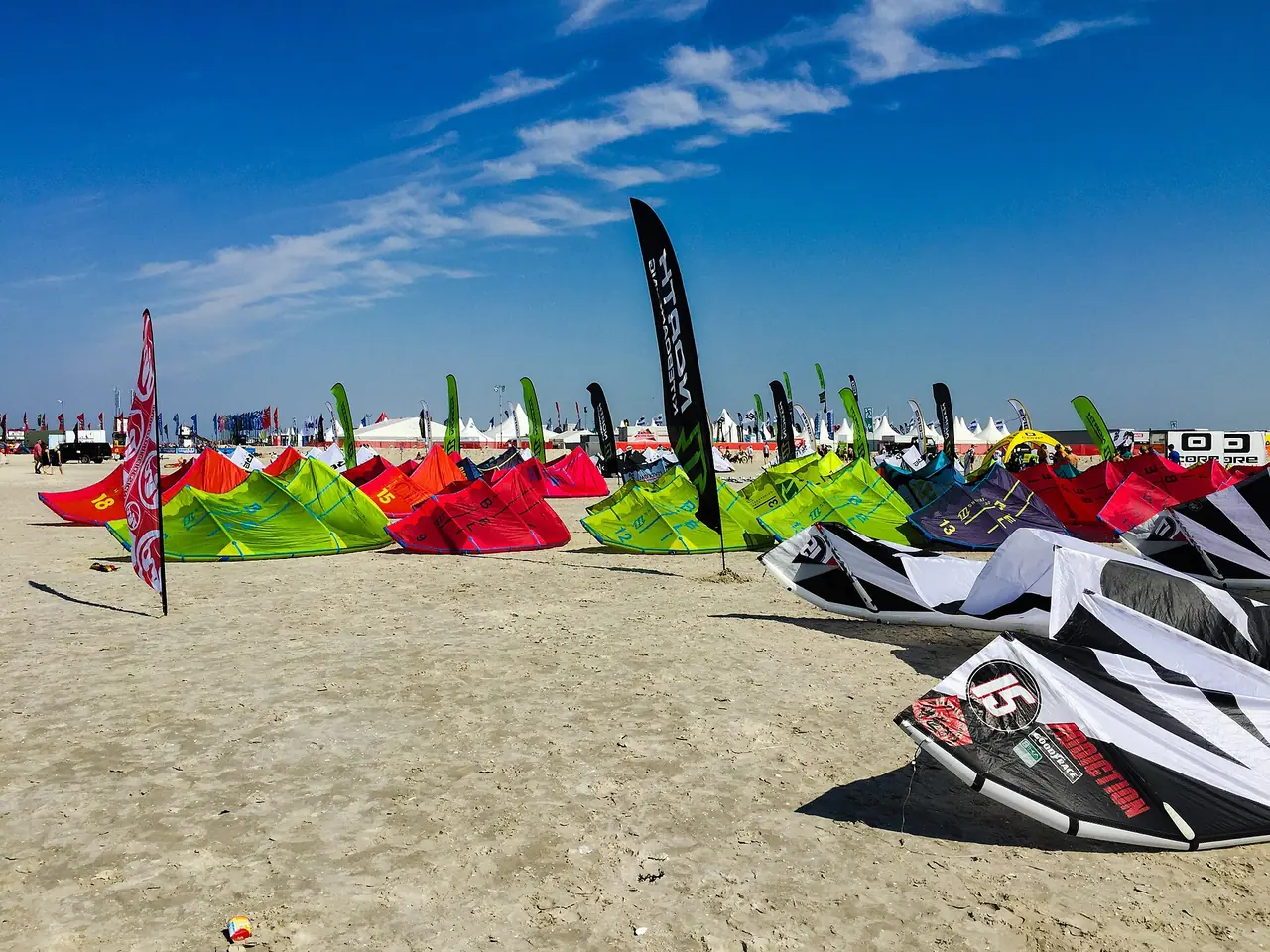
For the Baltic side of the story, and the years the World Cup spent there, see our Fehmarn guide.
Fly to Hamburg, then drive or take the train via Husum.
The tourism board calls Hamburg Airport the hub for air travel in the north: from there it's about an hour and a half by hire car or shuttle, 140 km via the A23. St. Peter-Ording also has its own airfield (ICAO code EDXO), but that's for private planes and sightseeing flights.
By train, take the line from Hamburg towards Westerland (Sylt) as far as Husum, then change to the regional train to Bad St. Peter-Ording, the end of the line. The single-track branch runs hourly through the day from Tönning, and the tourism board says the hourly connection with one change in Husum runs from May to September, and partly all year round. The last two stops are Bad St. Peter-Süd and Bad St. Peter-Ording. With a guest card, the local bus and the town shuttle are free, and they serve the Böhl beach and the Südstrand directly.
By road from Hamburg, the A23 takes you towards Heide; from there you either cross the Eider barrage onto the peninsula or go via Tönning on the B5 and B202. Check the road news before you set off: in 2026 the tourism board flagged a full closure of the B5 between Heide-West and Hemme from 22 June to 4 December 2026, with diversions in place.
112 on land and on the beach, Bremen for the sea rescue service.
In the bathing season, lifeguards work from six stations on the beach, according to the tourism board, and outside the season a mobile water-rescue team can be called out at any hour. Both are alerted through 112, the European emergency number.
At sea, Germany's rescue service is the DGzRS (Die Seenotretter). Its rescue coordination centre, MRCC Bremen, answers around the clock on +49 421 536870 and listens on VHF channel 16 as 'Bremen Rescue'. If you dial 112, ask to be put through to MRCC Bremen. The DGzRS also lists 124 124, but it works only from German mobile networks, only at sea or near the coast, and it's a network operators' service number rather than an official emergency number; on a foreign SIM, use 112.
The specific hazards here are the tide and the distance. The beach can flood on spring tides and storm surges, the currents on the mudflats can be strong, and an offshore wind pushes you away from a coastline that's already far off at low water. Ride inside the zone, tell someone when you go out, and keep your 50 metres from the bathing areas.
What riders ask before a trip to St. Peter-Ording.
Yes, inside the zone. Kitesurfing is banned in the Wadden Sea national parks except in the 52 zones listed by the 2023 Nordsee-Befahrensverordnung, and St. Peter-Ording is zone 18. Locally, you keep at least 50 metres from the bathing areas and from swimmers, stay out of the buoyed inner bay north of the Süd bathing area, and keep out of the Schutzzone 1 areas at the ends of the beach.
The federal regulation sets no time window for the St. Peter-Ording zone, unlike List and Hörnum on Sylt. In practice the tide still decides where you can ride: some spots, such as the Südstrand, only work around high water, and spring tides can flood the whole beach.
Böhl. The local school Kitesurfing Experience describes a large, waist-deep standing area kept flat by the outer sandbanks, and says Ording is less suited to beginners because the waves get big in strong wind and the standing area is limited.
Yes, at Ording and Böhl, from 7:30am to 10:30pm between mid-March and the end of October. Parking is paid and doesn't include the visitor levy (Kurabgabe), which every guest pays separately. Overnight parking is banned.
Fly to Hamburg, take the train towards Westerland as far as Husum, then change to the regional train to Bad St. Peter-Ording. The guest card covers the local bus, which serves the Böhl beach and the Südstrand.
112, and ask for MRCC Bremen if you're at sea. The sea rescue centre also answers directly on +49 421 536870 and on VHF channel 16. The short number 124 124 only works from German mobile networks near the coast.