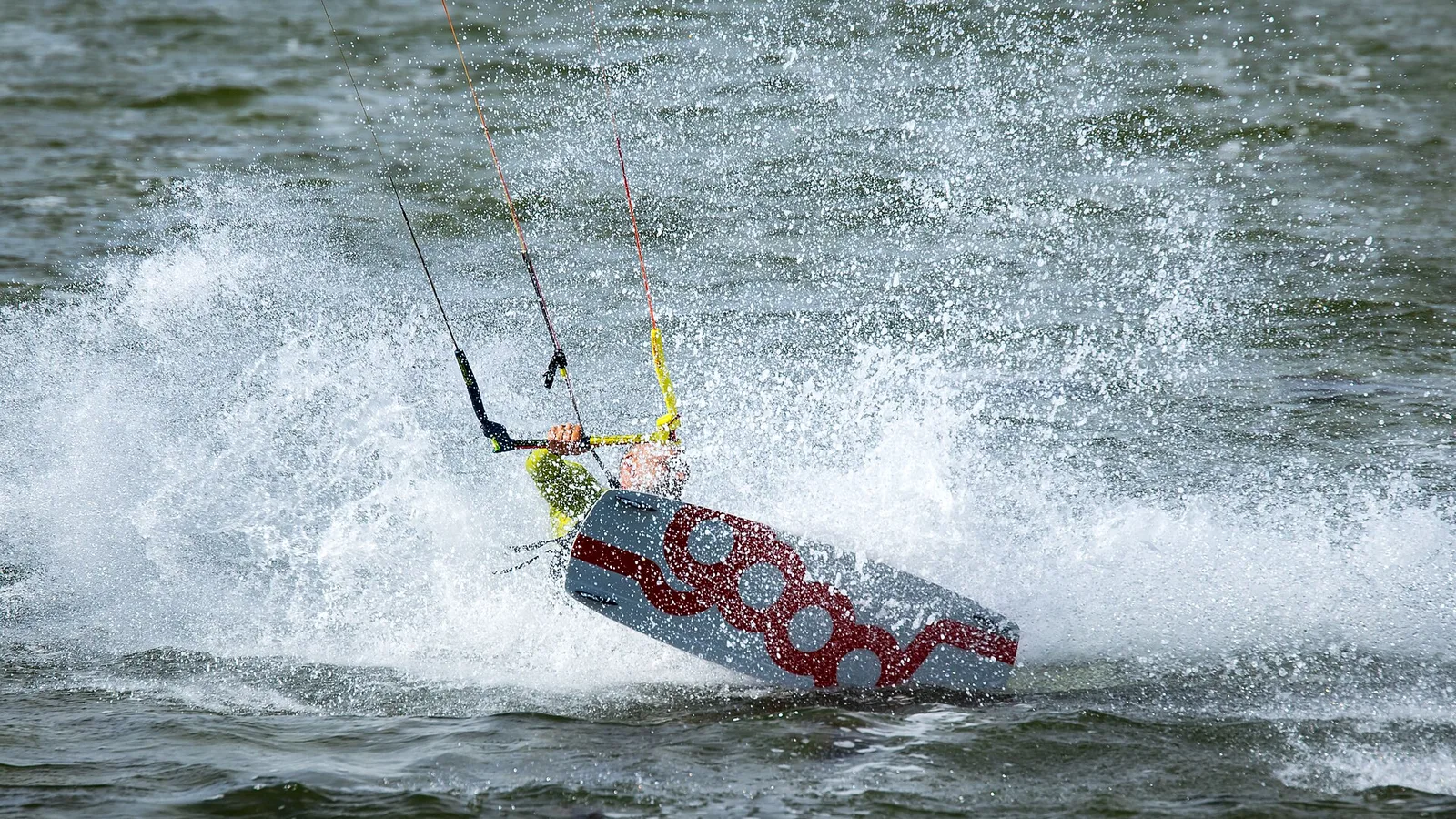
Photo: Superbass / Wikimedia Commons, CC BY-SA 4.0
The tideless Baltic, and a North Sea where a dedicated federal rule has governed kiting since 2023: two coastlines that don't compare term for term.
Two islands and several spots chosen by the day's wind, and a world-tour kite event at Fehmarn since 2016.
The Baltic in detail arrow_forward
Falckenstein and Surendorf, on the mainland — two nearby spots with two very different regulatory histories.
Kiel Bay in detail arrow_forward
The North Sea and the Wadden Sea National Park: 52 designated kite zones since 2023, some tied to the tide.
The North Sea in detail arrow_forward
Chiemsee, Walchensee, Forggensee: three lakes where thermal wind replaces the tide — but not with the same rules, or the same season.
Bavaria in detail arrow_forwardTwo coastlines, two tidal mechanisms, two regulatory regimes.
Two islands, a tideless sea, wind that shifts with the day's coastline.
On the island of Rügen, the Baltic wind — thermal and pressure-driven, not tidal — blows strongest and most consistently in spring and autumn (especially September-October), with the useful season broadly running April to October. The island's highly varied coastline means "there's a spot for every wind direction." Suhrendorf, at the Ostseecamp Suhrendorf campsite, offers a wide, shallow-water area, more beginner/freeride, rideable from south-west through north; the Berliner Kiteschule teaches there. Dranske, at the island's far north-west, is shallow with an east wind reinforced by the island's shape, best in autumn-winter-spring (from westerly depressions) and lighter in summer. Neu Mukran is a genuine wave spot: an unusually long fetch reportedly produces waves "up to 3-4 m" on the best north-east wind days, per a summary drawn from rider forums — a high figure for the Baltic, not corroborated elsewhere, best treated as an anecdotal report rather than an established fact. No named school was found specifically at Dranske or Neu Mukran.
See on Google Maps open_in_newSüdstrand/Burgtiefe has hosted the kiteboarding World Cup since 2016, but it's first and foremost the island's main summer bathing beach (beach huts, piers): several sources note that other spots on the island offer better riding conditions outside the event window. Grüner Brink, in the north-east, is cited as one of Germany's best east-wind spots — standing-depth water, but with a real, documented current: the German sea-rescue service (DGzRS) rescued a 15-year-old kitesurfer there in a life-threatening drift situation. The spot also sits inside a nature reserve where kiting is reportedly permitted only in designated areas, per a spot guide not cross-checked against an official park document. Wulfen/Katharinenhof, between Burgtiefe and Staberhuk, works on a south wind, with small waves possible on an onshore wind. Meeschendorf suits wave beginners. The Fehmarnbelt strait is one of the busiest shipping lanes in the Baltic (roughly 35,000 ship movements a year, a Puttgarden-Rødby ferry roughly every hour) — a real factor to plan around, not just scenery.
Kite Passion Fehmarn runs lessons, with schools described as based in Burg, on Burgtiefe's south beach, and in Lemkenhafen. The nearest airport is Lübeck, about 77 km away; Hamburg is about 150 km/1h45 by car. The major Fehmarnbelt fixed tunnel project (Puttgarden-Rødby, targeted from 2029) periodically creates zones temporarily closed to recreational shipping — worth checking before any trip if this page is read after construction begins.
Read the full Fehmarn guide — it lists the island's 18 named spots and their schools, explains what the Grüner Brink nature reserve rule actually says, traces the Kitesurf World Cup's real history (2016-2018, then Sylt), and examines the Fehmarnbelt strait in detail.
Two nearby mainland spots — and a local restriction worth knowing before you go.
Falckenstein (Falckensteiner Strand, Kiel) works well on an east wind; the Katamaran & Surfschule Kiel, based right on the beach, teaches there. Kiel's fjord (the Förde) carries active commercial and naval shipping traffic, though its precise density couldn't be quantified in this research — treat it as a real factor rather than a precise figure.
At Surendorf (Schwedeneck, on Eckernförde Bay — not to be confused with Suhrendorf on Rügen, two very similar names for two different places), kiting reportedly hasn't been permitted at the traditional entry point since summer 2014, in front of the former GlobalXTeam school, which is said to have relocated across the bay to Gut Ludwigsburg — a claim relayed by riders on a specialist forum, not confirmed against an official text. Riding is now reportedly confined to an area near a dog beach, under a steep bank, described by that same source as hard to ride due to a wind-stall effect on a cross-shore wind. Nordwind Wassersport, based on Eckernförde Bay, offers lessons with a shuttle to "the best spots of the day" in the wider area — one way a school works around exactly this kind of local restriction.
A dedicated federal regulation since 2023, with tidal windows to respect.
Unlike the Baltic, the North Sea/Wadden Sea has a genuine tide — roughly 2 to 3.5 m depending on the exact spot along the German coast — and a dedicated regulation. A federal regulation (the Nordsee-Befahrensverordnung), effective 28 April 2023, ended the general kitesurfing ban inside the Wadden Sea National Parks and created 52 designated kite zones: 22 in Schleswig-Holstein, 30 in Lower Saxony, valid for 10 years. The change followed a 14 December 2020 administrative court ruling that the national park law's "kite-flying" ban didn't cover kitesurfing, and that only a federal rule could govern powered or towed craft. The underlying reason: the Wadden Sea hosts about 12 million birds a year, mostly migratory, and kites are considered especially disruptive to them because of their height, speed and unpredictable turns.
Per one specialist magazine's reading of the regulation's Annex 3, two zones on the island carry precise tidal windows: at List, kiting is permitted 3 hours before and after high tide; at Hörnum, 3 hours before and after low tide. Active schools were identified at Westerland (Duotone Pro Center Sylt) and Rantum (Ride On, which can ride the North Sea or Wadden Sea side depending on the day's wind), but their exact tidal windows couldn't be confirmed — don't apply List's or Hörnum's schedule to them by default. The island has its own airport (Sylt Airport, GWT), though the exact list of scheduled routes couldn't be verified in this research.
A negotiated kite zone exists "in the shelter of the dike or dunes," along the roughly 10 km beach, excluding swimming zones and the interior of a small lagoon, with extra buffer zones near the Tümlauer Bucht (north) and the Eider estuary (south) — two ecologically sensitive areas. The zoning was negotiated between the municipality, the BoardSPOrt e.V. association, the local Schutzstation Wattenmeer office and the national park administration. One specialist magazine noted the 2023 mapped zone appeared to cover "nearly the entire western beach" — a generous reading that source itself flagged as needing to be checked against the regulation's actual Annex 3 coordinates rather than taken at face value; the exact boundary couldn't be independently confirmed in this research. Several schools operate on site, including Kitesurfing Experience (Markus Schreck) and UP-WIND Kitesurfschule. St. Peter-Ording has no commercial airport: Hamburg, about 140 km/1h30 by road (or roughly 3h by direct coach), is the practical option.
A hazard specific to the Wadden Sea, absent from the Baltic: Priele (tidal channels crossing the sandbanks) can look barely ankle-deep at low tide and turn into fast, dangerous currents within minutes as the tide comes in — a mechanism responsible for several deaths a year among mudflat walkers, and just as relevant to a kiter in the zone. An offshore wind can also carry a rider out to sea, and sea fog can cut visibility to a few metres within about 20 minutes.
Three alpine lakes, a thermal wind rather than a sea breeze — and three different regulatory regimes.
Bavaria's largest lake (nicknamed "the Bavarian Sea") is driven by passing low-pressure systems that bring a west wind — the most reliable direction, especially outside summer — and by a southerly Föhn; the Seebruck spot instead works on an east wind. Fronts can add 2 to 3 Beaufort in one go, and waves over a metre form on a sustained west wind; no knot-range figure could be sourced, only this qualitative description. At Chieming, a wide pebble beach leads into about 200 m of stony shallows (sharp stones, shells) before it drops off — flat water, no current, but often onshore wind made turbulent by shoreline trees. No rescue service is provided on site: self-sufficiency is explicitly required.
The spot is reserved for already self-sufficient riders: the Kiteboarding Chiemsee e.V. association requires riders to be able to water-start safely, control their kite's height and know right-of-way rules, and to have already landed a jump, before being allowed on the water. The water reaches 19°C in May, 24-26°C in July-August.
See on Google Maps open_in_newRegulations: kiting is only permitted in designated zones — a public one at Chieming (east beach, 6 km, freely accessible) and one at Übersee reserved for members/day-pass holders. A kite licence and liability insurance are mandatory and must be shown on request; rigging outside the marked zone, jumping outside it, or crossing swim lines are banned, on pain of expulsion. A 2005 Landratsamt Traunstein ordinance separately creates bird and fish rest zones on the lake — a general nature-protection text, not a kite-specific permit. Access: Chieming, on the east shore, about 90-100 km/1-2h by car from Munich via the A8. Chiemsee-Surfcenter Gstadt (VDWS-certified, since 1981) leans windsurf/SUP; Kiteboarding Chiemsee e.V. itself is the official point of contact with local authorities for the spot.
Bavaria's deepest lake (down to 190 m) runs on pure thermal wind: warm air rising along the northern flank of the Alps pours onto the lake, boosted by a funnel effect at the Kesselberg pass. The wind typically picks up around midday in the north (Urfeld) and spreads south, reaching 3 to 4 Beaufort (roughly 8-16 knots); it holds longer in the south (until around 5:30pm on a good thermal day, versus 3:30pm in the north). Best season: summer, when the day/night temperature gap is widest. The water, unusually cold for a Bavarian lake (17-22°C in summer, never exceeding about 22-23°C even at the peak), owes that chill to its depth and to cold groundwater fed in from the Rißbach, in the Karwendel range.
No required skill level was found for this spot — unlike Chiemsee, no explicit access rule was identified here, nor any Landratsamt Bad Tölz-Wolfratshausen ordinance mentioning a zone or kite permit. Sunnawind, long based at Urfeld/Walchensee, left the lake after six years and now operates from the Starnberger See instead — it is no longer based here, and was never confirmed as kite-specific rather than wing/windsurf. A "Windsurfing-Center-Walchensee" appears in several directories as offering lessons and rental, without a specific kite offering that could be verified: no kite school could therefore be confirmed with the same certainty as at Chiemsee. Access: the community of Kochel am See, about 75-80 km/1-1.5h by car south of Munich (A95, Murnau/Kochel exit, then the B11).
Germany's largest artificial reservoir, near Füssen, is drained every October and only refills from 1 June, reaching full level around 15 June — which effectively cuts the usable season to roughly June-September. The main spot, the Waldspitze peninsula (reached via Camping Brunnen), is narrow enough to be rideable "in almost every wind direction": the south is partly sheltered by trees, the north-east sweeps freely across the whole lake. During the draining and refilling period, the bay east of the peninsula becomes very shallow and develops dangerous shoals — a genuinely named hazard, not a generic caveat.
No kite school was found on site: one spot guide states plainly that "there is currently no kite school here." The local sailing clubs (Segelclub Füssen Forggensee, Segelclub Schwangau) were not confirmed as offering kite lessons. The water stays cold outside summer (17.4°C summer average, 20-24°C at the July-August peak, 3.3°C in winter): a wetsuit is needed outside that peak. A 1990 Landkreis Ostallgäu ordinance creates a landscape-protection zone over the Forggensee and neighbouring lakes, but it doesn't mention kitesurfing or watersports zoning; a possible 2017 fee ordinance from the same Landratsamt couldn't be retrieved in this research. Access: about 85-90 km as the crow flies (120-130 km by road)/1h40-2h from Munich, via the B16/A96.
Other Bavarian lakes — Tegernsee, Starnberger See, Ammersee, Altmühlsee, Grosser Brombachsee, Rottachsee — appear in spot-directory listings as riding locations, some with a stated wind direction, but without the same depth of verification carried out for Chiemsee, Walchensee and Forggensee on this page. The Starnberger See, in particular, is said to close its north and south ends to watersports from November to March to protect wildlife, with the central stretch open year-round — worth confirming before publishing rather than treating as an established fact.
There's no German equivalent to France's Division 240.
In Germany, no single federal law governs kitesurfing the way France's Division 240 does. The dividing line is structural, not just administrative: the Baltic coast (Rügen, Fehmarn, Kiel Bay) has no exposure to the Wadden Sea National Parks regime — no federal regulation equivalent to the Nordsee-Befahrensverordnung was identified there, only general principles (respect reed beds and bird resting areas, sometimes closed) and, at Grüner Brink and Surendorf, local restrictions reported by riders but not confirmed against an official text.
The North Sea coast (Sylt, St. Peter-Ording), by contrast, has fallen under a precise federal regulation since 2023, with 52 mapped kite zones — some tied to strict tidal windows. A rule observed at a Baltic spot never applies to a North Sea spot, and vice versa.
Bavaria's lakes form a third regime, specific to each body of water rather than to a natural border: Chiemsee requires a mandatory kite licence and insurance, managed by the local association; Walchensee and Forggensee have no kite-specific rule identified at all — which doesn't mean none exists, only that none could be verified for this page.
In a sea emergency, contact the DGzRS (Die Seenotretter, the German sea rescue service) or 112; on Bavaria's lakes, 112 remains the reference number.
What riders ask most before coming to Germany.
Suhrendorf, on the island of Rügen, is described as a beginner/freeride spot thanks to its wide, shallow-water area. Meeschendorf, on Fehmarn, also suits wave beginners.
No. The Baltic coast (Rügen, Fehmarn, Kiel Bay) has no dedicated federal kite regime; the North Sea coast (Sylt, St. Peter-Ording) has fallen under a precise federal regulation since 2023, with 52 designated kite zones inside the Wadden Sea National Park.
The Baltic has almost no tide; the North Sea has a real one (2-3.5 m), with tidal channels (Priele) that fill fast on the rising tide and an offshore wind that can carry a rider out to sea — hazards specific to the Wadden Sea, absent from the Baltic.
Not in the zones whose window is known: at List, kiting is permitted 3 hours before and after high tide; at Hörnum, 3 hours before and after low tide. The exact windows at Westerland and Rantum couldn't be confirmed.
Yes, notably on Chiemsee, Walchensee and Forggensee, where the wind is thermal rather than a sea breeze. Chiemsee requires a mandatory kite licence and reserves its spot for already self-sufficient riders; Forggensee is drained every year from October to June, cutting its usable season to June-September.