

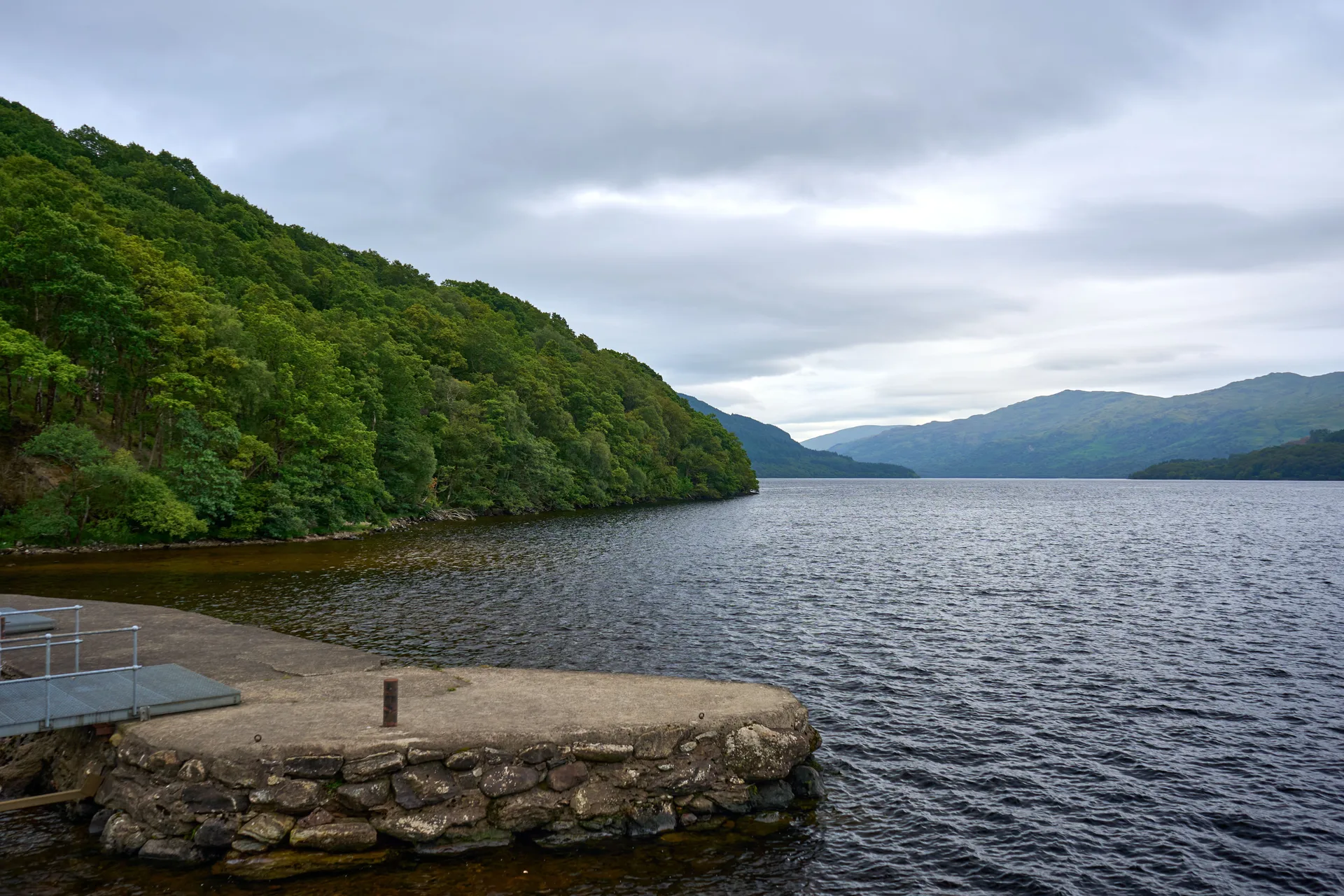
📍 Loch Lomond & The Trossachs National Park, Scotland
Best season
May – September
Water temp
8 – 17 °C year-round
From Glasgow
~35 min (Balloch)
Difficulty
Beginner-friendly
Loch Lomond Leisure offers SUP hire at three locations around Scotland's largest loch. Prices, availability and inclusions change seasonally — check directly with the provider before booking.
You step off your board onto a pebble beach with Ben Lomond rising directly across the water — that view is why Luss is the first place most people think of when they picture paddleboarding on Loch Lomond. Its sheltered shoreline also makes it one of the more forgiving places to start. Loch Lomond Leisure operates SUP hire here, with boards, paddles and safety equipment included. The village car park gives easy access to the beach, though it fills quickly in summer. Follow signs from the A82 to reach Luss from either Glasgow (about 26 miles north) or Crianlarich (about 22 miles south).
View on Google Maps open_in_newA short walk from the beach, the pier gives you a step-off into deeper water — ideal if you want to skip the shallows and start paddling straight away. It is also the meeting point for guided tours that push out towards the islands, so if that is your plan, this is where your day begins. Confirm the precise check-in point when booking, as the pier and beach are separate locations within the village.
View on Google Maps open_in_newFor anyone coming from Glasgow without a car, Balloch is where the train drops you — and the loch is a ten-minute walk from the station. It is the most accessible entry point on the whole loch, which means it can also be the busiest: come mid-week or early morning in summer and you will have far more of the water to yourself. Loch Lomond Leisure runs SUP hire from Loch Lomond Shores, the retail and leisure complex on the waterfront. Confirm the exact launch or meeting point directly when you book — the car park, the building entrance and the waterside access are in different spots, and first-timers often spend time finding the right place.
View on Google Maps open_in_newVerify before you book: prices, seasonal opening dates, equipment inclusions and age or swimming-ability rules all change. Check current details at lochlomond-scotland.com before visiting.
Access rules, parking and facilities differ at every location. Under the Land Reform (Scotland) Act 2003, you have a general right of access for recreation on the lochside — but car parks, launch fees, sign-posted restrictions and visitor management rules still apply.
The shore at Luss village is one of the most popular launching points for hire customers and self-guided paddlers alike. The village pay-and-display car park is a short walk from the water. Space is limited and the car park fills quickly on summer weekends and bank holidays, so arriving early or visiting mid-week is strongly recommended. The walk from the car park to the actual water's edge passes the village green and the pier — allow a few minutes and follow signs. Check current parking tariffs and restrictions on site, as charges apply.
View on Google Maps open_in_newMilarrochy Bay, on the eastern shore near Balmaha, has a car park, a beach and public toilet facilities. The National Park Authority has stated that the boat slipway at Milarrochy Bay is no longer in operation, but the beach and adjacent facilities remain open. For a paddleboard, a hand-carry launch from the beach may be possible depending on current conditions and any restrictions displayed on site — check the signage on arrival and follow any instructions posted by the National Park Authority.
View on Google Maps open_in_newLoch Lomond Shores is a paid-parking waterfront venue at the southern end of the loch. If you're a hire customer with Loch Lomond Leisure, confirm the exact meeting and launch point when you book, as the retail complex, car park and waterside access are distinct areas. Independent paddlers who want to self-launch here should confirm current public access rules and any permit requirements directly with Loch Lomond Shores before travelling.
Parking source: lochlomondshores.com — parking information (check for current tariffs on arrival).
View on Google Maps open_in_newBalmaha, on the eastern shore, is a popular visitor point with a National Park car park (pay and display), a boat yard and the visitor gateway to the Loch Lomond islands. SUP access from the shore is subject to current restrictions and signage at the site — check for posted notices on arrival. Parking fills quickly in summer. Confirm current tariffs and payment methods (pay-and-display machines or app-based) from signage on arrival, as charges are reviewed periodically.
View on Google Maps open_in_newAldochlay, on the western shore of the loch, is a quieter access point used by paddlers who prefer to avoid the busier spots further south. Parking here is limited roadside space — not a formal car park. Confirm that any pull-in you use is a designated, legal parking area before leaving your vehicle, as verges and informal pull-ins on the A82 corridor are not always authorised stopping places. Road safety and the legality of access to the shoreline need to be checked on the ground.
View on Google Maps open_in_newAccess and parking can change. The Loch Lomond & The Trossachs National Park Authority manages access and visitor facilities across the loch. Check current notices at lochlomond-trossachs.org before travelling, and always follow posted signs on site.
From a straightforward SUP rental to a guided tour of the islands, Loch Lomond has options for every level and group size.
Board, paddle and buoyancy aid supplied for a set time on the water. Includes a safety briefing. Age restrictions and swimming requirements vary by operator — confirm when booking. Wetsuit hire available as an add-on.
Covers standing, paddling technique, turning, falling safely and self-rescue. Look for instructors accredited by British Canoeing or holding a current BSUPA award. Ask for current qualifications and first-aid status before booking.
A qualified guide leads you out to the southern islands — Inchmurrin, Inchcailloch and the smaller islets — over two to three hours. Book ahead and check the cancellation policy: Loch Lomond weather changes quickly.
A private guided paddle to one of the loch's uninhabited islands. Weather-dependent; requires confidence on open water. Enquire well in advance, state your experience level, and confirm the wet-weather policy.
Group and hen-party sessions are available with more lead time and minimum numbers. If your group includes complete beginners, say so when enquiring — many operators will add a guided element for larger groups.
Hiring a wetsuit alongside your board makes sense on a cold Scottish loch year-round. Confirm whether it's included or an add-on, and check sizes are available. Cold-water immersion without thermal protection is a real risk here.
Cold water, rapidly changing weather and busy boat traffic make preparation essential. These are not optional precautions on Loch Lomond.
Loch Lomond is cold for most of the year — typically below 15°C even in summer. Water at this temperature causes cold-water shock on immersion: involuntary gasping, muscle weakness and difficulty breathing, even in strong swimmers. The risk is greatest in the first 30 seconds in the water and does not wait for you to feel cold. Wearing a buoyancy aid and a leash is the minimum — adding a wetsuit or appropriate cold-water immersion kit significantly reduces the risk. Dress for the water temperature, not the air.
Loch Lomond is a large, north-to-south loch surrounded by mountains. Wind can build quickly, particularly from the north and north-west, and conditions on the open water of the main loch can be significantly more severe than conditions on shore. Check the forecast before you go, stick to the sheltered southern bays in uncertain conditions, and plan your route so the wind is not behind you on the outward leg and against you on the way back.
Wear a buoyancy aid at all times. A leash keeps you attached to your board — your largest and most visible object — if you fall in. On flat inland water a coiled ankle leash is the common choice, as it stays out of the way. A quick-release waist leash is an alternative for paddlers who want to be able to release quickly. A leash is not a substitute for a buoyancy aid.
The Loch Lomond steamers, charter vessels, powerboats and sailing craft all share the loch. Keep well clear of boat routes, maintain visual contact with the shore, and give motor vessels plenty of room. The channels around the islands and the approaches to jetties and marinas have regular boat traffic — stay alert.
Tell someone your plans before you paddle — where you're launching from, your route and when you expect to be back. Carry a means of calling for help (a fully charged mobile in a waterproof case or a waterproof pouch). In an emergency on inland water, dial 999 and ask for the Coastguard — HM Coastguard coordinates search and rescue on Scottish inland water. Mountain Rescue teams also operate in the Loch Lomond area and may be dispatched for incidents in remote lochside terrain.
Loch Lomond is already home to invasive non-native species, including Himalayan balsam on the loch margins. Before moving to or from any other water body, follow the Check, Clean, Dry routine: inspect your board, paddle and kit for plant material and animals, clean and rinse everything, and let it dry fully before using it elsewhere. This is a legal responsibility under the Wildlife and Countryside Act 1981 and the Water Environment (Controlled Activities) (Scotland) Regulations.
Board type, leash choice and thermal protection all matter more on a large, cold Scottish loch than on a sheltered coastal lagoon.
For flat-water paddling on a large loch like Loch Lomond, an all-round inflatable SUP of 10 to 11 feet with good volume gives a beginner stability and confidence. A touring board — longer, narrower, faster — suits paddlers who want to cover distance and explore the islands. Both work here; the hire fleet at Luss and Balloch typically carries all-round boards. If you're buying your own, look for a board that performs well in light wind and choppy conditions, not just flat water.
On flat inland water like Loch Lomond, a coiled ankle leash is the standard choice: it keeps the leash off the water and out of the way when paddling. A quick-release waist leash is the preferred option for moving water (rivers and tidal estuaries), where a board that's caught in current could pull you underwater. On a loch, the snag-hazard risk of a waist leash is lower, but either type is acceptable. See Paddle Scotland's SUP leash guidance for a full explanation of environment-specific leash choice.
At minimum, a 3/2mm wetsuit provides meaningful protection on Loch Lomond in summer. A 4/3mm suit extends your comfort window into spring and autumn. Beyond October, a drysuit or full immersion suit with thermal underlayers gives significantly better protection. Whatever you wear, bring a full dry set of warm clothes to change into immediately after paddling — cold-water immersion followed by a cold wind is dangerous even after a short session. Hire operators may offer wetsuit rental; confirm sizes and availability in advance.
The practical questions most visitors ask before heading to Scotland's most iconic loch.
Loch Lomond Leisure operates SUP hire at three locations: Luss Beach, Luss Pier and Loch Lomond Shores in Balloch. Prices, seasonal availability and inclusions change — check current details at lochlomond-scotland.com before booking.
Yes, but beginners should take a lesson rather than heading straight onto hire equipment. The loch's cold water and changeable conditions mean that knowing how to fall safely, self-rescue and paddle effectively before going unsupervised is genuinely important. Beginner SUP lessons from qualified instructors are available at the hire locations.
Booking ahead is strongly recommended, especially for weekends, summer holidays and guided tours. The hire fleet at each location is limited and popular slots sell out. Walk-up availability exists but cannot be guaranteed — check with the operator directly for their current booking policy.
Under the Land Reform (Scotland) Act 2003 you have a general right of access for recreation on the lochside, which includes non-motorised paddleboarding. At Milarrochy Bay the boat slipway is no longer in operation, but the beach remains open — a hand-carry launch may be possible depending on current conditions and any signage on site. At Luss, access to the shore is straightforward but follows the route through the village. Always check signs posted at the location on the day, as the National Park can impose temporary restrictions.
A buoyancy aid is essential — wear it on the water at all times. A wetsuit is strongly recommended year-round, given Loch Lomond's cold-water temperature. Cold-water shock is a real risk in water below 15°C, regardless of air temperature, and the loch stays cold even in the height of summer. See the thermal protection guidance above for more detail, or check the National Park Authority's water safety guidance.
Look for a current award from British Canoeing or the British Stand Up Paddle Association (BSUPA), valid public-liability insurance, a current first-aid certificate and clear local knowledge of Loch Lomond's specific conditions. Ask the operator directly — a good provider will be happy to confirm their instructors' credentials.
Yes, guided tours to the Loch Lomond islands are offered by local operators. Private tours to specific islands depend on conditions, the group's ability level and any access restrictions in place at the time. Itineraries are always weather-dependent — book with a clear cancellation policy in place, because conditions on the loch can prevent a tour going ahead even on a day that looks fine from shore.
See the individual launch-spot profiles above for specific parking details. In general: Luss has a pay-and-display village car park (limited spaces, fills early in summer); Balmaha has a National Park pay-and-display car park; Loch Lomond Shores in Balloch has paid parking. Milarrochy Bay has a car park. Confirm current tariffs and payment methods from on-site signs on arrival. Do not rely on "free parking" claims without checking, as charges and restrictions change.