

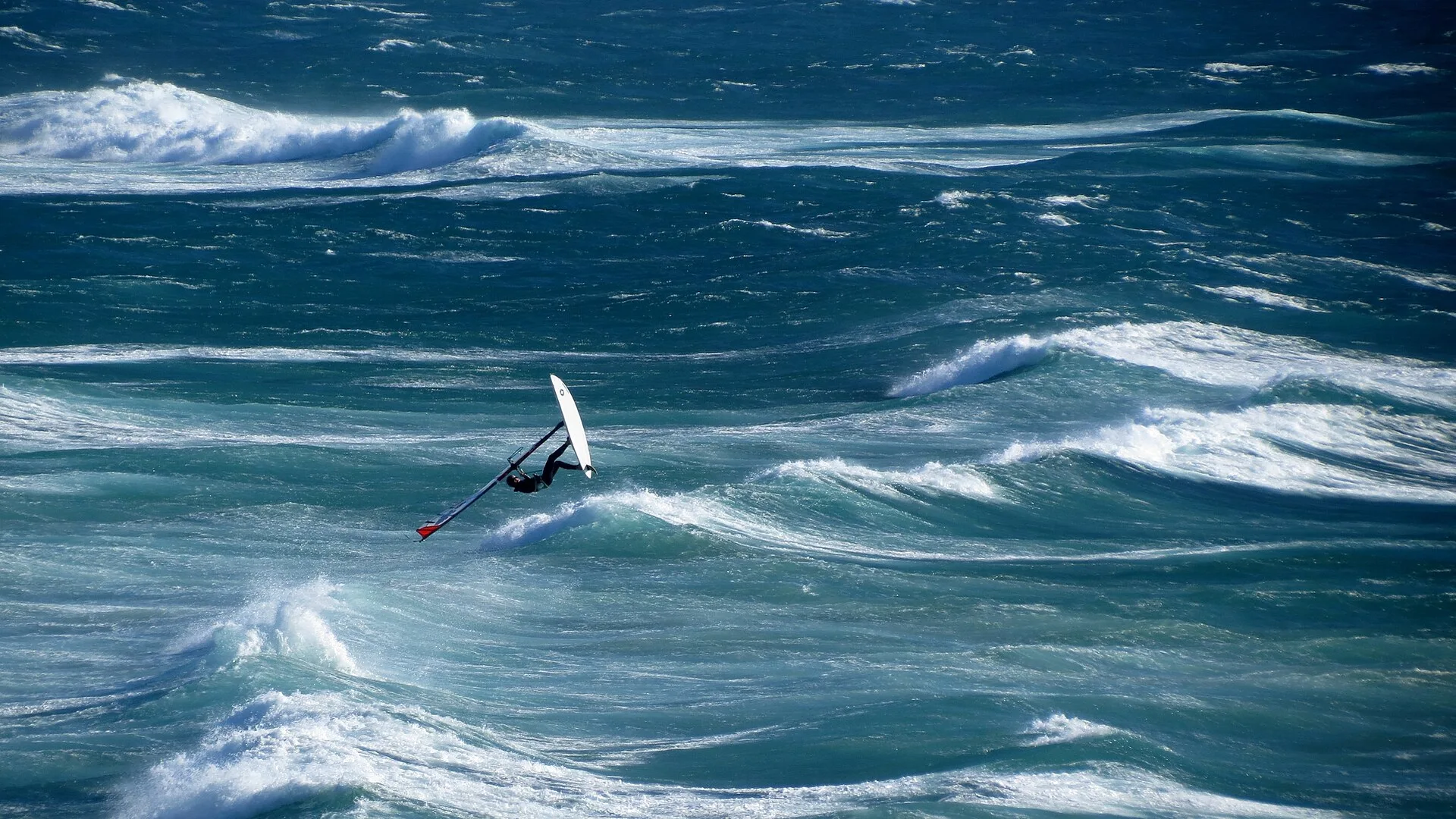
Photo: Walterpeitz / Wikimedia Commons, CC BY-SA 4.0
One of Europe's windiest beaches, 40 km from Lisbon, with a real Portuguese regulation worth knowing before you rig up.

A thermal wind channelled by the Serra de Sintra, the nortada averages 15 to 25 knots, with summer afternoons reaching 20 to 40 knots. Light in the morning, it fills hard after midday.
See destinations arrow_forward
Heavy shore break, strong currents, and rocks at both ends of the bay: spot guides classify Guincho as intermediate to advanced, not a beginner spot.
Kitesurf guides arrow_forward
Daytime navigation only, mandatory corridors, no closer than 300 m to bathers in season, force 7 Beaufort maximum. A real Portuguese regulation, not a legal void.
Cascais regulation arrow_forwardThe wind, the water and access, before you check the full regulation further down.
South section for kiting, north section for bathers.
Praia do Guincho is a wide, open, dune-backed Atlantic beach on the western edge of the Sintra-Cascais Natural Park. Spot guides document a south section recognised as the kite launch zone in summer, with bathers tending to use the north section instead. Shore break is documented as powerful, especially at high tide, and lateral currents (drift along the beach) are noted as strong near the rocks and rocky outcrops — which is why the spot is rated intermediate to expert. No precise mapping of the rocks turned up in the sources consulted: get your bearings on-site and ask a school for advice before sailing here alone for the first time.
View on Google Maps open_in_newSix named schools, IKO, FPVela or IPDJ certified according to the sources consulted.
Several schools operate directly on the beach: Guincho Wind Factory (IKO and FPVela certified), Gustykite, SBKiteboarding (IKO), South Adventures (IPDJ, the Portuguese sport and youth authority), Kitesurf Adventures / Guincho Wayra House (IKO) and 24Kiteboard Pro Kitesurf School Lisbon (IKO). Always check current certification and rescue cover before booking — the sources consulted note that no kite-specific rescue exists at Guincho, and there are no lifeguards outside the marked swimming zone.
Portugal has no codified national rule the way France does — but Cascais has its own, real and documented, for all kite and windsurf activity in its jurisdiction.
Two edicts from the Capitania do Porto de Cascais (185-2016, consolidated version, and the more recent 950-2024) govern kitesurfing and windsurfing across the whole Cascais jurisdiction, Guincho included. The activity is only permitted during daytime, from sunrise until one hour before sunset, and only in good visibility. Riders must launch and land through designated corridors so as not to interfere with other beach users.
Sailing within 300 m of the waterline is banned on supervised beaches during the bathing season (documented as 1 May to 30 September 2026 in the source consulted). Activity is also capped at a maximum wind of force 7 Beaufort (roughly 33 knots) and banned whenever IPMA (Portugal's meteorological institute) issues a yellow or higher sea-state warning. Beyond 750 m from shore, a motorised support boat is mandatory, and may supervise up to four riders at a time.
The spot guides consulted recommend a 50x50cm orange signal flag, a helmet, a line-cutting tool, and a buoyancy aid of at least 50N — equipment that lines up with the absence of kite-specific rescue noted above.
Portugal has no codified national 300 m rule covering the whole coast the way France does — it's the relevant Capitania do Porto (here, Cascais) that sets the rules for its own jurisdiction, documented above. In a maritime emergency, contact the Autoridade Marítima Nacional or call 112.
Lisbon airport, then 40-50 minutes by road or the train to Cascais.
Lisbon Humberto Delgado Airport (LIS) is the natural gateway, roughly 40-50 minutes by road from Guincho. From Cascais itself, count on 10 to 25 minutes. Without a car, the Lisbon-Cascais train followed by the MobiCascais bus network will get you to the beach.
April to September, with June-August as the nortada's core.
The nortada is documented as reliable from April to September, with June to August as the most consistent stretch. The daily pattern is thermal: light wind in the morning, building hard after lunch through to late afternoon. Plan a foil or a bigger kite for the early morning, and your strong-wind gear for the afternoon peak.
What riders ask most before heading to the Lisbon coast.
No. Spot guides rate Guincho intermediate to expert, because of the powerful shore break, currents and rocks at both ends of the bay. A certified school is still the best way to get to know the spot.
It's the thermal north-to-northwest wind that blows along the Lisbon coast, channelled by the Serra de Sintra and Cabo da Roca. At Guincho it's documented at 15-25 knots on average, with summer afternoons reaching 20-40 knots.
The Capitania do Porto de Cascais's: daytime navigation only, mandatory launch corridors, no closer than 300 m to bathers in season, a maximum wind of force 7 Beaufort (33 knots), and a mandatory support boat beyond 750 m from shore.
By road from Lisbon Airport (LIS), allow 40-50 minutes; by train to Cascais then the MobiCascais bus if you don't have a car. See the rest of our spots in our destination directory.