

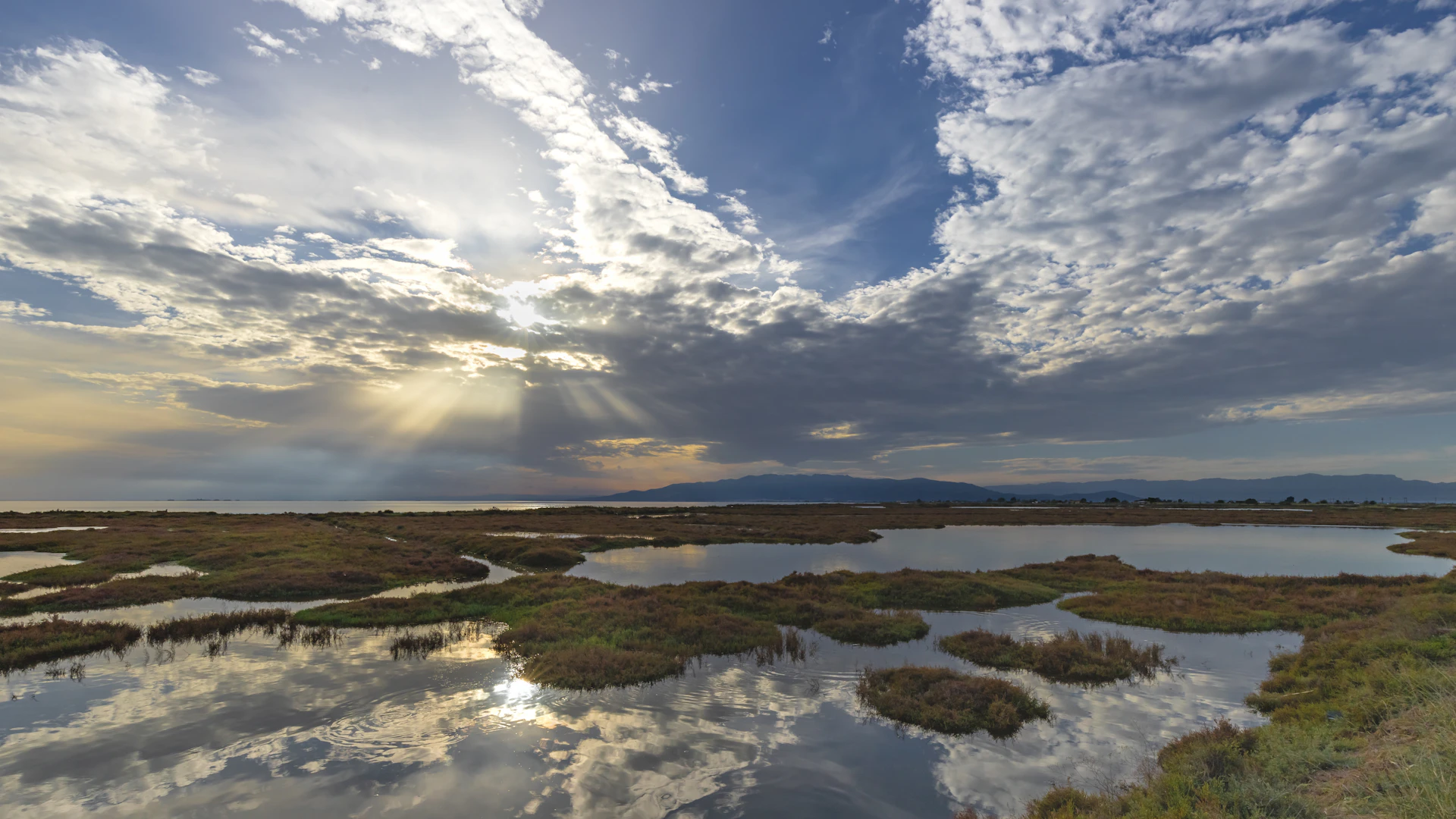
Catalonia's largest wetland, with two winds splitting the delta between north and south.
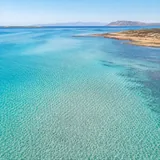
The mestral blows in from the north to Riumar; the garbí blows from the south and works at El Trabucador and the Alfacs bay. Knowing which one's on today is half the job here.
See destinations arrow_forward
Very flat, shallow bays for progressing, plus a stretch open to the Mediterranean when the mestral picks up and you want something more serious.
Kitesurf guides arrow_forward
Sailing on the park's lagoons is banned, and in spring the beaches where birds nest are cordoned off. Check before you rig up. In an emergency, call 112 or Salvamento Marítimo.
Kitesurf safety arrow_forwardThe delta's wind, water and wetsuit, in four lines.
The delta is huge and flat: the day's wind decides which end you head for.
At the northern tip of the delta, right by the river mouth, Riumar is the reference spot when the mestral blows in from the north or north-west. Local guides describe it as stronger and steadier than El Trabucador, with a range some local guides stretch from 15 to 50 knots depending on the day: 18 to 30 knots is the usual band, not the ceiling. It's the spot that makes the delta a winter destination, and also the one that demands the most judgement: with a settled mestral, this isn't a place to learn.
View on Google Maps open_in_newTo the south, the Trabucador sand spit is an extremely narrow strip of sand separating the open sea from the Alfacs bay, letting you pick a side to suit what you're after: sea on one flank, flat water on the other. It's the garbí's zone, and over the bay the thermal arrives gently and the water is very shallow — a combination that's hard to beat for racking up hours.
View on Google Maps open_in_newTo the north-east, the Fangar peninsula and Marquesa beach show up in every Costa Daurada sailing guide, though without as clearly defined a wind range as Riumar or El Trabucador. It's also one of the park's most sensitive areas: terns nest directly on the sand at El Fangar, and the cordoned-off zones have to be respected without exception. If it's your first visit, ask locally before rigging up here.
View on Google Maps open_in_newAlways choose an official school, with certified instructors and gear in good condition.
Kitesurf and windsurf schools operate across the delta, mostly split between Riumar and the area around Sant Carles de la Ràpita. Centres open and close with the season and move around depending on the wind, so the current year's list is always the right one to check before booking: look for instructors certified by the Federació Catalana de Vela (or by the IKO or VDWS internationally), valid insurance, and a boat or rescue service.
The Alfacs bay is inland water: shallow, with no swell to manage and the garbí arriving gradually in the afternoon. That removes two of the variables that complicate a first session most — waves and current — and leaves the focus on handling the kite or the sail. Riumar with the mestral is the exact opposite, worth being clear about before booking lessons for January.
One of the western Mediterranean's most important wetlands, with rules that directly affect where you can sail.
It's the clearest rule, and the one most people don't know: the official website of the Parc Natural del Delta de l'Ebre states that sailing on the park's lagoons is not permitted. It applies to the inland lagoons, not the open sea or the bays, and covers paddleboarding and kayaking too, not just craft with sails. Elsewhere on the water, the park asks visitors to stay out of the marked zones, land only at designated points, and keep a reasonable distance from wildlife, moving away if it's disturbed.
Colonies of terns, gulls and plovers nest in the delta directly on the beach sand, where the nests are almost invisible. In spring and early summer, stretches of beach are cordoned off and fenced to protect them: these are temporary closures, clearly signed, and must be respected both for rigging up and for sailing close to shore. Dogs must be kept on a lead everywhere in the park.
In practice, none of this stops what you've come to do: Riumar, El Trabucador and the Alfacs bay are all sailed normally. What changes is that signage rules here, and a stretch of beach that was open in October can be fenced off by May. Check the day's signage, not last trip's memory.
Between Barcelona and Valencia, with a train station nearby and a delta best covered by car.
The nearest airport is Reus (REU), about 85-95 km by road. Barcelona and Valencia are further away but have far more flight options. By train, the reference station is L'Aldea-Amposta-Tortosa, on the Barcelona-Valencia line, about 20-30 km from the water depending on which spot you're headed to.
A car is pretty much essential, not just to get there but to get around. Riumar sits in the north and El Trabucador in the south, at opposite ends of a very large, flat delta, and since the day's wind decides which one you head for, it helps to be able to change your mind in the morning. The AP-7 and the N-340 connect the area with Tarragona and Barcelona to the north, and with Castellón and Valencia to the south.
There's no off-season here: there are two seasons, with two winds and two spots.
The mestral blows in from the north with strength and regularity, usually 18 to 30 knots, with episodes well above that. Riumar is the place, and this is when the delta gets genuinely serious. The water drops to 13 or 14°C and the northerly wind does the rest: 4/3mm, boots and gloves. A season for self-reliant riders.
The southerly thermal arrives more gently, around 12 to 20 knots, and the action shifts to El Trabucador and the Alfacs bay. With water at 24 to 26°C at the height of summer and lycra or a shortie enough, it's the comfortable window for racking up hours and progressing. It's also when the most beach stretches are cordoned off for nesting, so check the signage.
The shoulder months can bring both mestral and garbí in the same week, with fewer people than in the height of August and water still reasonable into autumn. If you can pick your dates and don't mind a slightly thicker wetsuit, this is when the delta offers the most variety.
What riders ask most before coming to the delta.
No. The natural park expressly bans sailing on the delta's inland lagoons, and that rule covers paddleboarding and kayaking too. The open sea and the bays are sailed normally, but you need to stay out of the marked zones, land only at designated points, and keep your distance from wildlife. In spring and early summer, stretches of beach are closed to protect the bird colonies nesting on the sand: always respect the fencing and signage.
Two winds run the show, and each has its own spot. The mestral (or cerç) blows from the north and north-west, dominates from October to March with typical gusts of 18 to 30 knots, and mostly hits Riumar. The garbí is the south/south-west thermal, gentler, around 12 to 20 knots between April and September, and works best at El Trabucador and the Alfacs bay.
It depends what you're after. From October to March the mestral is stronger and more frequent, with cold water and episodes well above 30 knots — a season for self-reliant riders. From April to September the garbí is more manageable and the water is warm, which makes the bay a comfortable place to progress.
In summer (July to September) the water sits between 24 and 26°C and lycra or a shortie is enough. In winter it drops to about 13 or 14°C, so you'll want a 4/3mm, and with the mestral blowing it's worth adding boots and gloves: the northerly wind drops the felt temperature much further than the water temperature alone suggests.
The nearest airport is Reus (REU), about 85-95 km by road. The reference train station is L'Aldea-Amposta-Tortosa, on the Barcelona-Valencia line, about 20-30 km away depending on the spot. The delta is very flat and spread out, and Riumar and El Trabucador sit at opposite ends, so a car is pretty much essential for switching spots with the day's wind. Find the rest of our wind spots in our destination directory.