

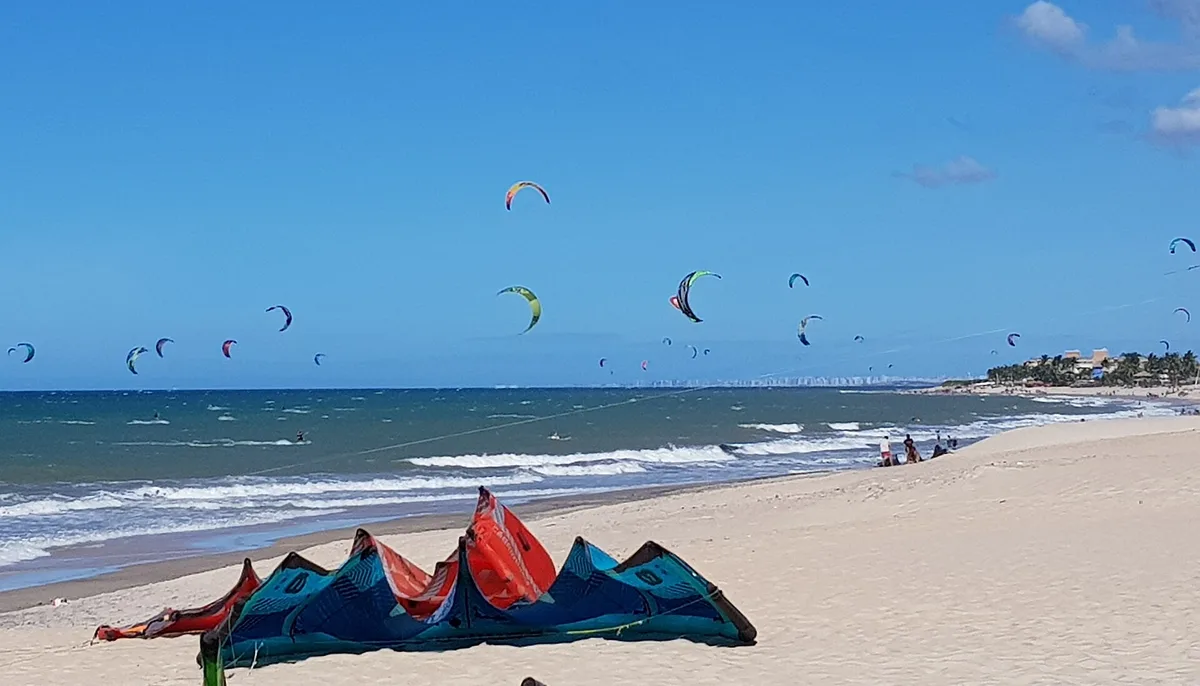
📍 Cumbuco, Ceará, Brazil
Cumbuco sits on Brazil's north-east coast, a short drive from Fortaleza, and, unusually, has both a flat-water lagoon and an open ocean beach within the same short trip, beneath a trade wind that blows for most of the year.

Shallow, flat and sheltered from the ocean by dunes, roughly 7-10km from the village and reached by dune buggy or 4x4. The go-to venue for lessons and freestyle — though it gets busy, gusty and shallow at times.
Kitesurf guide arrow_forward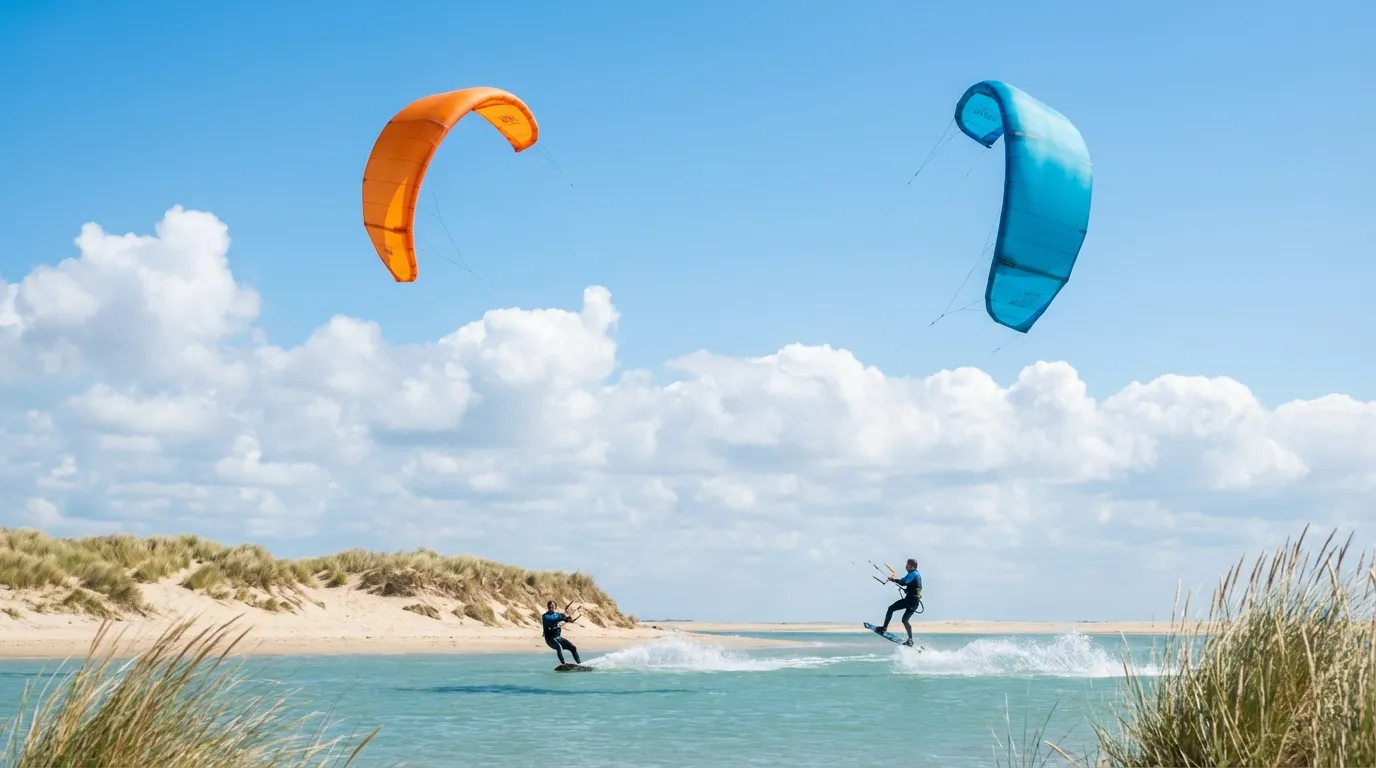
The beach itself faces the open ocean, with chop and occasional shore-break — better suited to intermediate and advanced riders than to a first lesson. Most beginners start on the lagoon instead.
Kitesurf guide arrow_forward
Brazil has no verified national distance-from-shore rule for kitesurfing — we say so rather than inventing one. The wind season runs roughly July to January, with August to December the strongest window.
Watersports safety arrow_forwardWhat to know before you book — and what we could not confirm.
Cumbuco is not one spot but three, and mixing them up is the easiest way to plan a trip wrong.
Cumbuco sits in Caucaia municipality, on Ceará's Atlantic coast, roughly 25-30km — about 35-45 minutes by road — west of Fortaleza and its international airport. It began as a fishing village and has grown, over the past two decades or so, into one of Brazil's best-known kiteboarding bases, without losing the low-rise, sandy-street feel that separates it from a purpose-built resort. Pousadas, kite schools and buggy operators line the approach to the beach, most of them within easy walking distance of each other.
View on Google Maps open_in_newThe lagoon that made Cumbuco's reputation for teaching sits some 7-10km from the village itself, cut off from the ocean by a run of dunes. Lagoa do Cauípe is shallow and flat, which is exactly why it has become the region's principal venue for lessons and freestyle: none of the swell or shore-break that complicates a first session on the open beach. Getting there means a dune buggy, a 4x4 or a transfer arranged through a school — it isn't walkable from the village, and that transfer is usually built into a lesson package rather than something you organise separately. The lagoon has its downsides too: it can get crowded with schools and riders at peak times, gusty in the lee of the dunes, and shallow enough in places to catch out anyone not watching the tide.
The beach in front of the village faces the open Atlantic, with chop and occasional shore-break depending on the swell and the state of the tide. It suits intermediate and advanced riders far better than someone on their first few sessions, so most schools steer beginners out to the lagoon and keep the beach for progression once the basics are solid. Riding directly off the village beach remains common among more experienced kiters and is a straightforward option if you're not relying on a lesson.
A south-east trade wind system that Brazilians call the "alísios" is strong, cross-shore, and around for most of the year.
The wind that reaches Cumbuco is part of the broader south-east Atlantic trade wind system, locally known as the alísios, typically blowing from the east to east-south-east and hitting the coast cross-shore to cross-onshore. In-season strength commonly runs 15-25 knots, with gusts above 30 knots not unusual during the stronger periods of the year. Because it's a trade wind rather than a local sea breeze, it tends to hold up for longer stretches at a time than the more start-stop thermal winds found at some other destinations.
The broad wind season runs roughly July to January. Within that, August to December is the strongest and most reliable window, and September to November is often singled out as especially good. July and January remain worthwhile but are more variable than the core months. February to May is the period to approach with caution — weaker wind and more rain — so it's not a stretch to plan a trip around if guaranteed wind is the goal, even if it can be a quieter, cheaper time to visit.
Peak season, especially the stretch around the New Year, can see schools and accommodation sell out well ahead of time. It's worth booking early if your trip falls in that window, rather than assuming a walk-up lesson will be available on arrival.
Cumbuco has plenty of small operators — publishing a definitive list of who's currently open isn't something we can do responsibly.
KiteFeliz KiteSchool describes June to January as its own stronger season on its current website, broadly matching the wind pattern above. Windtown Kite School, IKO-oriented and operating at or near the Windtown Beach Hotel, offers beach lessons plus transfers out to the Lagoa do Cauípe. Confirm current availability, pricing and instructor certification directly with either school before booking flights around it — a school's own website can go stale just as easily as any other listing.
Names like "Cumbuco Kite Center" and various independent instructors based at the lagoon turn up in listings and directories, but the evidence behind them is much thinner than for the two schools above. Cumbuco has a genuinely large number of small, seasonal operators who market mostly through hotels and social media rather than a stable website — which makes a confident, complete, current list of who's trading impossible to publish responsibly. Ask your accommodation for a current recommendation, and check a school's certification and reviews directly before booking.
Two realistic day trips and one destination that is not, despite sharing the same stretch of coast.
Taíba, along the coast from Cumbuco, has greater ocean exposure and suits riders seeking wave and freeride conditions rather than flat water. Paracuru offers a mix of flat water, chop and wave spots depending on exactly where you ride. Both are within realistic day-trip range of Cumbuco and are options if you want variety without changing base.
Jericoacoara turns up often in the same conversations as Cumbuco, and it's worth being clear about this: it is a genuinely separate destination, further along the Ceará coast, and not something to fit in as a Cumbuco day trip. If it's on your list, treat it as its own leg of the journey rather than an add-on.
One gateway airport near Fortaleza — check current routes before booking.
Fortaleza–Pinto Martins International Airport is Cumbuco's gateway, with the village itself roughly 25-30km away — about 35-45 minutes by road, taxi or transfer. Some direct or seasonal service from Portugal, notably Lisbon, is commonly cited; beyond that, routing via Lisbon, São Paulo, Rio de Janeiro, or a US hub such as Miami, Fort Lauderdale, Orlando, Atlanta or New York is the more usual path, depending on season and airline. Check current routes before booking — such details change with the season and shouldn't be taken as a fixed guarantee.
Dune buggies are a real, visible part of Cumbuco life, not just a tourist gimmick — used for sightseeing along the coast, dune excursions and the transfer out to Lagoa do Cauípe. Use a licensed operator, and confirm upfront whether a quoted ride is private, guided as part of a group tour, or shared with other passengers, since the price and the experience differ a lot between the three.
A long window, with a clearer core than edges.
This is the stretch the research most consistently points to for strong, reliable trade wind, with September to November often singled out as especially good.
Either edge of the core season provides rideable wind on most days, though with somewhat less consistency than the August-December peak.
Wind is weaker and rain more frequent in this stretch. It can be a cheaper, quieter time to visit, but it's not a period to book if you expect guaranteed wind.
No single distance rule, an honest gap on the maritime distress channel, and the numbers that do exist.
Brazil's national maritime authority is the Marinha do Brasil (Brazilian Navy), exercised locally through the relevant Capitania dos Portos (Port Captaincy). We found no verified, universal rule requiring kitesurfers to stay a specific distance from shore anywhere in Brazil, and we're saying so plainly rather than inventing a figure. Rules may vary by municipality or by beach-management zone, so what a school or beach authority tells you on the day at Cumbuco is likely to matter more in practice than a single written national rule.
Police answer on 190, fire and rescue (bombeiros militares) on 193, and medical emergencies (SAMU) on 192. For anything happening on the water, the local Capitania dos Portos and the Salvamar search-and-rescue service are the relevant authorities to reach — we have not been able to confirm a specific monitored VHF channel for this stretch of coast, so don't assume one without checking locally first.
Flat water is not the same as no-risk water. Standard precautions apply at both the lagoon and the beach: don't launch into deteriorating conditions, don't ride alone at a remote stretch of coast, and treat the lagoon's shallow patches and midday crowding as real hazards rather than assuming its calmer look makes it inherently safer than the open beach.
What riders ask most before booking.
The lagoon. Lagoa do Cauípe is shallow and flat, sheltered from ocean swell by dunes, which is why most schools run beginner lessons there rather than on the open beach, where chop and occasional shore-break suit intermediate and advanced riders better.
By dune buggy, 4x4 or a transfer arranged through a kite school — Lagoa do Cauípe sits roughly 7-10km from the village and isn't walkable. Transfers are usually included in a lesson package.
KiteFeliz KiteSchool and Windtown Kite School are the two for which we found current, checkable evidence of operation. Cumbuco also has many smaller, seasonal operators who market mainly through hotels and social media rather than a stable website, which makes a complete, current list impossible to publish responsibly — confirm directly with any school before booking.
We found no verified, universal national distance rule. Brazil's maritime authority is the Marinha do Brasil, exercised locally through the relevant Capitania dos Portos, and rules may vary by municipality or beach-management zone — check locally rather than assuming a fixed figure.
No — Jericoacoara is a genuinely separate destination further along the Ceará coast, not a Cumbuco day trip. Taíba and Paracuru, both closer, are the realistic day-trip options if you want to see more of the coast without changing base.