
📍 Cape Town, South Africa
Cape Town's Table Bay coastline turns up on more than one "kitesurf all year round" list, and the wind is genuinely that dependable through the southern-hemisphere summer. What those lists tend to skip: this is cold water, four beach names that don't mean the same thing, and a destination that suits confident intermediate riders more comfortably than total beginners on the windiest days.
A strong summer south-easterly, driven by a South Atlantic high-pressure system and a heated interior, funnelled and strengthened by the Cape Peninsula's own terrain. It builds through the day and is often strongest in the afternoon, roughly November to March.
Kitesurf guide arrow_forward
Bloubergstrand is the umbrella name for this stretch of coast. Kite Beach and Dolphin Beach are sections of it. Big Bay is a separate bay further north, generally more powerful and exposed. Knowing which is which matters before you book a lesson.
All destinations arrow_forward
The Benguela current and wind-driven upwelling keep this water cold year-round, unlike the warm-water destinations elsewhere on this site. Expect a proper wetsuit, not a rash vest, whatever the air temperature says.
Watersports safety arrow_forwardWhat to know before you book -- and what we could not pin down to a single figure.
One umbrella name, two sections of it, and a separate bay further north -- not four interchangeable labels for the same stretch of sand.
"Bloubergstrand" names the whole coastal area on the Table Bay side of Table View, and it is this wider name that most travel writing reaches for. Within it, Kite Beach is the best-known kite hub -- the launch most schools and most first-time visitors mean when they say "Bloubergstrand". Dolphin Beach, a separate section of the same stretch, leans more towards waves and shore-break riding than the flatter, more crowded Kite Beach. Neither is a synonym for the other, even though both sit under the Bloubergstrand name.
View on Google Maps open_in_newBig Bay sits further north again; it is a genuinely separate bay rather than another stretch of Bloubergstrand. It is generally described as more powerful and more exposed than Kite Beach — bigger swell, fewer wind shadows and less shelter if conditions turn. As a result, it draws stronger riders seeking a bigger-water session and is a place to be more cautious about if you're still building confidence.
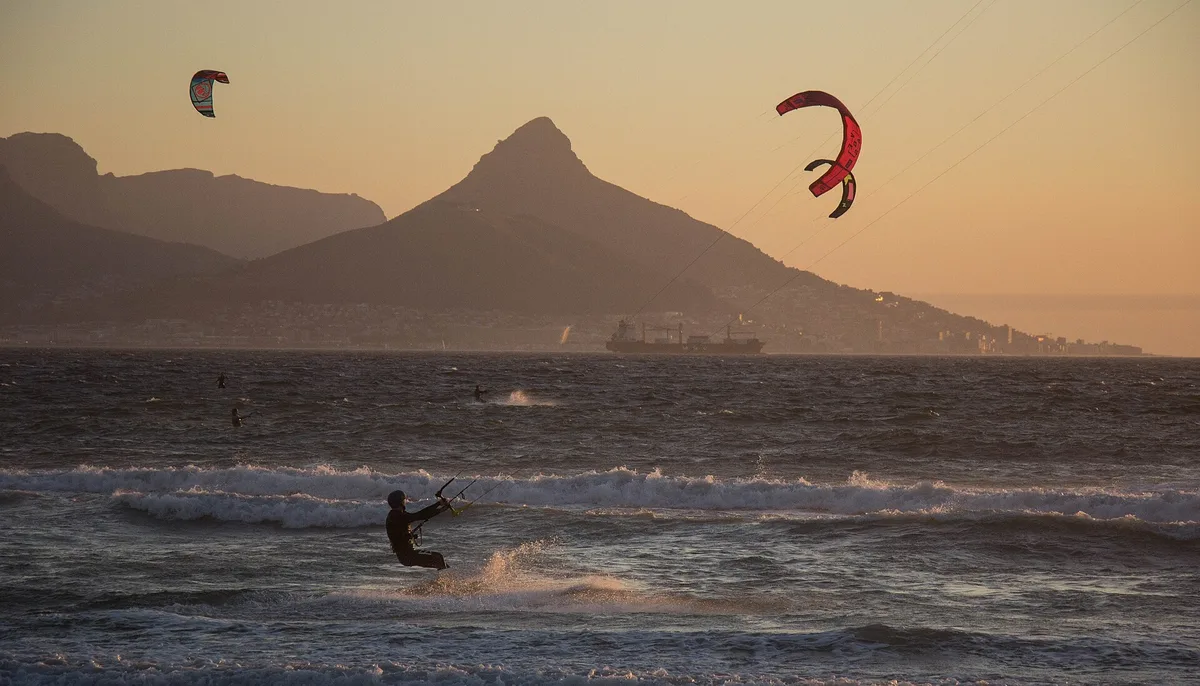
No matter which beach you're on, Table Mountain is visible across Table Bay. It forms the backdrop of most Bloubergstrand kitesurf photography — including this page's hero image — and is one of the reasons the spot gets photographed so often beyond the kitesurfing crowd.
A South Atlantic high, a heated interior, and a peninsula shaped to funnel the result straight down this coast.
The Cape Doctor is the local name for the strong south-easterly that blows through Cape Town's summer; it is produced by a South Atlantic high-pressure system working together with a coastal low and a heated interior. As that flow reaches the coast, the Cape Peninsula's terrain channels and strengthens it, a major reason Bloubergstrand and Big Bay experience wind far more reliably than many other coastlines at similar latitudes. Because the wind typically builds through the morning and is often strongest in the afternoon, a late-morning forecast check tends to be more informative than an early one.
Somewhere around 20-30 knots is typical for an in-season session. On a strong day—and Big Bay sees these more than Kite Beach—it can run 25-40 knots or more. That upper end is genuinely powerful wind, closer to a small-kite, advanced-rider day than a first-lesson day, and it's one reason this coast suits confident intermediate and advanced riders more comfortably than complete beginners doing an unsupervised first session.
The Benguela current and wind-driven upwelling keep this coast cold -- a real difference from the warm-water spots elsewhere on this site.
The cold Benguela current runs up South Africa's Atlantic coast, and the south-easterly wind that makes this spot so reliable also drives upwelling — cold water rising from depth to replace the surface water the wind pushes away. Bloubergstrand and Big Bay stay cold through the year in a way that has nothing to do with how hot the air feels on the beach. Reported figures vary by source, spot and season, roughly 12-20°C, and we're not going to pretend there's one number that settles it — treat that as a range to plan around, not a promise.
A 4/3mm wetsuit is a sensible baseline for most of the season. Warm-tolerant riders in peak summer might get away with a 3/2mm, but that's a personal-tolerance call, not a spot-wide rule. Boots are genuinely useful on colder days and at rockier launch points. This is a different framing from most of the destinations on this site -- Aruba, Bonaire and Margarita, for instance, are places where a wetsuit is optional or unnecessary. At Bloubergstrand and Big Bay, it isn't.
Two operators we found current, documented evidence of trading; two more we could not confirm with the same confidence.
AfriKite / Suntrax Kite School, IKO-certified and based in Table View, also teaches at Bloubergstrand and at Langebaan further up the coast, and carries current 2026 pricing. Coastline Kitesurfing, also IKO-certified, operates in the Blouberg/Big Bay area with published 2026 course pricing. Both gave us current, checkable evidence of trading, which is why we're naming them with more confidence than the two below.
Cape Town Kite Club, listed at a Big Bay/Bloubergstrand address, and High Five Kitesurf School, IKO-listed at 62 Beach Boulevard in Blouberg with a stated season running 1 October to 30 April, both turn up in directories. We could not independently verify either as currently operating with the same confidence as the two schools above -- "listed by IKO" or "reported" is as far as we'll put it. Confirm directly with any of the four before booking flights or lessons around them.
We could not confirm a currently operating, dedicated windsurf school specifically at Bloubergstrand or Big Bay. Consider this primarily a kitesurfing destination with some wave-riding and freeride kitesurfing on the side, rather than a windsurf spot with kitesurfing bolted on, and if you do windsurf here expect to be self-sufficient on kit and coaching rather than relying on a local school.
One international airport -- but check your routing before booking.
Cape Town International Airport (CPT) is the gateway for this coast, roughly 25-30 minutes' drive from Bloubergstrand and Big Bay depending on traffic. From the UK and Europe, direct flights run where schedules allow, but routing changes with the season -- travellers also connect via a hub such as Johannesburg, Doha, Dubai, Amsterdam, Frankfurt or Istanbul, depending on the airline and time of year. Check the current routing directly with an airline or travel agent before booking rather than assuming a direct flight will be available on your dates.
A clear peak, with looser shoulders either side of it.
Research most consistently identifies this stretch as when the Cape Doctor is most dependable, with the 20-30 knot range common and stronger days pushing well past that, especially at Big Bay.
On either side of the December-February core, wind is still strong and consistent, though without quite the same certainty on any given day.
Rideable, though less predictable than the summer core. Treat these months as ones to check a forecast closely rather than to book on faith.
Who's actually in charge on the water, an emergency-number caveat, and a plain-spoken word on sharks.
South Africa's national maritime authority is SAMSA (South African Maritime Safety Authority); local beach and coastal rules fall to the City of Cape Town. We found no verified, sport-specific municipal bylaw setting equipment or launch-distance rules for kitesurfing at Bloubergstrand or Big Bay -- rather than invent a figure, we're saying plainly that none was established in this research. If you need a definitive answer, ask a local school or the City of Cape Town directly.
112 works as a general emergency number from a mobile phone. 10111 reaches SAPS (the police), and 10177 reaches ambulance/EMS services in many regions, though coverage isn't uniform everywhere in the country. The NSRI (National Sea Rescue Institute) publishes an emergency line, 087 094 9774 -- worth saving, but verify it's current before you rely on it, since numbers like this do change. VHF Channel 16 is the international maritime distress convention, but we found no specific confirmation that it's actively monitored in the Cape Town area, so don't treat it as a guaranteed channel to a local response.
Great white sharks are documented in Cape Town's waters; denying that would be inaccurate. On a day-to-day basis, the hazards you're more likely to encounter are cold water, strong afternoon wind, shore-break at some launches and a crowded Kite Beach. Heed the beach signage and any lifeguard or NSRI advice posted that day instead of assuming a fixed seasonal pattern either way; shark-sighting advisories reflect real-time local information and cannot be stated here in advance.
What riders ask most before booking.
Not quite. Bloubergstrand is the umbrella name for the coastal area near Table View. Kite Beach and Dolphin Beach are both sections of Bloubergstrand -- Kite Beach the best-known kite hub, Dolphin Beach leaning more towards waves and shore-break. Big Bay is a separate bay further north, generally more powerful and exposed than either.
Yes. The Benguela current and wind-driven upwelling keep this water cold year-round -- reported roughly 12-20°C depending on source, spot and season. A 4/3mm wetsuit is a sensible baseline; some warm-tolerant riders manage a 3/2mm in peak summer. Boots are useful on colder days and rockier launches. Unlike the warm-water destinations on this site, this is not optional kit here.
AfriKite / Suntrax Kite School (Table View, also Langebaan and Bloubergstrand) and Coastline Kitesurfing (Blouberg/Big Bay) are the two we found current, documented evidence of trading, both IKO-certified with published 2026 pricing. Cape Town Kite Club and High Five Kitesurf School are also listed for the area but we could not confirm either as currently operating with the same confidence -- check directly before booking. We found no dedicated, currently operating windsurf school on this coast.
No verified, sport-specific municipal bylaw setting distance or equipment rules for kitesurfing at Bloubergstrand or Big Bay was found. SAMSA is South Africa's national maritime authority, and the City of Cape Town sets local beach rules. Rather than assume there's no rule at all, ask a local school or the City directly if you need a definitive answer.
Partly. The Cape Doctor is dependable through summer, which is genuinely useful for progression once you can already ride -- but wind of 25-40+ knots on a strong day, especially at Big Bay, is not a first-lesson conditions. Complete beginners are better served booking supervised lessons at Kite Beach with one of the confirmed schools above, in calmer conditions, rather than treating this as an easy first-timer's spot.