
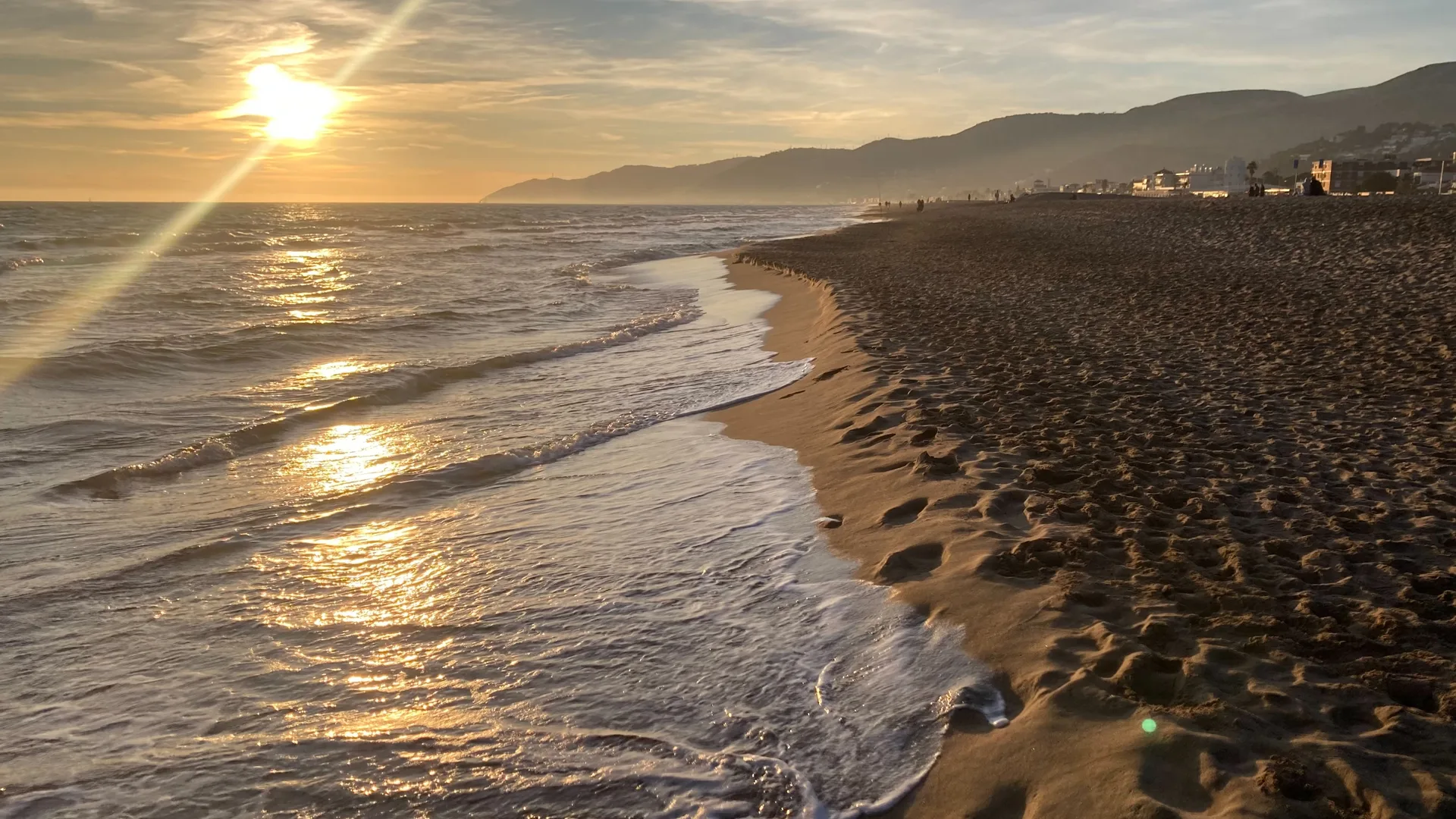
Photo: Kallerna / Wikimedia Commons, CC BY-SA 4.0
A thermal sea breeze most summer afternoons, a handful of real spots, and one of the tightest kitesurf rulebooks in Spain.
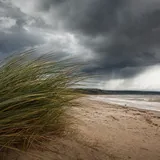
A south-westerly sea breeze that builds on summer afternoons, cross-shore on most of these beaches, typically 12 to 18 knots with gusts towards 20.
See destinations arrow_forward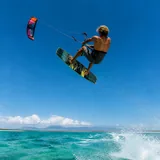
Castelldefels is the main kite beach of the area; Bogatell, Badalona and Montgat add windsurf and wing-foil options within easy reach of the city.
Kitesurf guides arrow_forward
Catalonia restricts kitesurfing on bathing beaches in summer, with Castelldefels the only authorised exception near Barcelona. Check the current rules before you rig up.
Local kitesurf rules arrow_forwardThe wind and the water, before you check the rules further down.
Castelldefels to the south, the city beaches, and Badalona/Montgat to the north.
South-west of the city, Castelldefels is described by kitesurf guides as the main kite beach of the Barcelona area: several kilometres of south-facing sandy beach, about 30 minutes from central Barcelona by direct train. It's also where Barcelona province's one authorised summer kite zone sits — see the rules section below before you rig up here between June and September.
View on Google Maps open_in_newCloser to the centre, Platja del Bogatell is where most of the city's kitesurfers are found, with the same summer garbí thermal (documented at 12 to 18 knots) as the rest of the coast. La Barceloneta and the Base Nàutica Municipal — Barcelona's municipal nautical base — are the reference spot for wing foiling in the city, sheltered by a breakwater for the first stretch out from the beach.
View on Google Maps open_in_newBadalona, about 10 km north of the centre, is documented as one of the area's more popular windsurfing beaches. Further along, Montgat and Montgat Nord — right next to the Montgat-Nord train station — are a commuter spot for kite and wing foil: train from the city, walk down to Platja de les Barques. El Masnou, a little further still, is another spot where the city's kitesurfers gather.
View on Google Maps open_in_newTwo named kite clubs at Castelldefels, plus a municipal base for wing foil in the city.
At Castelldefels, riders and schools are concentrated around two clubs: The Bunker (Club de Kite Bunker) at the north end of the beach, and Mojokite at the south end. In the city, the Base Nàutica Municipal de Barcelona, at La Barceloneta, is the municipal nautical facility associated with the wing-foil spot there. We couldn't source current, named schools for Bogatell, Badalona, Montgat or El Masnou specifically — ask locally, and always check that any school holds a valid IKO, VDWS or Federació Catalana de Vela qualification and carries rescue cover before booking.
Spain has no national 300 m rule — but Catalonia has its own, real, seasonal restriction, and it's stricter than most of the coast realises.
Barcelona city's own council states it plainly: kitesurfing is prohibited on the city's beaches, in the bathing zones, from 1 June to 30 September, and is not permitted in the channels reserved for boats either. More broadly, Catalonia restricts kitesurfing across the region for the same summer window, with only three authorised exception zones in the whole of Catalonia — and Castelldefels is the only one of the three in Barcelona province.
Castelldefels runs a regulated summer kite zone in front of the Club de Kite Bunker, in the most recently documented season open from 1 June to 18 September, weekdays only (Monday to Friday, closed on public holidays), between 15:00 and 19:00. Riders must register, carry liability insurance, and meet minimum wind thresholds that vary by discipline (foil around 7 knots average with a 6-knot floor; surfboard/race around 12 knots with an 11-knot floor; twin-tip around 14 knots with a 13-knot floor). Entry and exit go through a marked 200 m channel; once beyond it, riders can sail freely but must return via the same channel. These are the specifics as documented for the most recent season — check the current year's dates and hours locally before you go, since operating windows like this are set year by year.
Barcelona's municipal rules treat surf, paddleboarding and windsurf separately from kitesurf: they're recognised nautical sports allowed during the \"pre-warning\" and \"warning\" stages of the city's rough-seas emergency plan (PAEM), practised at each rider's own responsibility, and only barred outright once the plan's full emergency stage is activated. In other words, the tight, dated, zoned rule above is specifically a kitesurf rule, not a blanket ban on wind- and water-sports.
Outside these Catalonia-specific dates and zones, the general Spanish framework holds: no French-style national 300 m rule, the Capitanía Marítima and DGMM as the maritime authority, and a lifejacket required once you're outside the designated bathing area. In an emergency, call 112 or reach Salvamento Marítimo on VHF channel 16.
Barcelona-El Prat airport, and a short train ride to most of these spots.
Barcelona-El Prat Airport (BCN) is the obvious access point for the whole coast, with Castelldefels documented as roughly 20 km away by road, around 20-40 minutes depending on traffic and transport mode.
Castelldefels is reachable by direct train from central Barcelona (line R2, \"Platja de Castelldefels\" stop) in about 30 minutes, and by a similarly short train ride from the airport itself. Montgat and Montgat Nord sit right next to their own train stations to the north. The C-32 and AP-7 motorways run the length of the coast if you're driving, and having a car makes it easier to switch between the northern and southern spots depending on where the garbí is working best that day.
The garbí runs May to September; outside that window, conditions are far less documented.
This is the season kitesurf and windsurf guides for Barcelona point to: steady afternoon thermals, typically 12 to 18 knots, occasionally touching 20. It's also the exact window in which Catalonia's kitesurf restrictions apply, so it's worth reading the rules section above alongside the forecast.
Outside the May-to-September thermal window, we couldn't source a documented wind pattern specific to this coast with the same level of detail — some guides mention Castelldefels having worthwhile conditions between September and May too, tied to passing weather fronts rather than the thermal, but without the knot ranges and reliability figures available for summer. If you're planning a trip outside summer, check a live forecast rather than relying on a seasonal average.
What riders ask most before heading to Barcelona.
Not freely on the city's own beaches: Barcelona bans kitesurfing in bathing zones from 1 June to 30 September. Castelldefels, just south-west of the city, runs an authorised summer kite zone with its own hours, minimum wind thresholds and a marked access channel — it's the only such exception in Barcelona province. Always check the current year's dates and hours before you go.
Mainly the garbí, a south-westerly thermal sea breeze that builds on summer afternoons, typically 12 to 18 knots with gusts towards 20, cross-shore on most beaches. An easterly llevant is also documented as contributing to sailing conditions, though less consistently than the garbí.
La Barceloneta and the Base Nàutica Municipal, inside the city, are the reference wing-foil spot. Badalona, about 10 km north, is documented as a popular windsurfing beach, and Montgat/Montgat Nord further north is a straightforward commuter spot by train for both kite and wing foil.
Castelldefels is about 20 km from the airport by road, with a direct train connection (line R2) taking roughly 30 minutes from central Barcelona and a shorter ride from the airport itself. See the rest of our Spanish coast in our destination directory.