

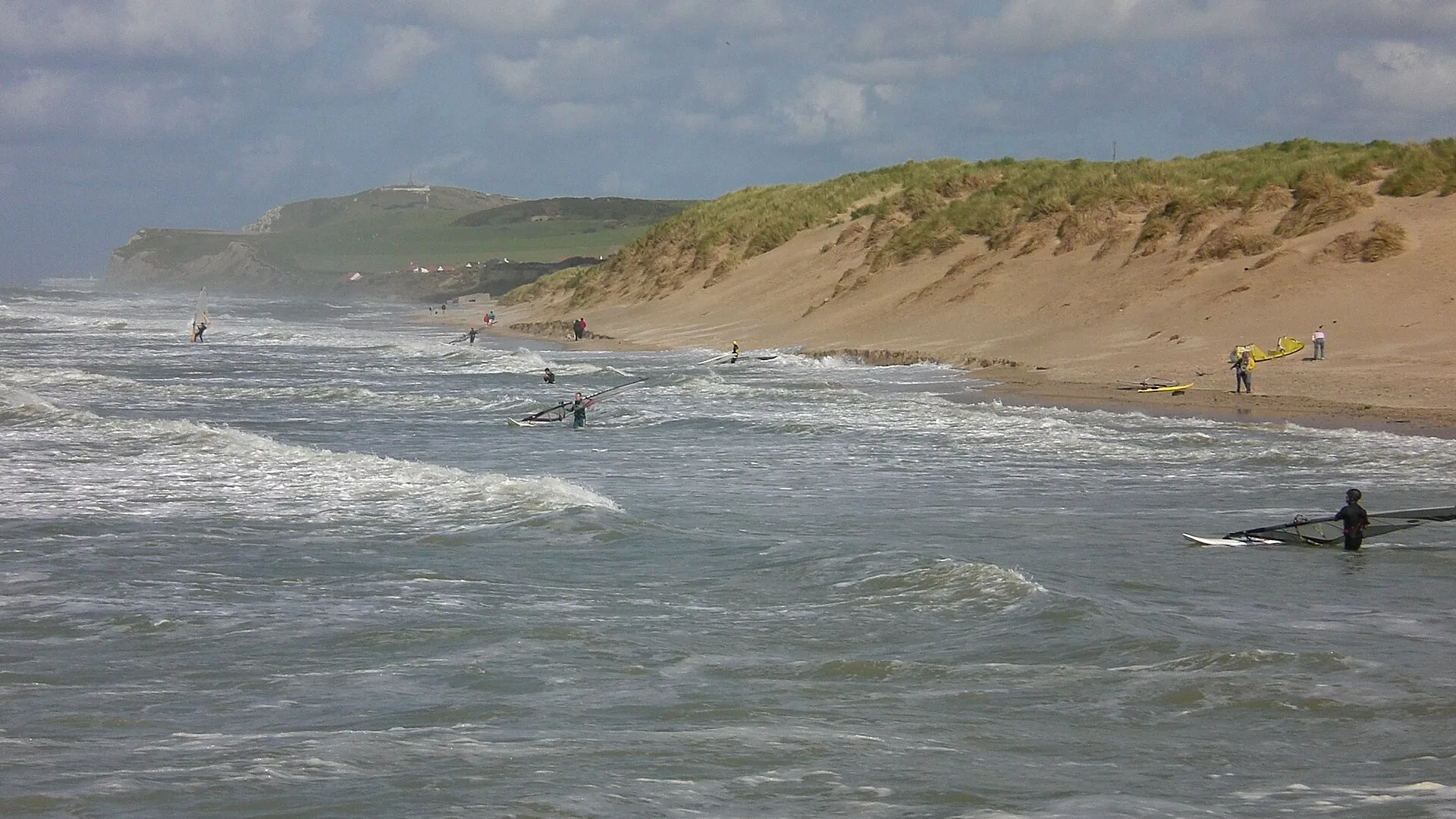
Photo: Romainberth / Wikimedia Commons, CC BY-SA 3.0
Wissant is one of the best-documented spots in this whole France batch, with an official zone and a mandatory licence in season.
The venturi effect between Cap Blanc-Nez and Cap Gris-Nez boosts the wind compared to the rest of the Côte d'Opale, with sessions at 16-22 knots close to half the time.
Wind in detail arrow_forward
A high tidal coefficient sharply reduces beach space. From 1 July to 31 August, a marked-out zone also requires a kite licence.
The regulations arrow_forward
A spot classed intermediate, with a submerged wreck to watch for at mid-low tide, and a downwind route possible as far as Sangatte.
Level and schools arrow_forwardWhat to know before rigging up between the two capes.
Wind reputed to be stronger than on the rest of the Côte d'Opale.
Wissant sits in a bay framed by Cap Blanc-Nez to the north-east and Cap Gris-Nez to the south-west. Several independent spot guides describe a venturi effect between the two capes that boosts the wind by 2 to 3 knots compared to the rest of the Côte d'Opale — making it, according to those same sources, one of the most prized spots in Hauts-de-France for its wind orientation and safety. The ideal direction remains south-west with a falling tide: wind and current then oppose each other, which makes riding easier. A south-east wind, almost entirely off-shore and very light, should be avoided.
See on Google Maps open_in_newOne spot guide breaks down the split of rideable sessions: roughly 49% between 16 and 22 knots, 44% between 22 and 30 knots, and only 7% above 30 knots. Between 12 and 15 knots the water stays flat; past 15 knots the spot turns into a wave spot. Beyond 15-20 knots, the same source says the site becomes markedly less accessible.
An intermediate spot, with a real submerged hazard worth knowing about.
Wissant is classed as an intermediate-level spot. One spot guide flags a specific hazard: a wreck that protrudes roughly 10 cm above the sandbank at mid-low tide, at the zone's boundary — a landmark worth identifying before riding unsupervised. Strong tidal currents (running right at high tide, left at low tide) also call for careful reading before each session. Two schools are documented on site: Wimkite School, founded in 2005 and the oldest kitesurf school in Hauts-de-France, with BPJEPS-certified, FFVL-affiliated instructors, in groups of up to 3-4 students; and Combokite, which offers an 8 km downwind route to Sangatte among other things.
A documented summer framework, on top of the general Division 240.
As everywhere in France, Division 240 governs kitesurfing within the 300 m coastal band under the mayor's authority. At Wissant, that framework is backed by a spot-specific protocol, documented by several independent guides: from 1 July to 31 August, a zone marked out by buoys and flags is set up on the north side of the beach, towards Cap Blanc-Nez, and the spot carries an FFVL label. During that period, a kite licence is mandatory (an AF-Kite licence or an FFVL licence). Always check the day's signage and the tidal coefficient before rigging up — a coefficient above 7 sharply reduces the beach space available.
In a sea emergency, contact CROSS Gris-Nez on 196, or 112 from a mobile phone.
What riders ask most before coming to Wissant.
Yes, from 1 July to 31 August, inside the zone marked by buoys and flags towards Cap Blanc-Nez: a kite licence (AF-Kite or FFVL) is mandatory. Outside that period and zone, the general Division 240 framework applies.
South-west with a falling tide, which opposes wind and current for safer riding. Avoid the south-east, which is almost entirely off-shore and very light.
The spot is classed intermediate, with strong tidal currents and a submerged wreck worth knowing about at the zone's boundary. A first session with a school (Wimkite School or Combokite) remains recommended.
Yes, the Combokite school offers a downwind route of roughly 8 km to Sangatte, further north on the Côte d'Opale.