

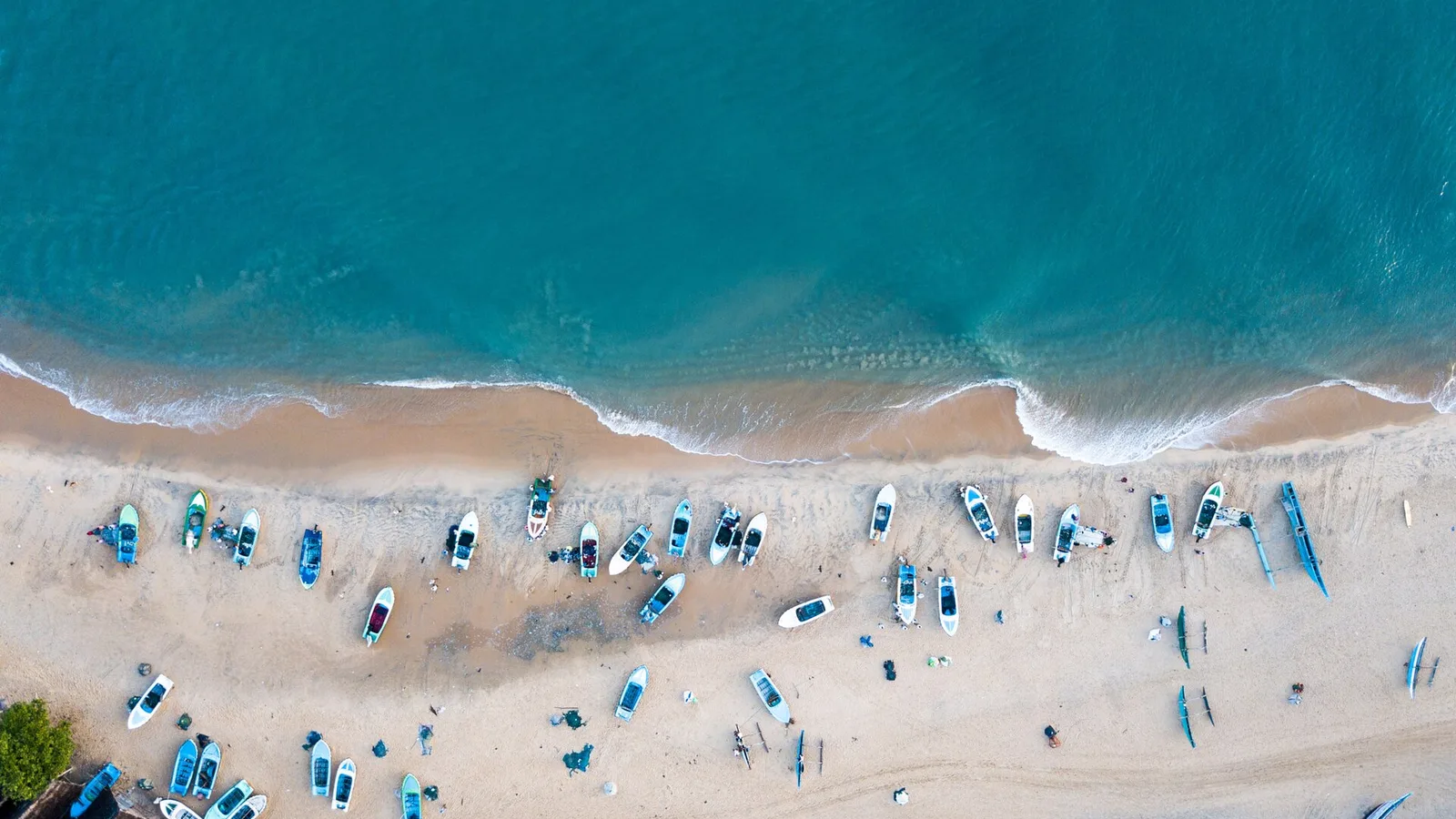
Photo: Etienne Boulanger / Wikimedia Commons, CC BY 3.0
One island, two surf seasons, and a kite spot that works for most of the year.
The monsoon that soaks one side of the island is the offshore wind on the other.
Sri Lanka has two monsoons. The south-west monsoon brings wind and rain off the Indian Ocean from around May to September (some references run it from mid-May to October), soaking the south-west of the island while the east stays drier. The north-east monsoon blows from the Bay of Bengal from around December to February or March. In between come two inter-monsoon periods, around March–April and October–November, with lighter, more variable winds.
That's why the surf flips coasts. Surf guides put the south and south-west coast season at November to April, when the winds there switch offshore and the swell is in the 2–5ft range most days, with shoulder weeks in late October and early May. The east coast, Arugam Bay, takes its turn during the south-west monsoon months, while the south-west of the island is wet. The Surf Atlas notes offshore winds dominating there in the early mornings, and Perfect Wave Travel says the south to south-east trade wind tends to kick in around mid-morning, so dawn sessions are the norm. The exact months vary by source: The Surf Atlas gives April to September, with October and November as shoulder months; Perfect Wave Travel gives May to October. April and October are the months when both coasts may have waves.
| Coast | Main spots | Main season | Off season |
|---|---|---|---|
| South and south-west | Hikkaduwa, Weligama, Midigama, Mirissa | November to April (shoulder weeks in late October and early May) | May to October, the south-west monsoon; Hikkaduwa's breaks all but shut down |
| East | Arugam Bay, Pottuvil, Okanda | April or May to September or October, busiest June to August | December to March is the low season |
| North-west (kitesurfing) | Kalpitiya lagoon, Kappalady, Vella Island | Mid-May to mid-October (strong wind); mid-December to mid-March (lighter) | The weeks between the two seasons |
The surf-season months come from The Surf Atlas and Perfect Wave Travel; the kite seasons come from Kitesurfing Lanka, a Kalpitiya kite camp, and Sri Lanka Tourism's own Kalpitiya page. None of them is an official forecast. Monsoons start early or late from one year to the next, so check a swell and wind forecast before you book.
Reef peaks, a beginner bay and the most surf schools on the island, from November to April.
Hikkaduwa, on the south-west coast about two hours by car from Colombo according to The Surf Atlas, is a long-standing surf town. Its Main Reef is an A-frame that breaks left and right over reef, which The Surf Atlas rates for intermediate surfers and up, leaving the bigger days to experts. Nearby Benny's is a fast left over deeper coral for experienced surfers, and North Jetty, by the harbour wall, sends long lefts across a shallow reef. First-timers are pointed to the mellow beach break at Narigama. In high season Main Reef is crowded, and the same guide notes 'a touch of localism here and there'.
Weligama, between Galle and Matara, is the learners' bay: a sheltered, sand-bottomed beach break with, according to The Surf Atlas, the widest choice of surf schools anywhere on the island bar Arugam Bay. The downside is the crowd: expect a lot of boards in the water, many of them in the hands of beginners. Close-outs are common on very big days.
Just west of Weligama, Midigama is where intermediate and advanced surfers go. Its best-known wave, Rams, is a short, sharp right over reef that breaks close to the rocks. East of Weligama, Mirissa has an intermediate right-hander with rocks to watch out for. Further east again are Hiriketiya and other breaks this page doesn't cover in detail.
See Weligama on Google Maps open_in_newA string of right-hand points, from spring to autumn.
Arugam Bay sits a few kilometres south of the market town of Pottuvil, on the opposite side of the island from Colombo. It's one of the island's most popular surf destinations, and surf tourism dominates the local economy. The breaks are mostly right-hand points spread north and south of the bay, so you'll spend some time in tuk-tuks.
Main Point, in the bay itself, is the headline wave: a right point that, according to The Surf Atlas, gives rides of roughly 50 to 150 metres and needs a south to south-east swell. Its inside section, Baby Point, is where beginners start. North of town, Whiskey Point is usually quieter, and Pottuvil Point is a fickle right over boulders that works best on south-east swells. South of the bay, Peanut Farm is a right-hand point used by surf schools from May to August, gentle on small days and for intermediates once it's bigger, and Elephant Rock is a softer wave suited to bigger boards. About 23 km south, Okanda has more right-hand points, holds bigger swell and suits strong intermediates and above; there are strong rips near the headland.
Expect crowds at Main Point and Peanut Farm in June, July and August. The guides also flag hazards you won't meet in Cornwall: crocodiles in the lagoon at Elephant Rock and in lagoon water that spills over Pottuvil Point in the low season, and wild elephants near Peanut Farm and Elephant Rock, which have been known to hit tuk-tuks. Ask locally before you paddle out near a river or lagoon mouth.
The sources don't agree on what's under Main Point: Perfect Wave Travel calls it a sand-bottomed point, The Surf Atlas a reef shelf. Ask a local school what's underneath before you paddle out at low tide.
See Arugam Bay on Google Maps open_in_newFlat lagoons on the north-west coast, with two wind seasons.
The Kalpitiya peninsula, about two hours north of Colombo according to Sri Lanka Tourism, is the island's kitesurfing centre. Sri Lanka Tourism's page says that from May to October the wind tends to stay at around 20 knots, whatever the time of day or night, and that for the rest of the year it usually blows in the afternoon. Kitesurfing Lanka, a kite camp on the peninsula, splits the year into a summer season from mid-May to mid-October, with cross-shore wind averaging 18–25 knots and peaks up to 30, and a winter season from mid-December to mid-March, with lighter afternoon wind of 15–25 knots. It puts the water at around 27°C and says you can kite without a wetsuit all year.
The Kalpitiya lagoon is the main spot: about 2 km long and 800 m wide, shallow and flat, with a muddy bottom, according to the Travel Mermaid kite guide. Kappalady is a smaller lagoon about 30 minutes south by tuk-tuk; the same guide says the wind changes direction there in winter. Trips go out by boat to Vella Island, about an hour from Kalpitiya, where a long sandbar makes a flat-water bay, and the large Puttalam lagoon behind the peninsula is described by Sri Lanka Tourism as sheltered terrain for less experienced riders.
Kitesurfing Lanka, founded in 2010, runs a kite and wing foil school and rental on the lagoon; its website shows an IKO affiliation. Travel guides mention other camps and resorts on the peninsula too; we haven't checked which of them teach. No prices are quoted here.
No national surf or kite law for independent riders that we could find; operator standards set by the tourism authority.
We found no Sri Lankan law that sets distances from shore, zones or mandatory kit for someone surfing or kitesurfing on their own. What does exist is a registration scheme for operators: the Sri Lanka Tourism Development Authority (SLTDA) registers surf and kite businesses as water-based adventure tourism activities and publishes a guideline for each. Those guidelines are conditions for a registered operator, not rules for an independent rider, but they tell you what a properly run school should be doing.
| Topic | Surf schools (SLTDA surfing guideline) | Kite schools (SLTDA kitesurfing guideline) |
|---|---|---|
| Instructors | A valid ISA Level 1 plus an ILS surf lifeguard award, or the ISA/ILS aquatic safety award, as a minimum | A qualification from a recognised national or international kiteboarding body, three years' experience, first aid/CPR, a powerboat licence and an open-water lifeguard certificate |
| Equipment | Basic lessons on soft boards; every board fitted with a leash of the right length; a rescue board at least 8ft long kept on the beach | Depower kites, short lines for beginners, harnesses and helmets, an anemometer, and certified buoyancy aids or lifejackets |
| On the water | Weather and wave conditions monitored; an orientation briefing covering emergency signals; instructors in a vest of a different colour from their clients; the school registered with and recognised by a national association | A lifejacket or buoyancy aid worn throughout the time in the water; trained lifeguards present; no lessons, rentals or trips in offshore wind without a safety boat; nothing in the dark, preferably finishing an hour before dark |
| Who can take part | Swimming ability and medical condition checked; pregnant women not allowed | Lessons only for people who can swim in open water; rentals and trips only for independent riders who can ride upwind |
At sea, the Sri Lanka Coast Guard, set up under the Coast Guard Act No. 41 of 2009 and part of the Ministry of Defence, is the maritime law-enforcement service. It also runs lifeguards: it operated 17 lifesaving posts on key tourist beaches as of March 2026 and says its lifesavers have rescued 2,688 people since 2010, 1,251 of them foreign nationals (figures to 31 August 2026). Sri Lanka Police runs its own lifeguard units under its Marine Division: 71 units and 308 officers in February 2026, covering 31 of the country's 48 police divisions. We couldn't find a published list of which beaches have a lifeguard post, so don't assume yours does.
Police advise visitors to use police lifeguards where possible, avoid unfamiliar or unsafe places to swim, and heed red flags and warning signs. These are Sri Lankan arrangements: the RNLI and UK flag zones don't apply, and we found no equivalent of France's 300 m rule.
Apply for the ETA before you fly, then allow for long road transfers.
British visitors need an Electronic Travel Authorization (ETA), which the FCDO describes as a form of visa. Apply online before you travel, on the official portal at eta.gov.lk. According to the FCDO's advice (updated 21 September 2026), ETAs are issued free of charge and are valid for 30 days; longer stays need an extension through Sri Lanka's official immigration portal. Your passport must be valid for at least six months after the day you arrive. Entry rules change, so check the FCDO page before you book.
International flights land at Bandaranaike International Airport (CMB) at Katunayake, about 32 km north of Colombo. SriLankan Airlines flies there direct from London Heathrow. Check your airline's board-bag rules before booking.
From the Colombo area, Hikkaduwa and Weligama are about two hours by private transfer, according to The Surf Atlas, and Kalpitiya about two hours north according to Sri Lanka Tourism. Arugam Bay is the long one: The Surf Atlas puts a private taxi across the island at six to eight hours and suggests breaking the trip in Kandy or Ella. The FCDO warns that monsoon rain can flood roads and cause landslips that close them, so leave slack in a cross-island transfer.
Warm water doesn't mean easy water.
The UK Foreign Office warns that many Sri Lankan beaches have dangerous surf or rip currents at certain times of the year, and advises getting local advice from your hotel or tour operator before going in the sea. In practice that means surfing the coast that's in season: a south-coast beach in the south-west monsoon is a different place from the one in the photos. Many of the island's best waves break over reef or boulders, so learn on a sand-bottomed beach break such as Weligama with a school, and pack a basic first-aid kit for reef cuts. On the east coast, add crocodiles in the lagoons and elephants on the roads to the list.
| Service | Number |
|---|---|
| Police | 118 or 119 |
| Ambulance | 1990, or 011 2691111 |
| Fire and rescue | 111 |
| Tourist Police | 011 2421052 |
| Sri Lanka Coast Guard, 24-hour maritime emergency line | 106 |
The police, ambulance, fire and Tourist Police numbers are the ones the FCDO lists. The Coast Guard's 106 line was launched in April 2025, according to the Ministry of Defence, and goes straight to the Coast Guard's operations room; the FCDO page doesn't list it.
What surfers ask most before a trip to Sri Lanka.
It depends on the coast. The south and south-west coast (Hikkaduwa, Weligama, Midigama, Mirissa) is in season from roughly November to April. The east coast around Arugam Bay works from roughly April or May to September or October. April and October are the months when both may have waves.
Yes, if you pick the right beach. Weligama's sandy beach break, Narigama near Hikkaduwa, and Baby Point and Peanut Farm at Arugam Bay are where schools take beginners. Most of the better-known waves break over reef or boulders and are for intermediates and up.
Through the south-west monsoon months, when the wind is offshore on the east coast. The Surf Atlas gives April to September, Perfect Wave Travel May to October. June to August is the busiest period; December to March is the low season.
Yes, mainly at Kalpitiya on the north-west coast. The main season runs from about mid-May to mid-October, with a lighter season from mid-December to mid-March, according to a Kalpitiya kite camp. Sri Lanka Tourism says the wind stays around 20 knots from May to October.
You need an Electronic Travel Authorization (ETA), applied for online before you travel. The FCDO says ETAs are free and valid for 30 days, and your passport must be valid for at least six months after you arrive.
The Sri Lanka Coast Guard's 24-hour maritime emergency line is 106. For an ambulance call 1990, and for the police 118 or 119.