

📍 San Sebastián (Donostia), Basque Country, Spain
Photo: Juanedc / Wikimedia Commons, CC BY 2.0
A city beach that takes the Atlantic swell, and a sheltered bay on the other side of town for flat-water paddling.
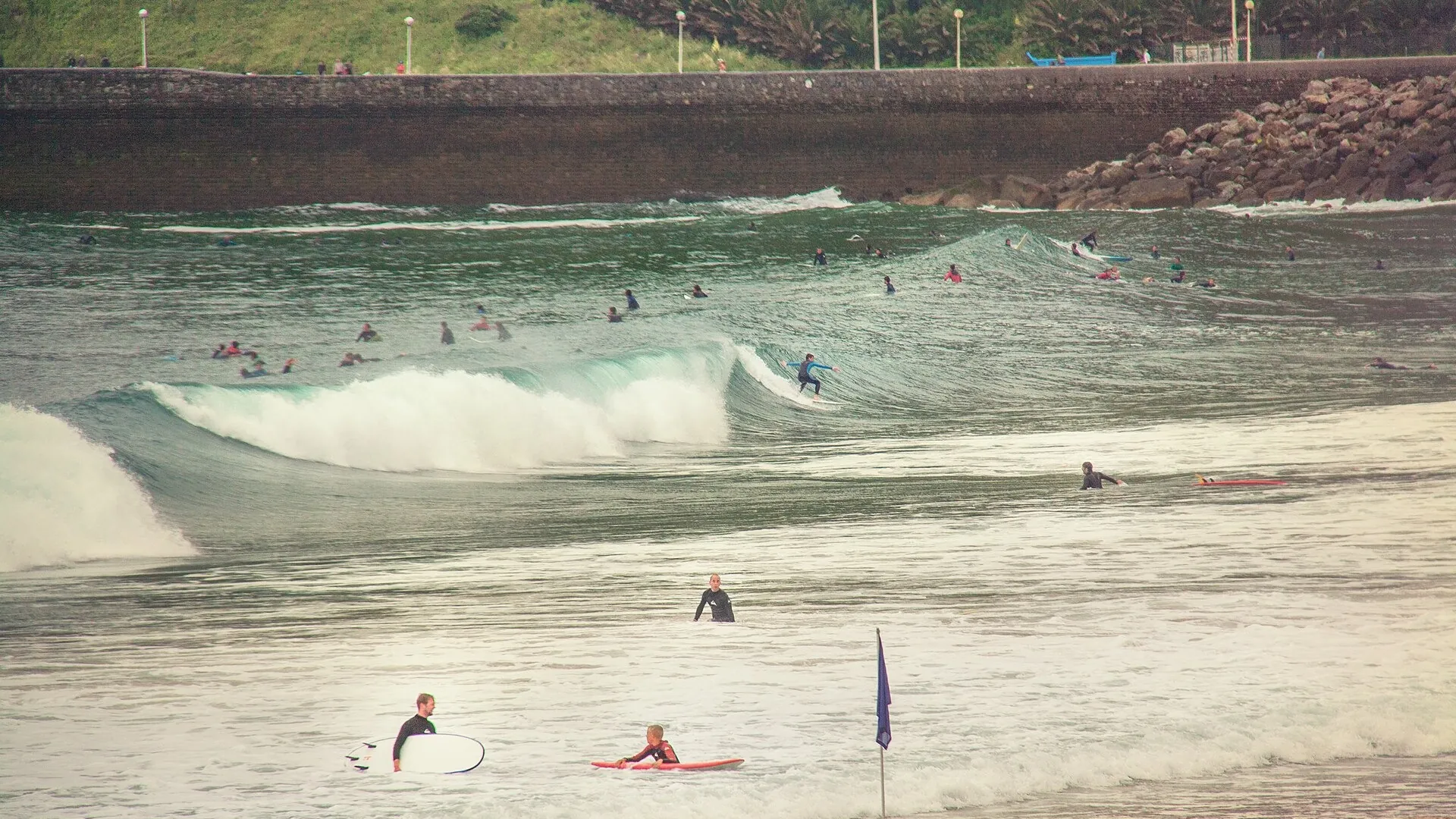
An exposed sandy beach in the middle of the city, with peaks that move as the sandbanks do.
Zurriola is the beach in the Gros district, beside the Kursaal. The council gives it an average length of 800 m and an average width of 110 m, and describes a sandy beach 'relatively open with strong swell'. It says the beach and the water have improved a lot since the 1994 remodelling. La Concha and Ondarreta, by contrast, sit inside the bay.
Surf Atlas describes a nice A-frame with quick lefts and longer rights, best on wrap-around north-westerly swell of 4 to 6 ft, and calls it the most reliable of the inner-city breaks in the area by a long way. The San Sebastián tourism board lists north to north-west swell from 1.5 ft, south, south-east or south-west wind, and says the beach works at all tides. Surf-Forecast also gives north-west as the best swell direction and a south-south-east offshore.
The tourism board names two main areas. Mompás is the right-hander, the most powerful wave on the beach, with tube sections on a good day. In the central area there are rights and lefts, mainly lefts at low tide and good rights as the tide comes in. The council's 2024 school documents put the Sagüés area on the right-hand side of the beach, which fits where the guides place Mompás. How the sandbanks sit changes with the swell and the tide, so the peaks drift.
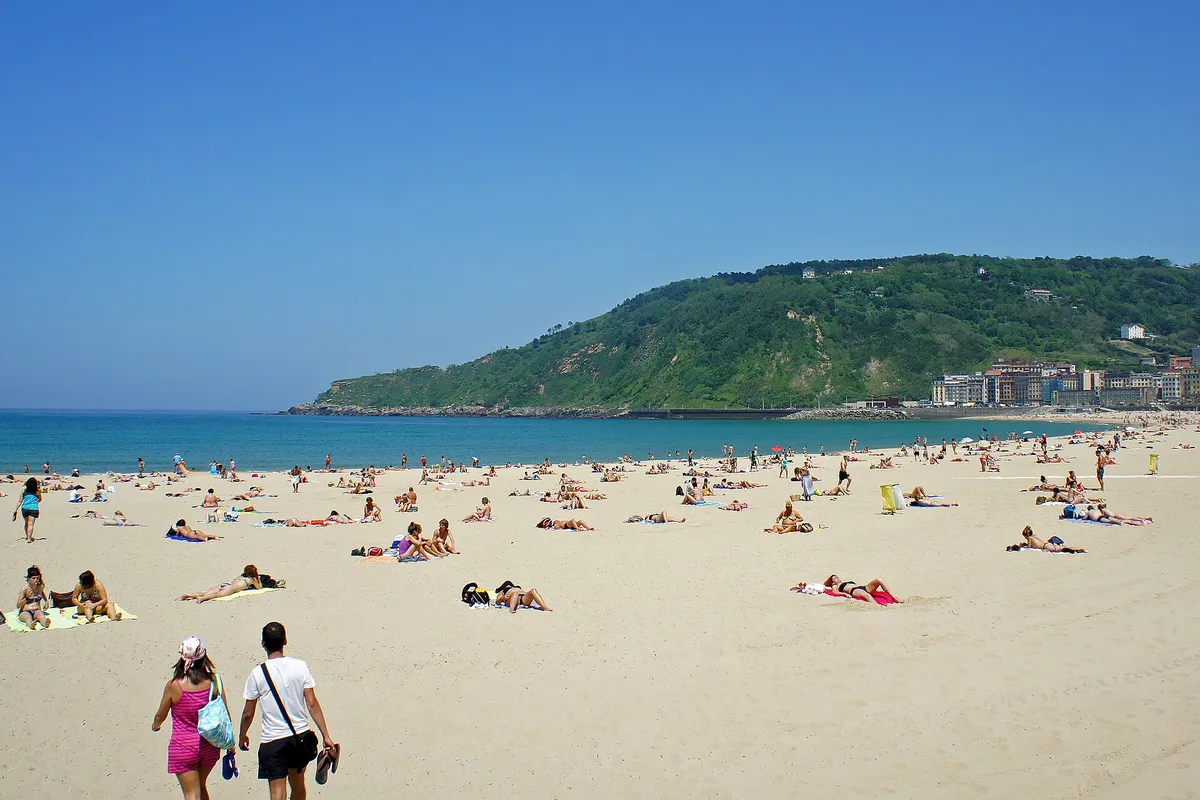
It's a town beach, and that shapes the session. Surf-Forecast warns that the break can get crowded, and Surf Atlas mentions a touch of localism at what it calls arguably the most surfed and most international spot in the Basque Country. Surf Atlas rates it for every level: beginners in summer, intermediates in winter. The beach has outdoor showers, drinking-water taps and changing cabins in summer (the cabins open from June to September), and the council lists five car parks nearby, at Boulevard, Okendo, Kursaal, Plaza Cataluña and Txofre.
How the beach is shared in summer. The council's 2024 call for surf schools (a PDF on its Zurriola page) sets out the plan. A beginners' zone of 100 to 150 m sits roughly behind the Kursaal, between two bathing areas and about 100 m from the breakwater, for soft boards only. An advanced zone of about 300 m in the Sagüés area, on the right of the beach, is shared with surfers and similar water sports. It also says that when lifeguards are on duty they decide at each moment how many metres are opened up in either zone, so the figures can change.
That tender was cancelled in February 2024 and the existing schools carried on, according to Noticias de Gipuzkoa. The council's Zurriola page still carries a suspension notice, and it doesn't publish the zone boundaries in force this year. Treat the numbers above as the council's own description of how the space was meant to work, and look at the flags and lifeguard posts when you arrive.
Surf all year, with smaller waves in summer and a heavier sea from autumn.
Surf Atlas says Zurriola is smaller and kinder to beginners in summer, more consistent in September and October and heavier in winter, with roughly five to six days in ten surfable in spring. Surf-Forecast's statistics also single out October. The table pairs those seasons with monthly sea temperatures from the sea-temperature site seatemperatu.re, which isn't an official series, and the wetsuit thicknesses Surf Atlas suggests.
| Season | Sea temperature | Waves, according to Surf Atlas | Wetsuit, according to Surf Atlas |
|---|---|---|---|
| Summer (June to August) | about 19-22°C | Smaller, better for beginners | 2mm or 3/2 |
| Autumn (September and October) | about 19-21°C | More consistent | 4/3 |
| Winter (November to March) | about 13-17°C | Heavier, with 60 to 80 per cent of days surfable | 4/3 with boots and hood |
| Spring (April and May) | about 14-17°C | About 50 to 60 per cent of days surfable | 4/3 with boots and hood |
The lifeguard season is much shorter than the surf season, which matters most in May and October. See the safety section below.
Three schools whose own websites were live in October 2026.
The council's 2024 documents planned for eight schools on the beach in summer, and the tourism board says the beach also has a local surf club. Three schools can be confirmed from their own sites. Zurriola Surf Eskola, in Gros, says it opened in 2011, was taking bookings for summer 2026 and runs lessons every day throughout the year. Groseko Indarra is a surf club and school that says it has run since 2006. Its site offers English and was live in October 2026, showing reviews dated up to September. Pukas Surf Eskola teaches from Avenida de Zurriola in San Sebastián and from a second base in Zarautz, with weekend, weekly and monthly courses and board rental listed on its booking site.
Prices aren't quoted here, and these three aren't a complete list. The Capitanía's draft rules say school pupils must be kept apart from other users and confined to the lower-quality parts of the waves, with at least one instructor for every 6 minors or 10 adults. The council's school authorisations in its 2024 documents run from 1 June to 30 September, though Zurriola Surf Eskola says it teaches all year, so ask a school directly about lessons in other months.
Zarautz is the usual alternative when Zurriola is too busy or too big for a first session. The Basque tourism board calls its beach the longest on the Basque coast, at 2.5 km, and Pukas has a base there. It's on the same Euskotren railway line as San Sebastián, which makes it an easy day without a car.
The sheltered side of the city, with Santa Clara island as the destination.
La Concha beach is 1,350 m long and 40 m wide on average, according to the council, and the tides often limit the usable sand. Ondarreta, at the western end of the bay, is 600 m by 100 m. The Capitanía Marítima de Pasaia's draft rules classify the waters of the bay south of the northernmost point of Santa Clara island as protected water. Beyond that line you are in open water, which matters for the buoyancy-aid rule below.
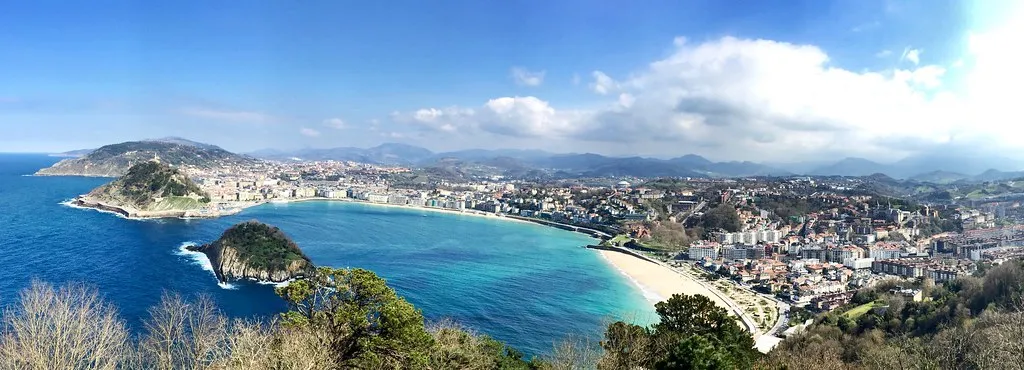
The Itsas Eskola of the Real Club de Tenis de San Sebastián, a few steps from the sand at Ondarreta, lists a 2026 season for single paddleboard rental. Rental includes the board, paddle, leash and life jacket. You must be able to swim, the minimum age is 10, and 10 to 15-year-olds need a responsible adult. The school says it blocks bookings when wind or waves are dangerous. It describes the trip to Santa Clara as its star route, says 90 minutes is enough for a first quiet paddle and 2 hours for the island, and adds that in summer you tie your board to the designated buoys if you want to swim near the island. Its sea school also gives SUP and kayak courses, and says it offers courses and online rental all year.
Stay clear of swimmers and of the buoyed bathing areas. The Capitanía's draft rules ask all craft to keep at least 50 m from swimmers when they could put them at risk, and they cap speed in the bay at 5 knots for vessels. For paddleboards, they ask for daylight, a leash on the ankle or calf and a flotation aid. Below, the safety section sets out when the rules say you shouldn't go out at all.
Airports within about 105 km, and rail from France and Spain.
According to the San Sebastián tourism board, San Sebastián Airport (EAS), at Hondarribia, is 20 km from the centre, with connections to Madrid and Barcelona. Biarritz (BIQ) is 45 km away and Bilbao (BIO) 105 km, and both offer international connections. Vitoria-Gasteiz (VIT) is 100 km away and has no shuttle service. An airport bus runs on line E21 all year and line E30 in summer. The board doesn't list airlines, so check which routes serve each airport from the UK for your dates.
By rail, the Adif-Renfe station has connections to Madrid, Barcelona, Paris and Lisbon. SNCF links Paris to Hendaye, on the French side of the border, and Euskotren's narrow-gauge line runs from Hendaye through San Sebastián and Zarautz to Zumaia and Bilbao. Lurraldebus covers Gipuzkoa, and national and international coaches run from the Donostia bus station, which is connected to the main railway station.
Spanish law, a Capitanía for the sea and the council for the beach.
The council's lifeguard service runs from 1 June to 30 September, from 10:00 to 20:00 between 15 June and 15 September and for shorter hours at either end. Its lifeguard page gives 10:30 to 19:30 for the first and last parts of the season, and its Zurriola page gives 13:30 to 19:30 for 16 to 30 September, so check the board on the day. Outside the season and the hours, the council says swimming is at your own risk. Each beach has an equipped first-aid kit.
The council's flags are a condition system: red means no bathing, yellow means bathing with caution, green means free bathing, white means jellyfish, and black means contaminated water. A blue-and-red flag marks a water-sports zone. These aren't the RNLI craft zones used in the UK. There, red-and-yellow marks the lifeguarded bathing zone, whereas here yellow means bathing with caution. The council's own advice is to read the flag before you go in and to follow the lifeguards.
Maritime safety here belongs to the Capitanía Marítima de Pasaia, whose area runs from the meridian through Punta Saturraran at Mutriku to the French border. The council manages the beach itself. The Capitanía's 2026 resolution on seasonal nautical activities replaces its 24 July 2025 one. The text this guide read is the draft put out for public consultation, and the version published in the Boletín Oficial de Gipuzkoa wasn't found, so confirm the final wording with the Capitanía (capitania.pasaia@transportes.gob.es) if a point matters to you. Nothing in it resembles the French 300 m rule.
For surfing, the draft asks for the main breaks of beaches, daylight (from one hour after sunrise to one hour before sunset) and a leash at all times. It recommends a helmet when waves are over 1 m, the bottom is rock or the water is crowded. For paddleboarding, it asks for daylight, a leash and a flotation aid, which is compulsory in open water and only recommended in protected water such as La Concha. It forbids paddleboarding above wind force 3, in waves above 1 m in open water or 2 m in protected water, or with visibility under 6 miles. The draft defines a bathing zone as any buoyed water plus, on beaches, any unbuoyed water within 200 m of the shore.
An open beach with moving sandbanks has currents, and Zurriola fills with swimmers in hot weather. The council's advice is that if a current carries you off, you stay calm, don't swim against it and signal for help. In May 2026, during the first heatwave and before the lifeguards started, a board member of Groseko Indarra told Noticias de Gipuzkoa that the school's surfers had pulled 30 to 40 swimmers in serious trouble out of the water over a weekend, and that no help arrived. The mayor acknowledged their help, according to COPE, and the council sent firefighters on jet skis and Red Cross rescue boats until the lifeguards started on 1 June. Outside the lifeguard season, there are no lifeguards on the beach.
The council has a protocol for Portuguese man o' war, which it says has become a regular summer visitor. Lifeguards judge the situation, and bathing is banned only when they count 15 or more large specimens at La Concha or Zurriola, 10 or more at Ondarreta or 2 or more at Santa Clara island, or when someone has a whiplash-type sting. After a sting, the council advises going to the lifeguard post, rinsing with seawater or saline rather than fresh water, and removing tentacles with tweezers rather than your hands.
Dial 112 for any emergency in Spain. For someone in difficulty in the water, Salvamento Marítimo asks callers on land to ring its free number, 900 202 202, or 112, and to leave a contact number. From a vessel with a VHF radio, call on channel 16. The Capitanía's draft names the Salvamento coordination centre in Bilbao (CCS Bilbao) as the one that organisers of paid activities must be able to alert.
Gaps in the sources, left as gaps.
The surf-zone boundaries and hours the council applies at Zurriola this season aren't published on the pages we read, and the school tender they come from was cancelled. We haven't confirmed the final text of the Capitanía's 2026 resolution. We found no measured water-quality figure for Zurriola, only the council's page for checking it. We didn't check which airlines fly from the UK, so routes are left for you to look up. And we found no rip-current map for Zurriola, only the council's general advice and the account of the May 2026 rescues.
What surfers and paddlers ask before a trip to San Sebastián.
Yes. The tourism board says Zurriola has waves all year, and Surf Atlas puts surfable days at 50 to 60 per cent in spring and 60 to 80 per cent in winter. The sea is about 13°C in winter, and Surf Atlas suggests a 4/3 wetsuit with boots and a hood. Lifeguards only work from 1 June to 30 September.
In summer, with a school. Surf Atlas says the waves are smaller and gentler then, and the council's school plan puts beginners in a soft-board zone behind the Kursaal. The beach is busy, and it gets heavier from autumn. Zarautz, on the same railway line, is the usual fallback.
The council lists a blue-and-red flag for water-sports zones, but the pages we read don't say how it's used on Zurriola on a given day, so ask the lifeguards. Its red, yellow and green flags describe bathing conditions and are not the UK's RNLI craft zones, so don't read a yellow flag as a surf-craft area.
La Concha bay and Ondarreta, which the Capitanía's draft rules treat as protected water south of Santa Clara island. The Real Club de Tenis Itsas Eskola rents boards from Ondarreta and lists a 2026 season. A flotation aid is compulsory in open water and recommended in protected water, and a leash is required in both.
Yes. The Capitanía de Pasaia's draft rules require the board to be attached to the surfer by a leash, and the paddleboarder's leash to be on the ankle or calf.
San Sebastián Airport is 20 km from the centre and has a bus on line E21 all year (E30 in summer), according to the tourism board. Biarritz is 45 km away and Bilbao 105 km, and both have international flights. From Hendaye, Euskotren's railway runs to San Sebastián.
112. For someone in difficulty at sea, Salvamento Marítimo can also be reached on 900 202 202, or on VHF channel 16 from a vessel.