

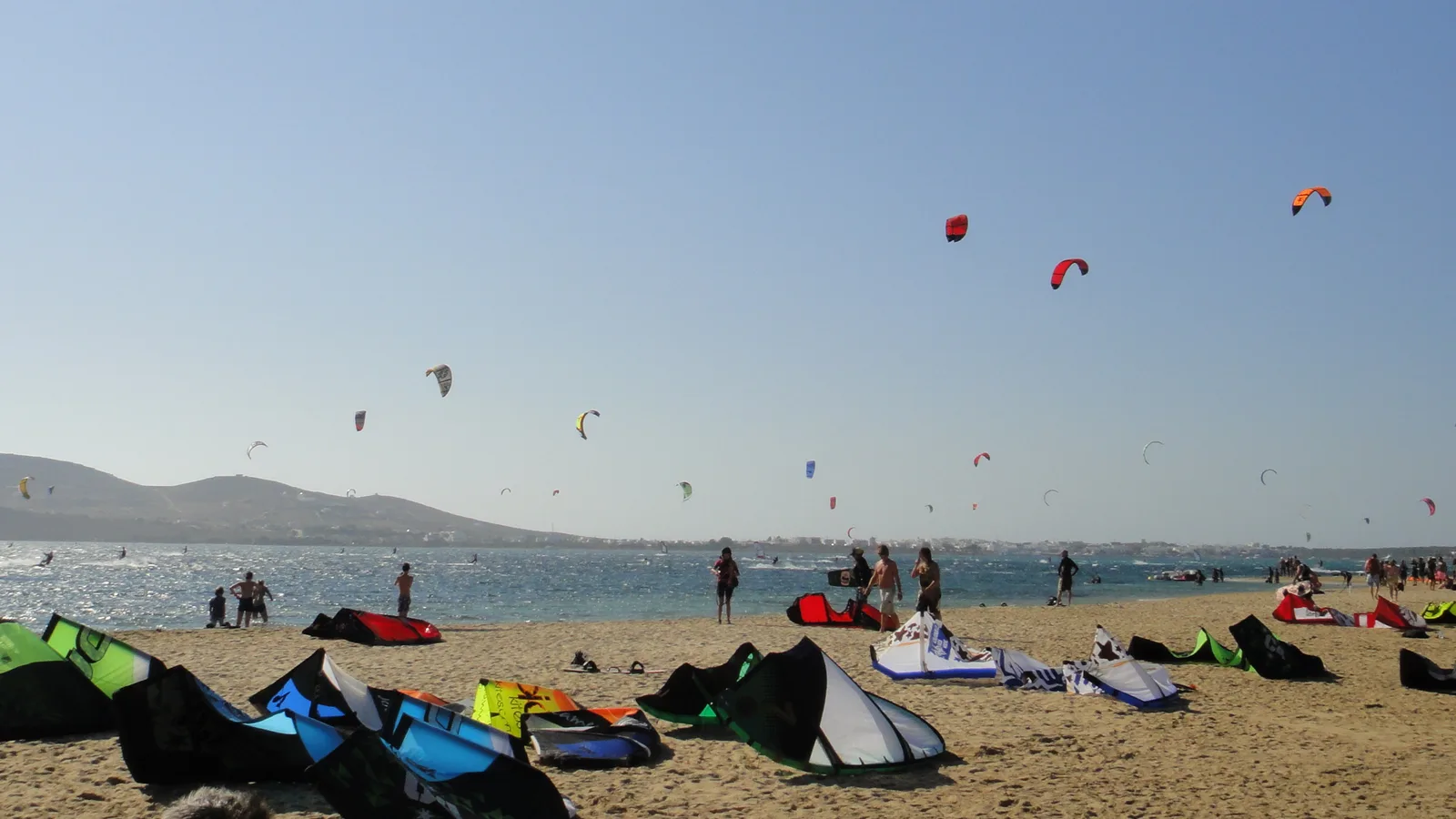
📍 Paros, Cyclades, Greece
Kites on the west coast, windsurfers on the south-east, one northerly summer wind for both.
A narrow strait, a sandy launch and a ferry harbour right next to it.
Pounda is a small settlement on the west coast of Paros, 9 km from Parikia according to the Paros–Antiparos port fund. Its harbour is the crossing point for Antiparos: the ferry covers one nautical mile in about five minutes. The water between the two islands is where the island's kite scene lives. Surf, the German windsurfing magazine, puts the channel at just under 1.5 km wide and describes steady wind from the right, smooth flat water as far as you can see and a little chop further out. It also warns satnav users not to confuse this Pounda with Punda on the east coast.
The wind arrives side-shore to side-onshore, mostly from the north-north-west, according to IKSURFMAG's spot guide, and the water gets choppy above about 20 knots. Sources agree on a sandy, shallow entry but not on how far the shallows run: ParosKite describes a long, shallow shoreline with a sandy bottom, while IKSURFMAG says it is shallow for the first 5-10 metres and then quite deep. Don't count on standing room far from the beach. Surf adds that Pounda gets slightly less wind than the east coast and that the channel is always manageable for intermediates.
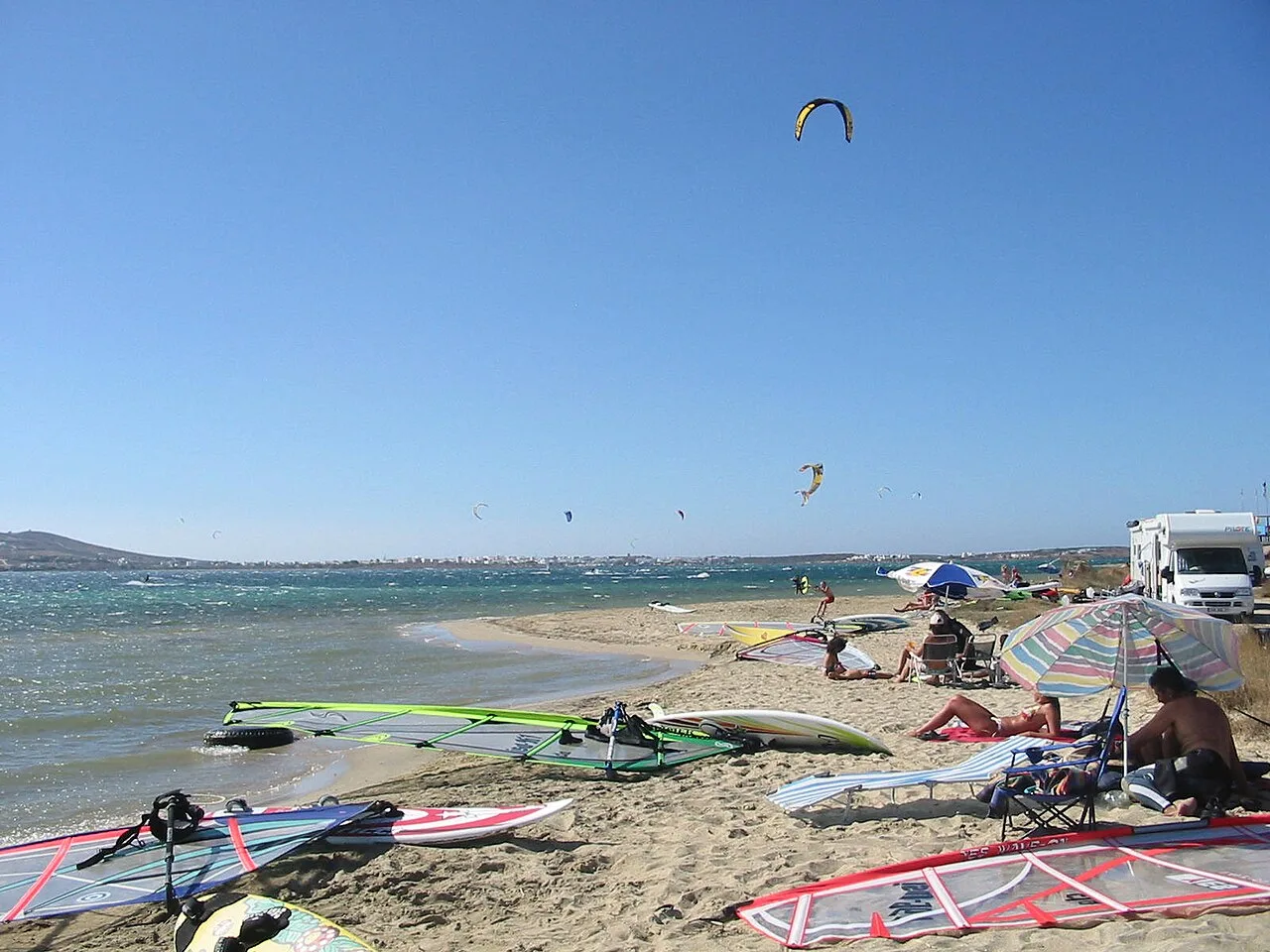
It gets busy. Several guides mention crowds in high summer, and one notes that the launch beach is small for the number of kites; once you're out, the channel spreads people out. How suitable midsummer Pounda is for a first lesson is where the guides part company: some call it ideal for beginners, while the GoParos island guide rates the July–August meltemi days for intermediate and advanced riders and points learners to May, June and September. The schools teach beginners all season, so if you're starting from zero, book lessons rather than rigging alone.
Surf also describes a reef wave just north of the harbour that works in a strong meltemi, with a rocky entry, a shallow reef and onshore conditions: experts only. On the other side of the channel, Psaralyki beach on Antiparos gets the same wind with fewer people, according to the same magazine.
See Pounda on Google Maps open_in_newThe Paros–Naxos channel, a former PWA venue and wind that blows slightly offshore.
Golden Beach (Chrysi Akti) is a 700-metre sandy beach between Drios and Piso Livadi on the south-east coast. Surf describes the summer meltemi here as blowing fairly offshore: gusty near the beach, steady further out in the channel, with flat water and small chop. There's a small standing area for beginners, but with the wind pushing away from the shore, being able to sail back upwind is a basic requirement.
New Golden Beach, also called Tserdakia, is about 2 km away, just to the north. The same magazine calls it the island's most popular all-round spot, with the strongest meltemi thanks to the jet effect in the channel towards Naxos. The wind comes slightly offshore near the beach, so the water stays flat inside, while swell wrapping round a rocky cape gives jumping ramps further out; the reef upwind is marked. This is where Paros made its windsurfing name: New Golden Beach first hosted the PWA World Cup in 1993, and the world tour last came in 2001.
In winter, southerly winds can turn both beaches into onshore wave spots, according to Surf. For kitesurfing, this research found no kite centre on the south-east coast: the kite schools are at Pounda. Force 7's website mentions kitesurfing at Golden Beach in passing, but no rules or launch zone specific to kites there were found, so ask locally before rigging.
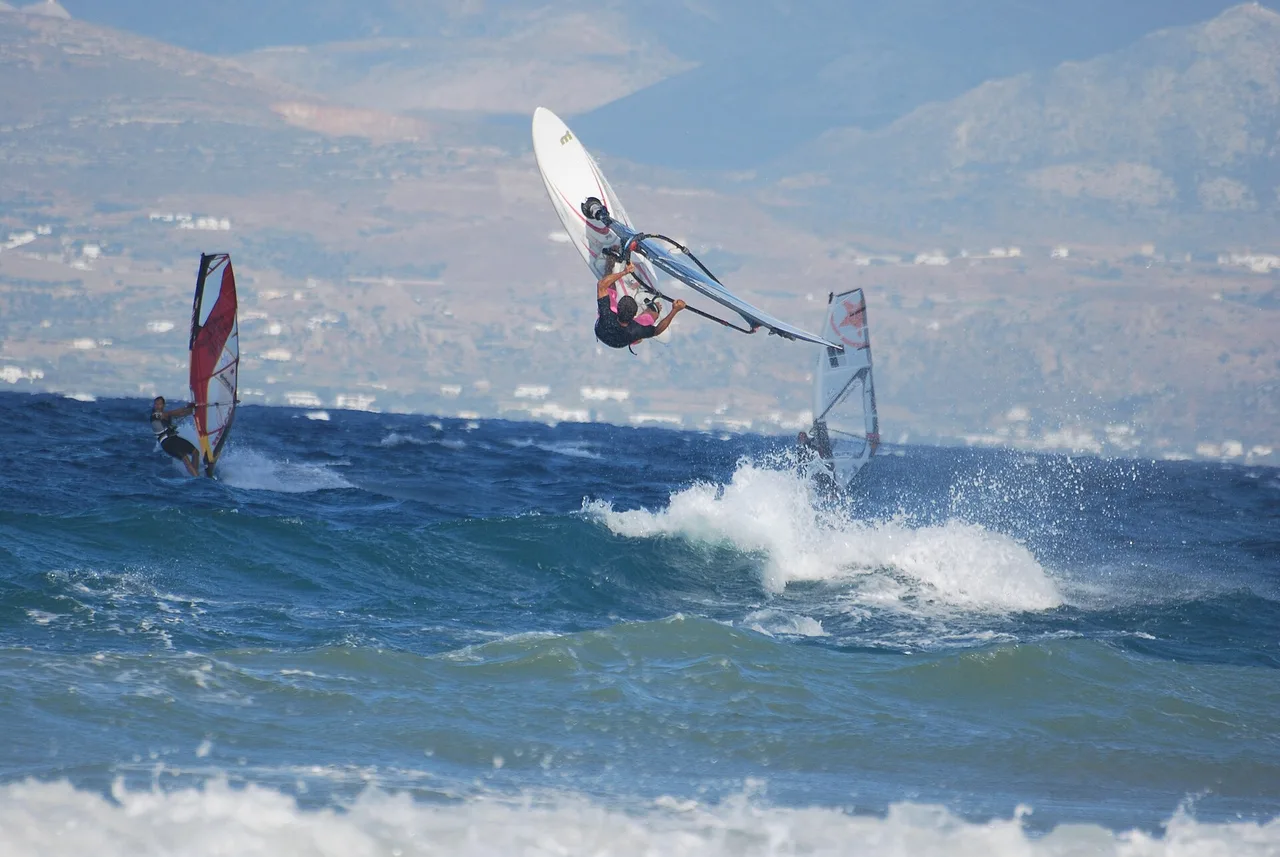
Further north on the east coast, Tsoukalia is the wave spot: the meltemi comes side-onshore and pushes in waves of one to two metres. There's no centre and no rescue service, and the shorebreak gets serious in a strong blow, so it's for windsurfers with wave experience. Across the channel, Naxos has its own kite spots (Windfinder runs a weather station at Mikri Vigla's kite centre); this page doesn't cover them.
A northerly summer wind, boosted between the islands.
The meltemi (the Etesian winds) is the strong, dry northerly of the Aegean, blowing periodically from mid-May to mid-September, according to the EU Space Programme's Copernicus imagery notes. Surf explains the mechanism as a heat low over the southern Aegean and the Turkish mainland drawing air in from the north. On Paros it usually blows from the north to north-west, and it is strengthened by channelling between Paros and its neighbours Naxos and Antiparos. The port fund adds that winds on the north of the island are northerly and north-westerly, particularly strong in summer, while the south gets mostly north-westerlies, westerlies and northerlies.
On strength, published figures vary. Surf says to be ready for anything between 12 and 35 knots and puts the share of planing wind at the top spots at over 70 per cent in midsummer; IKSURFMAG puts it at 'up to 20 knots and more'. The GoParos guide says it is often strongest from late morning to late afternoon. Small kites and sails are common, so pack accordingly.
For a measured comparison between months, Windfinder's weather station at Paros airport (observations from 2000 to 2026) puts the wind at force 4 to 6 in 59 per cent of readings in July and 57 per cent in August, against 34 per cent in May, 41 per cent in June and 46 per cent in September. Force 7 to 8 shows up in about 1 per cent of readings or less in every month. That station is inland, a few kilometres from Pounda, and records day and night, so treat it as a guide to the season rather than a spot reading.
| Month | Wind: share of readings at force 4-6 (Paros airport) | Water, monthly average |
|---|---|---|
| May | 34% | about 19°C |
| June | 41% | about 22°C |
| July | 59% | about 24-25°C |
| August | 57% | about 25°C |
| September | 46% | about 24°C |
| October | 45% | about 21-22°C |
The water temperatures come from two satellite-based sea-temperature sites (seatemperature.info and seatemperature.org), which broadly agree; they aren't an official series. Surf says a shortie is enough in August and recommends a long 4/3 wetsuit in spring and autumn. Note that Greek rules require kitesurfers to wear a wetsuit from 15 October to 15 May (see below).
Three with clear signs of trading this year, two worth checking first.
At Pounda, ParosKite runs kitesurf, windsurf and wing foil lessons and rentals on the beach, says it has taught kitesurfing since 1993 and welcomes visitors from April to October, according to its own website. Paros Kite Pro Center, a few hundred metres downwind according to IKSURFMAG, was taking bookings for IKO Level 1 kite courses on a booking platform at the time of writing (October 2026). IKSURFMAG says the Pounda schools offer a rescue service for a daily or weekly fee, which is worth having if you ride without lessons.
At New Golden Beach, Paros Windsurf Center offers windsurf, wing foil and SUP lessons and rental from April to October; its website says every rider gets a GPS tracker and that two rescue boats patrol the water. At Golden Beach, Force 7 (VDWS instructors, according to its website) and Sun Wind both appear on island listings and in Surf's 2022 guide, but Force 7's website carries a 2018 copyright date and no current-season information was found for Sun Wind, so contact them before planning around either.
Surf notes that you can hire up-to-date flat-water kit at almost every spot, so travelling without your own gear is realistic; wave sailors heading for Tsoukalia should bring their own. Prices aren't quoted here: check them with the centre.
National rules, read at source, with a local authority in Parikia.
In Greece, sea recreation is regulated nationally by the Hellenic Coast Guard (Λιμενικό Σώμα – Ελληνική Ακτοφυλακή) and enforced locally by each port authority. On Paros that is the Paros Port Authority (Λιμεναρχείο Πάρου) in Parikia, with a separate port station on Antiparos. Windsurfing is covered by Article 13 of General Port Regulation No. 20 (Γενικός Κανονισμός Λιμένα αριθ. 20), which applies in every port authority's area. Kitesurfing (αετοσανίδα) is treated as a 'novel' sea recreation craft with its own ministerial decision, 2133.3/62620/2020 (Government Gazette ΦΕΚ Β' 4415/2020), which covers both rental and individual use.
| Rule | Windsurfing (Regulation 20, Art. 13) | Kitesurfing (decision 2133.3/62620/2020) |
|---|---|---|
| Wind limit | Not above force 7 (61 km/h) | Not above force 7 (61 km/h), nor in poor visibility or with a risk of lightning |
| Daylight | Not before sunrise or after sunset | Not before sunrise or after sunset |
| Swimmers | Not within 200 m of the point swimmers usually reach where no buoys mark the bathing area, nor within 100 m of the outer edge of bathing buoys | Same 200 m and 100 m rules; no kitesurfing on beaches designated as crowded |
| Other hazards | – | Not within 200 m of anchored ships, dive buoys, rocks, reefs or moving vessels; not inside harbours, marinas or fishing shelters, nor within 1 nautical mile of their entrances (a local committee can reduce this to 500 m) |
| Distance offshore | – | Not beyond 1 nautical mile from the coast |
| Launching | Take care not to disturb swimmers when leaving or returning to the beach | Launch only with no people or obstacles within 100 m |
| Kit | A personal lifejacket (ατομική σωσίβια ζώνη) | Helmet, harness with hook, line-cutting knife, jacket-type buoyancy vest (σωσίβιο τύπου τζάκετ), quick release, kite leash, and a wetsuit from 15 October to 15 May |
| Age | 16 and over, and able to swim (younger riders only with parental consent and an escort) | 16 and over, and able to swim (14-15 with parental consent and an escort, through a rental centre) |
| Offshore wind | – | Not allowed without someone on a motorboat ready to pick you up |
The kitesurf wind limit was force 6 in the 2020 decision; a 2022 amendment to Regulation 20 (ΦΕΚ Β' 6543/2022) raised it to force 7. The Coast Guard's own page on kitesurfing, updated in December 2025, still points to the 2020 decision, and a July 2026 amendment to Regulation 20 (ΦΕΚ Β' 4559/2026) doesn't change the windsurf or kite rules. Centres that rent kite gear must also mark a launch corridor at least 100 m wide and 100 m long with red buoys, put up warning signs and keep an anemometer on site.
At Pounda, the ferry harbour sits right next to the kite area, so two of these rules matter on every session: the distance from the harbour entrance, which a local committee can set between 500 m and 1 nautical mile, and the 200 m you must keep from moving vessels such as the Antiparos ferry. This research didn't find the local decision that sets Pounda's distance, so ride in the zone your school uses and keep well clear of the ferry route. These are Greek rules: there's no French-style 300 m limit here, and RNLI flag zones don't apply. If in doubt, ask the Paros Port Authority (+30 22840 21240).
Fly to Athens, then a short domestic flight or a three-to-six-hour ferry.
From the UK, the usual route is a flight to Athens (about 3.5 hours, according to Windsurf Magazine's Paros guide), then either a domestic flight or a ferry. Paros National Airport, in the south-west of the island about 10 km from Parikia, opened in 2016 with a longer runway than the old airstrip; Olympic Air and Sky Express fly there from Athens with small aircraft. Surf says surf equipment can travel on these flights if you register it in good time, so check your airline's baggage rules before booking.
Ferries leave from both Athens ports, Piraeus and Rafina, and take between three and six hours depending on the route and the boat; Rafina is the closer port to Athens airport. Operators on the route include Blue Star Ferries, Seajets and Golden Star Ferries. Timetables change with the season, so check the sailing for your date with the operator.
Ferries arrive at Parikia. Pounda is 9 km from there, and Golden Beach is about 25-30 minutes by car from Parikia and the airport, according to the GoParos guide. The island's buses, hire cars and scooters cover the rest, though parking near the beaches is tight in high season.
The meltemi is the attraction and the main hazard.
The meltemi can blow hard (Surf's range runs up to 35 knots), and on the south-east coast it blows partly offshore, so a broken line or a torn sail drifts you away from the beach. Ride with the rescue service your centre offers, rig on the small side and don't go out alone in a strong blow. At Pounda, watch the Antiparos ferry and the other kites at the launch; in high summer the beach is crowded. The UK Foreign Office's advice for Greece is to book water sports only with a licensed centre and to make sure you know how to call for help before you start.
In an emergency at sea, call 108, the Hellenic Coast Guard's emergency number, or 112, the European emergency number, which also covers ambulance, fire and police in Greece. VHF channel 16 remains the international distress channel at sea.
What riders ask most before a trip to Paros.
July and August, when the meltemi is at its most consistent: at Paros airport, the wind is at force 4 to 6 in nearly six readings out of ten in those months. The meltemi season runs from mid-May to mid-September, and the centres we could confirm open from April to October.
It has schools that teach beginners all season, a sandy launch and flat water, but the sources disagree on how far the shallows extend, and midsummer meltemi days are strong and crowded. Book lessons, and consider May, June or September if you're starting from scratch.
This research found no kite centre on the south-east coast; Golden Beach and New Golden Beach are windsurf beaches, and the kite schools are at Pounda. Ask locally before rigging a kite there.
Yes. Greek decision 2133.3/62620/2020 requires a helmet, a harness with hook, a line-cutting knife, a jacket-type buoyancy vest, a quick release and a kite leash, plus a wetsuit from 15 October to 15 May. Windsurfers must wear a personal lifejacket under General Port Regulation No. 20.
Fly to Athens, then take a domestic flight to Paros National Airport or a ferry from Piraeus or Rafina (three to six hours, depending on the route). Check your airline's and ferry operator's rules for board bags before booking.
108 for the Hellenic Coast Guard, or 112, the European emergency number. VHF channel 16 is the distress channel at sea.