

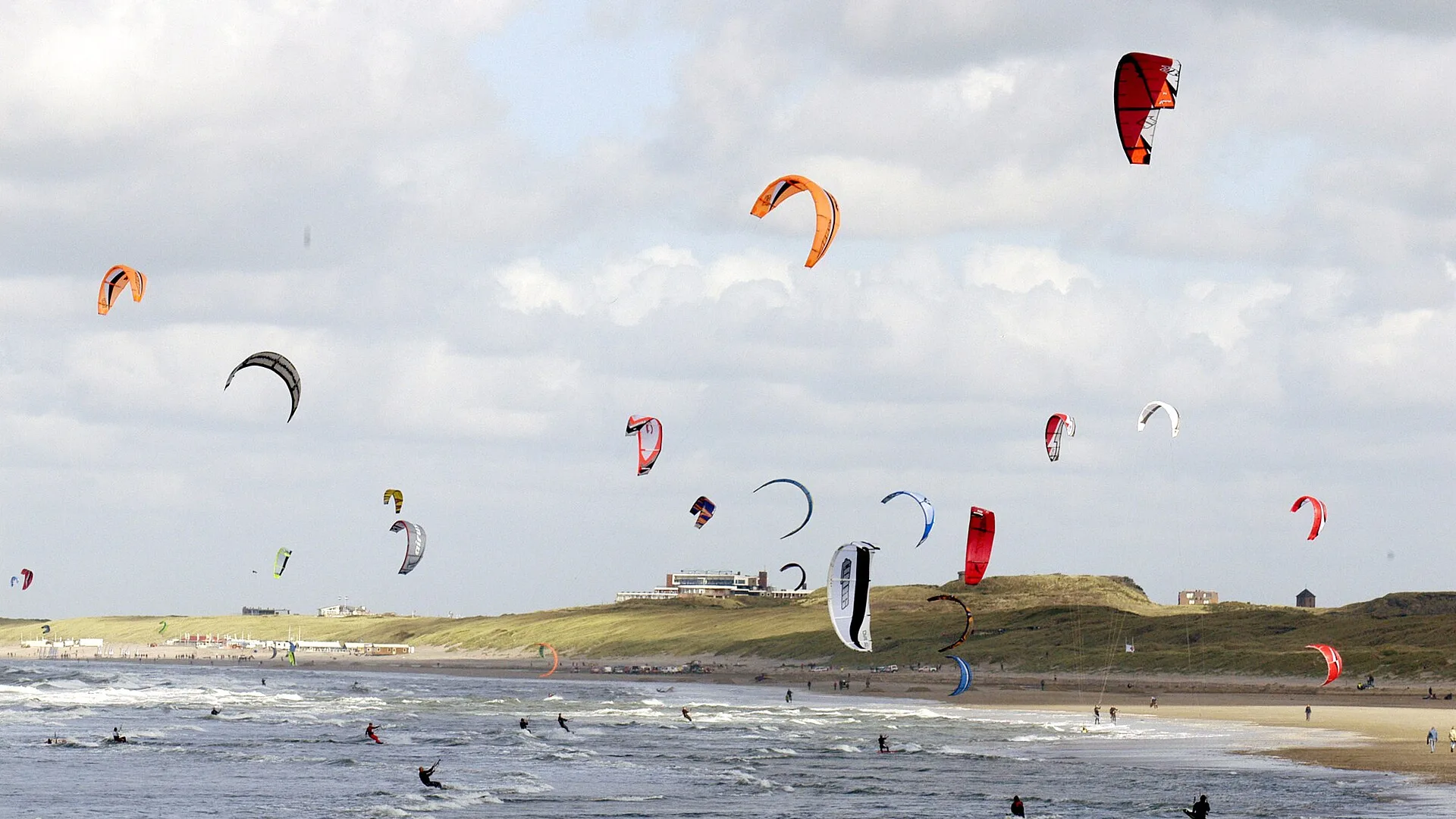
Photo: Kees Blokker / Wikimedia Commons (Noord-Hollands Archief Collection), CC BY 4.0
From North Sea beaches to the flat water of the IJsselmeer, every Dutch spot has its own character and its own municipal rulebook.
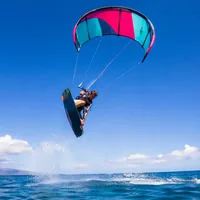
A dam between the North Sea and Lake Grevelingen, flat and shallow over 300 m: one of Europe's most reputed spots for learning.
Brouwersdam in detail arrow_forward
Wijk aan Zee, The Hague (Scheveningen, Kijkduin) and Zandvoort: three urban spots, from the most approachable to the most technical.
The coast in detail arrow_forward
The IJsselmeer's flat water (Workum, Makkum) for progressing, the island of Texel for a wilder setting between the North Sea and the Wadden Sea.
IJsselmeer and Texel in detail arrow_forwardSix spots, regulations decided municipality by municipality.
A dam between two seas, with a 300 m stretch of flat water.
Brouwersdam, in Zeeland, separates the North Sea from Lake Grevelingen. Several spot guides describe it as one of the best learning spots in Europe: a roughly 300 m stretch of flat, shallow water at low tide, suited to freestyle and freeride, while high tide brings in waves better suited to wave-riding. The wind works from the south-south-west, west, and north to north-north-east sectors, with a rideable-wind yield above 50% most months according to one spot guide, thanks to its direct exposure on the North Sea.
See on Google Maps open_in_newSeveral schools are based on the dam: Beware Beach, Kitesurfschool Natural High, Kitesurfcentrum Brouwersdam and KBC Brouwersdam (IKO-certified school and rental); Vertigo Sports, based in Vrouwenpolder, also runs a mobile base there. The best season runs from April to October, peaking between May and September.
Three urban spots, from the most approachable to the most technical.
Near the IJmuiden dam, north of Amsterdam, Wijk aan Zee works mainly on a south-west wind, with better conditions expected from west to north-west. The Pier (Noordpier) area, sheltered from swell and strong currents on a south-west wind, is described as beginner-suited — though watch for drift towards the pier on a north-east wind. The nearby Bunker area combines a strong current with sometimes sizeable waves: not a spot to learn on. The Kiwi Kite school gives lessons near the Bunker.
At Scheveningen, favourable wind comes from south-west, west, north-east and north; the area behind the north mole, near the lighthouse, is rideable but the water can turn choppy with small waves and inconsistent wind — not the best beach to learn on. Kijkduin, further south, benefits from the Zandmotor (an artificial sand extension) that creates shallow, flat lagoons close to shore, more sheltered from strong wind — a more beginner-friendly setting, with 15-25 knot wind from the south-west to north-west sector, particularly reliable in spring and autumn.
About 30 minutes from Amsterdam by train, Zandvoort is rideable on a south-west to north-north-east wind, with the best conditions in September-October and a lull in July-August (dominant east wind). The spot leans intermediate to advanced, even though flat-water strips form between the offshore sandbanks. The Spot, TÜV-certified, and Moana Surfschool run lessons there, from late April to late September.
An inland lake to progress with confidence, an island for a change of scenery.
The IJsselmeer, in Friesland, is described as the most wind-reliable inland body of water in Central Europe, with a shallow area stretching a long way out. At Workum, the water stays flat in front of the sandbank, with standing depth over 200 m from shore before a shallow reef gives way to deeper water; waves can build to 1 m in strong wind. At Makkum, inside the small bay the water is flat and shallow for beginners, while outside it suits foiling and freeride better, with ideal wind from north, north-west, west or south-west — north-east is off-shore there and should be avoided at launch. The KBC school runs lessons on the lake.
See on Google Maps open_in_newOn the island of Texel, between the North Sea and the Wadden Sea, Paal 9 (near De Cocksdorp) is cited as the most versatile spot: wind from north, south, south-west or north-west, chop and small-to-medium waves, a long sandy beach good for launching. The area lets you ride the North Sea side or the Wadden side depending on the day's direction. The best season runs from April to October, peaking in May and September.
The Netherlands has no single national rule like France's Division 240.
In the Netherlands, municipalities set, in their APV (local ordinance, roughly equivalent to a municipal decree), where and when kitesurfing is allowed. Many beaches have designated zones, often marked by yellow buoys or signs at beach access points. According to the sources consulted, recreational riding generally doesn't require an individual permit, but some areas do require membership of a local association — a principle similar to Le Jaï in Marignane, France.
The NKV federation (Nederlandse Kite Vereniging) keeps a reference map of spots for which it has secured a permit, waiver or exemption from local authorities. A spot not on that map should, as a rule, be treated as off-limits. Always check on-site signage and, when in doubt, the NKV map before rigging up.
In a sea emergency, contact the KNRM (Koninklijke Nederlandse Redding Maatschappij, the Royal Dutch Sea Rescue Institution) or 112.
What riders ask most before coming to the Netherlands.
Brouwersdam, in Zeeland, is cited as one of the best learning spots in Europe thanks to its flat, shallow water. Kijkduin, near The Hague, and the IJsselmeer (Makkum in particular) are also reliable beginner options.
No. Each municipality sets its own permitted zones by local ordinance, usually marked by buoys or signs. The NKV federation keeps a reference map of spots holding a permit; a spot not on that map should be treated as off-limits.
Wijk aan Zee has a sheltered zone (the Pier) suited to beginners and a more technical zone (the Bunker). Zandvoort, further south, leans intermediate to advanced overall, with its best conditions in September-October.
Yes, especially at Makkum, where the inside of the bay offers flat, shallow water. Workum is also heavily used by local schools in summer, with standing depth over a long distance before deeper water.