

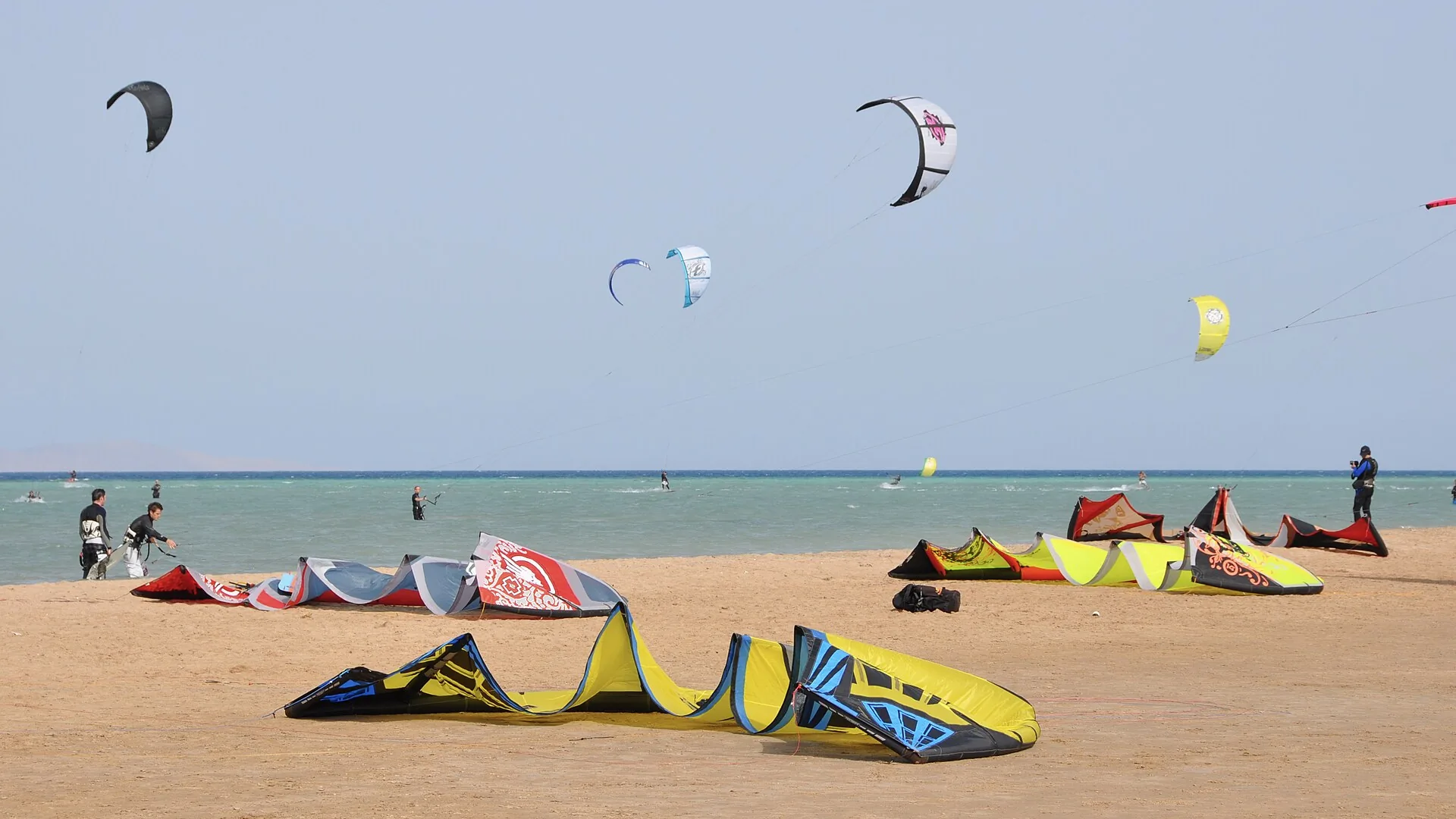
📍 El Gouna, Red Sea, Egypt
Photo: Marc Ryckaert / Wikimedia Commons, CC BY 3.0
Shallow, flat lagoons on the Red Sea coast north of Hurghada, with a wind that blows from the north most of the year.
Several centre-run beaches along the same coast, with Mangroovy at the northern end of the town.
Mangroovy Beach, at the north end of El Gouna, is the name most riders know. The UK operator Sportif describes it as a public beach, open to residents and non-residents alike, with a lagoon that stretches more than 500 m out to the offshore reef. The coast runs north-west to south-east, so the mostly northerly wind arrives cross to cross-onshore. The water is flat apart from wind chop, and there are no waves.

The other bases sit on the same coast. KBC El Gouna gives its address as Buzzha Beach, on Kite Center Road, and describes a lagoon of more than two square kilometres at standing depth, which by its account varies between 20 and 70 cm with the tide; it keeps the first 50 metres for launching and landing. Kitepower El Gouna rides a private lagoon in North El Gouna that it puts at 2-3 km long and about 1 km wide, knee-to-waist deep over sand for the first 800 m or so, with stones and reef on the far side beyond its marked boundaries. The Mövenpick resort has its own kite beach, which only its residents can launch from, according to Sportif.
View Mangroovy Beach on Google Maps open_in_newThe tide decides when you ride. Sportif notes that the kite zone is tidal and that lessons are scheduled around high water, and the guide Kitesurfing World warns that at an extreme low tide parts of it can dry out for a few hours. Check the tide table with your centre before planning a session, especially if you're learning.
Shallow doesn't mean soft everywhere. Sportif recommends boots or water shoes because of coral underfoot, and Kitesurfing World warns riders not to drift into the hotel bathing area that sits just downwind of one of the centres. Flat, waist-deep water is the reason El Gouna suits learners and freestyle riders; it isn't a wave spot.
Every source agrees on the direction. On the best months, they don't.
The wind at El Gouna comes from the north to north-north-west. KBC calls it 'direct, undisturbed, constant' and side-onshore; Kitepower describes a thermal that builds late in the morning and peaks in the afternoon, typically 15-25 knots. Kitepeople, at the Mövenpick, gives 20-25 knots from March to November and a lighter 12-18 knots from December to February.
Which months are best depends on who you ask. Sportif says April to November, Kitesurfing World and Kitepeople say March to November, and IKSURFMAG names February to May and August to December. The closest thing to measured data is Kitepower's own weather station, which the school says has logged four years of readings. Its rideable-day figures, in the table below, put June and August to October above 80% and February at 80%, against 61-63% in December, January, March and July, with an annual average of 77%.
| Month | Rideable days (Kitepower station) | Average sea temperature |
|---|---|---|
| January | 63% | 23.0°C |
| February | 80% | 22.2°C |
| March | 62% | 22.3°C |
| April | 65% | 22.9°C |
| May | 69% | 24.4°C |
| June | 83% | 26.1°C |
| July | 63% | 28.1°C |
| August | 85% | 28.6°C |
| September | 83% | 27.6°C |
| October | 81% | 27.2°C |
| November | 75% | 25.4°C |
| December | 61% | 24.2°C |
Sea temperatures are seatemperature.org's monthly averages for El Gouna. A single school's station on a single lagoon is not an official record, so read the percentages as a guide to the shape of the year rather than a promise for your week.
For kit, Kitesurfing World suggests a 10-12 m for typical days plus something smaller for the strong ones; for the lighter winter wind, the guide Kite Advice puts most riders on 10-14 m.
Warm for most of the year, but in winter you'll want neoprene.
Monthly sea-temperature averages run from about 22°C in February and March to 29°C in August. Kitepower puts the water at around 20-21°C in the coldest months, from January to March, and recommends a full, long wetsuit in winter; KBC suggests a shortie in spring and autumn and a long suit in winter, and notes that winter evenings turn chilly once the sun goes down. In summer most riders go without.
For much of the year the sun matters more than the water temperature. Kitepeople gives summer air temperatures of up to 38°C from June to August, so a rash vest, a hat between sessions and plenty of water matter as much as the right kite size.
The kite beaches at El Gouna are run by the centres, so you ride through one even if you don't take lessons.
KBC El Gouna (Kiteboarding Club) is on Buzzha Beach, describes itself as a VDWS-certified school, opens all year and publishes 2026 course prices on its site. It also has a swimming pool, which it says is the only one at an El Gouna kite centre.
Kitepower El Gouna, on its private lagoon in North El Gouna, says it has been running since 2004. It splits the water into a teaching zone, an independent riders' zone and a wing and foil zone, and has three rescue boats available during operating hours, while stating that response times aren't guaranteed. For riders who don't need lessons, it sells beach use with or without kit storage.
Kitepeople is based at the Mövenpick Resort, states an IKO affiliation and has a 2026 price list online.
Other names come up in guides and directories: RedSeaZone (listed as an IKO centre on northern Mangroovy Beach), Makani Beach Club (a VDWS centre whose site is live, though no 2026 dates were found on it) and Riah Kite Academy. This research couldn't confirm their current operation as firmly as the three above, so contact them directly before you book.
Bringing your own kit? Expect to ride from a centre's beach, pay it for beach use or storage (Kitepower publishes both options) and follow its rules on launching, zones and right of way.
Egypt licenses the centres. Who sets the kite zones beyond them is not documented.
Licensing. Water sports centres in Egypt, kite centres included, need a Ministry of Tourism licence and membership of the Chamber of Diving and Water Sports (CDWS). The CDWS's published technical requirements for a windsurf or kite centre include a technical manager certified by an international federation, medically trained staff, a rescue speedboat or RIB with a qualified skipper, a radio system, binoculars, civil-liability and personal-accident insurance for every participant, and a launch path that doesn't damage the reef. If you take lessons, it's reasonable to ask a centre whether it holds both.
Kite zones. This research found no published national or Red Sea Governorate rule that sets kite zones, distances from shore or mandatory kit for independent riders. At El Gouna the zones are marked and enforced by the centres on their own beaches, which is why you ride through one. That's a documented gap, not a rule we've filled in, so follow your centre's briefing.
Protected reefs. Egypt's nature reserves are declared under Law 102 of 1983 and managed by the Egyptian Environmental Affairs Agency. The Red Sea Northern Islands reserve (Prime Ministerial Decree 1618 of 2006, 1,991 km²) lies in the Red Sea Governorate, and the conservation group HEPCA lists the Giftun islands off Hurghada among the protectorate islands. In late 2025, Prime Ministerial Decree 4419 of 2025 declared the Red Sea's Great Fringing Reef a marine protected area and tasked the governors of the Red Sea and South Sinai with managing it. The sources read for this page don't show whether its boundary takes in the El Gouna kite lagoons. Whatever the map says, don't stand on or launch across coral, and keep boat trips to operators who brief you on the marine-park rules.
Emergency numbers. The UK Foreign Office lists 123 for an ambulance, 122 for the police, 126 for the tourist police and 180 for the fire brigade. Egypt also launched a unified 112 number in 2022, according to Egyptian press reports. No public sea-rescue number for this coast was found; on the water, your first line of help is your centre's rescue boat, and VHF channel 16 is the international distress channel.
Other risks. The Foreign Office notes that shark attacks are rare but have happened in the Red Sea region, and that safety standards among Red Sea diving and boat operators vary considerably; it advises booking through a reputable operator. Check its current travel advice for Egypt before you go.
30-40 minutes by road from HRG, with a visa needed for British travellers.
Hurghada International Airport (HRG) is the gateway. Kitepower puts El Gouna 30-40 minutes away by road, and KBC about 30 minutes by organised transfer. Which UK airports have a direct flight to Hurghada, and with which airline, changes from season to season, so check what's flying when you book.
According to the Foreign Office (checked 3 October 2026), British nationals flying into Hurghada need a visa: the free Sinai entry stamp doesn't apply here. You can buy one at a kiosk before immigration at approved airports (30 US dollars, cash only, at the time of checking) or get an e-visa in advance, and your passport must be valid for at least six months after you arrive. Entry rules change, so check the FCDO page before you travel.
Other kitesurfing destinations on the same coast.
The CDWS lists Hurghada, Soma Bay and Safaga, further south along the Red Sea coast, among Egypt's kitesurfing destinations, alongside El Gouna. This page doesn't cover them: their spots, centres and conditions weren't researched for it, so treat them as separate trips to look into rather than an extension of El Gouna.
What riders ask most before booking.
Yes. The lagoons are flat and shallow, with standing depth over sand in the teaching areas, and the wind is cross to cross-onshore. Watch the tide, though: lessons are timed around high water, and some areas get too shallow at low tide.
It's rideable all year, with lighter wind from December to February. The sources disagree on the best months; Kitepower's own station data puts June and August to October above 80% rideable days.
In winter, yes: the local centres recommend a full wetsuit, with the sea at around 20-23°C. In summer, when the average reaches 28-29°C, most riders go without.
Not really. The kite beaches are run by the centres, so independent riders ride from one and pay it for beach use or storage. No public rule on kite zones was found beyond the centres' own.
About 30-40 minutes by road, according to the local kite centres.