

📍 Larnaca and Limassol, Cyprus
Photo: Krzysztof Ziarnek, Kenraiz / Wikimedia Commons, CC BY-SA 4.0
One kite coast does most of the work, a few minutes from the main airport.
A long, shallow bay south-west of Larnaca, with the wind coming in off the sea.
The Cyprus Deputy Ministry of Tourism's Visit Cyprus site names the beaches of the Mazotos and Kiti villages as the island's kitesurfing area, with steady winds that peak from May to October. The schools there are on Softades beach at Kiti. KiteMed describes the bay as more than 10 km long with shallow water and wind until sundown, and suggests SUP in the morning, windsurfing in the morning and middle of the day, and kitesurfing after midday, when the wind gets stronger. Kahuna Surfhouse, on the same beach, also talks of wind until late in the evening and warm, calm water without strong currents.
The wind direction matters for safety here. Kahuna's owner, Elias Mantovanis, told the Cyprus Mail in 2023 that the onshore wind is what keeps riders from being carried out to sea, and the station records back him up: Windfinder's observations at nearby Larnaca airport put the dominant summer wind at south-south-west, off the water. If the wind swings offshore, that safety margin goes.
The same Cyprus Mail article describes the Kiti site as the only government-licensed kitesurfing beach and sea area in Cyprus, and says Mantovanis first got a licence to teach off Mazotos beach in 2011. Kahuna's website makes the same claim. This research didn't find the licence itself or a public register to check it against, so take it as the operator's description. Kahuna also runs the island's kitesurfing competition, held over a weekend in the last week of July; the 2023 edition, the tenth Cyprus Kitesurfing Championship, drew more than 120 competitors, according to the article.
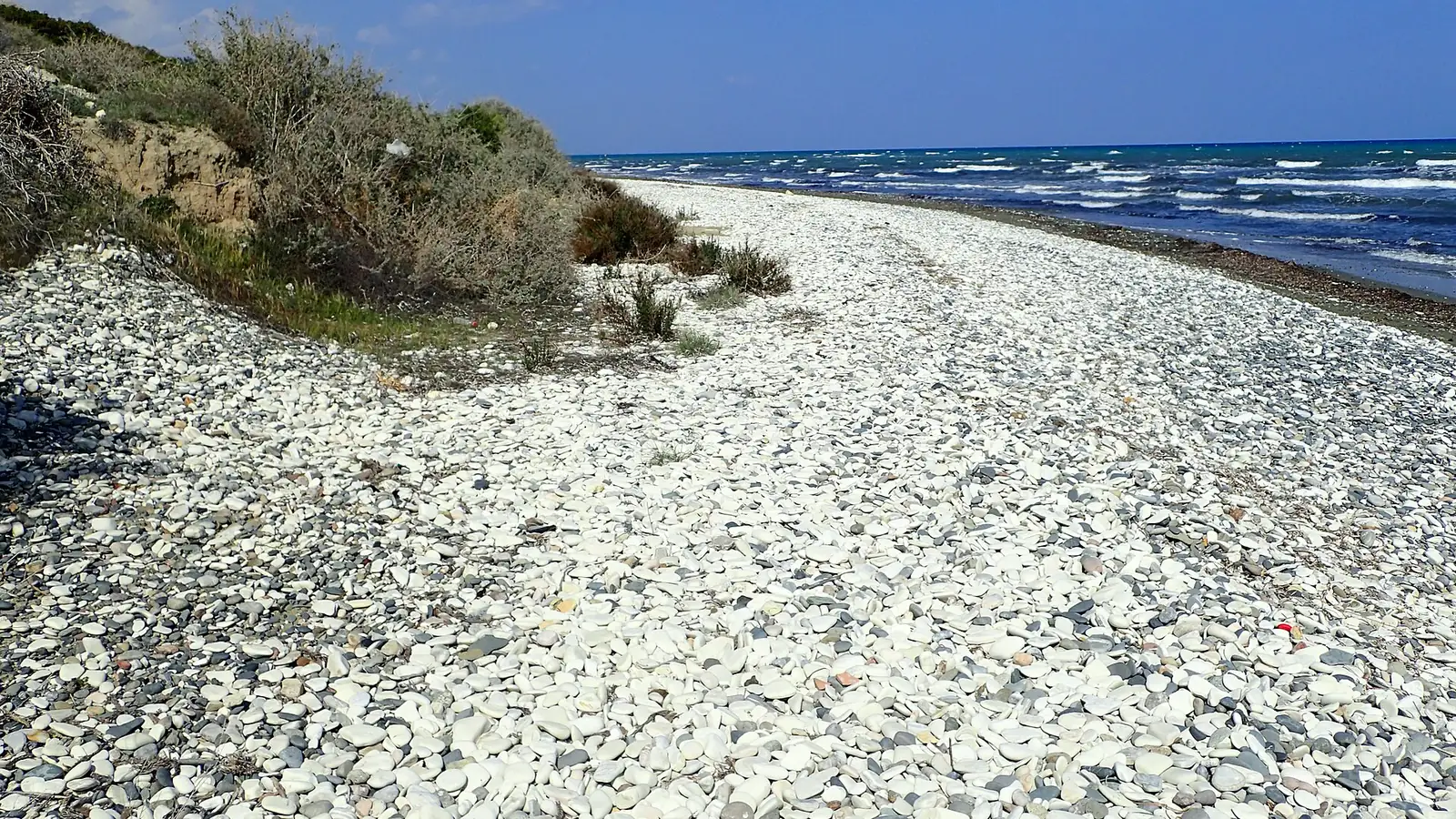
Not every stretch is sand. Around Cape Kiti itself the shore is a bank of white pebbles (the hero photo above was taken there), so check the launch before you rig and use the schools' beach if you're not sure.
See Softades beach on Google Maps open_in_newThe non-kite option, next to the airport.
Windsurf City Cyprus runs windsurf, wing foil, eFoil and SUP lessons and rentals from Mackenzie Beach in Larnaca, according to its website. If you're travelling with someone who windsurfs or wants to try wing foiling rather than kitesurfing, this is the documented base in town; the Kiti schools also teach windsurfing, wing foiling and SUP alongside kitesurfing.
A 5 km beach inside a British Sovereign Base Area, and a protected one.
Lady's Mile is a 5 km stretch of grey sand and shallow water on the east side of the Akrotiri peninsula, south of Limassol, with lifeguards from April to October according to Visit Cyprus. Kite guides describe it as long and spacious with flat water and small waves, and one Cyprus guide calls it suitable for beginners thanks to a sandy bottom and a wide shallow zone near the shore. The same guide warns that on crowded summer days lifeguards may ask kiters to move away or bring their kites down. Kiteflex, one of the centres listed by Visit Cyprus, gives Limassol as its base.
Two things make Lady's Mile different from the Larnaca coast. It lies inside the Akrotiri (Western) Sovereign Base Area, UK territory run by the Sovereign Base Areas Administration rather than the Republic of Cyprus. It is also a protected site: BirdLife Cyprus and Terra Cypria say it is designated a Special Area of Conservation and a Special Protection Area under the 2007 Nature and Wildlife Ordinance and the 2008 Wild Birds and Game Species Ordinance, and that it matters for nesting loggerhead and green turtles. In July 2026 the two groups named water sports among the pressures on the beach and asked the administration to explain how it enforces the rules; the administration acknowledged the challenge of reconciling recreation with protection. This research found no published SBA rule specific to kitesurfing, so check with a local school before riding there.
West of Limassol, a rider-edited spot database lists Curium (Kourion) beach for intermediate and expert riders: a thermal south-westerly in summer that usually starts around 14:00, flat water and crowds in summer, waves in winter, and rocks and currents to watch for. One Cyprus guide also mentions Paramali bay, between Limassol and Paphos, as scenic but for skilled riders only, with rocky cliffs on both sides and a current that can push a fallen rider towards them. Neither source is official, so treat both as pointers rather than spot reports.
What this research could and couldn't confirm.
The rest of the coast is thinly documented for kitesurfing. Around Paphos, one undated guide names a kite school and a spot by a hotel beach, but this research couldn't confirm either is trading. For Pomos, on the north-west coast, no kite spot guide or school was found. On the east coast, around Ayia Napa and Protaras, no documented kite spot or school turned up either. That doesn't mean nobody rides there; it means we can't point you to a launch or a centre, so if you're staying in the west or the east, plan on driving to Kiti. KiteMed puts its school about an hour's drive from Ayia Napa, Protaras and Paphos.
A sea breeze that builds through the day, and warm water from June.
Windfinder's weather station at Larnaca airport has recorded observations since 2001. From April to October its dominant wind direction is south-south-westerly, from the sea, and the monthly average wind speed is highest from May to August, at 10 to 11 knots. From November to February the dominant direction swings round to between north-west and north-north-east. Those averages include nights and calm mornings, so they understate the afternoon breeze the schools ride; the schools describe the wind building after midday and holding until sundown or later.
| Month | Average wind, Larnaca airport | Dominant direction | Water, Larnaca monthly average |
|---|---|---|---|
| April | 9.3 knots | South-south-west | about 18°C |
| May | 10.1 knots | South-south-west | about 21°C |
| June | 10.7 knots | South-south-west | about 24°C |
| July | 11.0 knots | South-south-west | about 27°C |
| August | 10.5 knots | South-south-west | about 28°C |
| September | 9.5 knots | South-south-west | about 27-28°C |
| October | 7.9 knots | South-south-west | about 26°C |
The water temperatures are satellite-based averages for Larnaca from seatemperature.info, which seatemperature.org broadly matches (about 28°C in August, 17°C in February); they aren't an official series. In winter the water sits at around 17-18°C, and both Kiti schools say they open all year.
Three confirmed from their own websites, and a longer official list.
On Softades beach at Kiti, KiteMed says it was established in 2003, is an IKO Pro Center with IKO-qualified instructors, and teaches kitesurfing, windsurfing, SUP and foiling; it now operates from the premises of the Lefkosia Kitesurfing Club, with the approval of the Kiti village authority. Kahuna Surfhouse, established in 2008, offers kitesurfing, surfing, wing, eFoil and SUP and says it is open all year round. Both are 10-15 minutes by road from Larnaca airport, according to their websites. In Larnaca town, Windsurf City Cyprus works from Mackenzie Beach (see above).
The Visit Cyprus kite page also lists Kiteboarding Cyprus, Kiteflex and Vulcan; the page is undated, and this research couldn't confirm their current locations or seasons, so contact them directly. Prices aren't quoted here: check them with the centre.
No kitesurfing-specific law found; here is what does apply.
This research found no Cypriot law or regulation written specifically for kitesurfing or windsurfing, and no national distance from shore for kites. That matches what the Interior Ministry's Director of Local Government told Politis in August 2026: the framework for water sports is incomplete, with no clear provisions covering every issue. What does exist:
These are Cypriot rules: there's no French-style 300 m limit here, and Greece's kitesurfing decision doesn't apply either. At sea, the Port and Marine Police, part of the Cyprus Police, deal with incidents in the Republic's territorial waters. At Lady's Mile, the Sovereign Base Areas Administration is the authority on land.
Fly to Larnaca for Kiti, or to Paphos for the west.
Cyprus has two international airports, Larnaca and Paphos, both run by Hermes Airports. There are direct flights from London to both (British Airways from Heathrow to Larnaca, easyJet from Luton to Paphos, for example), with a scheduled flying time of about 4 hours 35 minutes from Luton to Paphos. Larnaca is the one to choose for kitesurfing: the Kiti schools are 10-15 minutes away by road. Check your airline's sports-equipment rules for board bags before booking.
Entry for British visitors (GOV.UK, checked October 2026): you can stay up to 90 days without a visa. Cyprus is not in the Schengen area, so those 90 days are counted separately from Schengen time, and the EU Entry/Exit System doesn't apply when you enter Cyprus. Your passport must have been issued less than 10 years before you arrive and be valid for at least 3 months after the day you leave. This page covers the Republic of Cyprus. GOV.UK warns that time spent in the north counts towards the 90 days, that entering the Republic via the north (for example through Ercan airport) can be treated as illegal entry, and that cars hired in the Republic often have no insurance cover in the north.
A forgiving set-up, as long as the wind stays onshore.
The Larnaca kite coast works because the summer breeze blows from the sea; on a day when it doesn't, don't ride alone. Keep clear of the red-buoyed swimming areas and the boat corridors, and on crowded beaches expect lifeguards to ask you to move. At Lady's Mile, remember you're on a protected nesting beach. The UK Foreign Office advises using only properly licensed and insured water-sports operators, checking that your travel insurance names the sport, and never handing over your passport as a guarantee for rented kit.
In an emergency, call 112 or 199. For search and rescue at sea, the Joint Rescue Coordination Centre (JRCC) Larnaca, which the EU's maritime safety agency lists as Cyprus's designated search-and-rescue authority, answers on 1441. The Port and Marine Police take reports of incidents in Cypriot waters 24 hours a day on 25805350, with local stations including Larnaca (24804400) and Limassol (25805372), and any station can be called on VHF channel 16.
What riders ask most before a trip to Cyprus.
The Kiti and Mazotos coast, south-west of Larnaca, which the Cyprus tourism ministry names as the island's kitesurfing area. The schools are on Softades beach at Kiti, 10-15 minutes from Larnaca airport. Lady's Mile, near Limassol, is the other spot most guides mention.
The tourism ministry says the wind peaks from May to October. At Larnaca airport the average wind is highest from May to August, blowing from the sea, and it builds through the day, so afternoons are the time to ride. The Kiti schools say they open all year.
The Larnaca coast has shallow water, a long bay and an onshore summer breeze, and the Kiti schools teach beginners. Take lessons rather than learning alone, and stay out of the red-buoyed swimming areas.
This research found no Cypriot law written specifically for kitesurfing. Swimmers' areas are marked with red buoys and closed to watercraft, local authorities designate water-sports sites, and a new recreational craft law passed in 2026 was not yet in force in August 2026. Lady's Mile is in a British Sovereign Base Area with its own administration.
Around Larnaca, about 21°C in May, 27-28°C from July to September and 17-18°C in winter, according to satellite-based averages.
112 or 199 for the emergency services, 1441 for the Joint Rescue Coordination Centre in Larnaca. The Port and Marine Police answer on 25805350, 24 hours a day, and on VHF channel 16.