

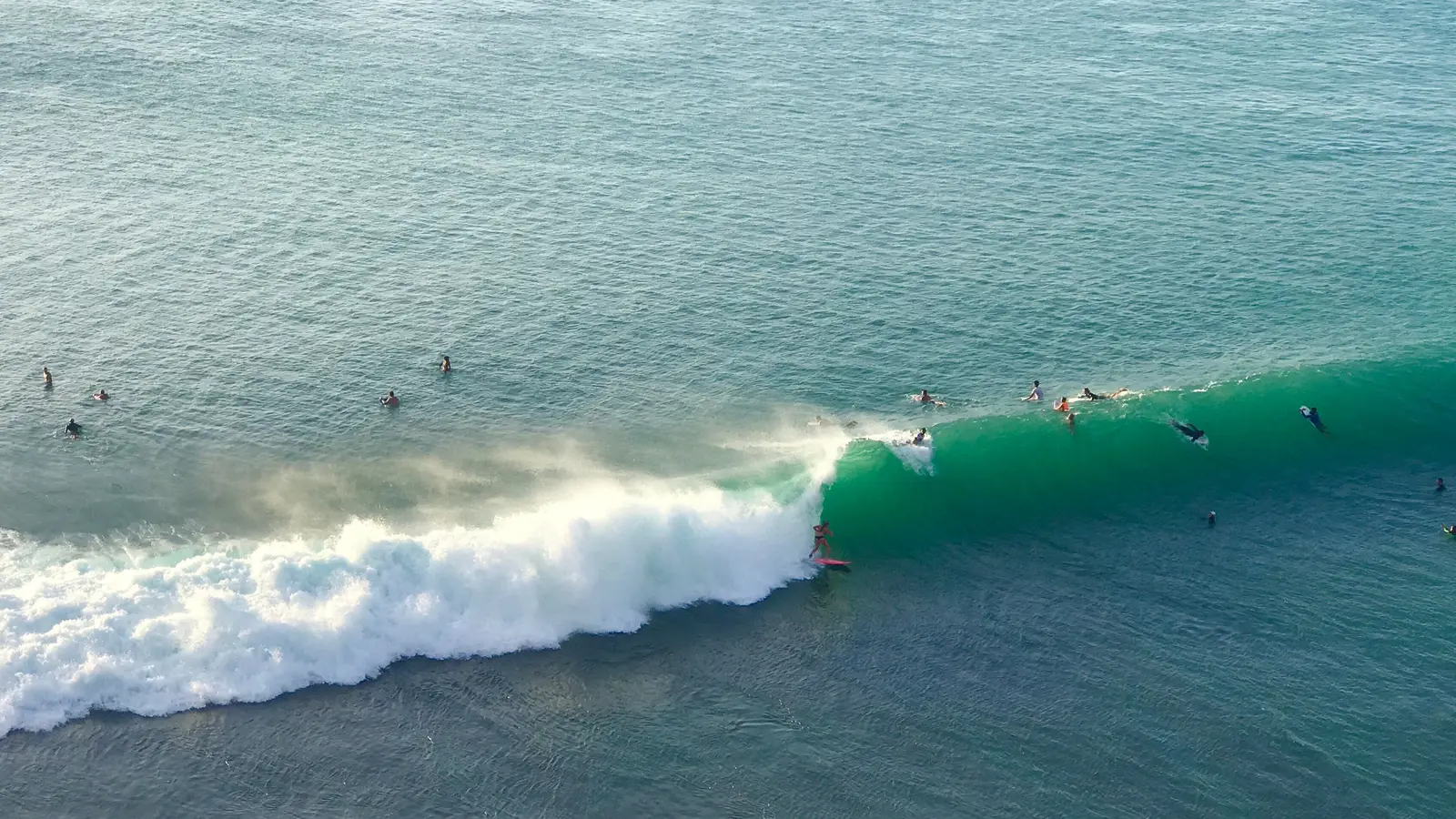
📍 Bali, Indonesia
Photo: Diana / Pexels
Two coasts, two seasons, and a sharp line between reef breaks and sand.
The wind decides which coast is offshore, and the guides draw the line in slightly different places.
Bali's surf season comes down to the wind. In the dry season the south-east trade wind blows offshore on the west coast and the Bukit peninsula; in the wet season the wind blows mostly from the west, which puts the east-coast breaks offshore instead. Perfect Wave, a surf travel company, gives the rule of thumb as west coast in the dry season, April to October, and east coast in the wet season. The Lush Palm guide is narrower: it calls May to September the dry season, roughly November to March the wet season, and treats October, April and May as shoulder months. The UK Foreign Office says the rainy season usually runs from October to March.
Lush Palm credits the Bukit's dry season with the combination of offshore wind and consistent swell, and names July and August as the busiest months. It also notes that the west coast's waves tend to be a little smaller and more user-friendly than the Bukit's.
| Coast | Best season | Offshore wind | Waves | Level |
|---|---|---|---|---|
| Bukit peninsula (Uluwatu, Padang Padang, Bingin, Balangan, Dreamland) | Dry season (April–October) | South-east trade wind | Mostly reef lefts | Mostly experienced; Balangan is the friendliest |
| Kuta, Legian, Seminyak | Dry season | South-east trade wind | Sandy beach break | Beginners and up |
| Canggu and the west coast up to Medewi | Dry season | South-east trade wind | Reef and sand, and a long left point at Medewi | All levels, depending on the break |
| East coast (Keramas, Sanur, Nusa Dua) | Wet season (about November–March) | Westerlies | Mostly reef rights | Experienced |
World-famous lefts over shallow coral, with crowds to match.
The Bukit is the peninsula at Bali's southern tip, administratively the South Kuta district. It holds the island's best-known waves, and the ones covered here break over reef. The Lush Palm guide notes that most Bukit breaks involve a 50- to 100-metre walk across jagged reef to reach the water and suggests reef booties.
Uluwatu is Bali's most famous wave: a left over coral reef that WannaSurf rates for experienced surfers and calls ultra-crowded; its directions send you down to the reef by the famous cave below the Uluwatu temple area. It is several waves in one. Perfect Wave describes the Peak as best at high tide, Racetrack as long and hollow at low to mid tide but sharp and shallow, 'experienced surfers only', and Outside Corner as a very powerful deep-water wave that wakes up on big swells and calls for a longer board.
Padang Padang is the one to watch from the cliff unless you're an accomplished tube rider. Perfect Wave calls it 'an insanely hollow left for experienced tube riders only', best on the dropping tide but shallow near dead low; WannaSurf puts it in its top experience band ('pros or kamikaze only') and lists rips among its dangers. Bingin is a short, hollow left, rated for experienced surfers by WannaSurf, which also lists sea urchins and warns against surfing the inside section over the reef. Lush Palm adds that you need to be comfortable in a crowded, tight lineup there.
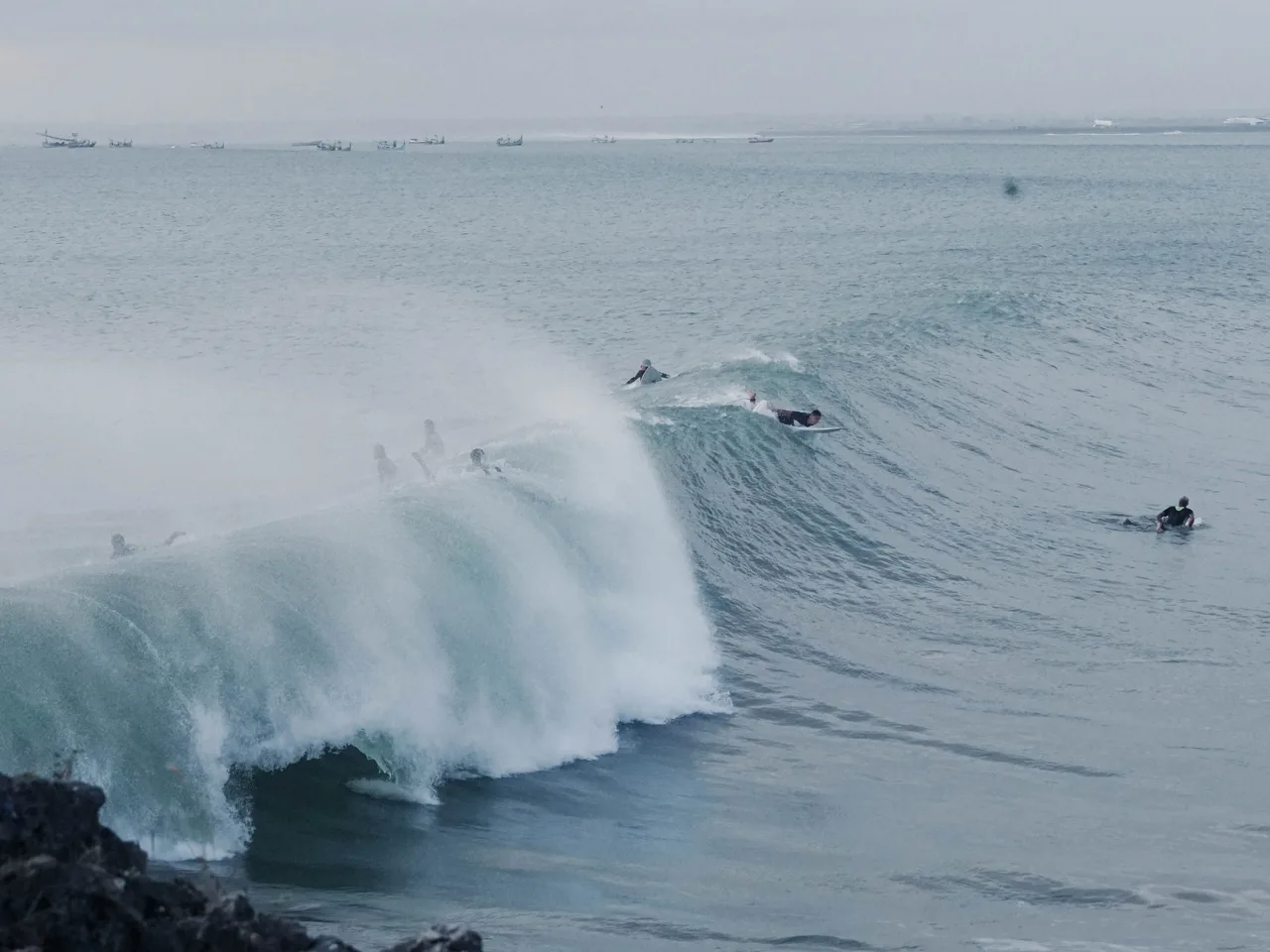
Balangan is the friendlier option on the Bukit: a fatter left over reef that Lush Palm calls popular with intermediates and improvers, and that WannaSurf rates for all surfers, with rocks as its listed hazard. Dreamland has half-reef, half-sand peaks according to Perfect Wave, while WannaSurf rates it for experienced surfers. Neither is a place for a first lesson: on the Bukit, a fall usually means coral underneath.
Where the sand is, and why it still pays to be careful.
Kuta is the classic place to learn. WannaSurf rates it a beginners' wave, a beach break with both lefts and rights over a 'very safe sand bottom', best from mid to high tide on the rising tide, and calls it Bali's most surfed, most crowded wave. Perfect Wave groups Kuta, Legian and Seminyak as beach breaks that work best at mid to high tide in the 2-5 ft range, and warns that rip bowls form in the gutters between the sandbanks.
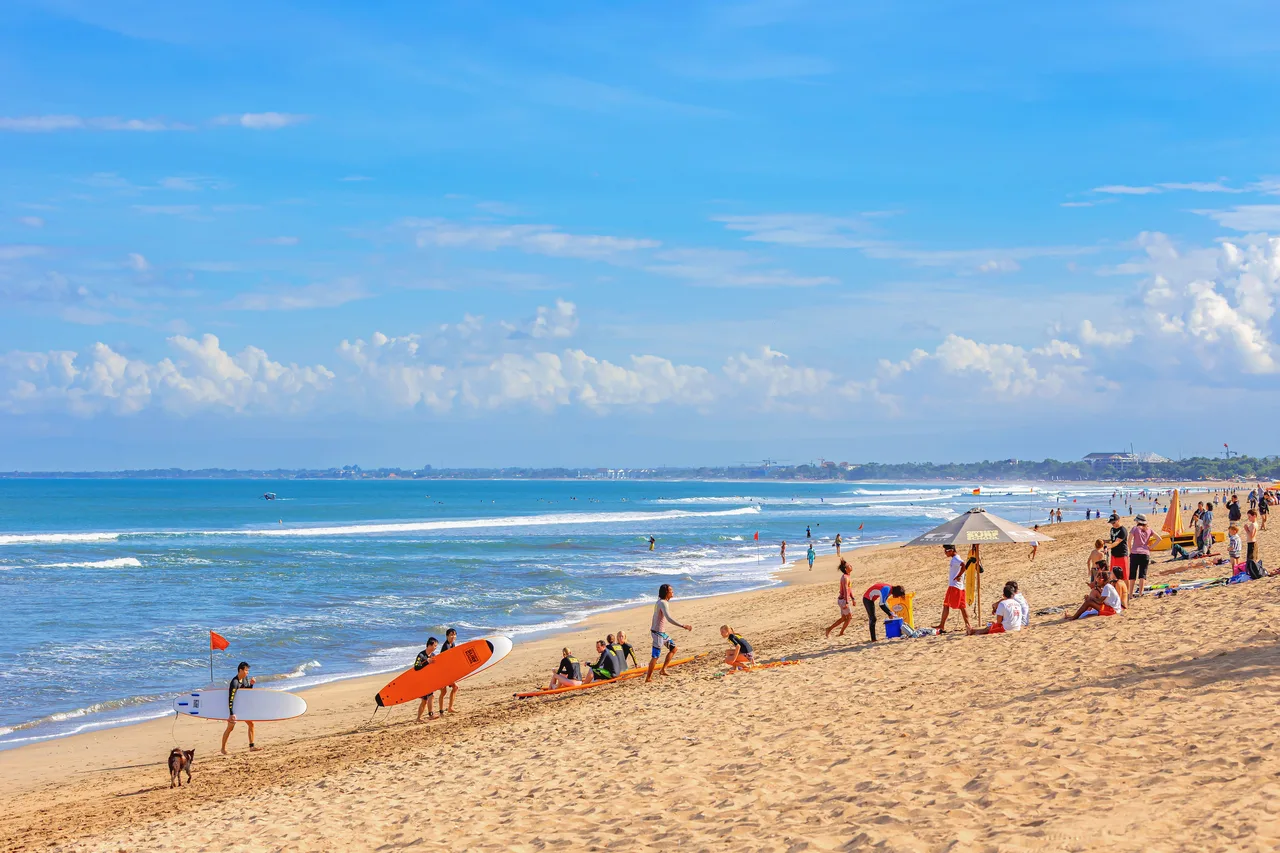
Kuta's beach is watched by Balawista (Badan Penyelamat Wisata Tirta), the lifeguard service of Badung regency. When the waves are big, its Kuta unit puts up red flags, which mean swimming in the sea is temporarily banned. Follow its flags and signs. WannaSurf also lists pollution among Kuta's dangers: in the wet season rubbish washes up on Kuta and Legian, which local officials blame on the west wind, and in December 2017 Badung declared a 'trash emergency' when more than 50 tonnes a day came ashore over five days.
Further north-west, Canggu is a cluster of peaks over reef and sand. Lush Palm calls it a good option for beginners and intermediates and singles out Old Man's as a longboard-friendly stretch of mellow rights and lefts; WannaSurf rates Canggu for all surfers but lists rips and rocks. At the far west of the island, Medewi is a long left point over boulders that WannaSurf describes as a fun wave for all surfers and less frightening than the island's other reef spots. It adds that the swell is generally smaller than at Kuta and advises coming early to avoid the onshore wind.
Reef rights that come alive when the wind turns westerly.
Lush Palm sums up the difference: the west coast serves up mainly lefts, while the east coast is full of rights. It is also the wet-season coast. Keramas is the headline wave: WannaSurf rates it world-class, for experienced surfers, a right and left breaking over a flat rock reef close to shore; Perfect Wave says it is best at 3-6 ft on the incoming tide with a light offshore wind or none, and Lush Palm calls it better suited to advanced surfers.
Sanur's outer reef is, in Lush Palm's words, an expert-only right-hander over shallow reef, which works best on a solid swell with a morning offshore wind and an incoming tide, according to Perfect Wave. Off Nusa Dua, a powerful right breaks on a reef about a kilometre offshore, reached by a long paddle or a boat; WannaSurf rates it for experienced surfers and warns of very strong currents at times. None of the east-coast reefs suits beginners.
A reef-protected lagoon, light trade wind and a tide to watch.
Bali's kite spot is Sanur, on the east coast. Kiteforum's spot guide describes a large pool protected by a coral reef, rideable only around high tide, with an easterly trade wind that is best from May to September and mostly 10-15 knots, 'not more'. It says the wind is side-onshore from June to August, and stronger but unsteady from December to March. Bring your biggest kite, and remember that the reef is the main hazard when the water drops.
Rip Curl School of Surf, based at the Hotel Prama Beach on Jalan Cemara in Sanur, lists kitesurfing alongside surfing, wing foiling, foiling and SUP on its website, which also lists teaching locations in Legian, Kuta, Jimbaran, Canggu and Yeh Gangga. This research didn't find another Sanur kite school with a current website it could check, so ask locally and look at a school's equipment and rescue cover before booking.
One rule worth knowing: Bali Provincial Regulation No. 9 of 2000 bans flying kites 'and similar games' within 5 nautical miles (9 km) of Ngurah Rai airport, and above 100 metres between 5 and 10 nautical miles, with penalties of up to three months in prison or a 5-million-rupiah fine. The provincial government reminded the public of it after a tourist helicopter crash in July 2024; this research found no source saying whether it applies to kitesurfing, so ride where the local school rides.
Plenty of choice, and no list here that we could verify school by school.
Surf schools and surf camps cluster around the beginner breaks at Kuta, Legian, Seminyak and Canggu. The one this research could document from its own website is Rip Curl School of Surf (see above), whose site lists Legian, Kuta and Canggu among its teaching locations. We haven't compiled a list of surf camps, because we couldn't check them one by one, and we don't quote prices.
For a first lesson, look for a school that teaches on a sand-bottomed beach break such as Kuta rather than on a reef, uses soft-top boards, keeps groups small and tells you how it handles rips. If you're already surfing green waves, a guide who knows the Bukit tides is worth more than a bigger board.
One airport, a visa for every visit, and a provincial levy on top.
I Gusti Ngurah Rai International Airport (DPS) is Bali's only airport with scheduled commercial flights. It sits in Tuban, in Kuta district, about 13 km south of Denpasar. Check your airline's rules for board bags before booking.
British citizens need a visa to visit Indonesia, according to the UK Foreign Office. A 30-day visa on arrival costs 500,000 Indonesian rupiah, can be paid by cash or card, is valid for a single entry and can be extended once, for another 30 days, at an immigration office. You need proof of an onward or return journey. You can also apply online through the Indonesian immigration website at least a week before travelling, which is where the 60-day and multiple-entry visas are. Your passport must be valid for at least six months from your arrival date and have two blank pages, and you must fill in the free All Indonesia arrival card online within 72 hours of arrival; the FCDO warns against look-alike websites that charge for it.
On top of the visa, Bali charges every foreign tourist a tourist levy of 150,000 rupiah (about £8, says the FCDO), which you can pay online before you fly or on arrival. The official channel is the provincial government's Love Bali website and app, which issues a voucher by email; the levy is set by Bali Provincial Regulation No. 6 of 2023, as amended by Regulation No. 2 of 2025.
Plan around Nyepi, the Balinese day of silence, which fell on 19 March in 2026 and moves each year. Everyone on the island is expected to stay indoors, and the airport is closed for the whole day, according to the FCDO, so there's no surfing and no flying that day.
Local lifeguards on the busy beaches, a national rescue agency at sea.
The main hazards are the reef itself, the currents and the crowds. On the Bukit and the east coast you'll be surfing over shallow coral at some stage of the tide, so wear booties for the reef walks, treat cuts quickly and stay off reefs that are beyond your level. The guides list rips at Padang Padang, Canggu and Nusa Dua, and rip bowls on the Kuta beach breaks. Beginners should stay on sand-bottomed beaches, with a school, inside the zones that the lifeguards mark.
On the beach, safety is a local matter: Balawista lifeguards patrol Kuta, and you shouldn't assume a lifeguard on quieter beaches. At sea, search and rescue is run by Basarnas (Badan Nasional Pencarian dan Pertolongan), the national search and rescue agency, through its Denpasar office; it takes emergency calls on 115. This research found no national Indonesian law specific to surfing or kitesurfing; beach rules are local, so follow the lifeguards' flags and signs. These are Indonesian arrangements: RNLI flag zones and UK rules don't apply here.
The UK Foreign Office lists Indonesia's emergency numbers as 118 for an ambulance, 110 for the police and 112 for fire. For a rescue at sea, call Basarnas on 115. VHF channel 16 is the international distress channel at sea. The FCDO also points to the Indonesian meteorological agency's BMKG multi-hazard early warning app, and advises following the local authorities' instructions after a major earthquake close to shore, because a tsunami could arrive within minutes.
What surfers ask most before a trip to Bali.
For the west coast and the Bukit reefs, the dry season, roughly April to October, when the south-east trade wind blows offshore and the swell is most consistent. In the wet season, about November to March, the wind turns westerly and the east-coast reefs such as Keramas take over.
On sand: Kuta, Legian and Seminyak are beach breaks with a sandy bottom, and Kuta is rated a beginners' wave. Canggu and Medewi also suit improvers. Book lessons, stay inside the lifeguard zones and watch for rips in the gutters.
No. Both are reef breaks over shallow coral. Padang Padang is described as a hollow left for experienced tube riders only, and Uluwatu's sections are rated for experienced surfers.
Not usually. The water is about 27-29°C all year. Boardshorts or a bikini with a rash vest is the norm, with reef booties for the walks across the reef on the Bukit.
Yes, at Sanur, in a reef-protected lagoon that is only rideable around high tide. The best months are May to September, with an easterly trade wind of mostly 10-15 knots, so bring a big kite.
Yes. British citizens need a visa: a 30-day visa on arrival costs 500,000 rupiah, or you can apply online in advance. Bali also charges foreign tourists a levy of 150,000 rupiah, payable online through Love Bali or on arrival.
The UK Foreign Office lists 118 for an ambulance, 110 for the police and 112 for fire. For search and rescue at sea, Basarnas takes calls on 115.